Less Paperwork, More Teaching: How AI Can Give Indian Teachers Their Time Back
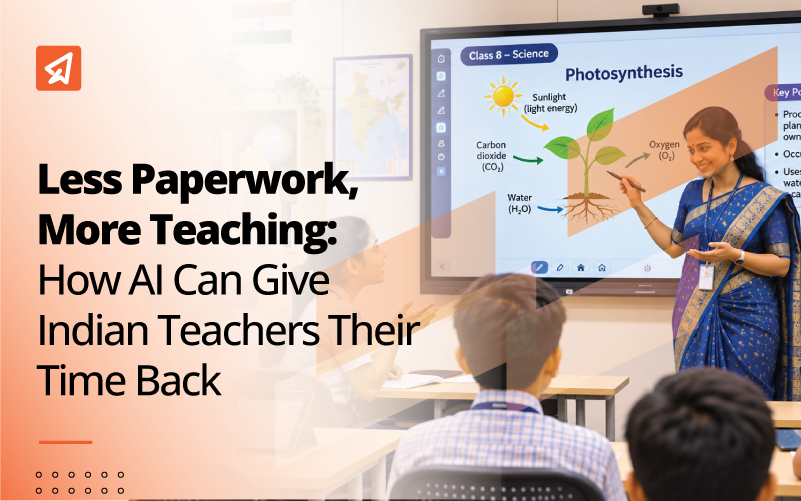
Teachers do much more than teach. Behind every engaging classroom session are hours spent preparing lesson plans, creating worksheets, designing assessments, and adapting learning materials for students with different needs. While these tasks are essential, they often leave educators with less time for what matters most: helping children understand concepts, build confidence and develop critical thinking skills. As Indian schools work towards the vision of the National Education Policy (NEP) 2020, artificial intelligence (AI) offers an opportunity to rethink how teachers spend their time.
The Real Cost of Lesson Planning
Lesson planning is an important part of effective teaching. However, when teachers spend a significant portion of their working hours on repetitive preparation, classroom interaction can take a back seat.
The challenge is not a lack of teaching resources. It is making those resources relevant to a particular class, curriculum, and students’ learning needs. A worksheet may need multiple versions, an assessment may need to test different competencies, and a difficult concept may require another explanation before every student understands it.
This is where schools need to look beyond the number of hours teachers work and consider the impact those hours create.
From Administrative Work to Meaningful Teaching
AI-powered teaching tools can simplify routine preparation, giving teachers more time to focus on students. Rather than generating everything from scratch, educators can use AI to create initial drafts and then refine them using their professional judgement.
Schools can begin with practical applications such as:
- Faster lesson planningGenerate curriculum-aligned lesson outlines based on the grade, subject and chapter being taught.
- Simpler worksheet and assessment creationDevelop quizzes, practice questions and revision material without repeatedly starting from a blank page.
- Support for different learning levelsAdapt explanations and activities to help students who need additional practice or more challenging tasks.
- More time for student supportUse the time saved to address doubts, provide individual feedback, and conduct classroom discussions.
The goal is not to remove the teacher from the preparation process. It is to reduce repetitive work so educators can concentrate on the decisions that require their experience and understanding of students.
Making NEP 2020 a Classroom Reality
NEP 2020 calls for a shift away from rote memorisation towards conceptual understanding, experiential learning, creativity and problem-solving. Achieving this requires more than changing textbooks or introducing new assessment methods. It calls for classrooms where students can ask questions, explore ideas and apply what they learn.

These experiences take thoughtful planning. Teachers need time to design activities, connect lessons with real-world situations and understand where students are struggling.
AI can support this transition by helping educators prepare discussion prompts, project ideas, classroom activities and competency-based questions. It can also help organise learning resources around curriculum requirements, making it easier to plan lessons that go beyond simply completing the syllabus.
Platforms such as Extramarks can complement teacher-led instruction with digital learning resources and interactive content. Used thoughtfully, such tools can help educators explain complex concepts and create more engaging learning experiences without making technology the focus of the classroom.
Keeping Teachers at the Centre of AI in Education
Saving time is valuable, but it should not be the only measure of success. The real question is what teachers can achieve with the time they gain.
School leaders should consider three priorities when introducing AI into teaching:
- Keep teachers in controlAI-generated lesson plans and assessments should be reviewed and adapted by educators before classroom use.
- Protect the human connectionThe time saved should create more opportunities for mentoring, discussion, feedback, and individual attention.
- Measure meaningful outcomesSchools should evaluate whether AI improves lesson quality, teacher preparedness and student engagement, rather than focusing only on the volume of material produced.
Teachers also need training to use AI responsibly, check the accuracy of its outputs and protect student information. Technology can assist professional judgement, but it cannot replace a teacher’s understanding of a child’s confidence, curiosity or emotional needs.
Conclusion: The Value of AI Lies in the Time It Gives Back
The future of AI in Indian schools should not be measured simply by how quickly a lesson plan can be generated. Its real value lies in what happens after that plan is ready.
If teachers spend less time on repetitive administrative tasks, they can devote more attention to explaining difficult concepts, encouraging curiosity and supporting students who need help. For school leaders, this means viewing AI not merely as a productivity tool, but as a way to strengthen the quality of teaching.
Ultimately, the purpose of AI in education is not to make teachers less involved, but to give them more time to do what only great teachers can: inspire, guide and help every child learn.
Published on November 24, 2026