
Teacher Training Programs in India: Types, Courses and Certifications (2026 Guide)

Which Teacher Training Program Should Your School Run in 2026?
Teacher training programs are structured courses that build pedagogy, classroom management and subject-specific skills in educators. In India, these range from diploma-level NTT and PTT courses to NEP 2020-aligned certifications governed by the National Council for Teacher Education (NCTE).
A Class 5 student failed her reading assessment three times. The content was correct. Her teacher needed a system for spotting gaps earlier.
That gap repeats in thousands of Indian classrooms every week. NEP 2020 restructured the curriculum into a 5+3+3+4 model. ECCE is now a policy-mandated stage. CBSE requires schools to log 50 hours of Continuous Professional Development per teacher annually. A 2023 NCTE audit found that over 40% of school teachers in India had completed zero formal refresher training in the previous three years.

The cost of that gap shows up in student outcomes.
| Key Takeaway | Detail |
| Who needs training | All K-12 and pre-primary educators, practising and aspiring |
| Minimum eligibility | Class 12 for NTT/PTT; graduation for B.Ed and above |
| Duration range | 6 months (certificate) to 4 years (ITEP under NEP 2020) |
| Government portals | SWAYAM, CBSE Training Portal, Malaviya Mission (UGC) |
| NEP 2020 mandate | ITEP replaces B.Ed as the minimum qualification by 2030 |
| Top 2026 demand | AI for Educators, Google Certified Educator, STEM certification |
LMS training for teachers alongside classroom tools see training translate directly into outcomes.
What Is a Teacher Training Program?
A teacher training programme is a structured course that builds competencies across lesson planning, classroom management, subject pedagogy and student assessment.
UNESCO research found that trained teachers improve student learning outcomes by up to 20% compared to untrained counterparts. In India, all programmes are regulated by the
National Council for Teacher Education, which sets minimum qualifications, durations and curriculum standards.

Schools running multiple subjects across 40-plus students per section need teachers who have frameworks. Frameworks come from training.
NTT, PTT and NPTT: Which Pre-Primary Course Is for Which Level?
These three teacher training courses are searched more than any other pre-primary category in India. Each one trains for a different age group and has a different salary ceiling.
1. NTT (Nursery Teacher Training)
Covers Nursery to KG. Focuses on child psychology, play-based learning and early activity design. Eligibility: Class 12 pass. Duration: 1 year. Average salary: Rs 12,000 to Rs 25,000 per month.
2. PTT (Primary Teacher Training)
Prepares teachers for Classes 1 to 5. Covers subject pedagogy, classroom management and activity-based instruction. Eligibility: Class 12 pass. Duration: 1 year. Salary range: Rs 18,000 to Rs 35,000 per month.
3. NPTT (Nursery Primary Teacher Training)
Combines NTT and PTT into one programme. Covers pre-primary and primary stages. Suited for candidates who want placement flexibility across both levels. Duration: 1 to 2 years.
| Course | Age Group | Eligibility | Duration | Avg. Monthly Salary |
| NTT | Nursery to KG | Class 12 | 1 year | Rs 12k to 25k |
| PTT | Class 1 to 5 | Class 12 | 1 year | Rs 18k to 35k |
| NPTT | Nursery to Class 5 | Class 12 | 1 to 2 years | Rs 15k to 35k |
| B.Ed | Class 6 to 12 | Graduation | 2 years | Rs 25k to 60k |
| ITEP (NEP 2020) | All levels | Class 12 | 4 years | NEP 2030 standard |
Types of Teacher Training Programmes in India in 2026
Five categories cover the full range of teaching levels and career stages. Here is how they break down.
1. Pre-Primary and Primary Training
NTT, PTT, NPTT and Montessori Teacher Training belong here. They focus on child psychology, play-based pedagogy and Early Childhood Care and Education. ECCE is now a formal curricular stage under NEP 2020. Demand for certified early childhood educators has risen directly as a result.
2. Secondary and Senior Secondary Training (B.Ed)
The Bachelor of Education is the recognised qualification for Classes 6 to 12. It covers subject-specific pedagogy, lesson planning and practicum teaching. The duration is 2 years. Eligibility is graduation in any stream.
3. Higher Education Faculty Development
The Malaviya Mission Teacher Training Programme (MMTTP) by UGC is built for college and university faculty. It covers research methodology, digital pedagogy and NEP-aligned curriculum design. Access it at ugc.ac.in.
4. Special Education and Inclusive Teaching
Special education courses train teachers to support students with visual, hearing, or learning disabilities. These are regulated by the Rehabilitation Council of India. NEP 2020 mandates inclusive classrooms across all affiliated schools.
5. Digital and AI-Integrated Teaching Courses
This is the fastest-growing category in teacher training in 2026. Options now active in India include Google Certified Educator, Levels 1 and 2, AI for Educators, NASSCOM-certified, STEM Teacher Certification for science and maths facilitators, SWAYAM online courses, free and NCERT-backed and TEFL and TESOL for English-medium and international placement roles.
Online Teacher Training Courses: Where to Enrol in 2026
Online teacher training courses have removed the biggest barrier to upskilling: scheduling. SWAYAM alone recorded over 1.2 crore enrolments in education-related courses in a single academic year.
1. SWAYAM
Free courses across all teaching levels. Backed by IITs, IIMs and NCERT. UGC recognises certifications for academic credit. Access at swayam.gov.in.
2. CBSE Training Portal
In-service workshops for practising teachers covering CBSE-aligned pedagogy, NEP 2020 implementation and assessment design. Free for teachers in affiliated schools at cbseit.in.
3. IISDT
Online diplomas in Practical Teaching Methods, Classroom Management and Computer Teacher Training. Structured and self-paced for working educators.
4. ITARI
Offers the PGDE-I with IB Educator Certificate, a specialist PG diploma for teachers targeting international school roles.
5. Asian College of Teachers (ACT)
Pre-primary and advanced programmes across Delhi and online. Covers NTT, Montessori, TEFL and TESOL.
Teacher onboarding in schools starts before the first classroom session. Online certification gives incoming teachers a working framework before they face forty students.
NEP 2020 Teacher Training: What Schools Need to Action Right Now
NEP 2020 carries concrete timelines that affect every hiring and training decision a school makes this year.
ITEP replaces B.Ed by 2030. The Integrated Teacher Education Programme is a 4-year dual-degree course that combines subject knowledge with teaching methodology from the undergraduate level itself. All new school teachers will need ITEP as a minimum qualification by 2030.
50 hours of CPD is mandatory. CBSE-affiliated schools must log 50 hours of Continuous Professional Development per teacher annually and report this in their school quality returns.
ECCE qualification deadline is 2026. All pre-primary teachers are required to hold an ECCE-specific qualification this year. NTT and Montessori enrolments have surged as schools work to meet this.
NEP 2020 classifies digital literacy for teachers as a core competency. Schools that have yet to build this into their training calendar are behind the compliance curve.
How to Set Up a Teacher Training Programme in Your School
Schools that build training into the academic calendar term by term see skill gains compound. Schools that run one annual workshop see the same classroom problems return the next year. Here is a six-step system that fits inside a real school week.
Step 1: Run a skills audit first
Survey teachers with 10 focused questions covering lesson planning, assessment design, technology use and student management. The reading gap in Class 3 and the board drop in Class 10 usually trace back to different training needs. Identify before you plan.
Step 2: Design across three tiers
New teachers need classroom management, lesson structure and school LMS basics. Mid-level teachers need subject deepening and assessment design. Senior teachers need leadership and mentoring skills. One generic session for all three levels wastes time.
Step 3: Choose the right trainers and resources
Trainers with classroom experience in Indian schools land differently than generalist facilitators. Workshops, online courses and peer mentoring work best in combination.
Step 4: Schedule around the school calendar
Train during breaks or after hours. Disrupting regular teaching time to run training reduces the goodwill teachers bring to the sessions.
Step 5: Make sessions active
Role-playing, group activities, micro-teaching and real classroom scenarios drive skill transfer. Theory without practice has a near-zero impact on classroom behaviour after four weeks.
Step 6: Track, review and repeat
Log attendance, module completion and post-training classroom assessments. Gather teacher feedback. Adjust the next round based on what the data shows.
Teacher development research consistently shows that skill transfer requires at least three practice rounds after training. One session builds awareness. Repeated application builds habit.
Schools that invest in structured teacher professional growth across the full year see it show up in student outcomes.
How Extramarks Supports Teacher Training in Your School
Extramarks builds teacher capability into daily school operations, backed by data from 15,000+ schools across India. Here is what that looks like in practice.
“My classrooms are bubbling with energy thanks to the informative, engaging and interesting modules provided by Extramarks.” Ms. Kamini Bhasin, Principal.
“Extramarks is a great tool for teachers to create and manage assessments and it has helped them improve their teaching skills.” Mr. Sharad Tiwari, Principal.
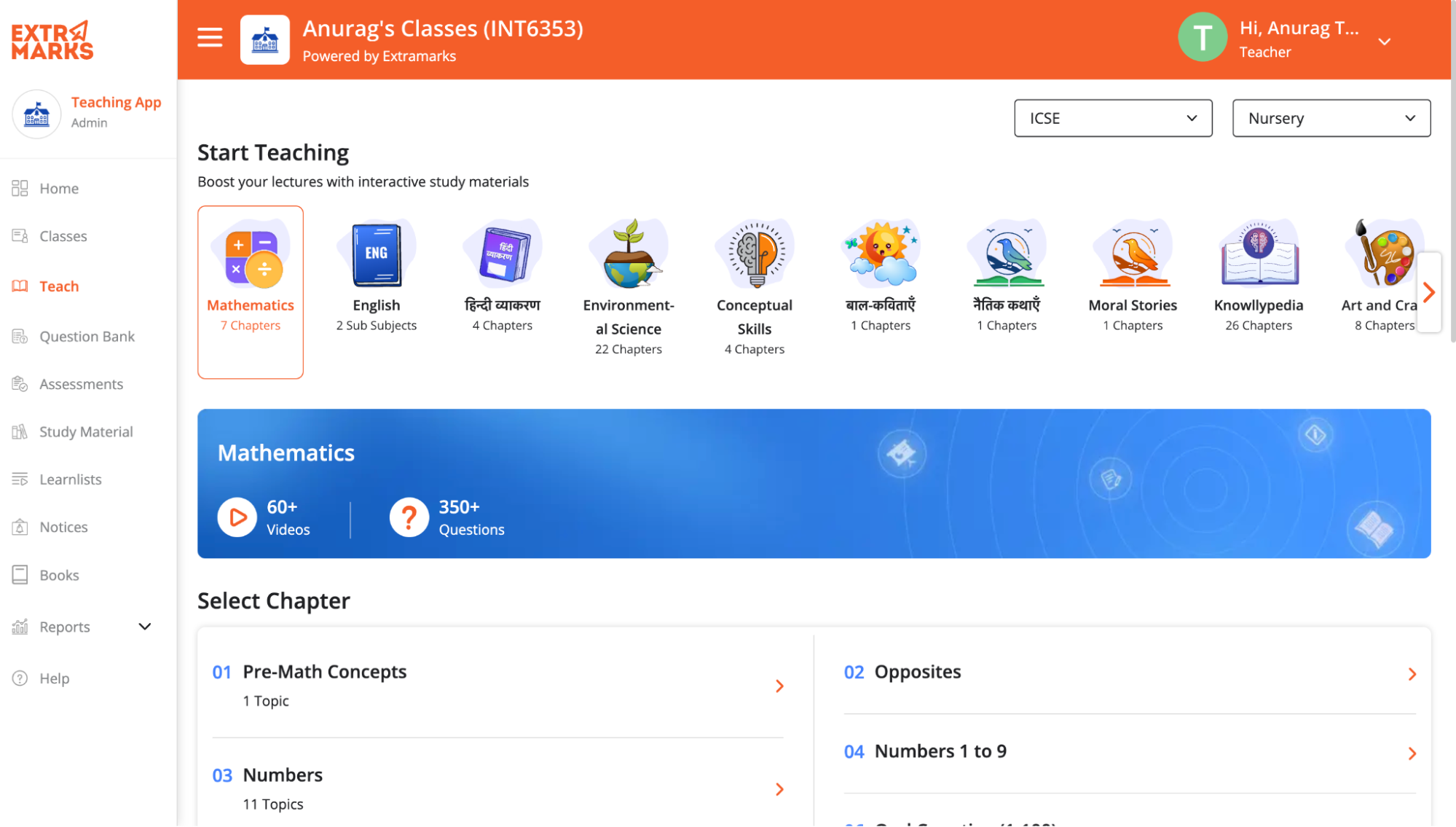
- Curriculum-mapped lesson content
Ready-to-use AV modules for every chapter across CBSE and state board syllabi. 80% of teachers say Smart Class Plus reduces their daily prep workload. - Concept-level student performance visibility
AI-powered teaching tools through Extra Intelligence flag learning gaps before the unit test. Teachers intervene during the term, not after. - Assessment creation and reporting
Teachers build, assign and review assessments in one place. Automated reports reach teachers, admins and parents with zero manual entry. - AV-driven classroom engagement
71% of principals report students learn better with AV content on the Extramarks Smartboard. - Smart classroom integration
Extramarks’ smart classroom solution fits existing school infrastructure with no separate rollout required. - Certified teacher training modules
Structured modules, quizzes and certification pathways available on the platform. Schools using
Frequently Asked Questions
1. Which teacher training course is best after Class 12?
NTT, PTT, or NPTT are the right entry points for pre-primary and primary teaching. For Classes 6 to 12, a B.Ed requires graduation first. The right choice depends on the age group you plan to teach.
2. What is ITEP under NEP 2020?
ITEP is a 4-year integrated teacher education programme introduced by NCTE. It combines subject education with teaching methodology from the undergraduate level. By 2030, it becomes the minimum qualification for all new school teachers in India.
3. Are there free teacher training courses online in India?
SWAYAM offers free online courses backed by UGC and NCERT, with over 1.2 crore education enrolments recorded in a single academic year. The CBSE Training Portal offers free in-service workshops for teachers in affiliated schools.
4. What is the difference between B.Ed and a teacher certificate course?
B.Ed is a 2-year degree that qualifies teachers for Classes 6 to 12 and is required for most government school appointments. Certificate courses run for 3 to 12 months and suit skill upgrades or pre-primary training. They do not replace B.Ed eligibility requirements.
5. How many training hours does NEP 2020 require per teacher per year?
NEP 2020 mandates 50 hours of Continuous Professional Development per teacher annually. CBSE-affiliated schools must document and report this as part of their annual school quality submission.
6. What teacher skills are most in demand in 2026?
Digital pedagogy, AI-assisted teaching, STEM facilitation and inclusive classroom management are the four highest-demand teacher skills in 2026. All four are tied directly to NEP mandates and the shift toward competency-based assessment across CBSE and state boards.
Reviewed by

Prachi Singh | VP - Academics
Prachi Singh is a highly accomplished educationist with over 16 years of experience in the EdTech industry. Currently, she plays a pivotal role at Extramarks, leading content strategy and curriculum development initiatives that shape the future of education...read more.


Published on June 18, 2026