CBSE Three-Language Policy 2026: Class 10 Unaffected, Relief for Classes 7–9
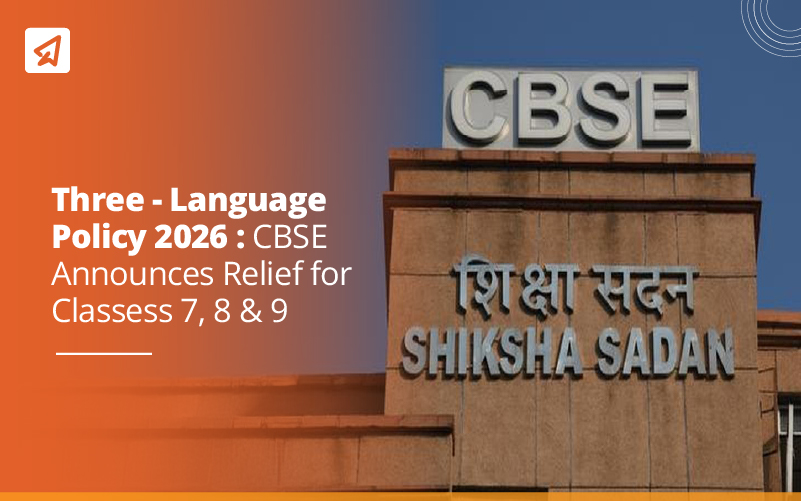
The Central Board of Secondary Education (CBSE) has issued revised implementation guidelines for the Three-Language Policy under the National Education Policy (NEP) 2020, providing significant relief to students currently studying in Classes 7, 8, and 9.
The Board has clarified that students who have already opted for two foreign languages will not be required to change their subjects midway through the academic session. Instead, they can continue with their existing language combination by adding one Bharatiya Bhasha (Indian language).
CBSE has also confirmed that the current batch of Class 10 students will continue under the existing two-language system and will not be affected by the revised policy.
What Has Changed?
To ensure that students are not disadvantaged during the transition, CBSE has announced a one-time relaxation for the current batches of Classes 7, 8, and 9.
The key changes include:
- Students already studying two foreign languages can continue with them by adding one Bharatiya Bhasha.
- No student will be required to switch languages in the middle of the academic session.
- The current Class 10 batch (2026–27) will continue with the existing two-language system.
Students receiving this one-time relaxation will not have to appear for a CBSE Board examination in the third language when they reach Class 10. The third language will instead be assessed internally by their respective schools.
CBSE stated that these guidelines have been introduced to align with NEP 2020 while ensuring that no student faces academic disruption.

Related Read: NEP 2020’s Three Language Formula Explained
Understanding the Three-Language Policy
The National Education Policy (NEP) 2020 recommends that students study three languages during their school education, with at least two of them being Bharatiya Bhashas.
Examples of Bharatiya Bhashas include:
- Hindi
- Sanskrit
- Tamil
- Telugu
- Kannada
- Malayalam
- Marathi
- Bengali
- Punjabi
- Gujarati
- Assamese
- Odia
Languages such as English, French, German, Spanish, Arabic, and Japanese are treated as non-Bharatiya languages under the policy.
Language Combinations Explained
CBSE has also explained how the revised language combinations will work.
Situation 1: You already study two Bharatiya Bhashas
Example:
- Hindi
- Tamil
You may choose either:
- Another Bharatiya Bhasha, or
- A non-Bharatiya language such as English or French as the third language.
Situation 2: You study one Bharatiya Bhasha and one non-Bharatiya language
Example:
- Tamil
- English
You will need to choose one additional Bharatiya Bhasha as your third language.
Situation 3: You study two non-Bharatiya languages
Example:
- English
- French
As a special one-time relaxation for the current Class 9 batch during the 2026–27 academic session, you may continue studying both languages by adding one Bharatiya Bhasha as your third language.
Third Language Assessment
For students covered under the one-time relaxation, the third language (R3) will be assessed through an internal school-based assessment.
There will be no CBSE Board examination for the third language when these students progress to Class 10.
CBSE and NCERT will also provide grade-appropriate learning resources to support schools and students.
What About Future Batches?
Students currently studying in Class 6 and future batches will follow the revised Three-Language Policy from the beginning.
When these students reach Class 10, they will appear for the Board examination in the third language as per the policy.
Who Is Exempt?
CBSE has provided exemptions in specific cases, including:
- Children with Special Needs (CwSN), as per the Rights of Persons with Disabilities (RPwD) Act, 2016.
- Students studying in CBSE-affiliated schools located outside India.
- Foreign students returning to India.
- Students whose parents relocate to another state may continue with their existing language combination, subject to school support.
What This Means for Students and Parents
The revised guidelines provide greater flexibility and ensure that students do not have to make sudden academic changes.
Parents can be assured that:
- Existing language choices will be respected for current batches.
- Students will not be forced to switch subjects mid-session.
- The focus remains on learning rather than additional Board examination pressure.
- Schools will receive support through learning resources and flexible teaching arrangements.
Frequently Asked Questions (FAQs)
Is the Three-Language Policy applicable to current Class 10 students?
No. CBSE has clarified that students currently studying in Class 10 during the 2026–27 academic session will continue with the existing two-language system.
Can students continue studying foreign languages?
Yes. Students who have already opted for two foreign languages under the one-time relaxation can continue studying them by adding one Bharatiya Bhasha.
Will there be a Board exam for the third language?
No. For the current Classes 7, 8, and 9 covered under the relaxation, the third language will be assessed internally by schools and will not be part of the CBSE Board examination in Class 10.
Why has CBSE introduced this relaxation?
The Board introduced the relaxation to ensure a smooth implementation of the National Education Policy (NEP) 2020 without disrupting the academic progress of students already studying under the previous language framework.
Students and parents are advised to stay in touch with their respective schools for any institution-specific guidance regarding language selection and implementation.

Last Updated on July 2, 2026