CBSE Education Reforms 2026: A Complete Guide for Schools
A school principal recently shared an interesting observation. During a parent interaction, most of the discussion wasn’t about board results or syllabus completion. Instead, parents wanted to know how the school was preparing students for Artificial Intelligence, how it supported student well-being, and whether children were learning skills that would actually help them later in life.
Ten years ago, that conversation might have sounded unusual. Today, it is the new normal.
Parents still care deeply about academics. However, they also recognise that the world their children will enter is vastly different from the one they grew up in. Driven by the National Education Policy (NEP) 2020 and the updated National Curriculum Framework (NCF), the Central Board of Secondary Education (CBSE) is fundamentally redesigning how students learn and how they are assessed.
Here is a closer look at how these reforms are shaping future-ready schools and what it means for students, teachers, and parents.
Beyond Marks: The Rise of Competency-Based Learning & SAFAL
For years, academic performance sat at the centre of every school conversation. Good marks opened doors, and examinations were often seen as the ultimate measure of success. While grades still matter, the understanding of what a grade represents has shifted.
A student may score well in a traditional exam by memorising a textbook. But can they work through an unfamiliar problem? Can they collaborate with others? Can they adapt when things don’t go according to plan?
To answer these questions, CBSE has introduced SAFAL (Structured Assessment for Analyzing Learning). Designed for Grades 3, 5, and 8, SAFAL evaluates foundational skills and competency-based learning rather than rote memorisation.
What this means in the classroom:
- Focus on Application: Assessments now feature case-study-based questions, real-life problem solving, and logical reasoning.
- Diagnostic, Not Punitive: SAFAL does not rank or fail students; it identifies learning gaps early so teachers can provide targeted support.
Demystifying AI in the Classroom (Classes 3 to 12)
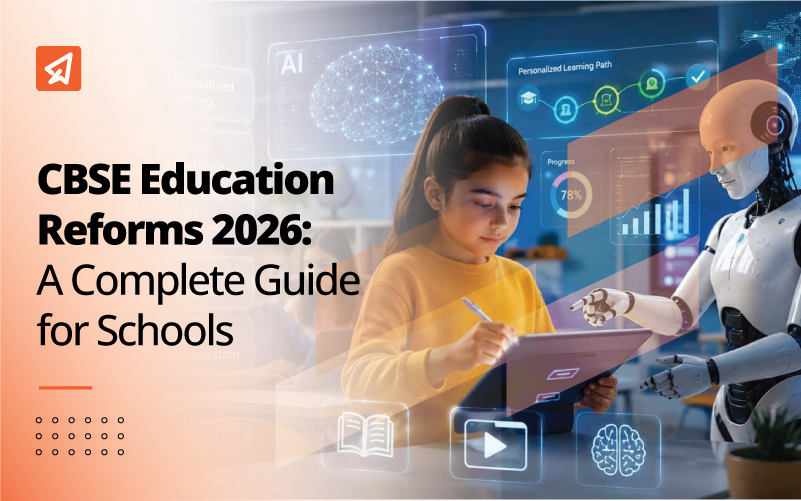
Not long ago, Artificial Intelligence felt like something that belonged in research labs. Today, students encounter it regularly—using AI-powered search tools, receiving personalised recommendations, and interacting with generative platforms.
Acknowledging this reality, CBSE has formally integrated AI and Computational Thinking (CT) into the curriculum. The goal isn’t to create a generation of software engineers, but to foster digital fluency and problem-solving skills.
How AI is rolling out across grades:
- Classes 3 to 5: Computational Thinking is woven into subjects like Mathematics through puzzles, pattern recognition, and games—without the pressure of textbooks or board exams.
- Classes 6 to 8: Students are introduced to foundational AI concepts, real-world use cases, data privacy, and ethical AI usage through hands-on activities.
- Classes 9 to 12: AI becomes available as an elective or skill subject, diving into deeper concepts like machine learning and data modeling.
Student Well-being in a High-Speed World
Every teacher has seen it happen: a bright, capable student suddenly becomes disengaged. Their performance drops, and confidence takes a hit. The issue is rarely just academic. It often stems from stress, anxiety, peer pressure, or simply feeling overwhelmed.
Through initiatives like the School Counselling Framework, CBSE is pushing schools to prioritise the emotional and social aspects of learning. The philosophy is straightforward: students learn better when they feel safe and supported.
The Real-World Challenge: Bringing Policy to the Classroom
Understanding the direction education is moving in is easy. The real challenge for Indian schools is implementation.
How do schools bring AI into classrooms across diverse economic backgrounds? How do teachers, who are already stretched thin, find the time to redesign their lessons around competency-based assessments? Bridging the gap between the vision of NEP 2020 and the daily realities of school infrastructure requires robust support systems.
How Technology Bridges the Gap
Educational reforms eventually reach the classroom, and teachers are the ones who bring them to life. To successfully navigate these changes, schools need tools that empower rather than burden their educators.
This is where digital partners like Extramarks step in. By offering AI-powered teaching tools, competency-focused question banks, and learning analytics dashboards, Extramarks helps schools seamlessly align with CBSE’s new guidelines. The objective is not to replace the educator, but to automate administrative heavy lifting, giving teachers more time and better data to support individual student growth.
Actionable Steps for Parents Today
While schools adapt to these reforms, parents play a crucial role at home. Here is how you can support your child through this transition:
- Encourage Concept Clarity over Rote Learning: Instead of asking, “What did you memorise today?” ask, “How would you solve this problem?” Let them explain concepts in their own words.
- Foster Healthy Tech Habits: Talk to your children about data privacy and the responsible use of AI tools like ChatGPT for brainstorming rather than copying answers.
- Normalise Failure: Competency-based learning requires experimentation. Let your child know that making mistakes is a vital part of the learning process.
The Bigger Picture
Viewed separately, AI literacy, student well-being, SAFAL assessments, and teacher empowerment may seem like distinct initiatives. Viewed together, they tell a larger story of India’s educational evolution.
At its core, CBSE’s evolving vision under NEP 2020 asks a simple question: Are we preparing students only for the next exam, or are we preparing them for what comes after it? How schools, parents, and educational platforms answer that question today will determine the readiness of tomorrow’s learners.
Published on July 14, 2026