12 Main Features of National Education Policy (NEP) 2020
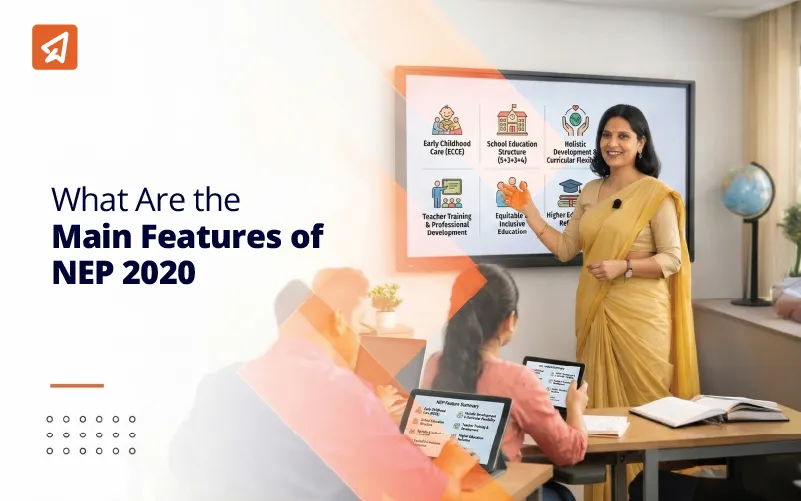
The National Education Policy 2020 has been discussed widely in schools, staff meetings, and training sessions. You may have heard about changes in curriculum, assessments, and the overall structure of schooling, but it can still feel unclear what all of this really means for you in the classroom. In this blog, we will look at the main features of NEP 2020 and understand what they focus on, especially from a teacher’s point of view.
What Are the Main Features of NEP 2020?
Here’s a closer look at the main features of NEP 2020:
-
New School Structure 5+3+3+4 Model
One of the biggest structural changes is replacing the old 10+2 system with a 5+3+3+4 model. Instead of organising schooling only by age, this structure is designed around how children actually develop.
Foundational Stage 5 Years
This includes 3 years of preschool or Anganwadi and Grades 1 and 2. At this stage, learning is play-based and activity-driven. The focus is not on heavy academics. It is about language development, early numeracy, motor skills, and social behaviour. The idea is to build comfort with learning before introducing formal pressure.
Preparatory Stage 3 Years
Grades 3 to 5 fall under this stage. Here, learning becomes more structured. Textbooks are introduced properly, but teaching is still interactive. Students start developing stronger reading habits, basic subject awareness, and classroom discipline.
Middle Stage 3 Years
Grades 6 to 8 focus more clearly on subject-based learning. Students begin to explore science, mathematics, social sciences, and arts in depth. Teachers are encouraged to promote discussion, reasoning, and concept clarity rather than direct memorisation.
Secondary Stage 4 Years
Grades 9 to 12 allow flexibility. Students can explore subjects across disciplines. The aim is to give them freedom to build combinations that suit their interests and future goals.
If you want a deeper breakdown of how this model works in practice, you can read our article on What Is 5+3+3+4 Structure in NEP 2020?
-
Early Childhood Care and Education ECCE
NEP recognises something many educators already know. The years between 3 and 6 are crucial for brain development. If these years are neglected, children struggle later.
The policy pushes for universal access to quality preschool education. It also focuses on strengthening the Anganwadi system by improving training, infrastructure, and curriculum. The aim is not just to teach alphabets early. It is to build emotional security, curiosity, communication skills, and cognitive readiness.
If you want to explore how ECCE is being structured under NEP, you can explore our article on Early Childhood Care and Education(ECCE).
-
Foundational Literacy and Numeracy FLN
One of the strongest messages of NEP 2020 is this. Every child must achieve basic reading and numeracy skills by Grade 3.
This is treated as a national mission. Schools are expected to track whether children can read with understanding and perform basic mathematical operations. If they cannot, interventions must happen early.
The reason is simple. Without foundational skills, everything else becomes difficult. A child who struggles to read cannot fully understand science, history, or mathematics in later grades.
Read in Detail: Foundational Literacy and Numeracy (FLN)
-
Mother Tongue or Regional Language as Medium of Instruction
NEP encourages teaching in the child’s home language at least till Grade 5, and preferably till Grade 8 wherever possible.
The logic is practical. Children grasp concepts faster when taught in a language they understand deeply. This improves comprehension and reduces fear of learning.
At the same time, multilingual education continues. Students are encouraged to learn other languages as well, so exposure is not limited.
If you want clarity on how schools can integrate local languages effectively, read our detailed article on NEP 2020 Guidelines on Integrating Local Languages in Education.
-
Curriculum and Pedagogy Reforms
Another major shift is reducing syllabus load and focusing on core concepts. Instead of covering too many chapters quickly, the idea is to teach fewer topics but with stronger understanding.
Teachers are encouraged to use projects, real-life examples, discussions, and application-based learning. The aim is to move students from memorising definitions to actually thinking about what they are learning.
This change directly impacts classroom planning and teaching strategies.
You can explore how this shift from rote learning to deeper understanding is being implemented in our article on How NEP is Revolutionising Education.
-
Flexibility in Subject Choices
Earlier, once students chose a stream in Grade 11, they were locked into it. NEP removes this rigid separation between Arts, Science, and Commerce.
Students can now mix subjects across disciplines. For example, a student can combine Physics with Political Science or Mathematics with Fine Arts. This flexibility recognises that interests and career paths are no longer limited to traditional streams.
-
Vocational Education Integration
From Grade 6 onwards, vocational education is introduced. Students are exposed to skill-based learning and internships.
This means they do not only study theory. They get hands-on exposure to fields such as coding, agriculture, entrepreneurship, crafts, or technical skills. The goal is to make learning practical and career-oriented.
If you want to understand how vocational education is structured under NEP, you can read more in detail in our article on Vocational Education under NEP 2020.
-
Assessment Reforms
NEP proposes moving from high-pressure, memory-based exams to competency-based assessment.
Board exams are expected to test understanding of core concepts rather than simple recall. There is also a proposal for PARAKH, a national assessment centre to bring consistency in evaluation standards.
The Holistic Progress Card is introduced to give a broader picture of student development. Instead of only marks, it includes skills, behaviour, and overall growth.
If you want to understand how exams and assessment patterns are expected to change, you can read our article on NEP 2020 Assessment Reforms.
-
Teacher Education and Professional Development
NEP clearly states that teachers are central to education reform. A 4-year integrated B.Ed. program is expected to become the minimum qualification.
Continuous Professional Development is also emphasised. Teachers are expected to update their teaching methods regularly. Recruitment and promotions are proposed to become more transparent and merit-based.
If you want to explore how professional development is structured under NEP, read our article on Professional Development for Teachers.
-
Technology in Education
Technology is seen as a support system, not a replacement for teachers. NEP promotes digital tools, blended learning models, and online resources to improve access and innovation.
The National Educational Technology Forum is proposed to guide how technology should be used in education. Digital repositories of content are encouraged so that quality resources can reach more classrooms.
If you want a clearer picture of how education technology fits into NEP, you can read our detailed article on Education technology in India.
-
Inclusive Education
The policy emphasises equitable access to education. Special focus is given to disadvantaged groups, remote regions, and students with different learning needs.
Targeted funding and region-specific interventions are planned to reduce gaps in access and quality. The intention is simple. No child should be left behind because of background or location.
To understand inclusive education under NEP in more depth, you can read in detail about Inclusive Education.
-
Higher Education Reforms
Higher education institutions are expected to become multidisciplinary. Students will have multiple entry and exit options in undergraduate programs.
This means a student can exit after one year with a certificate, two years with a diploma, or continue for a full degree. Academic credit banks allow smoother credit transfers between institutions.
The MPhil program is being phased out, and a 4-year undergraduate degree with research pathways is being introduced for those interested in advanced studies.

Closing Thoughts
NEP 2020 may look like a long list of reforms, but at its core, it is about making learning more meaningful for your students. It asks you to focus on strong basics, real understanding, flexibility, and overall development instead of just syllabus completion. The changes may feel gradual, but step by step, they can reshape how your classroom works. With clarity and the right support, you can turn these guidelines into practical action that truly benefits your students.
Partner with Extramarks Smart Class Plus and get expert guidance to make your
school is fully aligned with NEP goals.
Get Started Here
Last Updated on March 17, 2026