Outcome-Based Education: Framework, Benefits, & Implementation Guide
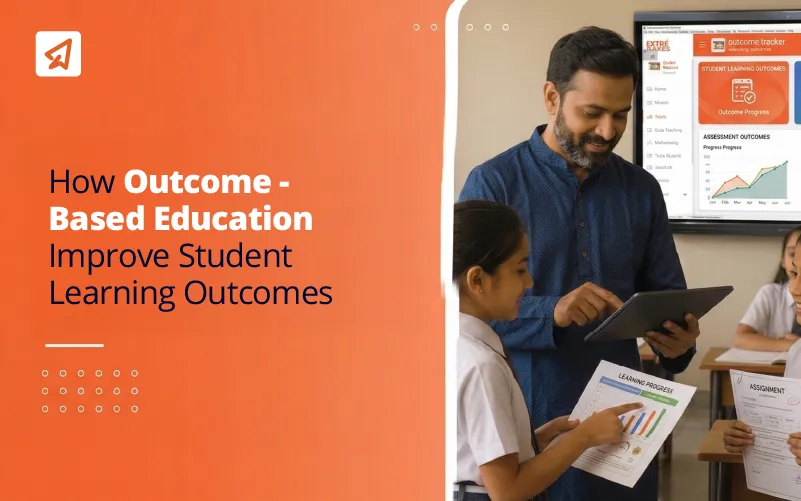
Are your students completing the syllabus but still struggling to apply concepts in real life? That gap between teaching and actual learning is exactly what outcome-based education (OBE) aims to fix.
The OBE approach connects strongly with NEP 2020, which emphasises competency-based education, holistic development, and meaningful assessment reforms. If you explore the vision of the NEP 2020, you will notice that measurable learning outcomes are central to its design.
Key Takeaways
- Outcome-based education focuses on measurable and achievable student learning outcomes rather than syllabus completion.
- It aligns strongly with NEP 2020 and modern assessment reforms in NEP.
- The outcome-based education framework includes four levels: COs, POs, PSOs, and PEOs.
- OBE promotes accountability, flexibility, and continuous quality improvement.
- Technology plays a crucial role in tracking, assessing, and improving outcomes.
What Is Outcome-Based Education?
Outcome-based education is a student-centred approach where all teaching, curriculum design, and assessment are planned around clearly defined learning outcomes. It is an educational model where schools first identify what students should know and be able to do at the end of a course or programme, and then design instruction accordingly.
This means that student success is measured by demonstrated skills and competencies, not just marks or content coverage.
Relation Between OBE & Bloom’s Taxonomy
A key pillar of OBE is alignment with Bloom’s Taxonomy, which categorises learning into levels such as remembering, understanding, applying, analysing, evaluating, and creating.
Related Read: Bloom’s Taxonomy
In fact, outcome-based education focuses on higher-order thinking skills rather than rote memorisation. Students are encouraged not just to recall facts but to apply, evaluate, and create knowledge.
This approach also aligns strongly with the goals of the National Curriculum Framework (NCF) and competency-based assessment reforms in NEP.
What Are the Key Benefits of Outcome-Based Education?
When implemented correctly, OBE can transform both teaching and learning. Here are some major advantages of adopting this approach in schools today:
-
Creates Adaptable & Individualised Learning Paths
In outcome-based education, students can progress at different speeds as long as they achieve the defined outcomes. This flexibility ensures that fast learners are challenged, while those who require more time to learn receive support where needed.
-
Centres Around Students
Unlike traditional models, OBE focuses on learner engagement and active participation. Students are kept at the centre of the entire learning process. This means that they must take full responsibility for achieving their learning outcomes rather than passively listening.
-
Provides Actionable Feedback
The OBE approach provides clear goals, and when these outcomes are clearly defined, expectations become transparent. Students understand what they are working towards, and teachers can provide targeted feedback aligned with measurable indicators.
-
Aligns with Workforce Needs
One major strength of the outcome-based education framework is that the curriculum is well aligned with industry needs. It focuses on intentionally-developed skills such as problem-solving, collaboration, and communication.
-
Creates Greater Accountability
In the OBE approach, every course and programme has clearly defined, measurable outcomes. Teachers need to regularly assess whether students are actually achieving those outcomes instead of just completing the syllabus. This data-driven tracking makes performance transparent for administrators, accreditation bodies, and policymakers, hence strengthening institutional accountability.
-
Encourages Critical Thinking
Because outcome-based education focuses on higher cognitive skills, students develop analytical and creative thinking abilities instead of memorising answers. This helps them shape their critical thinking skills, which are needed today.
-
Provides Room for Continuous Improvement
In this education approach, teachers need to regularly measure whether students are achieving the defined learning outcomes. If gaps are identified, they can revise curriculum design, teaching strategies, or assessment methods before it gets too late. This ongoing review process ensures continuous quality improvement.
Outcome-Based Education vs Traditional Education
The core difference between an outcome-based education framework and traditional education lies in focus.
Traditional systems emphasise syllabus completion and final exams. While OBE focuses on whether students are demonstrating competencies and showing improvement in skill development.
Here is a structured comparison:
| Aspects | Outcome-Based Education | Traditional Education |
|---|---|---|
| Flexibility | Learning pace adapts to outcome achievement | Fixed timeline for syllabus completion |
| Personalisation | Student progress varies based on mastery | Same structure for all learners |
| Memorisation | Focus on application and skills | Heavy emphasis on memorisation |
| Methodology | Backward design from outcomes | Forward design from content |
| Assessment Method | Continuous and competency-based | Primarily summative examinations |
Challenges in Implementing OBE in India: How to Overcome Them
Shifting to the outcome-based education framework is not just a curriculum change. It is a structural and cultural shift. Many schools may struggle with implementation, not because OBE is complex, but because systems, training, and mindset are not aligned with measurable outcomes.
Let us look at the real barriers and practical ways to address them.
-
Limited Clarity & Training
Many educators understand what OBE means, but they struggle with writing measurable outcomes, mapping COs to POs, and designing aligned assessments. Without clarity, OBE becomes another piece of paperwork instead of a practice.
Practical Solutions:
- Conduct hands-on workshops on writing measurable outcomes.
- Train faculty in outcome mapping with real course examples.
- Create internal OBE mentor teams within departments.
- Use standardised templates for CO-PO mapping.
-
Manual Assessment Tracking
Manual tracking of OBE outcomes is overwhelming, especially in large schools. Without proper data systems, outcome measurement becomes inconsistent and unreliable.
Practical Solutions:
- Adopt digital assessment tools and analytics platforms to minimise manual tracking.
- Automate CO-PO attainment reports.
- Use dashboards for department-level tracking.
- Integrate outcome tracking with existing ERP systems.
-
Inconsistent Assessment Standards
Sometimes schools state the need for students to develop skills like critical thinking or problem-solving. However, their exams still only test memory-based questions. This means the assessment does not actually measure the outcomes that were promised. As a result, the outcome-based education framework ends up looking good on paper and fails to work in practice.
Practical Solutions:
- Develop rubric-based evaluation frameworks.
- Introduce application-based and case-based questions.
- Align question papers with cognitive levels under Bloom’s Taxonomy.
- Conduct assessment audits every semester.
-
Curriculum Structures That Don’t Reflect Competency Goals
In many schools, the curriculum is content-heavy and lacks a clear focus on outcomes. If the syllabus is not redesigned, OBE ends up becoming just another added layer instead of an integrated system.
Practical Solutions:
- Redesign courses using backward curriculum planning.
- Map each module directly to defined outcomes.
- Align curriculum reforms with the vision of NEP 2020.
- Review curriculum annually based on attainment data.
-
Overemphasis on Grades
The OBE approach focuses on application, skills, and long-term competency, and yet many schools still treat grades as the final indicator of success.
Practical Solutions:
- Introduce skill-based internal assessments.
- Separate grade reporting from skill attainment reports.
- Include internships, projects, and simulations.
- Communicate clearly with parents and stakeholders about competency-based evaluation.
-
Resistance to Structural Change
Many teachers and institutions are used to the old way of teaching and evaluating. And the introduction of outcome-based education ends up feeling like extra work or an unnecessary change. Because of this fear or discomfort, educators may hesitate to fully adopt the new system.
Practical Solutions:
- Start with pilot departments before scaling.
- Share measurable improvement data to build confidence.
- Reduce manual workload using digital tools.
- Recognise faculty efforts in performance reviews.
Understanding the Levels of Outcomes in OBE
The outcome-based education framework operates at multiple levels, such as:
- Course Outcomes (CO): These define what students should achieve by the end of a specific course. COs are measurable and directly assessed.
- Program Specific Outcomes (PSOs): PSOs focus on discipline-specific competencies. They define the expertise expected in a particular programme.
- Program Outcomes (POs): POs represent broader skills such as teamwork, ethical reasoning, and communication. They often align with national standards.
- Program Educational Objectives (PEOs): PEOs outline long-term achievements expected from students a few years after completing the programme.
Together, these levels ensure clarity and alignment across teaching and evaluation.
Step-by-Step Guide to Implementing Outcome-Based Education
Implementing the OBE approach in schools requires careful planning and structured execution. Below is a simplified and practical roadmap that institutions can actually follow.
Step 1: Start with a Clear Vision
Before defining outcomes, schools must clarify why they are adopting the OBE approach. The vision should clearly state what kind of students the institution wants to produce and what competencies matter most.
Step 2: Conduct Curriculum Assessment
Before changing anything, evaluate your current curriculum. Identify gaps between what students are taught and what they are expected to demonstrate.
This is an important step, and it matters the most because schools cannot implement a proper outcome-based education framework without understanding what needs improvement.
Action Pointers:
- Collect input from students and teachers.
- Review curriculum alignment with industry expectations.
- Identify content-heavy areas that lack skill-based learning.
Step 3: Define Clear, Measurable Learning Outcomes
Now define what students should know and be able to do at the course and programme levels. Your outcomes should be heavily student-centred, and they must be specific, observable, and measurable.
Action Pointers:
- Align outcomes with Bloom’s Taxonomy.
- Define COs, POs, PSOs, and PEOs clearly.
- Ensure outcomes reflect both academic and real-world skills.
Step 4: Design Curriculum Around Your Outcomes
This is where real change happens. Teaching methods and assessments must directly measure the defined outcomes.
If assessments test memory but outcomes demand skills, your OBE approach is focusing on the wrong areas.
Step 5: Train & Support Teachers
Teachers are the backbone of the outcome-based education framework. Without training them, OBE becomes paperwork instead of practice.
Schools need to clearly map out outcomes, design the rubrics to follow, and properly analyse attainment data.
Action Pointers:
- Conduct regular professional development workshops.
- Provide OBE mapping templates and guides.
- Encourage peer collaboration and departmental review.
Step 6: Measure, Analyse, & Improve Continuously
The OBE approach is not a one-time reform. It is a continuous cycle of measurement and refinement. And that’s why it’s essential to continuously keep measuring, analysing, and improving strategies and techniques to adapt and get better assessment results.
Step 7: Engage Stakeholders in the Improvement Loop
Successful OBE approach adoption requires collaboration that goes beyond classrooms. Stakeholders, alumni, and administrators must contribute their insights for proper mapping and clear guidance.
This feedback ensures outcomes remain relevant to evolving societal and workforce needs.
Step 8: Leverage Technology to Strengthen Outcome Tracking
Implementing outcome-based education becomes difficult when outcome mapping, assessment tracking, and attainment analysis are handled manually. Technology simplifies this process by automating data collection, performance analysis, and reporting.
Why this matters: Digital systems make the OBE framework scalable, transparent, and efficient across departments and campuses.
Action Pointers:
- Use Learning Management Systems to align content with defined outcomes.
- Implement outcome attainment dashboards for real-time tracking.
- Automate CO-PO mapping and performance reports.
- Integrate digital tools that support competency-based assessment reforms in NEP.
Achieve Measurable Learning Outcomes with Extramarks
Transform your school’s approach to teaching and assessment with structured digital solutions.
Extramarks helps schools:
- Streamline competency-based assessments
- Track measurable learning outcomes
- Align curriculum with defined outcomes
- Generate performance analytics instantly
Explore Our Solutions
Conclusion
In this ever-evolving education landscape, content coverage is no longer enough.
Outcome-based education ensures that learning is meaningful, measurable, and aligned with real-world expectations. It supports accountability, skill development, and continuous improvement.
When aligned with NEP 2020, supported by structured assessment reforms, and strengthened through technology, OBE becomes a powerful model for institutional transformation.
Frequently Asked Questions (FAQs)
What are the features of outcome-based education?
Key features of the OBE approach include defined learning outcomes, continuous assessment, student-centred instruction, and data-driven improvement.
What are the objectives of outcome-based education?
The main objectives of the outcome-based education framework include measurable skill development, industry alignment, improved accountability, and better learning transparency.
What is the importance of outcome-based education?
The importance of outcome-based education lies in its shift from content delivery to measurable student achievement. Instead of focusing on how much is taught, it ensures that learners can clearly demonstrate skills, knowledge, and real-world competencies by the end of a programme.
What is the difference between competency-based and outcome-based education?
Competency-based education focuses specifically on skill mastery at individual pace, while outcome-based education includes broader programme-level goals and structured alignment across curriculum and assessment.
What are some examples of outcome-based education?
Some effective examples of OBE include project-based assessments, skill-based internships, industry-aligned curriculum mapping, and rubric-based evaluations aligned with measurable outcomes.
Reviewed by

Prachi Singh | VP - Academics
Prachi Singh is a highly accomplished educationist with over 16 years of experience in the EdTech industry. Currently, she plays a pivotal role at Extramarks, leading content strategy and curriculum development initiatives that shape the future of education...read more.

Published on March 12, 2026