NEP 2020 Completes Six Years: Measuring Its Impact on Indian Education
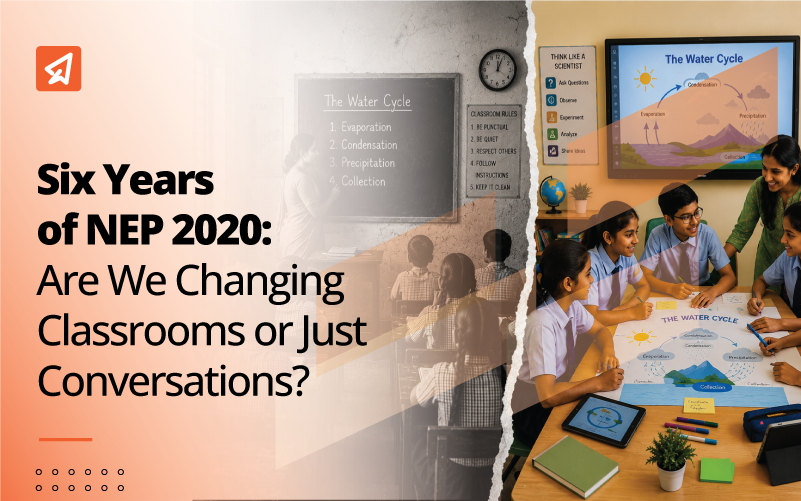
On 29 July 2020, India approved the National Education Policy, or NEP. Before this, our education policy had not changed for 34 years. On the same day, the Ministry of Human Resource Development was renamed the Ministry of Education.
Six years have passed. Standing here in July 2026, the question is simple: what has actually changed?
The honest answer is that a lot has changed — but not everywhere, and in many places, not where it matters most.
This week, many newspapers will say NEP is a big success. Others will say it has failed. This article is not for that debate. It is for the people on the ground: principals, coordinators and teachers.
For you, the question is much simpler. Has NEP reached your classroom? Or has it stopped at your notice board?
What Is Working at the Top
Let us be fair — a lot of real work has been done in six years. But look closely at these wins and you will see a clear pattern. NEP has moved very fast wherever the central government could do the work itself.
Frameworks, apps and guidelines can be made in one office in Delhi and sent to the whole country. Here is what that top-down success looks like.
- Structural shifts. About 32 states and union territories have moved to the 5+3+3+4 system. Education is a shared subject, so states like Tamil Nadu and West Bengal can keep the old 10+2 system.
- New textbooks. The National Curriculum Framework for School Education, or NCF-SE, came out in August 2023. Guided by it, the new NCERT books are finally here. Class 9 moves fully to new books this year, in 2026-27, including a new English book called Kaveri. Classes 10 and 11 will follow next year.
- Board exam reforms. CBSE has confirmed two board exams a year for Class 10, starting 2026-27. The February exam is compulsory, the May exam is optional, and the better score is kept. CISCE is planning to do the same.
- National assessments. PARAKH, the national body for assessment, is now fully working. Its survey covered about 21 lakh students and 2.7 lakh teachers. It has also released a digital Holistic Progress Card, so schools do not have to fill it by hand.
- Teacher training. More than 25 lakh teachers have completed NISHTHA training for foundational learning. A new four-year teacher education course, called ITEP, is running in 57 universities.
There was always a clear plan, written down in detail in SARTHAQ. But a policy does not teach students. Teachers do.

Where It Stumbles in the Classroom
The policy slows down sharply when the work depends on India’s 14.7 lakh individual schools. No central office can stop a child from dropping out. And no central office can change how a teacher takes a lesson on a normal Tuesday morning.
This gap between planning at the top and doing at the bottom has created three big problems.
Gap 1: Paperwork Instead of Teaching
The Holistic Progress Card, or HPC, is the best example of a good idea turning into a paperwork burden. A proper HPC tracks marks, behaviour, feelings and what classmates say about the child.
The reality: Filling one HPC by hand takes about 20 minutes. For a school of 1,000 students, that is more than 300 hours of work.
When a reform eats up a teacher’s free period, it becomes a chore. The cards get filled in a hurry one week before the deadline, with the same lines copied for every child. And the whole purpose of holistic tracking is lost.
Gap 2: New Exams, Old Teaching
Two board exams a year is not just a calendar change. The syllabus must finish earlier. Revision time becomes shorter. Extra classes are needed for students who come back in May.
The reality: Most schools have changed their academic calendar. Very few have changed how they teach. NEP wants questions that test understanding, not memory. But many teachers have not been trained to write such questions themselves, so they still depend on downloaded papers.
Gap 3: Reading and Maths in the Early Classes
NEP made a bold claim. If every child does not learn basic reading and maths — called Foundational Literacy and Numeracy, or FLN — by 2025, the rest of the policy will not matter.
The reality: We missed the 2025 deadline. The NIPUN Bharat target has now moved to 2026-27. Government primary schools have improved. But private schools, where nearly one-third of India’s children study, have not felt the same push. If you run a private school, FLN is your job — and it must start in the early classes, not in Class 3.
And Some of It Is Not Your Fault
These three gaps are yours to close. The next ones are not. It is important to say this clearly, because no principal can fix them alone.
Behind all of it is money. NEP says India should spend 6% of GDP on education. This target was first set in 1966 and has never been reached even once. Today the spending is about 3.2%.
That is a big reason why nearly 1 in 3 schools still have no internet. It is why India is short of roughly 10 lakh teachers. And it is part of why dropout rates are still in double digits at the secondary level — though children also leave school for money reasons and family reasons that no textbook can fix.
Are We Judging Too Soon?
Looking at these gaps, it is tempting to call the policy a failure. But that would not be correct.
State committees warned back in 2020 that the deadlines were too fast. NEP’s own documents say full rollout will take until 2040. In other big countries, such reforms took ten years or more to show results.
So the most accurate thing to say after six years is not “NEP has failed.” It is: “We are still in transition.”
But being in transition does not mean waiting. It only means the question moves from Delhi to your building.
The 10-Minute School Audit
You do not need a big national report to know where your school stands. You just need to ask the right questions. Take this 7-point audit to your next staff meeting and see how far your school has really come.
| Area | The Question to Ask | The Reality Check |
| 1. Assessments | Can you show three question papers from last term that your own teachers wrote to test understanding rather than memory? | Downloads do not count. Real reform needs teacher skill. |
| 2. Board Exams | Do you have a written plan for the February and May Class 10 exams, including what happens to students in between? | This is an academic change, not just a calendar update. |
| 3. Holistic Progress | How many minutes does one HPC take to fill in your school? | If nobody knows the answer, it is being treated as a file to submit, not a tool to track students. |
| 4. Foundational Learning | Do you have real reading and maths data for each child in Classes 1 to 3, or only exam marks? | Private schools must own FLN too. It is not only a government school job. |
| 5. Teacher Training | Your teachers finished NISHTHA. How many actually changed something in their classroom afterwards? | A certificate is not the same as a changed classroom. |
| 6. Curriculum | Class 9 gets completely new NCERT books this year, in 2026-27. Has your Class 9 team read them yet? | Planning for a new syllabus must happen before the term starts. |
| 7. Timetable | Are 10 bagless days, toy-based teaching and mother-tongue teaching actually on your timetable? | If they exist only in your school brochure, you are missing the point. |
The Road Ahead
If many of your answers were uncomfortable, do not feel bad. Your school has not failed. This is simply what happens when a very big policy is handed to schools without extra time, extra teachers or extra money.
NEP 2020 gave India something it did not have for three decades: a clear, single direction. The first six years gave us new structures, new apps and a new way of talking about school. But the easy part is over.
The real gap now is no longer between the Centre and the states. It is between schools that changed their teaching, and schools that only changed their files.
The question for year seven is not whether NEP works. It is whether your school can show its work.
Published on July 30, 2026