Understanding Education 5.0: The Future of Learning
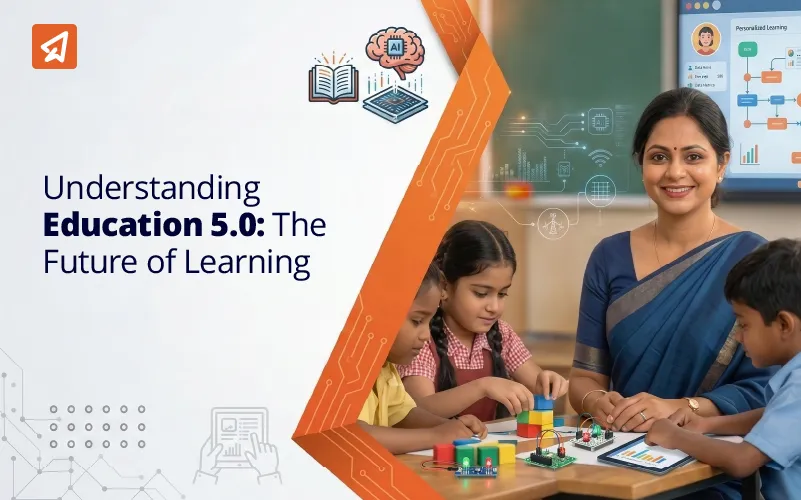
Education is changing faster than ever. Classrooms today are not limited to textbooks and blackboards. Students are learning through technology, real world experiences, and skill based activities that prepare them for life beyond exams. This shift is often referred to as Education 5.0. It focuses on combining human values with digital tools, creativity, and problem solving so that learning feels meaningful and practical. In this blog, let us understand what Education 5.0 in schools really means and how it is shaping the future of learning for the next generation.
What Is Education 5.0?
Education 5.0 is a learning approach that puts humans at the centre while using advanced technology to support growth. It combines tools like artificial intelligence, virtual reality, and connected devices with a strong focus on creativity, emotional intelligence, ethics, and social responsibility. Instead of only using technology to deliver content, this model focuses on shaping well-rounded individuals who can think critically, adapt to change, and contribute meaningfully to society. In India, Education 5.0 aligns closely with NEP 2020 by encouraging holistic development, sustainable thinking, and responsible use of technology while preparing learners for real-world challenges.
Journey to Education 5.0
The shift towards Education 5.0 did not happen overnight. It is the result of continuous changes in how teaching and learning have evolved over time, shaped by technology, industry needs, and society itself.
-
Education 1.0
Education 1.0 followed a traditional classroom setup where teachers delivered lectures and students listened. Learning was mostly based on rote memorisation and one way communication. Textbooks, chalkboards, and standardised tests were the main tools used to measure knowledge.
-
Education 2.0
Education 2.0 introduced digital elements into classrooms. Schools began blending traditional teaching with online tools. Multimedia resources, presentations, and early e learning platforms made lessons more interactive. Students slowly moved from passive listeners to active participants.
-
Education 3.0
Education 3.0 moved towards personalised learning. Here, technology became part of everyday teaching. Flipped classrooms, digital platforms, and collaborative tools gave students more control over how they learned. Critical thinking and active engagement started getting attention.
-
Education 4.0
Education 4.0 became future oriented and skill focused. This stage prepared students for the future job market. Skills like problem solving, communication, and adaptability became important. Advanced technologies like AI, AR, and VR were introduced in some learning environments. Education also became more flexible, with online learning and digital platforms playing a bigger role.
Benefits of Education 5.0
Here are some of the major benefits of Education 5.0 and why it matters in today’s world.
-
Human-Centred Technology Integration
Education 5.0 puts humans first and technology second. Technology is used to support learning, not replace human thinking or interaction. Tools like AI, virtual labs, and digital platforms help learners explore concepts better while still keeping empathy, creativity, and critical thinking at the centre. This balance ensures that learners grow not just academically, but also as responsible individuals.
-
A Sense of Social and Environmental Responsibility
One of the biggest strengths of Education 5.0 is its focus on responsibility. Learners are encouraged to think about society, the environment, and the impact of their actions. Education moves beyond exams and jobs and helps individuals understand real world issues like sustainability, climate change, and social equality. This creates aware citizens who contribute positively to the world around them.
-
Student-Centric Learning
Instead of forcing everyone to learn in the same way, Education 5.0 focuses on individual strengths and interests. Students are encouraged to explore topics that match their skills and future goals. This makes learning more meaningful and less mechanical. When students feel involved and understood, their motivation improves. They do not just memorise content but actually connect with it.
-
Formative Assessment and Active Learning
Education 5.0 supports continuous learning rather than one final exam deciding everything. Students receive regular feedback through projects, discussions, presentations, and practical tasks. This helps them understand where they are improving and where they need support. Active participation becomes more important than passive listening. As a result, learning becomes ongoing and more engaging.
-
Teachers with Continuous Training
For Education 5.0 to succeed, educators must grow along with the system. Continuous training ensures that teachers stay updated with new technologies, teaching methods, and assessment strategies.
When educators receive proper support and professional development, they are better equipped to guide students in modern learning environments. This creates a stronger and more responsive education system overall.
Key Components of Education 5.0
To understand how Education 5.0 works in practice, it helps to look at its main components.
-
Learner-Centric Education
At the heart of Education 5.0 is the learner. Every student has different abilities, interests, and goals. This model recognises those differences instead of treating everyone the same. Learning is designed around what students need, not just what the syllabus demands.
-
Personalised Learning Pathways
Each learner follows a pathway that matches their ambitions and preferences. This may combine classroom learning, online courses, vocational training, internships, or experiential learning opportunities.
Personalised pathways allow students to explore their interests deeply while still meeting academic standards. It prepares them for diverse career paths rather than limiting them to traditional routes.
-
Technology Integration
Technology plays a supportive role throughout the learning process. Students may use educational apps, digital resources, virtual labs, and AI-based tutoring systems.
These tools provide instant feedback, flexible learning schedules, and access to global knowledge. When used thoughtfully, technology expands learning beyond the physical classroom.
-
Teacher as Facilitator
In Education 5.0, teachers move from being the sole source of information to becoming mentors and guides. They help students set goals, track progress, and reflect on learning.
This shift encourages independence while still offering structured support. The teacher remains central to the learning process, but in a more collaborative and supportive role.
Challenges and Considerations in Implementing Education 5.0
While Education 5.0 offers many advantages, its implementation comes with challenges that must be addressed carefully.
-
Digital Infrastructure
Although digital infrastructure in India has improved, reliable internet access and device availability are still uneven. Rural and remote areas often face connectivity issues.
Without better infrastructure, the full benefits of technology-driven education cannot be realised. Addressing these gaps is essential for nationwide implementation.
-
Technological Accessibility
Not every student has access to smartphones, laptops, or high-speed internet. This creates inequality in learning opportunities.
Ensuring equal access to digital tools is necessary to prevent widening the gap between students from different backgrounds.
-
Teacher Training
Educators need proper training to adapt to new teaching methods and technologies. Without adequate support, it becomes difficult to implement learner-centric and technology-supported education. Ongoing training programs are necessary to help educators confidently guide modern learners.
-
Ethical and Privacy Concerns
With the use of AI and data analytics, large amounts of student data are collected and analysed. This raises concerns about privacy, data protection, and ethical use.
Clear policies and safeguards must be in place to ensure that student information remains secure and is used responsibly.
-
Socio-Economic Disparities
India continues to face significant socio-economic inequalities. For Education 5.0 to succeed, it must be inclusive and accessible to all sections of society.
If reforms benefit only urban or well-resourced institutions, the divide will grow wider. Policymakers must ensure that advancements reach every region and community.
The Synergy Between Industry 5.0 and Education 5.0
Industry 5.0 and Education 5.0 are closely connected. One focuses on reshaping the workplace, while the other reshapes how people are prepared for it. When both move in the same direction, the result is a system where learning and industry evolve together rather than separately. Let’s understand how this connection works.
-
Developing Future-Ready Skills
One strong link between Industry 5.0 and Education 5.0 is the focus on building future-ready skills. Industry 5.0 values creativity, collaboration, adaptability, and human judgment alongside advanced technology. This means the workforce is no longer expected to simply operate machines but to work with them intelligently.
Education 5.0 responds by shifting away from rote learning and focusing more on critical thinking, innovation, and problem solving. When students work on real-world projects, case studies, and interdisciplinary tasks, they begin to develop skills that match modern industry expectations. Instead of memorising information, they learn how to apply knowledge in practical situations.
This alignment ensures that learners are not just qualified on paper but are capable of contributing meaningfully in evolving work environments.
-
Work-Integrated Learning
Industry 5.0 highlights the importance of combining automation with human expertise. Even as machines handle repetitive tasks, human insight, empathy, and decision making remain essential. For this balance to work, individuals need practical exposure before entering the workforce.
Education 5.0 supports this need through internships, apprenticeships, industry projects, and experiential learning programs. These experiences allow learners to step into real workplace environments while still studying. They understand how theoretical knowledge connects with real operations, challenges, and expectations.
At the same time, industries benefit by shaping young talent early. They can guide students according to current technological tools, workflows, and standards. This creates a smoother transition from education to employment and reduces the gap between classroom learning and workplace realities.
-
Customised Learning Pathways
Industry 5.0 uses advanced technologies to create products and services tailored to individual preferences. Personalisation is no longer a luxury. It has become an expectation. Education 5.0 follows a similar path by making learning more flexible and learner-centred.
With the help of artificial intelligence, data analytics, and adaptive platforms, educational systems can now offer personalised learning pathways. Students can progress at their own pace, revisit difficult concepts, and explore subjects aligned with their interests and strengths.
This approach recognises that every learner is different. Instead of following a one-size-fits-all model, education becomes more responsive. As a result, learners build deeper understanding and stronger motivation. When education adapts to individual needs, it prepares individuals who are more confident and capable of thriving in a dynamic Industry 5.0 ecosystem.
Closing Thoughts
Education 5.0 is a shift in how we look at learning itself. It reminds us that while technology will continue to grow, human values, creativity, and responsibility must remain at the center. When schools balance digital tools with empathy, critical thinking, and real-world exposure, students grow into individuals who are not only skilled but also aware and adaptable. As Education 5.0 continues to evolve alongside Industry 5.0, it holds the potential to shape a future where learning feels relevant, inclusive, and truly connected to life beyond the classroom.
Frequently Asked Questions
Why is Education 5.0 important today?
Education 5.0 is important because jobs are changing fast due to AI and automation. Students need adaptable skills, innovation, and problem solving abilities to stay relevant in a tech driven world.
What are the key pillars of Education 5.0?
Its main pillars include technology use, creativity, critical thinking, emotional intelligence, ethics, and sustainability. These areas work together to build future ready learners.
What role does Artificial Intelligence play in Education 5.0?
AI helps personalise learning. It tracks progress, finds learning gaps, and suggests customised support. It also powers smart assessments and virtual learning tools.
Reviewed by

Prachi Singh | VP - Academics
Prachi Singh is a highly accomplished educationist with over 16 years of experience in the EdTech industry. Currently, she plays a pivotal role at Extramarks, leading content strategy and curriculum development initiatives that shape the future of education...read more.

Last Updated on March 11, 2026