CBSE Introduces On-Screen Marking for Class 12, Accelerating India’s Digital Evaluation Transformation
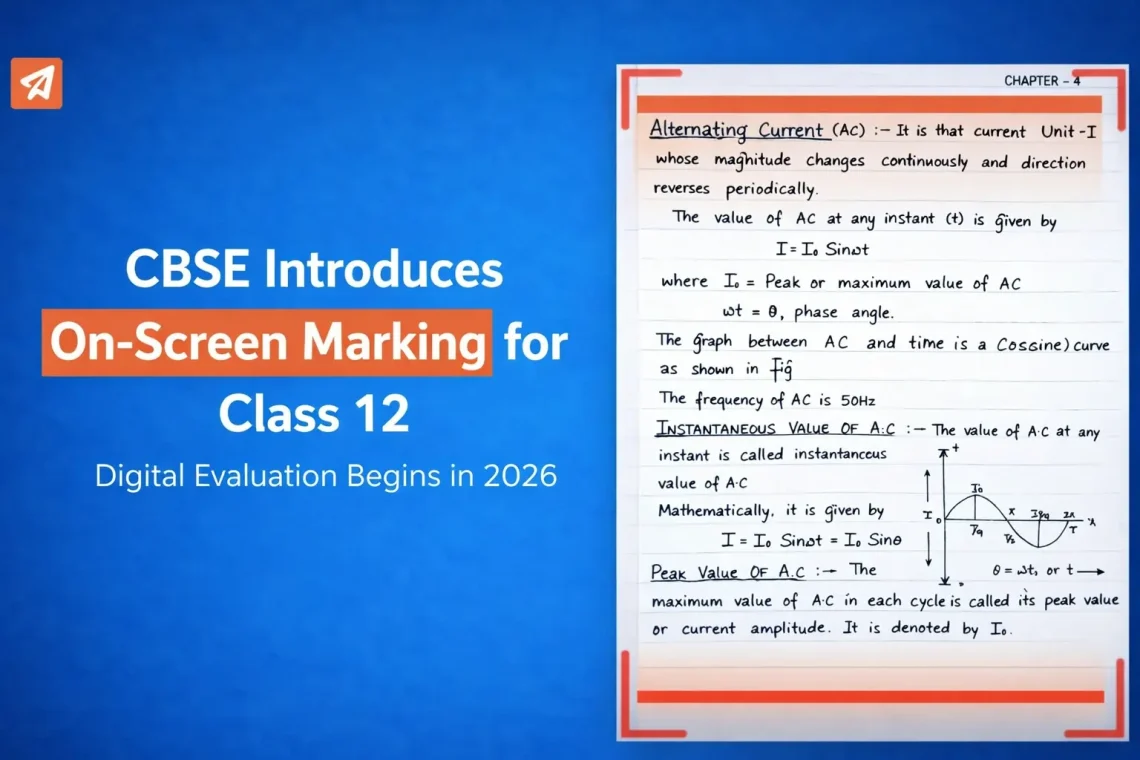
The Central Board of Secondary Education (CBSE) has announced the introduction of On-Screen Marking (OSM) for Class 12 board examinations starting in 2026. This marks a significant step toward modernising India’s examination and evaluation framework, aligning assessment processes with the country’s rapidly evolving digital education ecosystem.
A shift from manual to digital evaluation
Under the new system, students’ answer sheets will be scanned and evaluated digitally by examiners through secure online platforms. This replaces the traditional process of physically transporting answer scripts to evaluation centres and manually checking them. The transition is expected to deliver several key benefits, including:
- Improved accuracy in marking
- Reduced chances of manual errors such as incorrect totalling
- Faster evaluation and result processing
- Greater transparency and accountability
By digitising the evaluation workflow, CBSE aims to make the marking process more efficient and reliable at scale.
Enhancing efficiency across India’s largest examination system
CBSE conducts board examinations for millions of students every year, making it one of the largest school examination systems in the world. Managing and evaluating such a vast volume of answer sheets involves significant logistical coordination.
On-screen marking helps address these challenges by:
- Eliminating the need for physical transportation of answer sheets
- Enabling examiners to evaluate scripts digitally from designated locations
- Providing secure access and traceability within the evaluation process
- Supporting faster compilation and processing of results
This digital approach not only improves operational efficiency but also strengthens consistency and quality control in marking.
Reflecting growing digital readiness among schools and educators
The move toward digital evaluation reflects the increasing adoption of technology across India’s school ecosystem. Over the past several years, many CBSE-affiliated schools have integrated digital classroom platforms, enabling teachers to conduct lessons, assessments, and performance tracking through structured digital environments.
Educators familiar with digital tools are expected to adapt more easily to on-screen evaluation workflows, making the transition smoother and more efficient.
Supporting the future of technology-enabled education
CBSE’s adoption of on-screen marking highlights the broader shift toward technology-enabled teaching and assessment. As schools continue to invest in digital infrastructure, integrated classroom and assessment platforms are playing an important role in preparing institutions for evolving academic requirements.
Recognizing the need to reduce the burden on teachers and make the assessment process fairer, faster, and more robust, innovative solutions have been developed to address these challenges. These technology-enabled environments contribute to building familiarity with digital workflows, supporting smoother adoption of initiatives like on-screen marking.
Extramarks: Pioneering Digital Assessment Solutions
With a vision to transform the assessment landscape in Indian schools, Extramarks has developed comprehensive solutions that address the critical challenges faced by educators and institutions. Understanding that assessment is not just about evaluation but about improving learning outcomes, Extramarks has created a robust ecosystem that makes the assessment process fairer, faster, and more efficient while significantly reducing the burden on teachers.
Subjective Answer Evaluation: AI-Powered Assessment
Extramarks’ subjective answer evaluation system represents a breakthrough in educational assessment technology. This intelligent system goes beyond simple keyword matching to understand the depth and quality of student responses. The platform evaluates subjective answers based on multiple parameters including conceptual understanding, answer structure, relevance to the question, and completeness of the response.
The evaluation process is designed to mirror the way experienced teachers assess answers, but with greater consistency and speed. Teachers can set marking schemes with flexible rubrics, and the system evaluates student responses accordingly. This not only ensures fairness in marking but also provides detailed feedback to students, helping them understand where they scored well and where improvement is needed. The system significantly reduces the time teachers spend on evaluation, allowing them to focus more on teaching and student interaction.
Bloom’s Taxonomy-Based Reporting: Understanding Learning Depth
One of the most advanced features of Extramarks’ assessment solution is its reporting system based on Bloom’s Taxonomy. Bloom’s Taxonomy is a hierarchical framework that classifies learning objectives into six levels: Remember, Understand, Apply, Analyze, Evaluate, and Create. Each level represents a different depth of cognitive engagement, from basic recall of facts to higher-order thinking skills.
Extramarks’ platform tags each question and assessment item according to these Bloom’s levels. When students complete assessments, the system generates comprehensive reports that show not just overall scores, but performance across different cognitive levels. This allows teachers and parents to understand whether a student is strong in factual recall but struggles with application, or excels in analysis but needs support in basic concept understanding.
These insights are invaluable for personalized learning. Teachers can identify specific areas where individual students or entire classes need additional support. For instance, if reports show that students consistently perform well on “Remember” and “Understand” level questions but struggle with “Apply” and “Analyze” questions, teachers can adjust their teaching strategies to include more practical applications and problem-solving activities.
Comprehensive Digital Assessment Ecosystem
Extramarks Smart Class Plus, implemented across numerous CBSE-affiliated schools, provides an integrated platform for digital teaching, assessment, and performance tracking. The solution includes features such as automated question paper generation, online test administration, instant grading for objective questions, intelligent evaluation for subjective responses, and detailed analytics dashboards.
This comprehensive approach has helped schools transition smoothly toward digital assessment practices. Teachers who have been using these tools are already familiar with digital evaluation workflows, making them better prepared for large-scale initiatives like CBSE’s on-screen marking system. The platform’s emphasis on fairness, speed, and actionable insights aligns perfectly with the goals of modern educational assessment.
A progressive step toward a more transparent and scalable evaluation system
The introduction of on-screen marking represents a forward-looking initiative by CBSE to enhance the efficiency, transparency, and scalability of the board examination process. As digital transformation continues to reshape India’s education landscape, technology-driven evaluation systems will play a crucial role in ensuring accurate, efficient, and future-ready assessment frameworks for millions of students across the country.
Last Updated on February 24, 2026