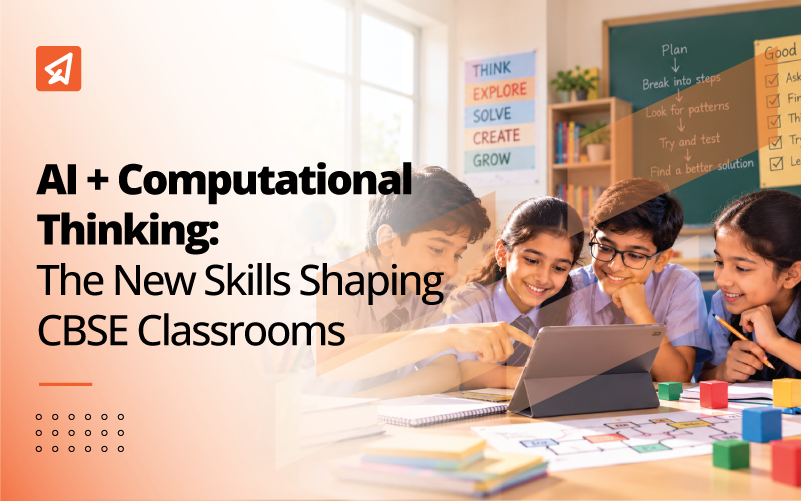
AI + Computational Thinking: The New Skills Shaping CBSE Classrooms
What does it really mean to prepare a child for an AI-driven world? It may not start with learning to code or understanding complex technology. It starts much earlier—with learning how to think.
With the academic session 2026–27, CBSE has introduced a structured curriculum on Computational Thinking (CT) and Artificial Intelligence (AI) for Classes 3 to 8. The move brings AI education into the school curriculum at an early stage, with a focus on developing the thinking skills students will need to understand and use technology responsibly.
For schools, this marks an important shift. AI is no longer just something students may encounter outside the classroom. It is becoming part of how they learn to approach problems, identify patterns, make decisions, and find solutions.
So, what will students actually learn?
The focus is not on turning young learners into AI experts. Instead, the new CBSE curriculum starts with something more fundamental: teaching students how to think systematically.
Through age-appropriate activities, puzzles, games, and problem-solving exercises, students can begin developing skills that form the foundation for computational thinking and AI readiness.
Here’s what that looks like:
- Breaking problems downA big problem can feel difficult. Breaking it into smaller, manageable steps makes it easier to understand and solve.
- Finding patternsStudents learn to notice similarities, sequences, and relationships—skills that are important in both mathematics and computing.
- Thinking logicallyRather than simply arriving at an answer, students learn to understand the steps that lead to it.
- Solving problems creativelyDifferent problems can have different solutions. Students are encouraged to explore, test, and rethink their approach.
- Understanding technologyAI becomes less of a mysterious concept and more something students can understand through familiar, everyday examples.
- Making responsible choicesAs students encounter AI, they also need to understand that technology must be used thoughtfully and ethically.
Why does computational thinking matter?
Here’s the interesting part: computational thinking is useful even when there is no computer involved.
A student deciding how to organise a set of objects, spotting a pattern in a number sequence, figuring out the shortest route between two places, or breaking a complex task into steps is already using elements of computational thinking.
That is why CBSE’s approach places computational thinking before advanced AI concepts. It builds the underlying skills first, allowing students to gradually understand how technology can be used to solve problems.
This also supports the larger direction of NEP 2020 and NCF 2023, which place greater emphasis on critical thinking, problem-solving, experiential learning, and competency-based education.
What could this mean for the classroom?
The change is not simply about adding another subject or giving students more information to remember. It can change the way learning happens.
Instead of relying only on traditional written exercises, students can learn through math games, puzzles, visual representations, hands-on activities, and group discussions. Teachers can observe how students approach a problem, explain their reasoning, and work with others, not just whether they arrive at the right answer.
This makes learning more active and gives students space to ask questions, try different approaches, and learn from mistakes.
For schools making this transition, the right learning resources can make these concepts easier to introduce. Age-appropriate content, clear explanations, visual learning, and practice opportunities can help students engage with computational thinking without making it feel overly technical.
Educational platforms such as Extramarks can complement classroom learning by creating structured, engaging experiences that help students understand concepts, practise them, and apply their thinking in different situations.
Building AI-ready learners starts with better thinkers
Technology will continue to change. The tools students use today may look very different a few years from now. What will remain valuable is their ability to ask questions, recognise patterns, solve unfamiliar problems and think critically about the technology around them.
That is ultimately what makes the new CBSE focus on AI and Computational Thinking significant. It is not simply about teaching students more about technology. It is about helping them develop the way of thinking they will need to navigate it.
Perhaps that is where AI-ready education should begin: not with the technology, but with the thinker behind it.

Published on October 8, 2026