NISHTHA 2026–27: Preparing Teachers for New-Age Learning
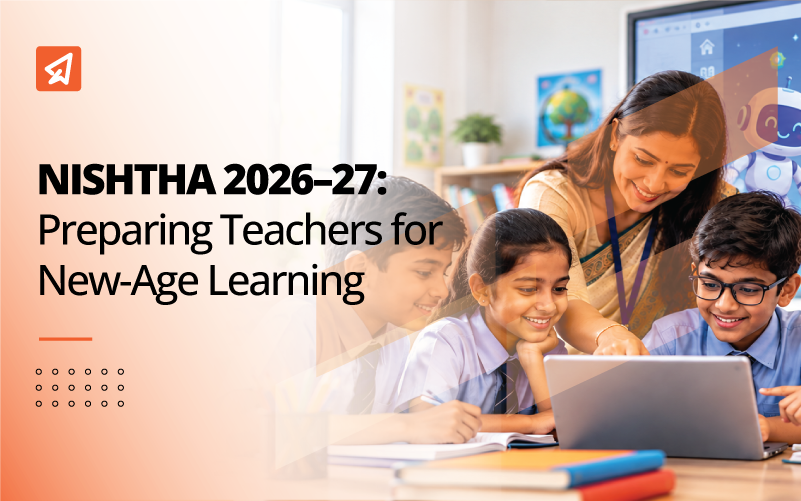
What does it take to create a future-ready classroom? A new curriculum is certainly part of it, but the change ultimately depends on the teacher standing in front of the class.
As schools adapt to new learning priorities, teacher development is becoming just as important as curriculum development. CBSE’s opening of NISHTHA 2026–27 Cycle 1 comes at a time when teachers are being called upon to respond to changing classroom needs, new technologies, and evolving approaches to learning. At the same time, the growing focus on Computational Thinking and Artificial Intelligence (CT + AI) is creating another important area for teacher capacity building.
The message is simple: preparing students for new-age learning also means preparing teachers for it.
Why is teacher development becoming a bigger priority?
The role of a teacher today goes beyond completing the syllabus. Students are expected to develop critical thinking, problem-solving, creativity and digital literacy, while classrooms are increasingly incorporating technology and experiential learning.
That means teachers, too, need opportunities to learn, adapt, and refresh their skills.
NISHTHA, or the National Initiative for School Heads’ and Teachers’ Holistic Advancement, supports this through structured professional development courses for teachers and school heads. The 2026–27 Cycle 1 includes courses across different areas, reflecting the range of skills educators may need in today’s schools.
What does NISHTHA 2026–27 Cycle 1 cover?
The courses span foundational learning, digital awareness, research, and broader social and environmental themes.
- Foundational Literacy and Numeracy (FLN)Helping teachers strengthen the building blocks of learning for younger students.
- Early Childhood Care and Education (ECCE)Supporting a better understanding of how young children learn, develop, and engage.
- Cyber HygieneBuilding awareness around safe and responsible use of digital devices.
- Action ResearchEncouraging teachers to examine classroom challenges and explore evidence-based ways to address them.
- Environmental awarenessCourses such as E-waste and Catch the Rain connect education with important issues beyond the classroom.
The diversity of these courses is worth noting. Teacher training is no longer only about improving subject knowledge. It increasingly encompasses technology, research, digital safety, environmental awareness, and approaches that help educators respond to changing student needs.
The AI-ready classroom needs AI-ready teachers
This becomes even more relevant as CBSE introduces Computational Thinking and Artificial Intelligence for Classes 3 to 8 from the 2026–27 academic session.
For students to meaningfully engage with AI, teachers need to be comfortable with the concepts and the pedagogy behind them. Teaching AI to younger learners is not about introducing complicated technology. It can begin with simple activities that help students identify patterns, break problems into smaller steps, think logically, and understand how technology is used in everyday life.
Teachers need the confidence and resources to turn these ideas into meaningful classroom experiences.
That makes teacher training for AI and computational thinking an important part of the wider move towards future-ready education. The more prepared teachers are, the easier it becomes to introduce new concepts without making learning feel complicated or disconnected from students’ everyday lives.
From one-time training to continuous learning
The larger shift is towards viewing continuous professional development (CPD) as an ongoing part of school improvement rather than a one-time training exercise.
Education will continue to change. New curricula, technologies and teaching approaches will keep emerging. Teachers who have opportunities to learn and experiment are better placed to adapt to these changes and help their students do the same.
Alongside formal professional development, the availability of relevant classroom resources also matters. At Extramarks, structured content, visual learning and engaging activities can complement teachers as they introduce concepts in new and more interactive ways.
The objective is not to add to a teacher’s workload, but to give them resources that can make planning and classroom learning more effective.
Stronger teacher development, stronger classrooms
NISHTHA 2026–27 comes at an important point in the evolution of school education. As the focus moves towards competency-based education, digital literacy, AI education and experiential learning, teachers remain at the centre of making these changes work.
A future-ready school, after all, is not defined only by the technology it has or the curriculum it follows. It is also defined by how prepared its teachers are to turn new ideas into meaningful learning experiences.
The future of education may be powered by technology, but it will continue to be shaped by teachers who know how to use it well.

Published on October 8, 2026