Understanding the Akhil Bharatiya Shiksha Samagam (ABSS) 2025
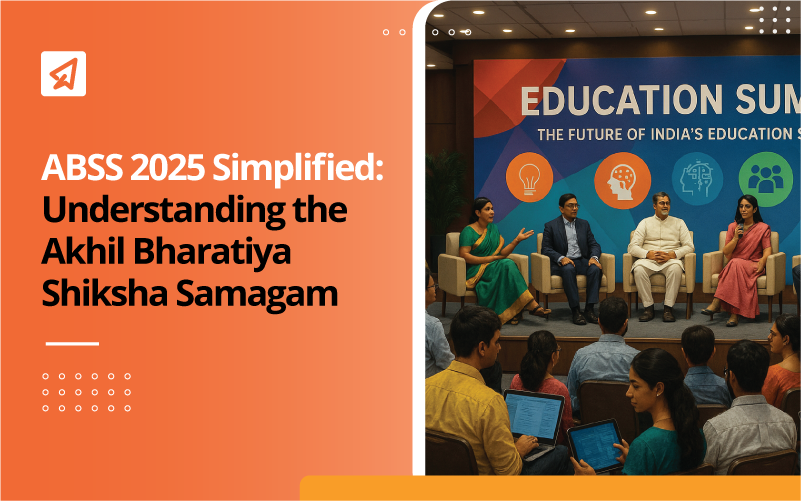
There has been a big shift in the way the education system of India works after the launch of the National Education Policy, or the NEP 2020. One of the most important platforms for reviewing this progress is the Akhil Bharatiya Shiksha Samagam (ABSS). It is an annual national education summit that brings together leaders, teachers, policymakers, and innovators from across the country.
The Akhil Bhartiya Shiksha Samagam plays a very important role and is a roadmap in India’s education as it tracks the implementation of this policy. It encourages collaboration and introduces new initiatives to improve schooling and higher education.
ABSS 2025 marked five years since NEP 2020 this year, and this occasion was focused on progress made so far along with the future direction of India’s learning ecosystem, especially in areas like Indian languages, research, technology, and AI in Education.
What is Akhil Bharatiya Shiksha Samagam?
ABSS (Akhil Bharatiya Shiksha Samagam) is an All-India Education Summit organised by the Ministry of Education. It is a national stage for exhibiting the progress, reviewing policies, and discussing new methods across schools and higher education institutions.
ABSS focuses on:
- Reviewing the progress made under NEP 2020
- Encouraging schools and universities to showcase innovative teaching practices
- Setting new targets for transforming India’s education landscape
In ABSS 2025, participants celebrated five years of NEP and reflected on the rise of Indian languages, digital tools, research, and AI in classrooms and universities. It also highlighted how far the country has come, and what needs to happen next.
What Happened at ABSS 2025?
ABSS 2025 included multiple sessions, discussions, and announcements. Here’s a simple breakdown of everything that took place.
-
Opening Session
The event began with a warm welcome, followed by keynote speeches from the education minister and other dignitaries. Several new education initiatives, reports, and digital platforms were launched to support NEP goals. The opening session also revisited India’s Vision 2030, emphasising innovation, inclusion, and improved learning.
-
India’s Education Progress (2020–2025)
ABSS 2025 looked back at the milestones that were achieved since NEP was introduced. This progress was covered across school education, higher education, assessment reforms, and overall quality improvement.
-
School Education
-
Improved Literacy and Numeracy Through NIPUN Bharat
NIPUN Bharat has played a major role here, helping young learners strengthen their reading, writing, and basic mathematical skills. Schools have reported better foundational learning as teachers have adopted more activity-based and child-friendly methods to teach.
-
Upgraded Infrastructure Under PM SHRI Schools
Many schools across the country have benefited from better classrooms, digital learning spaces, labs, and inclusive facilities. This upgraded infrastructure has helped the Indian education system keep up with the changing times and proved to the world that India is second to none when it comes to foundational or even higher education.
-
Better Nutrition and Attendance Via PM POSHAN
The updated mid-day meal programme has made a huge difference to education. With improved mid-day meals, students are receiving better nutrition, which directly affects their energy levels, focus, and overall well-being. As children feel healthier, their attendance has naturally gone up, and teachers have observed much better participation in classroom activities. For many students, this programme ensures they get at least one balanced meal a day, which plays a crucial role in supporting learning and consistent school engagement.
-
-
Higher Education
-
Flexible Learning Through the Academic Bank of Credits (ABC)
The Academic Bank of Credits has made higher education very flexible for students. Instead of being tied to one institution, students can now earn credits from different universities, store them digitally, and transfer them whenever needed. This freedom has given students the flexibility to choose their own paths that suit their interests, pace, and future goals, making education more personalised and accessible.
-
Rise of Online and Hybrid Courses
In the last five years, universities have opened up a much wider range of online and hybrid learning options. This has helped students who may not be able to attend regular on-campus classes due to distance, work, or personal commitments. With digital platforms, recorded lectures, and virtual labs, higher education has become more easy, flexible, and inclusive, giving learners more ways than one to be able to learn from wherever they are.
-
Growth in Research Through PMRF and HEI Collaborations
India’s research ecosystem has also grown stronger through programmes like the Prime Minister’s Research Fellowship (PMRF) and collaborations between higher education institutions. These initiatives encourage students to take up research early, especially in STEM fields. With improved funding, mentorship, and support, universities are able to guide young researchers and contribute to India’s scientific and technological progress.
-
Teacher Training and AI Awareness
Universities and colleges have also focused heavily on professional development for educators. Continuous teacher training sessions help faculty stay updated with new teaching techniques, curriculum changes, and digital tools. A major area of focus has been AI awareness; this has helped teachers understand how artificial intelligence can support their way of teaching, assessment, and contribute to personalised learning. This ensures both educators and learners benefit from the latest advancements in education technology.
-
-
Assessment & Quality
-
Nationwide Surveys Like NAS and PARAKH
Large-scale assessments such as NAS and PARAKH have helped identify learning gaps and improve classroom practices.
-
Better Quality Monitoring Through Accreditation Reforms
NIRF rankings and updated accreditation processes have pushed institutions to raise their standards.
-
-
Thematic Sessions at ABSS 2025
ABSS 2025 included multiple theme-based sessions that discussed the future direction of Indian education.
-
Indian Languages in Education
A major focus at the summit was the growing importance of Bharatiya Bhasha in classrooms. Speakers talked about how using Indian languages in teaching not only improves understanding but also helps students stay connected to their cultural roots. ABSS 2025 also reinforced the need to effectively implement the Three Language Policy so that children develop strong multilingual skills. This change supports better comprehension, stronger literacy, and more inclusive learning across diverse regions.
-
Research and Innovation
Another important thing to note was the push to strengthen India’s research ecosystem. Through programmes like PMRF and increased collaboration between universities, the country is encouraging students to explore scientific, technological, and social research more deeply. The summit highlighted the need for better research infrastructure, funding, and mentorship so that young researchers can contribute meaningfully to national development and global innovation.
-
Universal Secondary Education
ABSS 2025 also emphasised on making sure that every child in India completes secondary education by 2030. This includes creating stronger support systems for rural, tribal, and marginalised communities, where dropout rates are still higher. The discussions focused on improving school access, providing financial assistance, and offering flexible learning pathways so that no student is left behind.
-
AI in Education
Artificial Intelligence was another major discussion point, especially in terms of how it can enhance classroom teaching and student learning. Experts shared how AI tools can help personalise lessons, identify learning gaps faster, and support teachers with automated assessments and planning. With AI becoming more common in schools, the summit highlighted the need for careful adoption, teacher training, and ethical use. You can explore more about this shift here: AI in Education.
-
-
New Launches & Announcements
ABSS 2025 also introduced several new developments:
- Opening of new school and university facilities
- Release of new educational apps, digital platforms, and AI-enhanced tools
- Policy updates supporting research, language learning, and skill development
-
Panel Discussions & Knowledge Sharing
Experts, teachers, principals, and state-level leaders shared their experiences on NEP implementation. They discussed challenges faced in schools, success stories, and solutions for improving inclusion, quality, and access in education.
-
Closing Session
The event ended with:
- A summary of important discussions
- Presentation of a “Vision Document” outlining the next steps for NEP
- Closing remarks and thoughtful reflections on the future of education
-
Side Events & Exhibitions
The summit also included:
- Showcases of best practices from schools and universities
- Workshops on AI tools and digital learning
- Media briefings and networking sessions
- Student-led innovation exhibits
Key Takeaway from ABSS 2025
ABSS 2025 brings together India’s education community to reflect on the achievements of the past five years and plan for the next decade. It reinforces a shared national vision, which is building a modern, inclusive, tech-enabled education system grounded in Indian values and global skills.
The Akhil Bharatiya Shiksha Samagam serves as a powerful reminder of how far India has come since NEP 2020, and how much potential lies ahead. With clearer goals, stronger collaboration, and continued innovation in teaching, assessment, digital learning, and Indian languages, ABSS 2025 sets the foundation for transforming learning across the country. As teachers, educators, policymakers, and EdTech partners like Extramarks work together, India moves closer to an education system that is future-ready, equitable, and student-centred.
Reviewed by

Priya Kapoor | AVP - Academics
Priya Kapoor is an accomplished education professional with over 18 years of experience across diverse fields, including eLearning, digital and print publishing, instructional design, and content strategy. As the AVP – Academics at Extramarks, she leads academic teams in creating tailored educational solutions, ensuring alignment with varied curricula across national and international platforms...read more.

Last Updated on February 26, 2026