NEP Emphasis on ECCE for Grade 3 by 2025: Transforming Early Education for Schools and Teachers
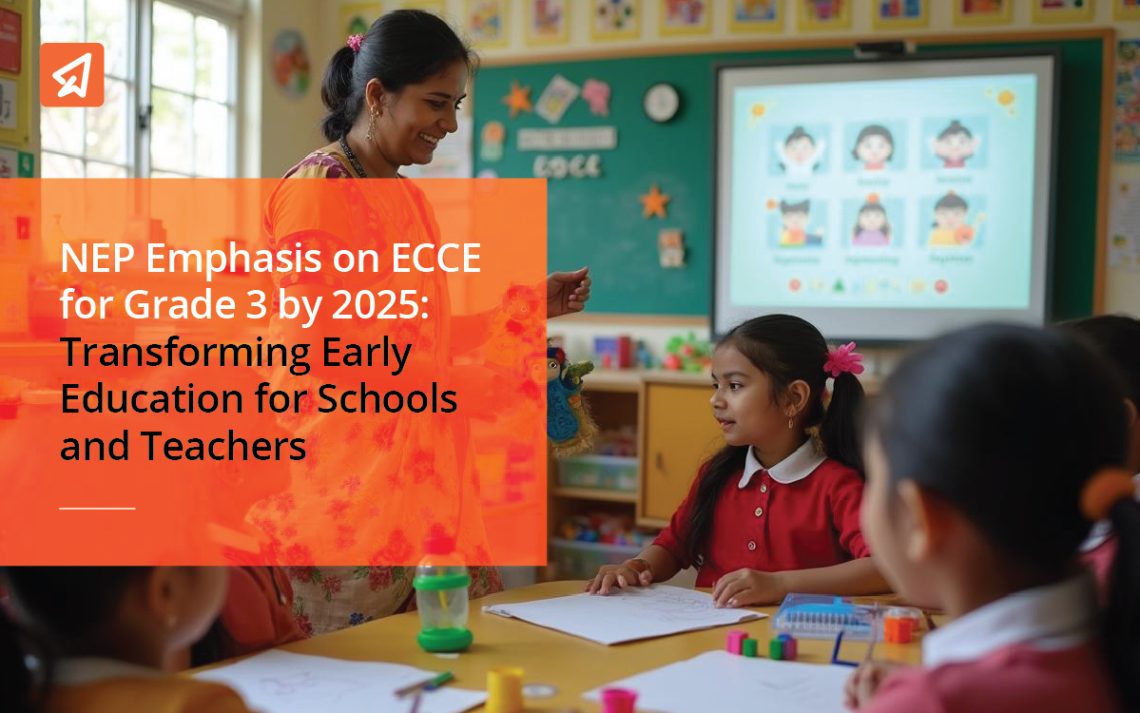
The national education policy has caused a major shift in how education systems in India work. They have brought the focus on Early Childhood Care and Education (ECCE) because it is a very important step in the way children learn.
The NEP’s emphasis on ECCE for grade 3 by 2025 is to make sure all the kids can read, write, and have basic math skills until they reach grade 3. This initiative understands the fact that the early years of learning are the most important years in a child’s life for them to succeed in school and beyond. For teachers, principals, and schools, understanding and implementing ECCE is key to creating a strong educational foundation for young learners.
What is ECCE?
Early Childhood Care and Education (ECCE) focuses on the overall growth of children from birth to eight years old, which is an important period of brain development and learning.
Why is ECCE Important?
ECCE includes education, health, nutrition, and emotional support to help children develop essential skills. ECCE can take place at home, in community centers, or in preschools, and it makes sure that children have a strong foundation for future learning.
Quality early education leads to better academic performance, stronger social skills, and long-term success. It also benefits society by reducing costs related to remedial education and social services.
Key Goals of NEP for ECCE
NEP aims to achieve a few goals through the ECCE. These are as follows:
- Universal Access: By 2025, all children aged 3-6 should have access to free and high-quality early education.
- Basic Literacy and Numeracy: The policy ensures that every child achieves foundational reading and math skills by Grade 3.
- Play-Based Learning: A new curriculum will focus on activity-based and experiential learning to keep young minds engaged.
How Schools and Teachers Can Implement ECCE Successfully
To improve Early Childhood Care and Education (ECCE) and make sure that all children have access to foundational learning, the government has introduced important initiatives under the National Education Policy (NEP) 2020. These programs focus on improving teacher training, developing better curriculums, and making learning for young children better.
-
SARTHAQ (Students’ and Teachers’ Holistic Advancement through Quality Education)
SARTHAQ offers a clear plan to achieve the ECCE goals of NEP 2020. It enhances early education by:

- Training teachers to use child-focused, activity-based learning methods.
- Updating curriculums to include play-based and hands-on learning.
- Improving school and Anganwadi infrastructure to create a more engaging learning environment.
-
NIPUN Bharat (National Initiative for Proficiency in Reading with Understanding and Numeracy)
NIPUN Bharat aims to ensure that every child can read and do basic math by Grade 3, which is key to ECCE. It supports:
- Schools by helping them use organized methods to improve reading and math skills.
- Teachers with training and resources for interactive, inclusive classrooms.
- Community involvement through parental support and local help for early learning.
New Education System: What Changes for Schools and Educators?
NEP has introduced a 5+3+3+4 learning structure, where the first five years will focus on interactive and play-based learning. Schools have to adopt creative teaching methods like storytelling, hands-on activities, and group learning to make early education effective and fun.
Also Read: NEP-Aligned Activities for Early Childhood Education
How Can Schools and Teachers Contribute?
There are a few simple ways through which teachers and schools can contribute to the way children learn, let’s understand how:
- You can create engaging classrooms with activity-based learning.
- You have to encourage interactive teaching methods like role-playing and puzzles.
- Make sure you have a supportive and stress-free environment for young learners.
- You have to train teachers in the new age methods and teaching techniques.
- Make sure the parents are involved in a child’s learning journey.
What is the Role of Digital Learning in ECCE
Teachers and schools are being able to improve education for children because of platforms like DIKSHA, as it provides resources for digital learning. Schools in digital areas lack resources and these tools make education accessible there.
Challenges and How to Overcome Them
While NEP’s emphasis on ECCE for Grade 3 by 2025 is a great initiative, some challenges remain, which are:
- Lack of Trained Teachers: More teacher training programs are needed to ensure effective ECCE implementation.
- Infrastructure Issues: Schools must create child-friendly learning spaces.
- Parental Awareness: Schools can educate parents about the importance of ECCE and encourage learning at home.
How Early Childhood Care and Education Shape a Child’s Future
Early Childhood Care and Education (ECCE) focuses on more than just reading, writing, and basic math. It supports a child’s overall growth, including cognitive, social, and emotional development, helping them navigate life more easily. The goal of ECCE is to help children achieve:
- Social Skills
- Academic Excellence
- Diversity in Learning
- Language and Literacy
- Develop Thinking Capacity
- Self-Control
The policy encourages play-based learning instead of rote memorization, allowing children to explore and learn in interactive ways.
It also focuses on inclusivity, treating children from all backgrounds and abilities equally. The policy incorporates technology for ECCE by offering e-content in regional languages and training teachers in modern tools for the betterment of students.
Schools, principals, and teachers play a key role in implementing ECCE successfully. The new education system is designed to make learning fun, engaging, and effective for young children. By adopting modern teaching methods, using technology, and involving parents, schools can ensure that every child receives a strong educational foundation.
Investing in ECCE is not just about academics; it’s about shaping confident and capable individuals. Schools, teachers, and communities must work together to make early education accessible and impactful.
FAQs
What is ECCE according to NEP 2020?
ECCE stands for Early Childhood Care and Education. Under NEP 2020, it refers to the foundational years of learning from ages 3 to 8, covering pre-school to Grade 2. It focuses on play-based, activity-based, experiential, and inquiry-driven learning. The aim is to support children’s cognitive, social, emotional, and physical development before they move into more formal academic learning.
Why is 2025 important for Grade 3?
The year 2025 is a key milestone under NEP 2020 because it is the target year by which foundational education reforms related to ECCE and Grade 3 are expected to be fully implemented. From this point, Grade 3 learning outcomes will be aligned with foundational literacy and numeracy goals to ensure students are ready for the next stage of schooling.
Is Grade 3 being removed under NEP?
No, Grade 3 is not being removed under NEP 2020. Instead, the policy strengthens the role of Grade 3 by making it a critical checkpoint for foundational learning. The focus is on ensuring students achieve essential literacy and numeracy skills by the end of Grade 3 before progressing to higher classes.
What will be the ECCE syllabus by 2025?
By 2025, the ECCE syllabus will focus on holistic, play-based, and activity-centred learning. It will include foundational literacy and numeracy along with cognitive, social, emotional, physical, and creative development. Learning will involve storytelling, art, music, movement, early number concepts, language development, and collaborative activities that encourage curiosity and understanding.
What changes must schools make before 2025?
Before 2025, schools need to align their early education approach with NEP 2020 by updating ECCE and Grade 1 to 3 curricula to be more play-based and experiential. Schools must adopt formative assessment methods, train teachers in early childhood pedagogy, create child-friendly learning environments, and integrate language, numeracy, art, music, and physical activities into everyday classroom routines.

Reviewed by

Priya Kapoor | VP - Academics
Priya Kapoor is an accomplished education professional with over 18 years of experience across diverse fields, including eLearning, digital and print publishing, instructional design, and content strategy. As the VP – Academics at Extramarks, she leads academic teams in creating tailored educational solutions, ensuring alignment with varied curricula across national and international platforms...read more.

Last Updated on December 16, 2025