
Dummy School Problem: How Schools Can Win Students Back
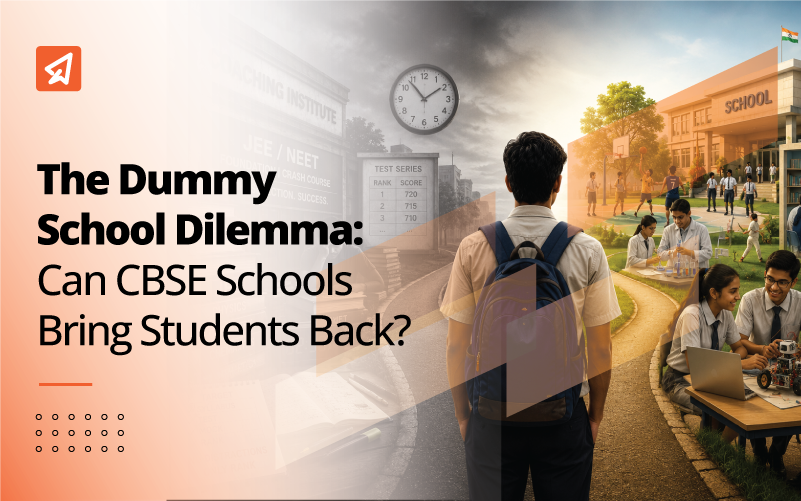
Every principal knows this moment.
Class XI starts in April. The classroom is full. By August, some seats are empty.
The names are still on the register. Those students will come back for practicals and board exams. But their real learning has shifted somewhere else — to a coaching institute preparing them for JEE or NEET.
This has happened so often that it now has a name. We call it the dummy school model. If you want the basic comparison first, we have covered integrated programmes versus dummy schools separately.
For years, schools treated this as a sad but harmless trend. That time is over.
CBSE is now inspecting, disaffiliating and warning. A High Court has called the practice a fraud. And students themselves may lose the right to sit for their board exam.
So this article is not a debate about attendance. It is about what a school should do next.
Part 1: Why dummy schools became normal
Let us start honestly. Parents are not the villains here.

No parent chooses a dummy school because they dislike school. They choose it because they believe it gives their child the best chance at a JEE or NEET rank.
Look at the pressure and the choice makes sense. Six hours of school. Four hours of coaching. Travel in between. Homework from both sides. Something has to go.
For a long time we accepted a simple idea: school gives you board marks, coaching gives you a rank. Two different jobs, two different places.
But there is a second reason nobody likes to say out loud.
For some schools, dummy admissions became easy money.
A non-attending student pays full fees. But that student uses no lab material, no bus seat, no library book, no sports ground. There is almost no teaching cost. In some places, a Delhi address also helps families claim state quota seats in medical and engineering colleges.
So the school earns, the coaching centre teaches, and everyone stays quiet.
That arrangement is now breaking. And it is breaking fast.
Part 2: What has actually changed
This is the part most schools have not fully understood. Here are the facts.
We reported the first big change when it happened — CBSE’s crackdown and the new rule from 2025-26. Here is where things stand now.
The court has spoken. In January 2025, the Delhi High Court called the dummy school practice a fraud. The bench said schools cannot allow students to attend only coaching and then sit for exams on the basis of false information. It directed CBSE and the Delhi government to act.
Schools have already lost their affiliation. After surprise inspections, show-cause notices and video evidence, CBSE withdrew the affiliation of 21 schools. Six more were downgraded from senior secondary to secondary. Most were in Delhi, the rest in Rajasthan. In total, action has been taken against more than 300 schools across the country.
Inspections are not a one-time drive. In September 2024, CBSE inspected 27 schools in Delhi and Rajasthan on the same day. Twenty-seven teams went out together, each with one CBSE officer and one principal from an affiliated school, so that no school could be warned in advance.
In August 2025, it happened again — 15 schools across seven states and union territories, including Delhi, Chandigarh, Andhra Pradesh, Jharkhand, Maharashtra, Uttar Pradesh and West Bengal. Dummy students were found in many of them.
The student is at risk too. CBSE has said that candidates found missing from school during a surprise inspection may not be allowed to appear for the board examination. The board has also made it clear that the responsibility does not sit with the school alone — it sits with the student and the parents as well.
The rule behind all this is not new. CBSE has always required a minimum of 75% attendance to sit for the board exam. What is new is that the rule is being checked.
Students who fail the attendance test may have to go through NIOS, the open schooling board, instead.
Part 3: The one number CBSE looks at first
This is the most useful thing in this article, so please read it twice.
During the 2025 inspections, CBSE noticed a pattern in the records. Enrolment in Classes 11 and 12 was much higher than in Classes 9 and 10.
Think about what that means.
A normal school grows slowly. Some students join in Class XI, yes. But if your Class XI strength is far bigger than your own Class X strength, the extra students came from somewhere — and they may not be sitting in your classroom.
That single ratio is a red flag. It can be seen from a desk in Delhi, before any inspector visits your campus.
Check it today. Take your Class X strength from last year. Compare it with your Class XI strength this year. If the jump is large and you cannot explain it with real admissions, you already have a problem to fix.
Part 4: The cost that never appears on the register
Even if your school never faces an inspection, the dummy model costs you something. It just does not show up in any file.
- The classroom becomes quieter. Discussion needs students who argue back. When the strongest students stop coming, that stops too.
- Healthy competition disappears. Marks stop being a contest. The remaining students lose the push that comes from sitting next to someone sharper.
- Younger students lose their role models. A Class VIII child who never sees a confident Class XII senior loses something a teacher cannot supply. This is also where sports and leadership habits are learnt.
- Teachers lose their best learners. Most teachers stay in this profession for the curious student who asks the difficult question. Take that student away and you slowly lose the teacher too.
- And the student loses the most. No coaching class can teach a child how to speak in front of 300 people, lead a team, lose a match, run a school event, or work with someone who thinks differently.
None of this appears on a report card. All of it decides how that child performs in a job interview ten years later.
Part 5: Why this clashes with NEP 2020
There is a bigger reason this model cannot survive.
Indian education is moving in the opposite direction.
Through NEP 2020 and the National Curriculum Framework 2023, CBSE is shifting away from memorising and towards understanding and applying. The new assessment system is built to test critical thinking and problem solving, not recall.
Now think about it practically.
You can post a syllabus to an absent student. You cannot post a group project. You cannot post a lab experiment, a debate, a presentation or a class discussion.
Competency-based education only works when the student is physically in the room. Even the assessment design assumes the teacher can watch the child work. The whole design of NEP assumes presence.
So the dummy model is not just a rule violation now. It is a direct clash with the direction the entire system is walking in.
Part 6: The honest argument on the other side
Any school leader reading this deserves a fair discussion. So let us admit what is true.
The workload argument is real. A serious JEE aspirant genuinely cannot do full school plus full coaching. The day is not long enough. Pushed too far, it ends in student burnout. Telling that family to simply attend school more is not a solution.
Many integrated programmes have failed. This is the part most articles skip. Schools have tried adding JEE and NEET preparation and got poor results, because:
- The coaching period was put at the end of the day, when children are tired
- The same school teachers were asked to teach competitive-level content without training
- Only two or three periods a week were given to a syllabus that needs far more
- The programme was sold to parents before it was ready
When that happens, parents lose trust and go straight back to the coaching centre. Worse, they now believe integration does not work anywhere.
So the answer is not “integration is good.” The answer is integration only works under certain conditions.
Part 7: What real integration needs
If your school wants to keep its best students, here is what actually has to happen. We have written more on integrated coaching and on how schools can support competitive exam preparation. Be honest with yourself on each point.
1. Protected time, in the morning. Competitive preparation cannot be the last period. It needs proper slots during the fresh part of the day, fixed in the timetable, not adjusted every week.
2. Faculty with real subject depth. Board-level teaching and JEE-level teaching are different skills. Either train your teachers properly or bring in people who already do this work. Do not pretend.
3. Regular tests in the actual exam pattern. Students trust preparation that shows them a rank. Weekly or fortnightly tests, proper analysis, and a clear picture of where the child stands.
4. Board preparation must not be sacrificed. Parents want both. If board marks fall, the programme is finished, no matter how good the rank data looks.
5. Technology to handle the personal part. Every child is weak in something different. Adaptive practice and learning technology can do the individual work that one teacher with 60 students cannot.
6. Keep school life alive. This is the whole point. Sports, house events, stage, leadership roles. If your integrated programme removes all of that, you have simply built a coaching centre with a school signboard.
7. Talk to parents before they decide. Most dummy admissions are decided in a single conversation in March or April. If you have not shown parents your plan and your results by then, you have already lost. Clear parent communication is not a soft skill here. It is admission strategy. Strong school counselling helps too, especially when families are still deciding which stream to take after Class 10.
Many schools do this by bringing competitive exam preparation inside the school day, often by partnering with an education provider for faculty, structured tests, technology and curriculum support, while keeping the school in charge of the child’s overall growth. Some have gone further and tried to bring the Kota model into their own classrooms.
Part 8: A short checklist for your next meeting
Ask these five questions in your next leadership meeting.
- The ratio. How does our Class XI strength compare with our own Class X strength last year? Can we explain the gap?
- The register. If a CBSE team walked in tomorrow, unannounced, how many Class XI and XII students would be missing?
- The reason. For every regular absentee, do we know whether it is coaching, health or something else?
- The offer. What can we honestly promise a JEE or NEET aspirant that a coaching institute cannot?
- The conversation. Who in our school speaks to these parents, and when? March is too late.
Make this part of your regular school audit, not a one-time exercise. And treat it as a student retention problem, because that is what it is.
If these questions are uncomfortable, that is useful. It is far better to answer them internally now than to answer them to an inspection team later.
The real question
The dummy school debate is usually framed around attendance. It is really about relevance.
If our brightest students feel they must leave school to reach their goals, the problem is not that they left. The problem is what school was offering them.
The schools that lead the next ten years will not try to defeat coaching institutes at their own game. They will do what only a school can do — teach, mentor, build character, create a community — and add serious exam preparation on top of it, under one roof. The move to two board exams a year gives them more room to do this than they had before.
Because the question is no longer whether a student should choose between school and coaching.
It is whether schools can change enough that the student never has to.

Published on July 30, 2026