School Management Committee (SMC) Guidelines 2026: What Every School Needs to Know
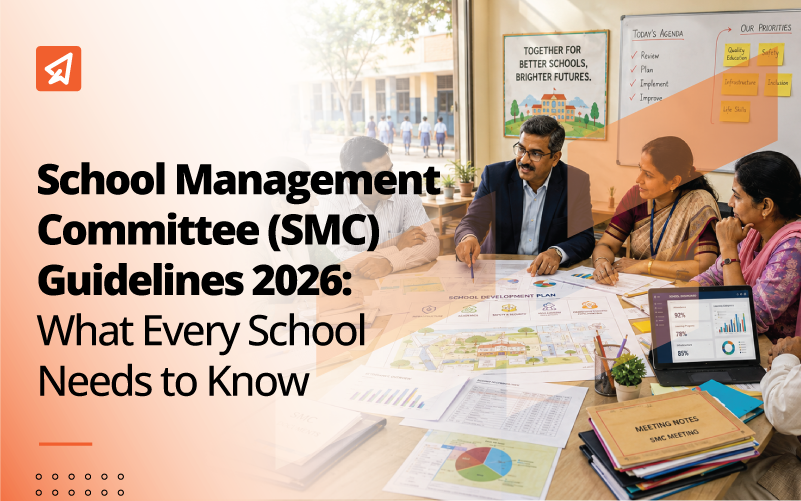
Schools work best when the people closest to them have a say in how they run. On 6 May 2026, the Ministry of Education launched the School Management Committee (SMC) Guidelines 2026. These new rules give parents, teachers, and the local community a bigger role in running schools.
This is the first single national framework for SMCs. It replaces all earlier instructions issued under older schemes. This blog explains what changed, who is on an SMC, what powers it now has, and which schools the rules apply to.
What Is a School Management Committee (SMC)?
A School Management Committee (SMC) is a group of parents, teachers, school leaders, and local community members who help run and monitor a school. It plans school improvements, checks how funds are used, monitors attendance, and works for the safety and inclusion of every child. SMCs were first made compulsory under the Right to Education (RTE) Act, 2009.
What Are the SMC Guidelines 2026?
The Guidelines were launched by Union Education Minister Dharmendra Pradhan in New Delhi. They were prepared by the Department of School Education and Literacy under the Ministry of Education.
The main points are simple:
- They are one national framework for all States and Union Territories.
- They replace all earlier SMC guidelines issued under older schemes.
- They are in line with the National Education Policy (NEP) 2020, the RTE Act 2009, and Samagra Shiksha.
- They have been released in all official languages so that people at the village level can read them.
To understand the policy behind these changes, read our guide on the National Education Policy (NEP) 2020.
The Biggest Change: One SMC for the Whole School
Earlier, SMCs were mainly linked to elementary schools, that is Class 1 to Class 8. Secondary sections often had separate committees or none at all.
Under the 2026 Guidelines, one single SMC now covers the entire school, from Balvatika (the pre-school year before Class 1) right up to Class 12. This means one committee, one plan, and one set of records for the full school.
What Changed: Before and After
| Area | Earlier Position | Under SMC Guidelines 2026 |
|---|---|---|
| Coverage | Mainly Class 1 to 8 | Balvatika to Class 12 |
| Structure | Separate or no committee for higher classes | One unified SMC for the whole school |
| Rules | Many separate guidelines | One national framework |
| Sub-committees | Varied by state | School Building Committee and Academic Committee |
| Civil works | Limits differed by state | Up to ₹30 lakh directly by the SMC |
| Audit | Limited | Social audit at least once a year |
Who Is on a School Management Committee?
The Guidelines make parents the centre of the committee. The main rules are:
- At least 75% of members must be parents or guardians of children studying in the school.
- At least 50% of members must be women.
- There must be representation from weaker sections, disadvantaged groups, and parents of children with special needs.
- Members serve a term of two years.
- The SMC must be formed within one month of the academic session starting.
- The first meeting must be held within one week of formation.
This structure makes sure school decisions are not taken only by officials and teachers. Mothers and families from weaker sections get a direct voice.
What the SMC Has to Do
The Guidelines set out clear duties. The work is divided between two sub-committees.
1. School Building Committee
This group looks after construction, repair, and maintenance work. It handles planning, cost estimates, supervision, and accounts for all building work.
2. Academic Committee
This group looks after teaching and learning. It monitors student and teacher attendance, supports guidance and counselling, and collects data for UDISE+ (the government’s national school data system).
3. School Development Plan and Social Audit
Every SMC must help prepare a School Development Plan. It should also carry out a social audit at least once each academic year, so parents and the community can see how funds and facilities are being used.
4. Safety, Child Protection, and Inclusion
The SMC must help prepare a School Safety and Security Plan and conduct safety walks of the school every quarter. Schools are expected to run safety drills and create awareness about the POCSO Act (Protection of Children from Sexual Offences Act), which protects children from abuse.
The SMC must also help identify children with special needs using the PRASHAST app, and make sure they take part in all classroom and co-curricular activities. It must also help find out-of-school and dropout children and bring them back through enrolment drives.
Financial Powers: The ₹30 Lakh Rule
The Guidelines give SMCs real financial responsibility.
- Civil works costing up to ₹30 lakh can be carried out directly by the SMC, without outside tendering.
- Work above ₹30 lakh must go through a public tender, following CPWD or state PWD rules.
- SMC funds must be kept in a separate joint bank account in the names of the chairperson and the member secretary.
- A separate cash book, bank passbook, and purchase records must be kept.
- Bank reconciliation must be done every month.
- Stock and asset registers must be checked physically once a year.
- Annual financial statements must be filed. If they are not filed, the next grant will not be released.
This is a big shift. Parents and community members can now directly monitor whether building work is finished and whether the quality is good.
Do the Guidelines Apply to Private Unaided Schools?
Soon after the launch, many schools asked whether these rules applied to them.
Through a communication dated 20 May 2026 to all States and Union Territories, the Ministry clarified that schools covered under Section 2(n)(iv) of the RTE Act, 2009 are not covered by these Guidelines, provided they have not received any aid or grant from the government or a local authority. In simple terms, private unaided schools that take no government money are outside the scope of these rules.
However, the Ministry has encouraged such schools to form SMCs on their own. Doing so can improve transparency, accountability, and trust with parents. You can read the official clarification on the Press Information Bureau website.
This is a balanced approach. India’s school system is diverse. Government, aided, and private unaided schools work in very different conditions. Giving flexibility while encouraging participation respects that difference.
Why Community Participation Matters
The idea behind all this is simple: good schools cannot be built by school leaders alone.
Schools today do far more than teach the syllabus. They handle student well-being, competency-based learning, digital tools, teacher development, and now artificial intelligence in the classroom. A strong SMC gives everyone a shared platform to understand what the school needs and work towards it together.
How Technology Can Support SMCs
Technology can make SMC work much easier. Digital attendance records, simple dashboards, shared school data, and regular parent communication all reduce guesswork. When parents can see real information, meetings become useful instead of formal.
Extramarks helps schools build this kind of transparency. Its school solutions support attendance and performance tracking, competency-based assessment, digital communication with parents, and clear reporting that school leaders can share with their committee. This makes it easier to prepare the School Development Plan and to show progress during a social audit.
Book a free demo for your school to see how Extramarks can support better school governance and parent communication.
Looking Ahead
The School Management Committee Guidelines 2026 are more than a governance rulebook. They are a chance to rebuild the relationship between schools, families, and communities.
By giving flexibility to unaided schools while encouraging voluntary participation, the Ministry has taken a balanced position. The next step is turning that intent into real participation. If schools, teachers, parents, and communities approach SMCs with clarity and trust, these committees can grow from administrative bodies into genuine partners in building safer schools and better outcomes for every child.
Published on August 17, 2026