Curriculum Development: Process, Design, Types and Principles Explained
This blog is a detailed guide on what curriculum development is, its importance, types of curriculum development, main principles of designing a curriculum, and steps on how to develop an effective curriculum.

What Is Curriculum Development?
Curriculum development is the systematic process of planning, designing, implementing, and evaluating educational programmes to improve student learning outcomes. It is the process through which teachers decide what students should learn, how the content should be organised, and how learning should be assessed.
Its meaning extends beyond designing a syllabus. It includes aligning teaching methods, learning experiences, and evaluation methods with broader educational goals.
Related Read: Curriculum in Education
What Is the Importance of Curriculum Development?
A strong school curriculum development process ensures that education systems remain relevant, structured, and aligned with modern learning needs.
-
Creates a Clear Academic Structure
Curriculum development provides schools with a clear framework for learning. It helps you define learning objectives, select appropriate content, and structure teaching activities effectively.
-
Ensures a Logical Content Flow
An organised curriculum ensures that learning concepts are introduced gradually and logically. This sequencing allows students to build knowledge step by step, improving comprehension and retention.
-
Connects Learning Goals, Teaching Methods, & Assessments
Effective curriculum development in education ensures that learning goals, teaching methods, and assessments are interconnected. This alignment improves the overall effectiveness of the learning process.
-
Supports Education Policy Implementation
Education reforms such as NEP 2020 require regular curriculum updates to ensure that schools adopt competency-based learning and skill-focused education.
Related Read: How NEP is Transforming Education from Rote to Holistic
-
Defines Clear Roles & Responsibilities
A well-structured curriculum clearly defines the responsibilities of teachers, schools, and curriculum planners, ensuring that everyone works towards common educational goals.

Curriculum Development vs Curriculum Design
While the terms are often used interchangeably, curriculum design and curriculum development are two distinct — though closely connected, concepts in education.
Curriculum design refers to the structural framework of a curriculum — the deliberate decisions about what to teach, how to organise content, and what sequence of learning experiences will best help students achieve specific outcomes. It is essentially the architecture of learning: the blueprint that defines the scope, sequence, and structure of an educational programme.
Curriculum development, on the other hand, is the broader, end-to-end process that brings that blueprint to life. It encompasses everything from identifying learning needs and setting objectives, to designing the curriculum, implementing it in classrooms, and then evaluating whether it has achieved the intended outcomes.
| Aspect | Curriculum Design | Curriculum Development |
|---|---|---|
| Focus | Structure and organisation of content | The full lifecycle from planning to evaluation |
| Scope | What to teach and in what order | How to plan, build, implement and improve |
| Output | A curriculum framework or syllabus | A complete, functioning educational programme |
| Who leads it | Curriculum designers and subject specialists | Educators, institutions, and curriculum committees |
| Relationship | A component within curriculum development | The overarching process that includes design |
In practice, curriculum design is a critical phase within the larger curriculum development process. A well-designed curriculum that is poorly developed — without proper needs analysis, teacher training, or evaluation — will fall short of its goals. Equally, a robust development process built around a weak or misaligned design will not deliver meaningful learning outcomes.
What Are the Types of Curriculum Development?
-
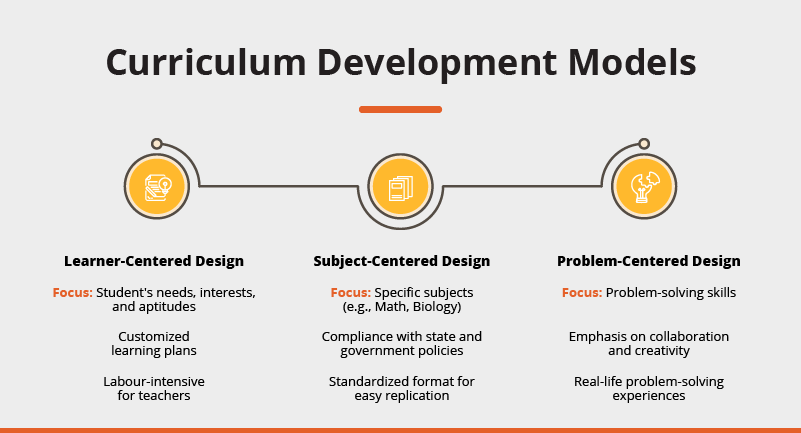
Learner-Centred Design
Leaning towards a student-centred approach, this model focuses on the needs, interests, and learning requirements of students.
Every student has different learning needs and aptitudes. The design and plans under this approach are differentiated, keeping this in mind, while adhering to a broad outline based on an overall understanding.
While this approach is more inclusive and sensitive to differing needs, it can be very labour-intensive for teachers.
-
Subject-Centred Design
Under this model, the focus is on a specific subject or discipline, like Math or Biology. It stresses certain core subjects and is driven by state and government policy on education.
Though the curriculum is developed keeping in mind the cognitive abilities of students at a particular age, the focus is more on the subject matter than on the students. And since it is a standardised format, it is easier to replicate across schools with set material and teacher training.
-
Problem-Centred Design
More student-centric than subject-focused, this model rests on equipping students with problem-solving skills. It helps teach them different ways to approach problems, communication skills, and the importance of collaboration. With this approach, students learn by working on real-life problems, bringing in their creativity and innovative ideas.
A balanced curriculum needs to integrate all three models to arrive at a more inclusive yet readily replicable approach.
What Are the Elements of Curriculum Development?
A well-structured curriculum development process is built on several key elements that guide how learning is planned, delivered, and evaluated. Many schools also rely on structured curriculum frameworks such as the linear model of curriculum development.
Below are some of the most important elements:
-
Objectives of Curriculum
This is the core purpose of a curriculum design exercise. It asks and answers questions such as:
- What are we trying to achieve with the curriculum?
- What is the goal or focus at this stage of student learning?
- What is the knowledge we are trying to impart?
- What behavioural skills are we trying to inculcate in the students?
-
Content of Curriculum
Based on the objectives defined, this part lists the actual syllabus and topics to be covered.
A curriculum developer has the tough job of balancing factors that influence a curriculum, such as learning and developmental needs, cultural norms, government guidelines, school policies, etc. Overall continuity between the curriculum taught at the previous level and the one to be taught at the next level also needs to be taken into account.
-
Scope & Sequence
Scope refers to the breadth of topics and concepts included in the curriculum, while sequence refers to the order in which these topics are taught.
- A well-planned scope ensures that all necessary learning areas are covered.
- An appropriate sequence helps students gradually build knowledge and understanding over time.
This structured progression in curriculum development makes learning more logical and easier for students to follow.
-
Learning Experiences
Learning experiences include the activities and interactions through which students engage with the curriculum. These may involve:
- Discussions
- Projects
- Group work
- Practical exercises
- Real-world problem-solving tasks
Well-designed learning experiences encourage students to actively participate in the learning process and help them apply concepts in meaningful ways.
-
Teaching/Learning Methodologies
This part lays down how the curriculum will be rolled out. It deals specifically with instruction design. It mostly answers:
- Which lessons will benefit more from interactive teaching styles?
- Which lessons will benefit more from the traditional instruction methods?
The objective is to arrive at the most effective teaching methods or strategies for the given behavioural, cognitive, and applicable knowledge to be imparted. This section also deals with the methods most suitable for the assessment of this knowledge.
-
Learning Resources
Learning resources include all materials and tools that support teaching and learning. These may include:
- Textbooks
- Digital content
- Videos
- Educational software
- Laboratory equipment
- Classroom learning aids
Selecting appropriate resources helps teachers present information more effectively and allows students to explore concepts through multiple learning formats.
-
Evaluation of Curriculum
Different from student learning assessment, the focus here is to evaluate if the designed curriculum meets the initial objectives laid out for it and achieves the desired results.
Steps of Curriculum Development?
The steps of curriculum development provide a structured approach for effective curriculum planning and curriculum implementation. These stages help educators plan learning goals, organise content, and implement teaching strategies that support meaningful student outcomes.
-
Identify the Educational Needs
The first step in curriculum development is identifying the academic and developmental needs of learners. This involves analysing student abilities, societal expectations, and evolving educational trends to ensure the curriculum remains relevant.
-
Build a Curriculum Development Team
Curriculum design requires collaboration between teachers, subject experts, school leaders, and education policymakers. A diverse team ensures that different academic perspectives and practical classroom insights are considered.
-
Define Objectives & Learning Goals
This step focuses on setting the direction of learning. Educators decide what students should be able to understand or do by the end of a lesson, unit, or course.
-
List the Intended Outcomes
This step focuses on making the defined objective measurable and specific. Curriculum planners translate the learning goals into clear outcomes that can be observed and assessed. Clearly defined outcomes help measure whether learning goals are successfully achieved.
-
Shortlist & Select Content
Relevant topics, concepts, and subject material are selected based on curriculum objectives and student learning needs.
-
Organise Selected Content
The chosen content is arranged in a logical order so that concepts build progressively on previous learning. A clear sequence helps students understand complex ideas more easily.
-
Select Activities
Educators need to then design activities such as discussions, projects, and problem-solving tasks during curriculum development. These activities help students engage with the curriculum more effectively.
-
Integrate Technology & Digital Tools
Modern curriculum development strategies often take the help of digital tools to enhance learning experiences. Technology can support interactive lessons, personalised learning, and real-time feedback for students.
-
Develop Teaching Methods
Teachers have to choose the appropriate teaching methods that match curriculum objectives and student learning styles to ensure that students are able to understand and retain knowledge.
-
Development of Assessment Strategies
Assessment methods are created to evaluate whether students are achieving the intended learning outcomes. These methods may include tests, projects, presentations, and performance-based evaluations.
-
Implementation of Curriculum
Once designed, the curriculum is introduced in classrooms through structured teaching and learning activities. Teachers follow the curriculum plan while adapting it to meet the needs of their students.
-
Evaluation of Curriculum
Curriculum effectiveness is regularly reviewed to determine whether learning objectives are being achieved. Evaluation helps educators identify strengths and areas that require improvement.
-
Revision of the Existing Curriculum
Based on feedback from teachers, students, and administrators, the curriculum is refined and updated. Continuous revision ensures that the curriculum remains relevant and effective in changing educational contexts.
Challenges in Curriculum Development
The curriculum development process follows a structured, cyclical sequence — evaluation at the end feeds back into the next revision cycle.
- Needs Assessment: Identify learning gaps, student needs, and stakeholder requirements through data, feedback from teachers and parents, and analysis of societal demands.
- Setting Learning Objectives: Define specific, measurable goals — what students should know, understand, and be able to do by the end of the programme.
- Content Selection and Organisation: Choose and sequence subject matter that is accurate, age-appropriate, culturally relevant, and logically ordered from foundational to complex.
- Curriculum Design: Determine teaching approaches, instructional methods, and assessment strategies — deciding whether to use a learner-centred, subject-centred, or problem-centred model.
- Implementation: Roll out the curriculum in classrooms through teacher training, resource allocation, and timetabling — with ongoing support from administrators and curriculum teams.
- Evaluation and Review: Measure whether learning outcomes were achieved using student results, teacher feedback, and assessment data. Feed findings into the next development cycle.
What Are the Principles of Curriculum Development?
To design an effective educational programme, schools need to follow the main principles of curriculum development. These include:
- Principle of Totality of Experiences: A good curriculum should include all learning experiences, whether in the classrooms or outside the classrooms, for holistic development. These include academic, co-curricular, and extracurricular experiences.
- Principle of Child-Centeredness: Curriculum design should focus on the needs, interests, and abilities of learners. The content, teaching methods, and assessments should be tailored to suit individual needs.
- Principle of Conservation & Creativity: The curriculum should preserve cultural knowledge while encouraging creativity and innovation.
- Principle of Integration: Subjects and learning experiences should be interconnected to promote interdisciplinary understanding and create a cohesive learning ecosystem.
- Principle of Flexibility: Education trends change, and so do student needs. A curriculum must be flexible enough to adapt to these changes.
- Principle of Utility: An effective curriculum equips students with practical knowledge and life skills.
- Principle of Character Formation: Education should help students develop ethical values and responsible behaviour. A curriculum should be developed keeping this in mind.
- Principle of Mental Discipline: As the educational reforms now stress more on holistic development, an effective curriculum should promote critical thinking, reasoning, and intellectual discipline.
- Principle of Social Fulfilment: Curriculum should encourage students to contribute positively to society. Incorporating community service, social studies, and societal discussions is necessary.
What Are the Factors Influencing Curriculum Development?
Curriculum development is affected by several factors, such as psychological, environmental, physiological, political, technological, economical, and more. Let’s look at them in detail:
- Psychological Factors: Student learning styles, motivation, and cognitive development influence curriculum design.
- Political Factors: Government policies and educational reforms influence curriculum priorities.
- Philosophical Factors: Human values and beliefs greatly influence the educational goals when designing a curriculum.
- Gender Factors: Gender representation and inclusivity influence curriculum content and learning opportunities.
- Societal Factors: Social values, culture, and community expectations shape curriculum priorities.
- Technological Factors: Advances in technology also majorly influence teaching methods and learning resources.
- Economical Factors: Financial resources and socio-economic conditions affect curriculum implementation.
- Educational Factors: Teacher training, institutional goals, and academic standards also influence curriculum design.
What Are the Challenges in Curriculum Development?
-
Balancing Diverse Stakeholder Expectations
Curriculum developers must balance the expectations of teachers, policymakers, parents, and students.
Solutions
- Encourage collaborative curriculum planning
- Conduct stakeholder consultations
- Use feedback-driven revisions
-
Rapid Technological Changes
Educational technology evolves rapidly, making curriculum updates necessary.
Solutions
- Integrate flexible digital learning frameworks
- Provide teacher training on edtech tools
-
Alignment with Educational Policies
Curriculum must always remain aligned with the changing national policies and educational standards.
Solutions
- Regularly review policy updates
- Constantly work towards aligning curriculum objectives with national frameworks
-
Resource Constraints
Sometimes, limited funding and infrastructure can affect curriculum implementation.
Solutions
- Adopt scalable learning resources
- Use digital platforms to support teaching
-
Resistance to Change
Another challenge in curriculum development can be teachers’ resistance to reforms.
Solutions
- Provide professional development programmes for teachers
- Encourage participatory curriculum design
Difference Between Curriculum Design & Curriculum Development
Although these terms are often used interchangeably, there is an important difference between curriculum design and curriculum development:
- Curriculum design focuses on structuring the learning framework. It involves deciding how content will be organised, what teaching methods will be used, and how learning experiences will be planned.
- On the other hand, curriculum development is a broader process that includes designing, implementing, evaluating, and continuously improving the curriculum to meet evolving educational needs.
In Short: Curriculum design is one part of the overall curriculum development process.
How Extramarks Supports Curriculum Development
Modern schools require technology-enabled tools to support effective curriculum development and implementation.
Extramarks provides digital learning platforms that help schools design and implement curriculum aligned with CBSE, ICSE, and other major boards.
These platforms support teachers with:
- Curriculum-aligned digital content
- Smart assessments and analytics
- Interactive learning resources
- Data-driven insights for teaching improvement
By combining educational expertise with technology, Extramarks helps schools implement modern curriculum development strategies effectively.
Discover how Extramarks helps schools design and deliver a modern curriculum aligned with national boards such as CBSE, ICSE, and State Boards.
Explore Extramarks Solutions
Conclusion
A well-structured curriculum ensures that teaching methods, learning experiences, and assessments work together to support student success.
With modern reforms, curriculum development is evolving to emphasise competency-based learning, critical thinking, and holistic development. By adopting effective strategies, schools can create learning environments that prepare students for both academic success and real-world challenges.
Reviewed by

Prachi Singh | VP - Academics
Prachi Singh is a highly accomplished educationist with over 16 years of experience in the EdTech industry. Currently, she plays a pivotal role at Extramarks, leading content strategy and curriculum development initiatives that shape the future of education...read more.


Last Updated on March 18, 2026