What is Contemporary Education in India?
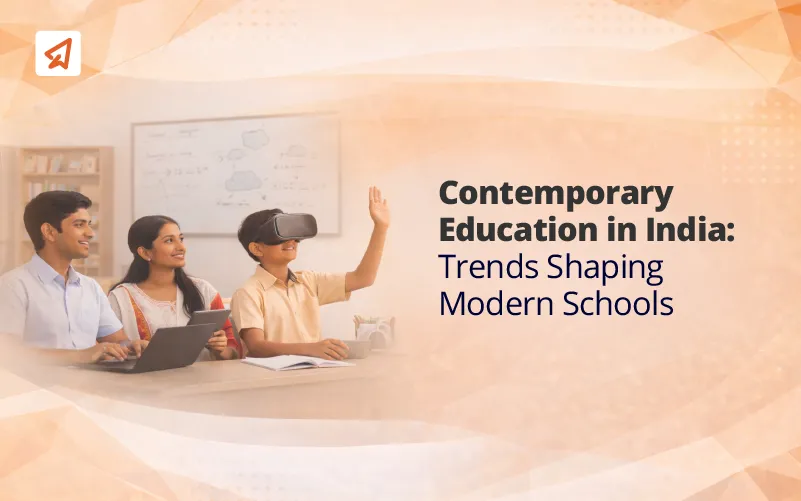
Expectations from modern schools have evolved significantly. Today, educators are expected to prepare students not only for examinations but also for careers and lifelong learning.
This shift is driving the rise of contemporary education in India.
The growing demand for skills, adaptability, and technology integration has transformed the traditional schooling model into a dynamic contemporary education system that focuses on real-world readiness.
What Does Contemporary Education Mean?
It refers to a modern approach to teaching and learning that aligns with present-day societal, technological, and economic needs. It moves beyond memorization and emphasizes skills, critical thinking, creativity, and adaptability.
Contemporary education focuses on preparing learners for today’s world rather than yesterday’s curriculum.
The rise of NEP 2020 has accelerated this transformation in India. The policy promotes flexibility, multidisciplinary learning, and competency-based assessment, all of which strengthen the foundation of the modern education system.
Key Characteristics of the Contemporary Education System in India
The structure of the modern education system reflects the changing expectations from schools and learners. Below are the defining elements:
-
Skill-Oriented & Holistic Curriculum
The modern curriculum focuses on communication, collaboration, leadership, and emotional development alongside academic subjects. This holistic structure highlights the true importance of the modern education system in shaping balanced individuals.
-
Digital Learning & Smart Classrooms
Technology integration through smart classroom modifications like digital boards, simulations, and interactive platforms is central to contemporary education, making lessons more engaging and accessible.
-
Real-World Learning Exposure
Field projects, internships, and community engagement initiatives bridge the gap between classroom knowledge and practical application.
-
Emotional & Social Development
The contemporary education system recognizes emotional intelligence, empathy, and teamwork as essential competencies for success. It doesn’t isolate these skills from the traditional learning environment.
-
Multidisciplinary Education
Students are encouraged to approach multidisciplinary education by combining subjects across streams, promoting flexible career pathways and innovation.
-
Continuous & Competency-Based Assessment
Under the new NEP reforms, the focus shifts from one-time examinations to ongoing evaluation methods that measure understanding and skill mastery.
-
Emphasis on Critical Thinking & Problem-Solving
Students are trained to analyze, evaluate, and innovate rather than simply recall information to strengthen their critical thinking skills.
-
Inclusive Education
Equal participation for learners from diverse backgrounds strengthens equity and access within contemporary education, making education more inclusive.
Modern Teaching Approaches in Contemporary Education
The evolution of modern education in the country is also reflected in teaching methodologies. Here are some modern approaches to adapt to the evolving needs:
- Experiential Learning: With modern teaching approaches, experiential learning takes a significant spot. Students learn through experience, reflection, and application rather than passive listening.
Learn More About: Experiential Learning
- Project-Based Learning: Learners work on real-world projects that require research, collaboration, and presentation.
Learn More About: Project-Based Learning
- Flipped Classroom: Students review content at home and use classroom time for discussion and problem-solving.
Learn More About: Flipped Classroom
- Gamification: Game-based strategies enhance engagement and motivation in the contemporary education system.
Learn More About: Gamification in Education
- Inquiry-Based Learning: In this modern learning approach, students ask questions, investigate problems, and discover solutions independently.
Learn More About: Inquiry-Based Learning
- Student-Centric Learning: The shift from teacher dominance to learner autonomy defines the modern education scene in India.
Read More: Teacher-Centered vs Student-Centered Learning
Challenges in Implementing Contemporary Education & Their Practical Solutions
While the contemporary education system offers numerous benefits, implementation is not without obstacles.
-
Digital Divide
Many schools, particularly in rural or semi-urban areas, lack stable internet access, devices, and smart infrastructure, which makes equitable digital learning difficult.
Solution: Institutions must priorities phased infrastructure investment and blended models that do not exclude students without constant connectivity.
-
Teacher Training & Adaptation
Teachers who were trained under traditional models may find it challenging to shift towards experiential and student-centric approaches.
Solution: Continuous professional development and structured mentoring programmes are essential to help educators confidently adapt to the changing education system.
-
Examination Pressure vs Holistic Learning
Board examinations and competitive entrance tests still dominate school priorities, often pushing life skills and project-based learning into the background.
Solution: Schools must redesign internal assessments to align academic rigour with holistic competencies rather than treating them as competing goals.
-
Infrastructure & Funding Limitations
Implementing smart classrooms, digital platforms, and skill-based labs requires financial planning that not all institutions can immediately afford.
Solution: Strategic partnerships, government schemes, and scalable technology solutions can help institutions gradually modernize without overwhelming budgets.
-
Balancing Traditional Values with Modern Demands
India’s education system must preserve cultural values while integrating global competencies.
Solution: Schools need curriculum frameworks that respect heritage while preparing students for international academic and professional landscapes.
How Extramarks Enables Contemporary Education in India
Extramarks supports the implementation of contemporary education in India by providing:
- AI-enabled learning platforms
- Interactive digital classrooms
- Continuous assessment tools that align with the contemporary education system
- Data-driven insights for educators and administrators
By combining technology with teaching and strong AI-powered analytics, Extramarks empowers schools to implement modern education practices effectively.
Conclusion
The contemporary education system prepares modern learners for real-world challenges, technological advancement, and global opportunities. Understanding its importance helps schools design learning environments that are flexible, inclusive, and future-focused.
Institutions that adapt today will lead tomorrow.
FAQs
Why is contemporary education important today?
Contemporary education is important today as it prepares students for evolving career landscapes, digital transformation, and global competition. It equips them with practical skills beyond textbook knowledge.
How is the contemporary education system different from traditional education?
The contemporary education system emphasises flexibility, continuous assessment, and critical thinking, whereas traditional education focuses largely on rote memorisation and final examinations.
How does NEP 2020 influence contemporary education in India?
NEP 2020 strengthens contemporary education in India by promoting multidisciplinary learning, flexible curriculum design, digital integration, and inclusive policies.
What are the key features of contemporary education?
Key features of contemporary education include skill-based learning, technology integration, real-world exposure, emotional intelligence development, and inclusive teaching practices.
What role does technology play in contemporary education?
Technology enables interactive lessons, personalised learning, data-driven assessment, and improved engagement.
How can schools effectively implement contemporary education practices?
Schools can adopt structured teacher training, invest in digital tools, redesign assessments, and align curriculum with NEP reforms to strengthen contemporary education practices.
Published on March 30, 2026