
The Ultimate Guide to Assessment Tools in Education
We all think about our choices and how well they work for what we’re trying to achieve. This is basically what assessment is all about. In more formal settings, like schools or workplaces, though, assessments become more organised and often involve specific tools to make them effective.


This article will introduce you to different assessment tools you can use to evaluate performance in various situations. We’ll break down each method, explaining its advantages and disadvantages, and then highlight some important features to consider when making your choice.
What is an Assessment Tool?
An assessment tool is simply a way to evaluate information. It helps us understand how much someone knows about a particular topic and whether their knowledge fits with a larger idea or framework.
Different assessment methods are used for different situations and goals. For instance, personality tests use your answers to figure out your character traits, while financial assessments focus on how well you understand concepts like saving and investing.
No matter the context, all assessment tools rely on well-designed questions. These questions gather information that can then be interpreted to reach informed conclusions.
Extramarks Complements teachers’ subject matter expertise & helps with assessments

Characteristics of an Assessment Tool
1. Reliability
This refers to the tool’s ability to produce consistent results over time. Imagine giving the same assessment to the same group of students twice. A reliable tool would give you similar results on both attempts. This ensures the assessment accurately reflects the skill or knowledge being measured.
2. Validity
This focuses on whether the assessment truly measures what it’s designed to measure. An assessment can only be effective if it accurately reflects the intended learning objectives. Imagine testing physical fitness with a written exam. That wouldn’t be valid! Instead, the assessment should directly involve activities that demonstrate physical capabilities.
3. Fairness (Equity)
An effective assessment tool should be equitable for all participants. This means it shouldn’t give an unfair advantage or disadvantage to any one person. Ideally, assessments should test students using methods that best suit their learning styles. Additionally, everyone taking the assessment should be familiar with the format and context of the test beforehand so they can perform to the best of their ability.
4. Consistency (Standardization)
Consistency is another important quality of a good assessment tool. This means using the same methods and procedures for everyone taking the assessment. For instance, if you’re using a questionnaire, everyone should receive the same set of questions, and the answers should all be graded using the same criteria.
What is an Educational Assessment Tool?
Educational assessment tools act as a resource for measuring student performance and knowledge within a specific subject. These tools come into play throughout the learning process, not just at the end.
For instance, formative assessments involve various methods teachers use to track student progress as they learn. This allows for identifying and addressing knowledge gaps as students move through different learning stages. In contrast, summative assessments involve waiting until the end to measure performance based on a rubric of expected learning outcomes.
Unsurprisingly, different assessment tools work best for different types of evaluation. Quizzes and quick polls might be ideal for formative assessments, while traditional exams with closed-ended questions are better suited for summative assessments.
Extramarks’ customized learning & assessment options help 89% of students practice better
Assessment in Education
In education, assessments are all about figuring out what students know, their skills, and how well they’re progressing in learning. The main goal is to see if students are meeting learning goals and to guide teaching strategies. Assessments come in different types and serve various purposes in education.
Learn more about Assessment in Education here!
Types of Assessment
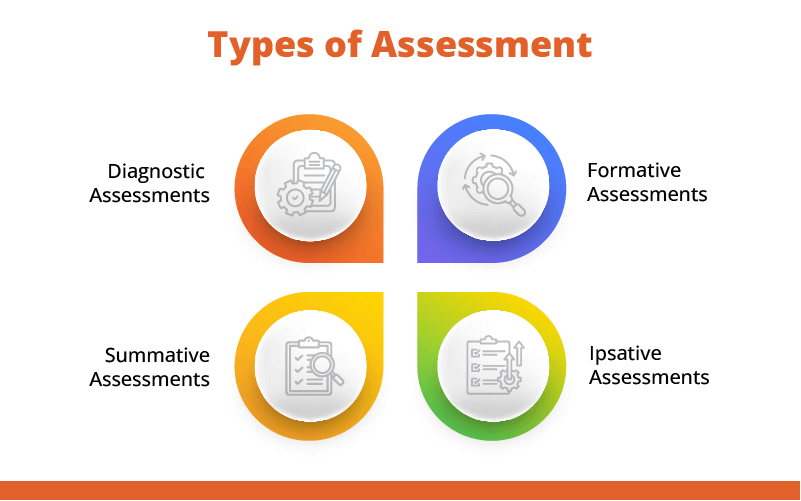
1. Diagnostic Assessments
Used at the beginning of a unit or year to understand what students already know and where they need support. These are usually informal and not graded.
2. Formative Assessments
Conducted during teaching to monitor student understanding and adjust instruction in real time. They are low-stress and focus on continuous feedback.
Learn more about Formative Assessments here!
3. Summative Assessments
Happen at the end of a unit or term to evaluate overall learning. They are often graded and aligned with learning standards.
Learn more about Summative Assessments here!
4. Ipsative Assessments
Extramarks can be integrated into it
Measure a student’s progress by comparing their current performance with their past results. The focus is on personal growth rather than comparison with others.
Examples: Pre-tests followed by post-tests, portfolios, and project-based learning can all be used for ipsative assessments.
There's no Call To Action with the ID #100.5. Norm-Referenced Assessments
Compare a student’s performance with that of a larger group or national average. Results show how a learner ranks relative to peers.
6. Criterion-Based Assessments
Assess performance against fixed learning goals or standards. Students are evaluated on mastery, not on how others perform.
If you’d like to explore the types of assessment in more detail with examples and classroom use cases, you can read this : Types of Assessments in Education
What are Purposes of Assessment Tools
Assessment tools are not just about measuring performance. They serve distinct purposes at different stages of the learning process, helping educators make informed instructional decisions and support students more effectively.
- Formative Purpose
Assessment tools used for formative purposes help guide instruction while learning is still in progress. Tools like quick polls, short quizzes, or classroom discussions provide real-time insights into student understanding, allowing teachers to adjust pacing, clarify concepts, or offer immediate support. - Summative Purpose
When used summatively, assessment tools evaluate how well students have mastered learning objectives at the end of a unit, term, or course. Final exams, end-of-unit tests, and projects fall into this category and help determine overall achievement against defined standards. - Diagnostic Purpose
Diagnostic assessment tools are designed to identify students’ prior knowledge, strengths, and gaps before instruction begins. By understanding where learners stand at the outset, teachers can plan lessons more effectively and tailor instruction to student needs. - Adaptive Purpose
Adaptive assessment tools dynamically adjust the difficulty level based on student responses. This approach supports personalised evaluation by meeting learners at their current level, offering a more accurate picture of their abilities while keeping them appropriately challenged.
Together, these purposes highlight how assessment tools play a continuous and strategic role in teaching, learning, and student growth rather than serving as one-time measurement instruments.
Types of Assessment Tools
- Quizzes, Tests, and Examinations: Traditional methods are still important for testing factual knowledge and fundamental skills. They can include multiple-choice questions, fill-in-the-blank exercises, or essay writing, depending on what students need to learn.
- Projects and Presentations: Going beyond just memorising facts, projects, and presentations let students show how well they understand a topic by applying their knowledge to create something new. This could mean building models, writing research papers, or giving group presentations.
- Speaking and Listening: These abilities are crucial for doing well in school and later in jobs. Teachers can use debates, role-playing, or group talks to see if students can explain their ideas clearly, listen well, and join in conversations constructively.
- Portfolios: A student portfolio is a collection of their work that shows how much they’ve learned and improved over time. It can have essays, artwork, reflections on projects, and even their reviews. Portfolios give a full look at how a student learns and grows.
- Observation: By carefully watching students, teachers can assess many different skills right away. This could mean observing how students participate in group activities, how they approach solving problems, or how engaged they are during lessons.
- Rating Scales and Rubrics: These tools provide a clear structure for evaluating student performance. They outline specific things to look for and corresponding levels of achievement, offering a systematic way to assess projects, presentations, or participation.
- Anecdotal Records: Informal notes about specific observations can be a valuable resource. They capture interactions, behaviours, or moments of understanding (“aha” moments) that might not be reflected in more formal assessments.
- Checklists: Simple and effective, checklists help keep track of whether students have completed specific tasks or mastered certain skills. This can be especially helpful for monitoring how well students have learned basic ideas or procedures.
Examples of Assessment Tools for Education
1. Extramarks
Extramarks offers a robust Assessment Centre designed to support diverse classroom evaluation needs. Educators can easily create, manage, and analyse assessments through an intuitive interface while tracking student progress and generating detailed performance reports.
With the launch of Extra Intelligence, Extramarks has expanded its assessment capabilities further. New features include Offline Test Evaluation, which enables AI-assisted grading of offline student answer sheets, and Objective to Subjective Question Conversion, allowing teachers to transform subjective questions into objective formats when designing assessments. Together, these additions help save time, improve accuracy, and support more flexible, data-driven assessment practices.
2. Mentimeter
Mentimeter makes assessments more interactive by letting teachers create live polls, quizzes, and feedback sessions. It engages students right away with different kinds of questions and multimedia. Teachers can see how well students understand things and get feedback right away. The real-time data also helps teachers spot where students might need more help quickly.
3. Kahoot
Kahoot is a learning platform that makes assessments fun and engaging. Teachers can create interactive quizzes that motivate students with friendly competition. It offers a variety of ready-made quizzes and customizable options, making it useful for both regular assessments and final tests. Kahoot’s instant feedback and progress-tracking features help teachers and students interactively monitor performance.
4. Socrative
Socrative provides a range of tools designed to simplify classroom assessments. Educators can generate quizzes, polls, and exit tickets that students can conveniently complete using their devices. The platform’s real-time reporting and analytics offer instant visibility into student performance, allowing quick adjustments to teaching strategies. With its user-friendly interface and adaptable question formats, Socrative stands out as an invaluable resource for evaluating student understanding and participation.
5. Edpuzzle
Edpuzzle improves video-based learning by integrating assessments into videos. Teachers can pick from a library of educational videos or upload their own, adding questions throughout to check how well students understand. This interactive method keeps students interested in the videos and lets teachers track their progress and understanding. Edpuzzle’s data analytics also helps teachers figure out which ideas students need more help with, making it a useful tool for teaching and testing.
Closing Thoughts
This guide has given you a starting point for understanding assessment tools in education. Now that you’ve learned about different types of assessments and the tools available, you can choose how to evaluate student learning in a way that works best. Remember, the best approach considers what students need to learn and their individual needs. As you explore these tools and try different methods, you’ll build a helpful set of resources to improve your teaching and help students succeed.
Reviewed by

Prachi Singh | VP - Academics
Prachi Singh is a highly accomplished educationist with over 16 years of experience in the EdTech industry. Currently, she plays a pivotal role at Extramarks, leading content strategy and curriculum development initiatives that shape the future of education...read more.

Last Updated on December 26, 2025