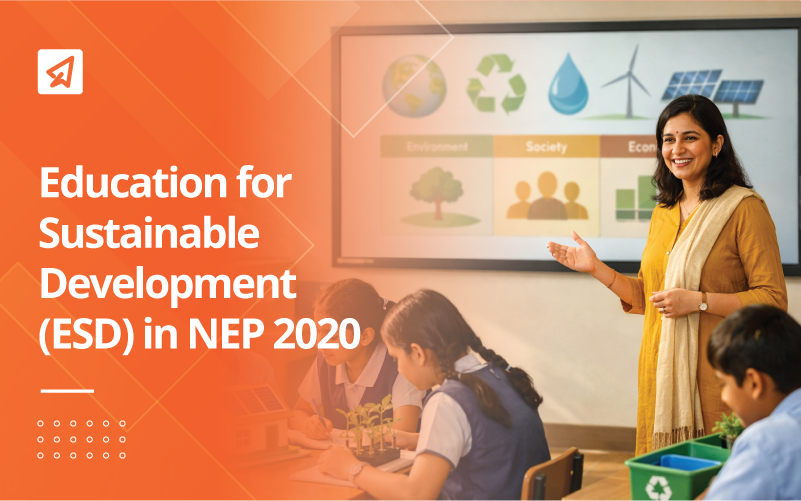
Education for Sustainable Development (ESD) in NEP 2020
As India continues to grow and modernise, the need for sustainable education has never felt more urgent. While schools and colleges are catching up with technology and innovation, many still fall short when it comes to preparing students for real-world challenges like climate change, environmental loss, and resource management. The National Education Policy (NEP) 2020 recognises this gap and puts forward a clear vision to bring Education for Sustainable Development (ESD) into the mainstream.
In this blog, we are taking a look at what ESD means, why it matters in today’s context, and how schools and educators can bring this vision to life. Without waiting further, let’s get started.
What is Education for Sustainable Development (ESD) in NEP 2020?
Education for Sustainable Development (ESD) in NEP 2020 is about preparing students to live and act responsibly in the world. It brings in ideas of sustainability across subjects and grade levels, helping learners understand how their actions affect the environment, society, and economy. The goal is to help students develop the right mix of knowledge, values, and attitudes to make thoughtful decisions and solve real-world problems.
NEP 2020 encourages schools to include ESD through changes in the curriculum, teacher training, and activity-based learning. It also aligns closely with global goals like SDG 4.7, which focuses on making education more inclusive and meaningful. As a teacher, this means guiding your students not just in academics, but also in how to care for their communities and the planet. ESD is not a separate subject, but a way of thinking that blends into everything you teach.
Understanding ESD’s Three Dimensions
Education for Sustainable Development (ESD) is not just about the environment. It brings together environmental, social, and economic thinking to help students understand how everything is connected. Here’s how each dimension works in real classrooms and learning.
-
Environmental Protection
This part of ESD is all about taking care of the planet. It teaches students how to use resources responsibly, reduce waste, protect wildlife, and understand climate change. You might bring in lessons on recycling, nature walks, or projects that focus on saving water or energy. When students learn how their actions impact the environment, they become more mindful of their choices and more motivated to protect the world around them. A strong foundation in this area builds awareness that supports long-term sustainability.
-
Social Equity and Inclusion
Social equity focuses on the people side of sustainability. It encourages students to care about fairness, equality, and human rights. In class, this might look like group discussions about access to education, lessons on different cultures, or exploring real-world challenges like poverty and discrimination. You help students think critically about justice and empathy. When they see how communities function and what makes them strong or fragile, they are more likely to become thoughtful and active citizens who care about others and stand up for what’s right.
-
Economic Viability and Growth
This dimension connects learning to the real world of work, innovation, and money. It helps students understand how economies work and how choices affect both people and the planet. You can introduce activities on budgeting, small business ideas, or projects that explore how products are made and where materials come from. It’s about finding smarter ways to grow without harming the environment or ignoring people’s needs. When students grasp the balance between earning, saving, and sustaining, they begin to see how the economy can support a better future for all.
NEP 2020’s Strategic Integration of Education for Sustainable Development (ESD)
The National Education Policy (NEP) 2020 brings sustainability into the heart of education. Instead of treating it as a separate subject, the policy blends Education for Sustainable Development (ESD) into how students learn, think, and act. It ties in directly with the United Nations’ Sustainable Development Goal 4, which pushes for inclusive and quality education. Let’s walk through how the NEP makes this shift possible inside real classrooms.
-
Mandatory Environmental Education
NEP 2020 makes Environmental Studies a compulsory subject at the undergraduate level. This ensures that every student, regardless of their stream, develops a basic understanding of environmental issues. Topics like climate change, biodiversity, waste management, and responsible use of resources are introduced early and revisited in meaningful ways. As a teacher, this gives you a clear structure to build awareness and encourage students to think about how their actions affect the planet. It also helps students connect classroom learning with what they see happening around them.
-
Supporting Experiential Learning
The policy strongly encourages learning through real experiences instead of only textbooks. Activities such as projects, field visits, community work, and hands on problem solving are given more importance. This approach helps students understand sustainability by observing and engaging with real situations. When you involve students in local environmental projects or practical activities, they begin to see sustainability as something real and relevant. It also builds responsibility and critical thinking, which are essential for long term change.
-
Emphasis on Technical Education
NEP 2020 highlights the role of technical and vocational education in supporting sustainable development. Students are encouraged to learn skills related to renewable energy, sustainable agriculture, waste management, and green technologies. This prepares them not just for jobs, but for solving real problems in society. As an educator, you can link technical skills with sustainability concepts, helping students see how innovation and responsibility can go hand in hand.
-
Technology Usage for Sustainability
Technology plays a large role in NEP 2020’s approach to sustainable education. From digital learning platforms to energy-efficient classrooms, the focus is on using technology wisely. Digital tools reduce paper waste, online labs simulate experiments safely, and open learning platforms promote equal access. As a teacher, you can now integrate apps, simulations, and videos that show the impact of climate change or the benefits of renewable energy. These tools help make abstract ideas more visible and relatable for students.
-
Teacher Training and Capacity Building
The NEP understands that teachers play the most important role in making sustainable education real. That’s why it includes focused training to help teachers learn how to bring sustainability into everyday teaching. Workshops, continuous development programs, and updated teaching materials will help you connect your subject with bigger environmental and social themes. Whether you’re teaching science, commerce, languages, or art, you’ll have the tools to highlight sustainability in a way that fits your classroom.
Challenges in ESD Implementation
-
Teacher Capacity
Many teachers are still figuring out what ESD really means and how to bring it into their teaching. Some are not fully confident with the principles, and professional training is either limited or not practical enough. This lack of support leads to hesitation or even a lack of motivation to try something new in the classroom.
-
Curriculum and Resources
Teachers often find that their textbooks and teaching materials are outdated or do not match the goals of ESD. Adapting an existing curriculum to include sustainability topics can feel like an extra task, especially when there is already pressure to meet exam-related targets. There is also not enough time in the school schedule to introduce new themes or project-based work.
-
Systemic and Structural Barriers
ESD works best when everyone is on the same page. But in many schools, a shared vision is missing. Teachers may not get the needed support from principals or district leadership. Budget limitations and a shortage of staff make it even harder. On top of that, assessing ESD progress is complicated, since it involves values, skills, and attitudes that are not always easy to measure.
Solutions to Support ESD in Schools
-
Support for Teachers and Leaders
Teachers need practical, hands-on training to understand and apply ESD in real classroom settings. Regular workshops, resource guides, and peer learning can go a long way. School leaders should also be part of this process. When principals and heads of department are well-informed, they can create a more encouraging environment and offer the right kind of support to teachers.
-
Curriculum and Teaching Methods
It helps to rethink the curriculum in a way that brings ESD into the centre, not as an extra topic. Project-based learning, real-life case studies, and community-based tasks can make sustainability topics more relatable. Teachers can benefit from sample lesson plans, teaching toolkits, and ready-to-use models. Partnering with other schools or organisations can also bring fresh ideas and shared resources.
-
Clear Strategy and Whole-School Approach
ESD needs a full-school mindset. That means involving parents, community members, support staff, and even students in the planning process. When everyone works together, small changes become sustainable. Schools can also follow clear frameworks or roadmaps that help track what is working and what needs adjustment. Strategic partnerships, such as with local businesses or NGOs, can help fill the gap when money or resources are tight.
Closing Thoughts
Education for Sustainable Development under NEP 2020 is a step towards helping students think beyond textbooks and exams. It encourages schools to connect learning with real life issues that shape our future. While challenges remain, steady support for teachers, clear planning, and whole school involvement can make ESD part of everyday learning. Over time, this approach can help students grow into responsible individuals who understand their role in caring for society and the planet.
Frequently Asked Questions (FAQs)
What are the two curriculum projects that Education for Sustainable Development has been linked with?
ESD has been closely linked with two curriculum projects: Environmental Education (EE) and Global Citizenship Education (GCED). Environmental Education helps students understand nature, pollution, and how to care for the planet. Global Citizenship Education teaches them to think about the world as a shared space, where their actions affect others. When combined, these projects make ESD more complete by focusing on both the planet and people.
How does NEP 2020 integrate Education for Sustainable Development into school curriculum? How does ESD implementation differ between school and higher education levels?
NEP 2020 brings ESD into schools by making sustainability part of everyday subjects like science, social studies, and language. It encourages hands-on learning through eco-clubs, clean-up drives, and nature-based projects. At the school level, the focus is on building awareness and good habits early on. In higher education, ESD becomes more research-based, linking sustainable thinking to future careers, innovation, and policy work. The shift is from simple practices to deeper understanding and leadership.
What are the first three steps a school should take to integrate ESD into their curriculum?
To get started with ESD, a school can take these three steps:
- Raise awareness among teachers and staff through training and workshops on sustainability.
- Review the current curriculum and find topics where ESD concepts can be naturally added.
- Start small projects or clubs that allow students to apply what they learn, such as waste reduction, gardening, or energy-saving activities. These steps build momentum and make ESD part of everyday learning.
What are some successful examples of ESD implementation in Indian schools?
Many schools in India are already setting great examples. Some have introduced composting in school gardens, banned single-use plastic on campus, or started rainwater harvesting projects. Others have eco-clubs that lead awareness drives or monitor energy use in classrooms. These efforts show that when students are given the chance to lead, they take sustainability seriously and inspire their communities to do the same.
Reviewed by

Priya Kapoor | AVP - Academics
Priya Kapoor is an accomplished education professional with over 18 years of experience across diverse fields, including eLearning, digital and print publishing, instructional design, and content strategy. As the AVP – Academics at Extramarks, she leads academic teams in creating tailored educational solutions, ensuring alignment with varied curricula across national and international platforms...read more.