
CBSE Moderation Policy: What Does It Mean for Schools in 2026?
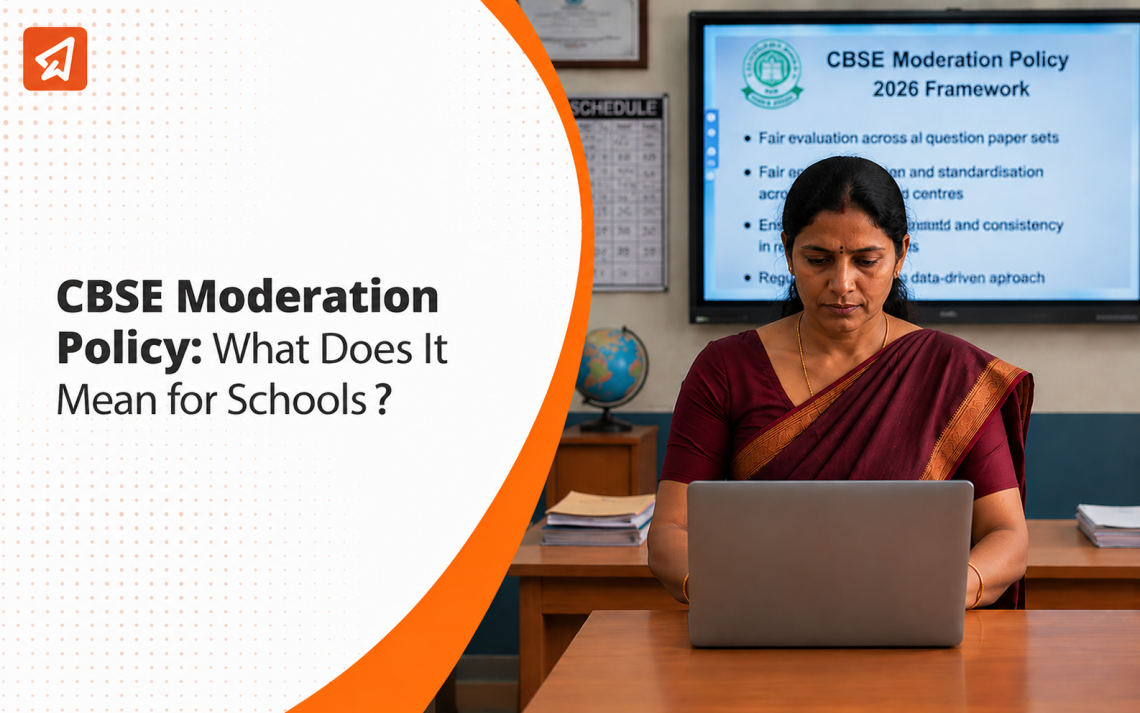
Key Takeaways:
-
The CBSE moderation policy is used to ensure fairness in evaluation by adjusting marks when question papers vary in difficulty.
-
According to the policy, marks may be increased for groups of students to maintain consistency in results.
-
This applies in specific cases where students fall slightly short of passing marks, but the moderation policy is different from grace marks.
-
The difference between the two is that the moderation policy works at a broader level, while grace marks are applied individually.

The moderation policy is a structured process used by the Central Board of Secondary Education to ensure fairness in exam results when question paper sets differ in difficulty or evaluation standards. While it may lead to marks being adjusted for groups of students, it is often confused with grace marks, which are applied individually.
In this blog, we break down how the moderation policy works, its connection with grace marks, and what schools need to understand.
What Is CBSE Moderation Policy?
The moderation policy is a system for adjusting marks after exams to maintain fairness and consistency for all students.

Under this, the board reviews exam difficulty levels and evaluation patterns before finalising results. If inconsistencies are identified, marks may be adjusted for a group of students.
This does not mean marks are given randomly. Instead, the process is based on expert analysis and data to ensure that students are evaluated fairly.
Why Was the CBSE Moderation Policy Introduced?
The moderation policy was introduced to address key challenges in large-scale board examinations.
-
Balancing Paper Difficulty
Different sets of question papers may vary slightly in difficulty. The policy helps ensure that students are not penalised for receiving a tougher paper.
-
Preventing Unfair Evaluation Outcomes
In some cases, strict evaluation or unexpected question patterns can affect results. The policy helps correct such anomalies.
-
Historical Context
Over the years, the CBSE moderation policy has undergone many significant changes. At times, moderation practices were reduced or discontinued, but they were later reinstated in light of legal and academic considerations to maintain fairness.
How Does the CBSE Moderation Policy Work?
The moderation policy follows a structured but non-public process based on academic and statistical review. Here’s how the policy works in general:
-
Review of Question Paper Difficulty
Experts analyse whether a particular paper was significantly tougher or easier compared to standard expectations.
-
Statistical Evaluation of Performance
The board then evaluates answer sheets and performance trends to identify irregularities.
-
Marks Adjustment for Fairness
If discrepancies are found, the policy may involve adding marks to ensure consistent pass rates and fairness across student groups.
It is important to note that the CBSE board has not publicly released the exact formulas. However, this policy is based on data-driven analysis and expert judgment.
What Are Grace Marks in CBSE?
The CBSE Grace Marks Policy 2025 refers to extra marks awarded to students who fall slightly short of passing marks.
Under this, students who miss the passing score by a small margin may receive additional marks to clear the exam. This system ensures that minor shortfalls do not lead to failure, especially when students demonstrate overall competency.
Moderation Policy vs Grace Marks in CBSE: What’s the Difference?
The moderation policy and grace marks are closely related but not identical.
In many discussions, the two terms may even be used interchangeably because moderation often results in marks being added. However, they serve different purposes.
- Moderation adjusts marks at a group level based on exam difficulty.
- Grace marks are applied at an individual level to help a student pass.
| Feature | Moderation Policy | Grace Marks |
| Purpose | To ensure fairness by adjusting marks when exam difficulty varies across papers. | To support individual students who narrowly miss passing marks. |
| Level of Application | Applied to a large group of students based on overall exam analysis. | Applied to specific students on a case-by-case basis. |
| Reason for Use | Triggered by tougher question papers or inconsistent evaluation practices. | Triggered when a student falls short by a few marks. |
| Method of Application | Marks may be increased statistically across affected students. | Extra marks are given to students to help them meet the criteria for passing. |
| Example | If a paper is unusually difficult, marks may be scaled for all students who attempted it. | If a student scores 32 instead of 33, 1 mark may be added to help them pass. |
Conclusion
The CBSE moderation policy plays a crucial role in maintaining fairness in board examinations by addressing variations in difficulty and evaluation. At the same time, the CBSE Grace Marks Policy 2025 ensures that individual students are not unfairly failed due to minor gaps.

FAQs – CBSE Moderation Policy
-
Does the CBSE moderation policy guarantee extra marks for everyone?
No, the moderation policy does not guarantee extra marks for all students. Instead, marks are adjusted only when necessary to ensure fairness.
-
Can moderation push students’ scores above 95?
The moderation policy is not designed to inflate high scores. It focuses on fairness rather than boosting already high marks.
-
Is grace marking the same as moderation?
No, grace marks apply to individual students, whereas moderation affects groups of students based on exam difficulty.
-
Has CBSE changed its moderation policy over the years?
Yes, the CBSE moderation policy has evolved over the years. It has been modified, reduced, and reintroduced over time to balance fairness with academic standards.

Published on May 8, 2026