What Is 5+3+3+4 Structure in NEP 2020?
Following the adoption of the global education development agenda in 2015, India is seeking to ensure inclusive and equitable education for all by 2030. Consequently, the Ministry of Human Resource Development (MHRD), under the direction of Prime Minister Narendra Modi, released the National New Education Policy on July 29, 2020, after approval by the Union Cabinet.
What is the 5+3+3+4 Education System in India?
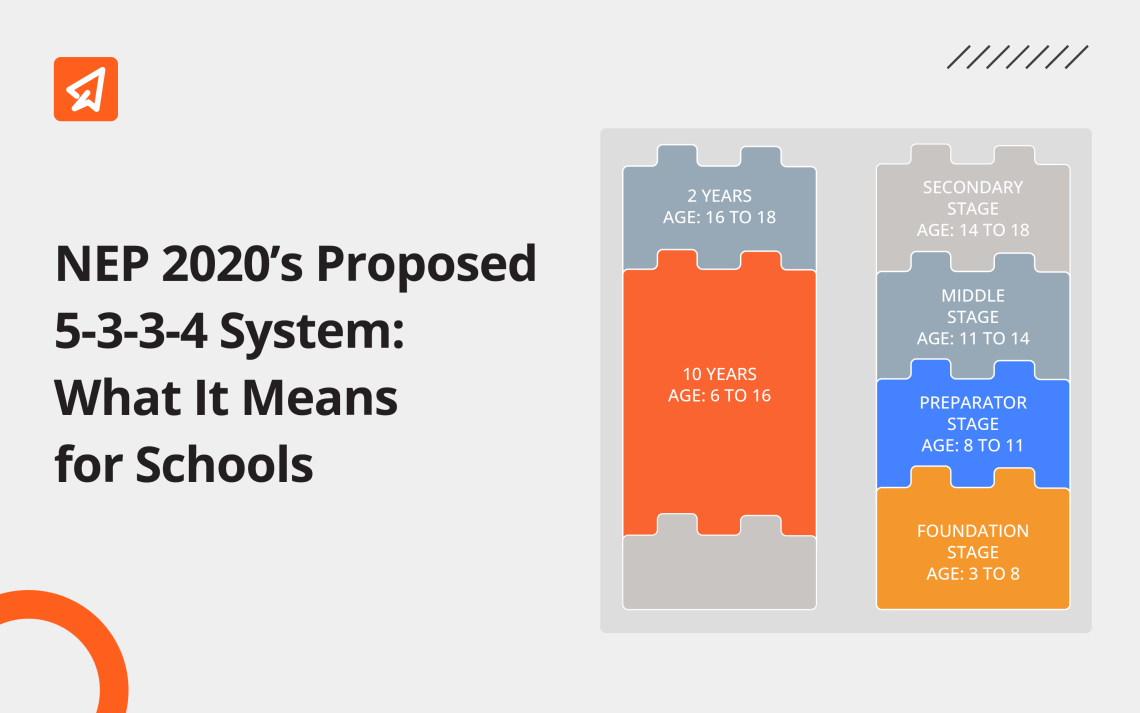
The 5+3+3+4 education system is the restructured school education framework introduced under the National Education Policy (NEP) 2020 in India, which replaces the previous 10+2 format and organises the academic journey from age 3 to 18 into four progressive stages—Foundational (5 years), Preparatory (3 years), Middle (3 years), and Secondary (4 years). This approach aligns schooling with the cognitive and developmental stages of learners, integrates early childhood care and education into formal schooling, and emphasises holistic learning, critical thinking, creativity, and multidisciplinary capabilities over rote memorisation.
Difference between the Traditional Model and the New 5+3+3+4 Education System
While there is no change with respect to the number of school years in the NEP 5+3+3+4 system, there is a revision in the stages within it. Let us see a few comparative parameters between the old and the new.
Swipe sideways to see the full table.
| Parameter | Traditional 10+2 Education System | New 5+3+3+4 Education System (NEP 2020) |
|---|---|---|
| Structural Stages | The Traditional (10+2) schooling structure is divided into two broad phases: education up to Class 10, followed by higher secondary education in Classes 11 and 12. The structure is not explicitly aligned with child development stages. | The 5 3 3 4 education system is organised into four clearly defined stages—Foundational, Preparatory, Middle, and Secondary—each aligned with learners’ cognitive and developmental needs. |
| Age Range | Formal schooling generally covers ages 6 to 18 years, excluding early childhood education from the structured system. | Covers ages 3 to 18 years, formally integrating early childhood care and education (ECCE) into the schooling framework. |
| Total Duration | Consists of 12 years of formal schooling from Class 1 to Class 12. | Extends to 15 years, including 3 years of preschool/ECCE followed by 12 years of formal schooling. |
| Foundational Focus | Early learning is largely academic and textbook-driven, with limited emphasis on play, creativity, or experiential methods. | Early education is play-based and activity-oriented, supporting holistic cognitive, social, emotional, and language development. |
| Pedagogical Approach | Instruction is mainly teacher-centred, focusing on syllabus coverage and content delivery. | Learning is student-centred and experiential, encouraging conceptual understanding, discussion, and real-world application. |
| Assessment Methods | Relies primarily on summative assessments and high-stakes examinations, emphasising memory and factual recall. | Emphasises formative, competency-based, and holistic assessments, with board exams redesigned to test understanding and reduce exam pressure. |
| Vocational Education | Vocational learning is minimal and usually introduced at later stages, if at all. | Vocational education begins from Class 6 onwards, including skill-based modules and internship exposure. |
| Choice of Subjects | Subject selection is rigid, with predefined streams such as Science, Commerce, and Arts introduced in Classes 11 and 12. | Offers flexibility in subject selection from the secondary stage, allowing multidisciplinary combinations based on student interests. |
| Language Policy | Medium of instruction varies by school or board; English or regional languages are commonly introduced early, with no uniform emphasis on mother tongue instruction in the initial years. | Recommends mother tongue or local language as the medium of instruction from early years up to at least Class 5, and preferably beyond, while promoting multilingual learning. |
| Holistic Skill Development | Limited structured focus on life skills, creativity, critical thinking, or socio-emotional development. | Strong focus on holistic skill development, including life skills, coding, critical thinking, creativity, ethics, and socio-emotional learning across stages. |
| Digital System for Credits/Certifications | Does not include a centralised digital mechanism for storing or transferring academic credits or certifications. | Implements the Academic Bank of Credits (ABC) as a digital system to securely store, transfer, and recognise academic credits across learning pathways. |
4 Stages of 5+3+3+4 Education System
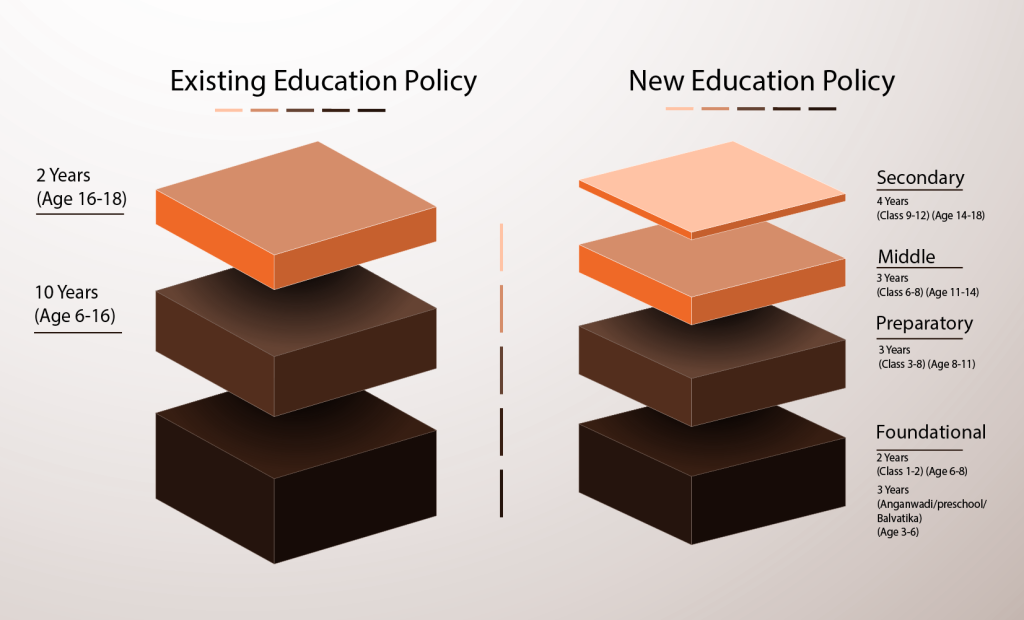
The classification of stages in the NEP 5+3+3+4 education system has been done based on the intellectual growth of a student. In the earlier model, the age group of 3 to 6 was not covered. However, in the 5+3+3+4 education system, a strong foundation of early childhood care and education has also included which is aimed at promoting play-based, activity-based, inquiry-based and flexible ways of learning.
The new 5+3+3+4 education system is broken into four stages:

1. Foundational Stage
For Ages: 3 to 8 Years
For Classes: Pre-school (ECCE), Class 1, and Class 2
Main Focus: Emphasises play-based and activity-driven learning to build early language, numeracy, motor, and socio-emotional skills through exploration and interaction.
The Foundational Stage spans five years for children aged 3–8, covering pre-school and Classes 1 and Class 2. It focuses on playful, hands-on learning to strengthen language, social, emotional, and basic cognitive skills. Children are encouraged to explore, communicate, and express creativity, forming a strong base for lifelong learning.
2. Preparatory Stage
For Ages: 8 to 11 Years
For Classes: Class 3 to Class 5
Main Focus: Strengthens foundational literacy and numeracy while introducing structured classroom learning through interactive, experiential, and discovery-based methods.
The Preparatory Stage lasts three years for students aged 8–11, covering Classes 3–5. It gradually introduces structured classroom learning while retaining activity-based methods. Students build competencies in reading, writing, speaking, mathematics, arts, physical education, and basic science, preparing them for deeper academic understanding in the next stage.
3. Middle Stage
For Ages: 11 to 14 Years
For Classes: 6 to 8
Main Focus: Encourages conceptual understanding and critical thinking through subject-based learning, hands-on activities, and experiential exposure across disciplines.
The Middle Stage spans three years for children aged 11–14, covering Classes 6–8. Students begin learning from subject-specific teachers and engage with more abstract concepts in sciences, mathematics, arts, social sciences, and humanities. Emphasis is on hands-on projects, experiments, and interdisciplinary exploration, promoting critical thinking and practical understanding.
4. Secondary Stage
For Ages: 14 to 18 Years
For Classes: 9 to 12
Main Focus: Promotes multidisciplinary education with flexible subject choices, focusing on analytical skills, real-world application, and preparation for higher education or careers.
The Secondary Stage lasts four years for students aged 14–18, covering Classes 9–12. Students deepen their learning in multiple subjects while developing analytical, problem-solving, and life skills. This stage offers flexible subject choices and prepares learners for higher education, vocational courses, or career pathways, while supporting personalised learning and critical decision-making.

NEP 5+3+3+4 Classes and Exam Pattern
Let us come to the most important point, that is, assessments under the new policy…
The new education policy aims at having regular and competency-based assessments rather than rote learning and summative assessments that create fear and pressure for students.
Changes prescribed in the NEP 5+3+3+4 system are given below.

Focus on formative assessments
Assessments to be formative and competency based with a focus on testing higher order skills such as analysis, critical thinking and conceptual clarity
Revision in report cards
Report cards to be redesigned to capture progress as well as uniqueness of each student through self, peer and teacher assessment. Progress in cognitive, psychomotor, etc. domains to be captured through quizzes, role plays, group work and interactive questionnaires for students, teachers and parents
School examinations up to middle stage
All students to take examinations at class 3, 5 and 8, that will track progress and achievement of basic learning outcomes; grade 3 examination to test basic literacy, numeracy and foundational skills

Board examinations at the secondary stage
These may be taken twice at the secondary stage, one main and one improvement exam, thus reducing exam pressure and offering flexibility. Subjects could be offered at two levels, standard and higher, based on the intelligence and competency of students, in addition to availability of choice of subjects

PARAKH, a nodal assessment body
Creation of a national assessment centre, PARAKH (Performance Assessment, Review and Analysis of Knowledge for Holistic development) for setting norms, benchmarks and standards for assessments and evaluation of all recognised school boards. PARAKH to also monitor learning outcome achievement throughout the country and provide guidance to school boards to create evaluation criteria
What are the Benefits of the 5+3+3+4 Education System in India?
The 5+3+3+4 education system marks a significant transformation in India’s schooling framework under the National Education Policy 2020. This restructured approach offers several advantages that support students’ academic growth and overall development.
1. Reduced Academic Pressure
The 5+3+3+4 education system minimises rote learning and exam stress by introducing age-appropriate curricula and flexible assessments. This allows students to learn at a natural pace without early academic overload.
2. Early & Skill-Based Learning
Skill development is introduced from the foundational years through hands-on activities, vocational exposure, and experiential learning. This helps students build practical life skills alongside academic knowledge from an early age.
3. Practical & Conceptual Learning
The focus shifts from memorisation to understanding concepts through real-world applications, projects, and inquiry-based learning. This approach strengthens critical thinking, problem-solving, and long-term knowledge retention.
4. Foundation in Mother Tongue
Teaching in the mother tongue or regional language during the early years enhances comprehension, communication skills, and cognitive development. It creates a strong learning base before gradually transitioning to additional languages.
5. Early Childhood Care and Education (ECCE)
The integration of ECCE ensures proper cognitive, emotional, and physical development during the most crucial learning years. It emphasises play-based and activity-driven learning to support overall child well-being.
6. Holistic Development
The system promotes balanced growth by integrating academics with sports, arts, ethics, and emotional learning. Students develop social, moral, and creative abilities alongside intellectual skills, preparing them for real-life challenges.
How is Extramarks Aligned With NEP 2020 and the 5+3+3+4 Structure?
The National Education Policy (NEP) 2020 and the 5+3+3+4 framework emphasise age-appropriate learning, reduced academic pressure, experiential pedagogy, and greater use of technology. Extramarks aligns with these core principles through its blend of Smart Class Plus and AI-powered Extra Intelligence:
✔️ It offers an integrated academic teaching–learning platform that uses rich, animated, and interactive content to boost engagement and accessibility across all stages of the 5+3+3+4 structure.
✔️ Smart Class Plus provides curriculum-aligned lessons and collaborative classroom features to support holistic and active learning.
✔️ Extra Intelligence enables personalised lesson planning and content generation for teachers, saving time and promoting tailored instruction.
✔️ AI-driven assessments include instant evaluation of handwritten and subjective answers, supporting formative assessment with efficiency and bias-free scoring.
✔️ Students receive 24/7 AI Co-Pilot support for doubt resolution and guided problem-solving, fostering independent and confident learning.
✔️ Real-time classroom insights track engagement and attentiveness, enabling timely interventions and stronger learning outcomes.
✔️ Curriculum mapping and multilingual support help align content to school syllabi and regional languages, further enhancing access and comprehension.
With these dynamic, technology-enabled capabilities, Extramarks enables learner-centric, practical, and holistic education across the Foundational, Preparatory, Middle, and Secondary stages of the 5+3+3+4 education structure, in line with the objectives of NEP 2020.
With access to such fun and dynamic features, Extramarks Smart Class Plus perfectly aligns with the core principles of what NEP 2020 stands for.
Conclusion
The successful implementation of the 5+3+3+4 education system has the potential to redefine the future of learning in India. By restructuring schooling around developmental stages rather than rigid class-based progression, it creates an ecosystem where students are encouraged to explore, question, and learn meaningfully.
As schools, educators, and policymakers adopt this framework, the focus gradually shifts toward nurturing well-rounded individuals who are academically competent, socially responsible, and adaptable to change. In the long run, the 5+3+3+4 model serves as a critical step toward building a resilient, equitable, and learner-driven education system aligned with the evolving needs of society.

FAQs
When will the new education policy 2020 come into effect?
State governments have freedom with respect to timeline and extent of implementation of the policy – so far, it is effective in Karnataka, Assam, Madhya Pradesh and Uttar Pradesh. Telangana, Maharashtra, Andhra Pradesh and Rajasthan are currently in the process of implementation.
To which boards in India is the NEP 5+3+3+4 applicable?
The new education policy 2020 may be adopted by all recognised boards in India, including CBSE, state boards, ICSE, ISC, etc.
Reviewed by

Prachi Singh | VP - Academics
Prachi Singh is a highly accomplished educationist with over 16 years of experience in the EdTech industry. Currently, she plays a pivotal role at Extramarks, leading content strategy and curriculum development initiatives that shape the future of education...read more.

Last Updated on August 20, 2026