India’s First National Assessment Regulator – PARAKH Explained
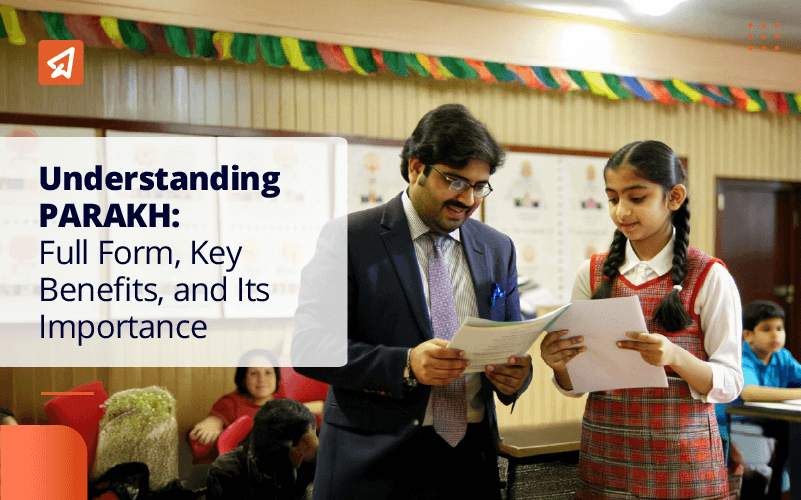
The National Education Policy (NEP) 2020 introduced a new initiative called PARAKH, which serves as a national body aimed at setting standards for student assessments across schools in India.
According to Prime Minister Narendra Modi, PARAKH was established to improve the way students are evaluated, ensuring a more comprehensive system that goes beyond just academics. He stressed the importance of providing education that prepares students for real-world industries and practical challenges. By linking learning to the surrounding environment, students can gain valuable, hands-on experience.
In this blog, we’ll explore what PARAKH is, its main objectives, benefits, and much more. Let’s dive in!
What is PARAKH Scheme?
The full form of PARAKH stands for Performance Assessment, Review, and Analysis of Knowledge for Holistic Development.
PARAKH was established as a separate unit within NCERT, following a notification on February 8, 2023 (Notification no. 1-4/2012-EC/101-164). Its main goal is to create standards, set guidelines, and manage activities related to student assessments.
Aligned with Para 4.4.1 of NEP 2020, PARAKH plays a crucial role in transforming the assessment framework, focusing on competency-based learning and holistic development. It also undertakes additional tasks outlined in National Education Policy (NEP) 2020 to improve the overall assessment system in education.
There are four main areas that PARAKH focuses on, which we’ll explore in detail.
What is the PARAKH according to NEP 2020?
According to the National Education Policy 2020, PARAKH (Performance Assessment, Review and Analysis of Knowledge for Holistic Development) is proposed as a national assessment centre to set standards and guidelines for student evaluation across all school boards in India.

PARAKH was established under the National Council of Educational Research and Training (NCERT) to reform the assessment system and ensure uniformity, fairness, and competency-based evaluation nationwide.
4 Focus Areas of PARAKH in NEP 2020
-
Capacity Development in Competency-Based Assessment
Project Vidyasagar – PARAKH, in partnership with the PhD Chamber of Commerce (PhDCC), is hosting a series of workshops across India. These workshops aim to spread knowledge about learning competencies at different educational levels—Foundational, Preparatory, Middle, and Secondary—according to the National Curriculum Framework 2023 (NCF 2023). The goal is to help educators and teachers understand the new teaching methods and policy changes introduced by NCF 2023. This will help address any gaps in implementing competency-based learning and teaching.
-
Large-Scale Achievement Survey
One of the core responsibilities of PARAKH is conducting large-scale achievement surveys to measure and monitor learning outcomes across the country. These surveys help evaluate whether students are achieving the expected competencies outlined in the National Education Policy (NEP) 2020 and the National Curriculum Framework (NCF) 2023.
Unlike traditional exams that focus mainly on marks, these surveys assess conceptual understanding, foundational literacy, numeracy skills, and application-based learning. The objective is to generate reliable data that can guide evidence-based decision-making in education policy and classroom practices.
2.1: State Educational Achievement Survey 2023
On 3rd November 2023, PARAKH conducted the State Educational Achievement Survey (SEAS) across India. The survey assessed students of:
-
Grade 3
-
Grade 6
-
Grade 9
The assessment focused on key learning areas such as:
-
Foundational Literacy
-
Foundational Numeracy
-
Language
-
Mathematics
The survey was conducted across 30 States and Union Territories, covering approximately 8 million students. Due to assembly elections, Rajasthan and Chhattisgarh conducted the assessment later in December, increasing the total participation to around 8.5 million learners.
This large-scale survey provided valuable insights into learning gaps, regional variations, and student performance trends across India.
2.2: PARAKH Rashtriya Sarvekshan 2024
Building on earlier assessments, the PARAKH Rashtriya Sarvekshan 2024 further expanded the national evaluation framework. It covered:
-
74,229 schools
-
21,15,022 students
-
2,70,424 teachers
-
Conducted across 36 States and Union Territories
-
Classes assessed: 3, 6, and 9
-
Subjects: Language, Mathematics, The World Around Us (EVS), Science, and Social Science
This survey strengthens India’s transition toward competency-based education, ensuring that assessment goes beyond rote memorization and focuses on practical understanding and real-world application.
For more: here
-
-
Equivalence of School Boards
PARAKH is working towards standardizing examination practices across various school boards in India. This effort aims to ensure that all forms of learning—academic, vocational, or experiential—are given equal credit. To support this, PARAKH held regional workshops from June to August 2023, gathering data on administration, curriculum, assessments, and infrastructure from different boards.
Tools like the Equivalence Questionnaire and Question Paper Template Analysis were used for data collection. Based on this data, a report was prepared to highlight areas needing improvement. National workshops in November and December 2023 allowed boards to review and comment on the report, leading to the drafting of policy recommendations for achieving examination equivalence.
-
Holistic Progress Cards
PARAKH is developing Holistic Progress Cards for the Foundational, Preparatory, Middle, and Secondary educational stages. These 360-degree Holistic Progress Cards aim to provide a more complete assessment of competency-based learning by offering a thorough and well-rounded view of student progress.
Why NEP 2020 Introduced PARAKH
NEP 2020 recognized that traditional exams focused heavily on memory-based learning. PARAKH was introduced to transform the evaluation system so that assessments measure:
- Conceptual understanding
- Critical thinking
- Application of knowledge
- Real-world problem-solving skills
In short, under NEP 2020, PARAKH functions as India’s national assessment regulator, ensuring that school examinations align with the vision of holistic and competency-based education.
Benefits of PARAKH
1. Reduces Cramming
PARAKH moves away from last-minute studying by focusing on helping students understand concepts deeply rather than just finishing a curriculum. This approach encourages the development of fundamental learning principles and enhances students’ understanding of the material.
2. Promotes Practical Knowledge
PARAKH emphasizes hands-on learning. Students get opportunities to engage with computer labs, science labs, and other specialized facilities. This practical experience helps students connect theory with real-world applications and reduces dependence on textbook knowledge alone.
3. Lessens Student Stress
Traditional exams can cause anxiety and stress among students. PARAKH aims to reduce this pressure by improving the assessment and evaluation process. This approach helps manage student workload more effectively and promotes a healthier learning environment.
4. Prepares for Industry
PARAKH incorporates business-related subjects and technical skills into the curriculum. By learning subjects like math, physics, and science in a practical context, students gain knowledge that’s valuable not just for school but also for future college studies and careers.
Closing Thoughts
PARAKH aims to transform student assessments by focusing on holistic development and practical knowledge. By moving beyond traditional exams and emphasizing real-world applications, it seeks to enhance learning experiences and better prepare students for future challenges. As we explore PARAKH’s initiatives, it’s clear that this approach could significantly impact the education system in India, creating a more supportive learning environment.
PARAKH – FAQs
1. What does PARAKH stand for?
PARAKH stands for Performance Assessment, Review, and Analysis of Knowledge for Holistic Development. It is India’s national assessment regulator set up under the recommendations of the National Education Policy 2020.
2. What is the PARAKH Exam 2025?
The PARAKH Exam 2025 refers to assessment reforms and standardized evaluation initiatives conducted under PARAKH by the National Council of Educational Research and Training (NCERT).
In 2025, PARAKH is expected to focus on:
- Competency-based assessments
- Reducing rote learning
- Standardizing school board evaluation systems
- Aligning assessments with NEP 2020 guidelines
- Improving question paper design and marking schemes
It is not a single competitive exam like JEE or NEET, but a national-level assessment reform framework.
3. When was PARAKH launched in India?
PARAKH was officially launched in 2023 by NCERT as part of the implementation of the National Education Policy 2020. It functions as a national assessment centre to bring uniformity and quality standards in school education assessment across India.
4. What is the PARAKH test?
The PARAKH test refers to assessment tools and standardized frameworks developed under PARAKH to:
- Evaluate students’ conceptual understanding
- Promote application-based learning
- Benchmark state and central board performance
- Create common norms for exam setting and marking
It helps ensure fair, transparent, and competency-focused evaluation across different school boards.
5. परख कार्यक्रम कब शुरू हुआ ?
परख (PARAKH – Performance Assessment, Review and Analysis of Knowledge for Holistic Development) कार्यक्रम की आधिकारिक शुरुआत 2023 में हुई थी। इसे National Council of Educational Research and Training (NCERT) के अंतर्गत स्थापित किया गया, ताकि पूरे देश में स्कूल मूल्यांकन प्रणाली को एक समान और गुणवत्ता-आधारित बनाया जा सके।
6. What is PARAKH full form in Hindi?
PARAKH (परख) का फुल फॉर्म Performance Assessment, Review, and Analysis of Knowledge for Holistic Development है, जिसे हिंदी में ‘समग्र विकास के लिए प्रदर्शन मूल्यांकन, समीक्षा और ज्ञान का विश्लेषण’ कहा जाता है।
यह नई शिक्षा नीति (NEP) 2020 के तहत स्थापित एक राष्ट्रीय मूल्यांकन निकाय है, जो स्कूली शिक्षा में मूल्यांकन प्रणाली को अधिक पारदर्शी, मानकीकृत और दक्ष बनाने का कार्य करता है।
7. What is PARAKH full form in Gujarati?
PARAKH (પરખ) નું સંપૂર્ણ નામ Performance Assessment, Review, and Analysis of Knowledge for Holistic Development છે.
ગુજરાતીમાં તેનો અર્થ થાય છે —
સમગ્ર વિકાસ માટે પ્રદર્શન મૂલ્યાંકન, સમીક્ષા અને જ્ઞાનનું વિશ્લેષણ।
PARAKH નવી શિક્ષણ નીતિ (NEP) 2020 હેઠળ સ્થાપિત રાષ્ટ્રીય મૂલ્યાંકન સંસ્થા છે, જે શાળાઓમાં મૂલ્યાંકન પ્રણાલીનું માનકીકરણ અને સુધારણા કરે છે।
8. What is PARAKH meaning in Marathi?
“परख” म्हणजे एखाद्या गोष्टीचे परीक्षण करणे, मूल्यमापन करणे किंवा योग्य-अयोग्य ठरवणे.
शैक्षणिक संदर्भात, PARAKH म्हणजे विद्यार्थ्यांच्या ज्ञान आणि कौशल्यांचे मूल्यांकन करून त्यांच्या सर्वांगीण विकासाचे परीक्षण करणे।
9. What is PARAKH full form in Telugu?
PARAKH (పరఖ్) యొక్క పూర్తి రూపం Performance Assessment, Review, and Analysis of Knowledge for Holistic Development.
తెలుగులో దీనిని ఇలా చెప్పవచ్చు —
సమగ్ర అభివృద్ధి కోసం ప్రదర్శన మూల్యాంకనం, సమీక్ష మరియు జ్ఞాన విశ్లేషణ.
ఇది NEP 2020 కింద స్థాపించబడిన జాతీయ మూల్యాంకన సంస్థ, పాఠశాల విద్యలో మూల్యాంకన ప్రమాణాలను మెరుగుపరచడం దీని లక్ష్యం।
10. What is PARAKH full form in Kannada?
PARAKH (ಪರಖ್) ಯ ಪೂರ್ಣ ರೂಪ Performance Assessment, Review, and Analysis of Knowledge for Holistic Development ಆಗಿದೆ.
ಕನ್ನಡದಲ್ಲಿ ಇದರ ಅರ್ಥ —
ಸಮಗ್ರ ಅಭಿವೃದ್ಧಿಗಾಗಿ ಪ್ರದರ್ಶನ ಮೌಲ್ಯಮಾಪನ, ಪರಿಶೀಲನೆ ಮತ್ತು ಜ್ಞಾನ ವಿಶ್ಲೇಷಣೆ.
ಇದು NEP 2020 ಅಡಿಯಲ್ಲಿ ಸ್ಥಾಪಿಸಲಾದ ರಾಷ್ಟ್ರೀಯ ಮೌಲ್ಯಮಾಪನ ಸಂಸ್ಥೆಯಾಗಿದ್ದು, ಶಾಲಾ ಶಿಕ್ಷಣದಲ್ಲಿ ಮೌಲ್ಯಮಾಪನವನ್ನು ಮಾನಕೀಕರಿಸುವ ಕಾರ್ಯ ಮಾಡುತ್ತದೆ.
11. What is PARAKH abbreviation?
PARAKH is an abbreviation for Performance Assessment, Review, and Analysis of Knowledge for Holistic Development.
Reviewed by

Priya Kapoor | VP - Academics
Priya Kapoor is an accomplished education professional with over 18 years of experience across diverse fields, including eLearning, digital and print publishing, instructional design, and content strategy. As the VP – Academics at Extramarks, she leads academic teams in creating tailored educational solutions, ensuring alignment with varied curricula across national and international platforms...read more.

Last Updated on February 26, 2026