How Smart Classrooms Help Schools in Tier 2 & Tier 3 Cities Bridge Educational Gaps
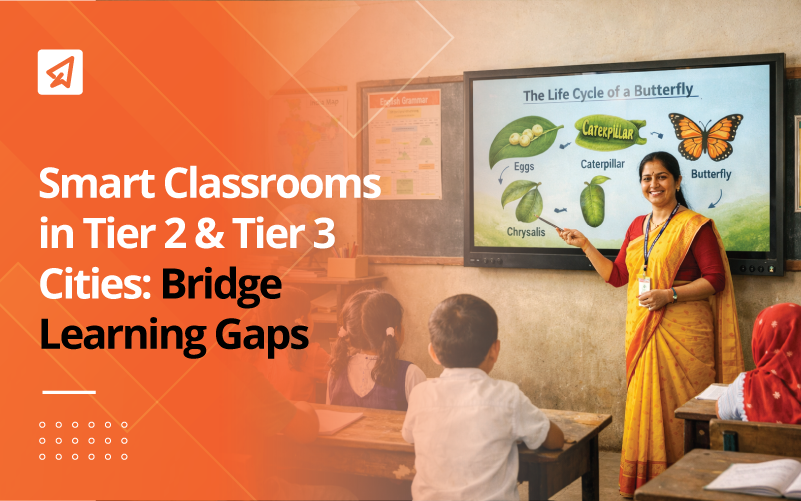
Despite strong policy intent and growing budgets, smart classroom adoption in India remains uneven. With ₹1,900 crore allocated under Samagra Shiksha in FY 2024-25 specifically for smart classes, only 24.4% of Indian schools currently have functional smart classrooms. Adoption in states with a high concentration of Tier 2 and Tier 3 cities remains significantly lower.
The challenge is clear. Infrastructure alone does not improve learning outcomes. Schools need trained teachers, curriculum-aligned content, offline access, and ongoing monitoring to convert hardware into real academic impact.
When implemented thoughtfully, smart classrooms help schools in Tier 2 & Tier 3 cities bridge educational gaps by enabling interactive instruction, providing proper teacher support and training, aligning digital learning with the current curriculum, and ensuring consistent student engagement, even in low-connectivity environments.
How Smart Classrooms Help Schools in Tier 2 & Tier 3 Cities Bridge Educational Gaps
Compared to Tier 1 cities, Tier 2 and 3 city schools face a unique mix of challenges that include limited teacher availability, inconsistent infrastructure, and uneven access to quality academic resources. At the same time, parental aspirations and digital penetration in smaller towns continue to rise. This is where smart classrooms benefit government schools and affordable private institutions.
Why Smart Classrooms Matter in Tier 2 & 3 Cities
Below are some of the main benefits and impacts of smart classrooms:
- Bridging the urban-rural education divide: Smart classrooms give students access to high-quality, curriculum-aligned digital lessons and expert-designed content. This levels the playing field for students in Tier 2 and 3 cities.
- Improving engagement & retention: Visual explanations, animations, and simulations help students grasp abstract concepts more effectively than traditional chalk-and-board methods.
- Supporting personalised & adaptive learning: With integrated data-driven insights, teachers can easily track student understanding, identify gaps early, and adjust instruction without increasing their workload.
- Developing future-ready skills: Exposure to digital learning builds confidence, digital literacy, problem-solving ability, and collaboration skills essential for higher education and employment.
- Empowering teachers, not replacing them: Smart classrooms provide ready-to-use lesson resources and assessment insights, helping teachers focus on instruction rather than preparation overhead.
- Ensuring accessibility & inclusion: Offline digital content for schools, multilingual support, and low-power configurations ensure learning continuity despite internet or electricity challenges.
- Aligning with national policy priorities: Initiatives under DIKSHA and NEP 2020 encourage technology-enabled, competency-based learning, particularly in non-metro regions.
Types of Smart Classrooms That Suit Tier 2 & 3 Cities
To make sure smart classrooms are adopted and accepted across Indian schools, it’s necessary to understand that not all schools require the same smart classroom configuration. It depends on the connectivity available, budget constraints, and teacher readiness.
Here are some types of smart classrooms that mostly suit Tier 2 and 3 city schools:
-
Standard Smart Classroom
A projector, a basic computing device, and digital content form the most affordable entry point. This model works well for schools starting their digital journey with minimal infrastructure upgrades.
-
Interactive Board/IFP Classroom
Interactive flat panels enable real-time annotation, multimedia integration, and higher student participation. These are ideal for schools where teachers are comfortable using technology daily.
-
Hybrid or Blended Classrooms
These types of smart classrooms combine in-person teaching with recorded or live digital lessons, making them suitable for teacher shortages or multi-section schools.
-
Immersive AR/VR Classrooms
Primarily used for labs and visualisation in senior classes, this model works best as a supplementary tool rather than a core requirement.
-
AI-Enabled, Data-Driven Classrooms
Advanced setups use learning analytics to support instructional planning, but only work effectively when teachers are trained to interpret insights.
How to Make Tier 2 & 3 Schools Ready for Smart Classrooms
A successful rollout of adopting smart classrooms in India requires more than installing screens and devices. Tier 2 and Tier 3 schools benefit most when the implementation of smart classrooms is phased, realistic, and closely aligned with teacher readiness, infrastructure constraints, and curriculum needs.
Step 1: Infrastructure Assessment
Schools should begin by auditing existing classrooms for power availability, room size, device readiness, and internet reliability. For Tier 2 and Tier 3 contexts, planning for offline digital content for schools, backup power, and low-bandwidth operation ensures learning continues despite infrastructure limitations.
Step 2: Teacher Training & Professional Development
Teacher training that advocates the use of smart classrooms is important for the successful implementation of technology. Training should focus on classroom pedagogy, lesson integration, and student engagement, rather than only on operating hardware, so teachers feel confident using technology as a teaching aid.
Step 3: Curriculum & Content Planning
Digital content must be mapped carefully to the state boards, CBSE, or ICSE syllabus to avoid classroom disconnect. Schools should prioritise DIKSHA/NEP 2020 alignment, regional language support, and offline-accessible resources so smart classrooms enhance, rather than disrupt, daily teaching.
Step 4: Scheduling & Usage Policy
Smart classrooms should be integrated into the school timetable across subjects and grade levels. Clear usage policies prevent underutilisation and ensure that smart classrooms support regular instruction instead of being reserved only for occasional demonstrations.
Step 5: Monitoring & Evaluation
Regular monitoring helps schools understand and maximise the benefits of smart classrooms, especially for government schools and private institutions. Usage data, teacher feedback, and basic learning outcome indicators should be reviewed periodically to refine classroom practices.
Step 6: Maintenance & Sustainability Planning
Long-term success depends on planning for maintenance, spare equipment, and refresher training. Allocating a small annual budget for upkeep ensures that smart classrooms remain functional, relevant, and effective well beyond the initial implementation phase.
What Are the Common Challenges That Hinder Smart Classroom Adoption in India?
Tier 2 & 3 schools often face predictable challenges, which can be addressed proactively for better adoption of smart classrooms in India:
- Power & internet issues: Offline-first content, scheduled data syncs, and backup power solutions reduce dependency on continuous connectivity.
- Underutilisation after installation: Ongoing professional development, peer coaching, and leadership support keep classrooms active.
- Content misalignment: Curriculum mapping, regional language support, and DIKSHA integration improve relevance.
- Equity & inclusion concerns: Gender-sensitive access, support for marginalised learners, and structured usage policies ensure fair participation.
How Extramarks Can Help Schools Implement Smart Classrooms Effectively
Smart classrooms deliver results only when technology, teaching, and assessment work together. Extramarks Smart Class Plus is designed to support this integration while keeping teachers firmly in control of classroom instruction.
- Improved learning outcomes backed by school-level evidence: According to the Extramarks Impact Assessment Survey (Aug-Sept 2024), 71% of principals reported improved board exam performance after implementing Extramarks solutions, indicating that structured digital instruction and practice directly support academic achievement.
- Stronger conceptual understanding for students: 85% of students shared that Extramarks classroom practice tests helped them understand concepts better. Visual explanations, curriculum-aligned questions, and repeated practice make complex topics easier to grasp, particularly in mixed-ability classrooms.
- Clear visibility into learning gaps for teachers: 92% of teachers said Extramarks helped them identify students’ weak areas more accurately and provide precise feedback. This allows teachers to intervene early rather than reacting after assessments.
By focusing on teacher enablement, student understanding, and measurable academic impact, Extramarks helps schools implement smart classrooms that actually bridge learning gaps, rather than simply digitising classrooms.
Frequently Asked Questions (FAQs)
What teacher training is required for smart classrooms to impact learning?
Teachers need pedagogy-focused training that shows how digital tools support instruction, assessment, and student engagement.
Which smart classroom type should low-budget schools choose first?
A standard smart classroom with projector-based content is the most practical starting point for budget-constrained schools.
What is the simplest way to start a smart classroom in a small-town school?
Schools should begin with one pilot classroom, offline-ready content, and structured teacher training before scaling.
Reviewed by

Priya Kapoor | AVP - Academics
Priya Kapoor is an accomplished education professional with over 18 years of experience across diverse fields, including eLearning, digital and print publishing, instructional design, and content strategy. As the AVP – Academics at Extramarks, she leads academic teams in creating tailored educational solutions, ensuring alignment with varied curricula across national and international platforms...read more.

Published on January 17, 2026