How to Fix Common Lecture Recording Problems in Digital Classrooms
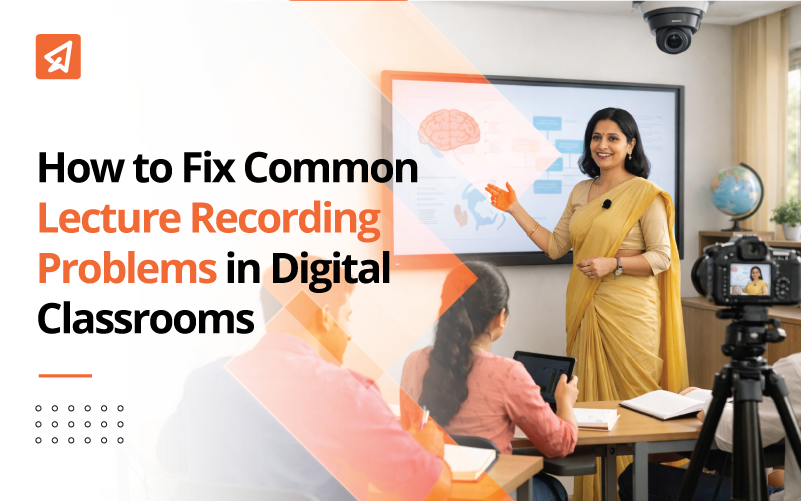
Recording offline classroom lectures has become an essential part of modern teaching, especially in smart classrooms. However, many teachers face recurring technical and practical challenges that can affect recording quality. Understanding how to fix these small smart classroom recording issues ensures that recorded lessons run smoothly.
How to Fix Common Lecture Recording Issues in Digital Classrooms
Identifying the type of issue first makes it easier for teachers to resolve problems quickly without disrupting teaching time. Below, we have listed some of the most common challenges you can face, along with their practical fixes:
Audio Quality Issues (Voice Clarity):
-
Problems With Clear Audio Throughout the Lecture
Challenge: In many classrooms, the teacher’s voice is clearly audible to students present in the room but sounds faint, uneven, or distorted in the recording. This is one of the most frequent smart classroom lecture recording challenges, especially in larger classrooms.
Fix:
- Use a wireless lapel or headset microphone connected directly to the smart classroom system.
- Avoid depending only on ceiling-mounted or camera microphones, which often pick up ambient noise instead of the teacher’s voice.
- Check microphone battery levels, audio input sources, and volume levels before starting the class.
-
Capturing Student Interaction & Classroom Discussions
Challenge: Student questions, responses, and discussions are often not captured clearly in recordings, which reduces the value of the lecture for revision.
Fix:
- Repeat student questions aloud before responding so they are captured in the recording.
- Use a boundary or classroom microphone where available.
- Encourage students to speak clearly during discussions, especially in larger rooms.
Video Quality & Visibility Issues:
-
Maintaining Clear Visibility of the Smart Board & Writing Area
Challenge: Smart board content, annotations, or handwritten explanations appear unclear, cropped, or partially visible in recorded lectures.
Fix:
- Position the camera to fully cover both the smart board and the teaching area.
- Use high-contrast digital pens or markers while writing on the board.
- Avoid standing in front of important content for extended periods.
-
Managing Teacher Movement Within the Camera Frame
Challenge: Teachers naturally move while explaining concepts and may frequently step outside the camera’s field of view, causing gaps in recorded explanations.
Fix:
- Use wide-angle or auto-tracking cameras that are commonly available in smart classrooms.
- Deliver key explanations within the main camera coverage zone.
- Quickly test the camera framing before the lesson begins.
Related Read: Smart Classroom Design
System & Software Issue:
-
Recording Smart Board Content & Digital Presentations Together
Challenge: The recording captures only classroom video or audio, while smart board content, slides, or digital annotations are missing.
Fix:
- Enable smart board screen capture along with camera and audio recording.
- Use integrated lecture capture systems that combine video, audio, and screen inputs.
- Save the smart board files separately as a backup in case of system failure.
-
Avoiding Missed or Incomplete Recordings
Challenge: Teachers may forget to start or stop recordings, resulting in incomplete or missing lecture videos. This is a common issue when managing multiple classroom tasks simultaneously.
Fix:
- Follow a simple pre-class recording checklist.
- Use one-click or scheduled recording features wherever available.
- Assign a quick confirmation step, such as checking a recording indicator, before beginning the lesson.
Hardware & Classroom Environment Issues:
-
Reducing Classroom Noise in Recorded Lectures
Challenge: Background noise from fans, corridors, doors, or student movement interferes with audio clarity in recordings.
Fix:
- Close doors and windows during recording whenever possible.
- Use directional or noise-reducing microphones.
- Pause briefly during unexpected noise before continuing the explanation.
-
Hardware Positioning & Wear-and-Tear Problems
Challenge: Loose cables, misaligned cameras, or worn-out microphones can silently affect recording quality over time.
Fix:
- Conduct periodic checks of microphones, cameras, and connectors.
- Secure cables properly to avoid accidental disconnections.
- Schedule routine maintenance at least once per term.
File Storage, Access, & Organisation Issues:
-
Securing & Organising Recorded Lecture Files
Challenge: Recorded lectures may be misplaced, overwritten, or not uploaded correctly, making them difficult for students to access later.
Fix:
- Save recordings immediately to the school’s LMS or smart classroom system.
- Use consistent file-naming conventions that include subject, class, and date.
- Maintain cloud or external backups to prevent data loss.
How Extramarks’ Smart Class Plus Enables High-Quality Lesson Recording
Extramarks’ Smart Class Plus is designed to simplify lecture recording during offline teaching. It allows teachers to record classroom audio, video, and smart board content together with a single click, without disrupting the teaching flow. Recordings are stored securely, making them easy to access for revision, blended learning, and academic continuity.
Conclusion
Understanding how to fix common lecture recording problems in digital classrooms helps teachers create reliable, high-quality learning resources without added stress. By addressing the common audio, video, and workflow pitfalls, schools can ensure that offline classroom teaching seamlessly supports revision and blended learning.
Frequently Asked Questions (FAQs)
How often should smart classroom recording equipment be maintained?
Recording equipment should be checked at least once every academic term to identify microphone, camera, or software issues early.
How can recorded smart classroom lectures support absent or slow learners?
Recorded lectures allow students to revisit explanations at their own pace, helping reinforce concepts and close learning gaps effectively.
Reviewed by

Priya Kapoor | AVP - Academics
Priya Kapoor is an accomplished education professional with over 18 years of experience across diverse fields, including eLearning, digital and print publishing, instructional design, and content strategy. As the AVP – Academics at Extramarks, she leads academic teams in creating tailored educational solutions, ensuring alignment with varied curricula across national and international platforms...read more.

Last Updated on February 20, 2026