PARAKH Assessment Framework 2025 Explained: Key Insights Shaping India’s Classrooms
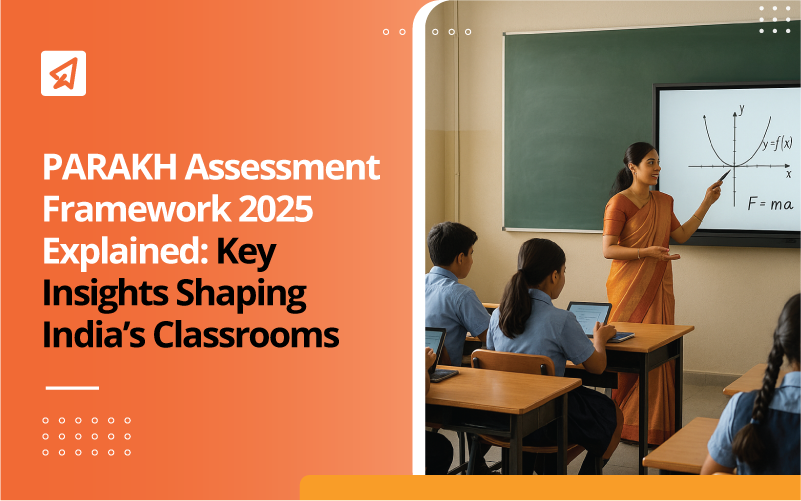
Under the leadership of PM Narendra Modi, the NEP 2020 in India started the PARAKH initiative aimed at setting a certain standard for the way student assessment is conducted across schools all over the country.
PARAKH was started to improve the way students are examined, making sure the system is more detailed and in-depth, and goes beyond just theory and academics. The Prime Minister highlighted the need for education that prepares students for real-world industries and practical challenges. And how students’ classroom learning should be connected with their surroundings to help them gain meaningful, hands-on experience.
NEP 2020 was developed with a vision for competency-based, Holistic Assessment, and PARAKH, as an initiative, was introduced in line with this vision. In this blog, we’ll talk about what PARAKH is, its main objectives, benefits, and more. Let’s understand it in detail.
Key Takeaways
- PARAKH Assessment Framework 2025 shows that learning gaps widen as students move to higher grades.
- Maths, Science, and higher-order comprehension remain major challenges.
- State-wise performance varies, mainly due to differences in training and resources.
- The system still depends heavily on memorisation instead of conceptual learning.
- Schools, policymakers, and EdTech platforms must work together to strengthen teaching, assessments, and remediation.
Overview of the PARAKH Assessment Framework 2025
PARAKH stands for Performance Assessment, Review, and Analysis of Knowledge for Holistic Development. It was introduced as a separate unit within the NCERT with the goal of having a benchmark for student assessments and having guidelines that manage all the activities related to it.
The PARAKH Assessment Framework 2025 aims to understand how well students across the country are learning, not because they need to be ranked, but because the gaps in the system need to be identified and improved upon. It covers students from Grades 3, 6, and 9 in all states and union territories. The subjects tested vary by grade:
- Grades 3 and 6: Language, Mathematics, and “The World Around Us” (EVS)
- Grade 9: Language, Mathematics, Science, and Social Science
The assessment mainly uses questions based on competency, which examine the students’ understanding of concepts and their real-life skills. Schools and teachers are also made to fill up questionnaires that help understand teaching practices, resources available, and identify the learning environment. The idea is to make the learning system better by understanding the gaps and help states plan better interventions.
This assessment builds on earlier cycles, including the Parakh Rashtriya Sarvekshan 2024 assessed, giving a clearer picture of how learning levels are changing across India.
Key Findings: What the Data Shows
The 2025 PARAKH results take note of important trends across different grades. While there has been some improvement in foundational skills, the data shows growing gaps as students move to higher classes.
-
Grade 3 Highlights
Students in Grade 3 performed better in basic language skills, especially reading simple texts and recognising words. Their comprehension has shown improvement compared to previous cycles. However, significant gaps remain in Mathematics. Many students struggled with number operations, unit conversions, and understanding measurements.
Foundational learning is improving, but the progress is slow, and many learners still enter higher grades without strong basic skills.
-
Grade 6 Highlights
Grade 6 results show a shift from basic skills to higher-order thinking. While most students can read, many struggle with reasoning, interpretation, and understanding the meaning behind passages.
In Mathematics, students found fractions, basic algebra, and patterns challenging. EVS results showed that students can remember facts but find it hard to link concepts to real-life situations. This indicates that conceptual application remains a major gap at this stage.
-
Grade 9 Highlights
The decline in learning outcomes becomes more noticeable by Grade 9. Only about 30–35% of students can apply concepts in Mathematics and Science. Many learners rely on memorising steps but cannot explain the reasoning behind them.
Language results show that students have difficulties in reading longer passages or understanding complex ideas. This highlights a deeper issue: Students who learn to read early still struggle to grasp subjects in higher classes.
Common Trends Across Grades
Across all grades, the data points to a few consistent trends:
- Foundational gaps persist and widen with each grade
- Mathematics and Science show the steepest decline
- Early literacy skills do not always translate into higher-level comprehension
- Learning progress slows down significantly after Grade 6
Regional & Demographic Patterns
PARAKH 2025 also highlights differences across states and districts.
- Top-Performing States: Kerala, Punjab, Himachal Pradesh
- States Needing Attention: Jharkhand, Jammu & Kashmir, Meghalaya
- Urban vs Rural: In certain states, rural schools perform better due to community involvement and stronger foundational programmes
- Private vs Government: Private schools generally score better, but the gap varies widely
- Success Stories: States investing in teacher training and learning resources show clear improvement
These variations show that access to training and resources strongly influences how students perform and learn.
What the Results Mean
The findings from the PARAKH Assessment Framework 2025 reveal important outcomes:
- Learning Gaps Grow Over Time: Weak foundations in early grades make advanced learning difficult later
- Memorisation is Still Common: Students can follow steps, but cannot explain concepts
- Progress Slows in Middle and Secondary Grades: Many students stop improving after Grade 6
- System-Level Issues Persist: Limited teacher training, large class sizes, and resource shortages continue to affect learning outcomes
These insights give schools and policymakers a clear direction for improvement.
What Needs to Be Done
-
For Teachers & Schools
Teachers can use PARAKH data to plan extra classes in Grades 6 and 9. The focus should shift from rote learning to conceptual understanding. NEP encourages this transformation. You can learn more about it here: How NEP is transforming education.
Schools should introduce Holistic Progress Cards to track continuous development rather than just marks.
-
For Policymakers & Administrators
Policymakers must invest in teacher training and digital learning tools to improve the way instructions are given and material is taught. Some of the finest programmes can be reached here: Teacher training programmes.
Low-performing districts should receive extra support, and PARAKH insights should be aligned with UDISE+ and DIKSHA for better planning.
-
For EdTech Platforms like Extramarks
EdTech platforms can play a major role in addressing the issues highlighted in PARAKH 2025.
- Personalised Learning: Using PARAKH data, Extramarks’ AI tools can identify weak areas and offer extra support.
- Conceptual Clarity: Visual content and smart diagnostics can simplify complex topics in Science and Mathematics.
- Teacher Support: Extramarks Smart Class Plus helps schools align teaching, assessments, and remediation with PARAKH competencies.
- Data-Driven Interventions: Collaboration between EdTech and education departments can help design customised remedial plans.
-
For Parents & Students
Parents should use assessment feedback to understand strengths and weaknesses and encourage activity-based and self-paced learning at home.
Future Planning
Future PARAKH assessments must be conducted more frequently, ideally at the district level, to track learning gaps more accurately. There is also a need to include skills like critical thinking, problem-solving, digital literacy, and real-world application. Real-time dashboards can help schools respond faster to emerging learning trends.
The PARAKH Assessment Framework 2025 provides a clear and honest picture of learning levels in India. While foundational skills are improving, major gaps remain across grades, especially in Mathematics and Science. The results emphasise the need for stronger teacher training, better resources, and a shift from memorisation to understanding. With the right support from schools, policymakers, and EdTech platforms like Extramarks, India can create a fair, skill-focused education system that helps every student move forward with confidence.
Last Updated on February 26, 2026