NCERT Solutions of Class 7 Maths Ganita Prakash Chapter 7 – A Tale of Three Intersecting Lines
Here is the complete and updated set of solutions for NCERT Class 7 Maths Chapter 7 – A Tale of Three Intersecting Lines from the new Ganita Prakash textbook.
NCERT Solutions of Class 7 Maths Ganita Prakash Chapter 7 - A Tale of Three Intersecting Lines
 A Tale of Three Intersecting Lines (New NCERT)
 Medium
A Tale of Three Intersecting Lines (New NCERT)
Medium
Medium
A Tale of Three Intersecting Lines (New NCERT)
Medium
 A Tale of Three Intersecting Lines (New NCERT)
Medium
A Tale of Three Intersecting Lines (New NCERT)
Medium
A Tale of Three Intersecting Lines (New NCERT)
Medium
A Tale of Three Intersecting Lines (New NCERT)
Medium
A Tale of Three Intersecting Lines (New NCERT)
Medium
A Tale of Three Intersecting Lines (New NCERT)
Medium
A Tale of Three Intersecting Lines (New NCERT)
Medium
A Tale of Three Intersecting Lines (New NCERT)
Medium
A Tale of Three Intersecting Lines (New NCERT)
Medium
A Tale of Three Intersecting Lines (New NCERT)
Medium
A Tale of Three Intersecting Lines (New NCERT)
Medium
A Tale of Three Intersecting Lines (New NCERT)
Medium
 A Tale of Three Intersecting Lines (New NCERT)
Medium
A Tale of Three Intersecting Lines (New NCERT)
Medium
A Tale of Three Intersecting Lines (New NCERT)
Medium
A Tale of Three Intersecting Lines (New NCERT)
Medium
A Tale of Three Intersecting Lines (New NCERT)
Medium
A Tale of Three Intersecting Lines (New NCERT)
Medium
A Tale of Three Intersecting Lines (New NCERT)
Medium
A Tale of Three Intersecting Lines (New NCERT)
Medium
A Tale of Three Intersecting Lines (New NCERT)
Medium
A Tale of Three Intersecting Lines (New NCERT)
Medium
A Tale of Three Intersecting Lines (New NCERT)
Medium
A Tale of Three Intersecting Lines (New NCERT)
Medium
A Tale of Three Intersecting Lines (New NCERT)
Medium
A Tale of Three Intersecting Lines (New NCERT)
Medium
A Tale of Three Intersecting Lines (New NCERT)
Medium
A Tale of Three Intersecting Lines (New NCERT)
Medium
A Tale of Three Intersecting Lines (New NCERT)
Medium
A Tale of Three Intersecting Lines (New NCERT)
Medium
A Tale of Three Intersecting Lines (New NCERT)
Medium
A Tale of Three Intersecting Lines (New NCERT)
Medium
A Tale of Three Intersecting Lines (New NCERT)
Medium
A Tale of Three Intersecting Lines (New NCERT)
Medium
A Tale of Three Intersecting Lines (New NCERT)
Medium
A Tale of Three Intersecting Lines (New NCERT)
Medium
This chapter explores the conditions required to construct a triangle, focusing on the Triangle Inequality Theorem, collinearity of points, and geometric constructions using compasses and rulers.
Complete Figure It Out & Exercise Solutions
Figure it out (Page 171)
Question:
Through construction, explore if it is possible to construct an equilateral triangle that is (i) right-angled, (ii) obtuse-angled.
Also construct an isosceles triangle that is (i) right-angled, (ii) obtuse-angled.
Correct Answer is:
- An equilateral triangle that is right-angled and obtuse-angled is not possible because each angle of an equilateral triangle is always 60°.
- An isosceles right-angled triangle has one angle of 90° and the other two angles of 45° each.
- An isosceles obtuse-angled triangle can have one angle as 120° and the other two angles of 30° each.
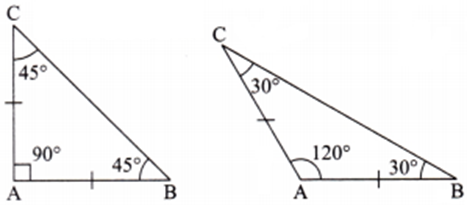
Text Solution by Our Experts:
1. Understanding Equilateral Triangles
An equilateral triangle is a triangle in which all three sides are equal in length.
A fundamental property of equilateral triangles is that all three angles are also equal.
Since the sum of angles in any triangle is 180°, each angle in an equilateral triangle is:
180° ÷ 3 = 60°
2. Can an Equilateral Triangle be Right-angled or Obtuse-angled?
A right-angled triangle has one angle equal to 90°.
An obtuse-angled triangle has one angle greater than 90°.
Since every angle in an equilateral triangle is exactly 60°, it cannot have an angle of 90° or an angle greater than 90°.
Therefore, it is not possible to construct an equilateral triangle that is either right-angled or obtuse-angled.
3. Understanding Isosceles Triangles
An isosceles triangle is a triangle in which at least two sides are equal in length.
A key property of an isosceles triangle is that the angles opposite the equal sides are also equal.
4. Constructing an Isosceles Right-angled Triangle
For an isosceles right-angled triangle, one angle must be 90°. This is the right angle.
Since two sides are equal, the angles opposite these sides must also be equal.
The other two angles must be equal. Let each of them be x°.
The sum of angles in a triangle is 180°.
90° + x° + x° = 180°
90° + 2x° = 180°
2x° = 180° - 90°
2x° = 90°
x° = 90° ÷ 2
x° = 45°
Therefore, an isosceles right-angled triangle has angles:
90°, 45°, 45°
5. Constructing an Isosceles Obtuse-angled Triangle
For an isosceles obtuse-angled triangle, one angle must be greater than 90°.
Let us choose 120° as the obtuse angle.
Since two sides are equal, the other two angles must also be equal. Let each of them be y°.
The sum of angles in a triangle is 180°.
120° + y° + y° = 180°
120° + 2y° = 180°
2y° = 180° - 120°
2y° = 60°
y° = 60° ÷ 2
y° = 30°
Therefore, an isosceles obtuse-angled triangle can have angles:
120°, 30°, 30°
In Summary
- An equilateral triangle cannot be right-angled or obtuse-angled because all its angles are 60°.
- An isosceles right-angled triangle has angles 90°, 45°, 45°.
- An isosceles obtuse-angled triangle can have angles such as 120°, 30°, 30°.
Figure it out (Page 171)
Question:
Construct a right-angled triangle ΔABC with ∠B = 90°, AC = 5 cm. How many different triangles exist with these measurements?
[Hint: Note that the other measurements can take any values. Take AC as the base. What values can ∠A and ∠C take so that the other angle is 90°?]
Correct Answer is:
Given, ∠B = 90°, and AC = 5 cm (hypotenuse)
Since ∠B = 90°, ∠A and ∠C add up to 90°.
If we fixed AC = 5 cm and ∠A and ∠C vary, then there are infinitely many triangles possible.
Because the shape of the triangle can change with the different values of angles A and C.
One such example is given here:
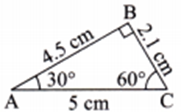
Text Solution by Our Experts:
To determine how many different right-angled triangles can be constructed with the given measurements, let us analyze the properties of triangles.
- You are given a right-angled triangle ABC where angle B = 90°.
The side opposite to the right angle is the hypotenuse. Here, AC is the hypotenuse and its length is given as 5 cm.
- Recall that the sum of angles in any triangle is 180°.
Since angle B = 90°, the sum of the other two angles, angle A and angle C, must be:
180° - 90° = 90°
So,
Angle A + Angle C = 90°
- You are given one side (hypotenuse AC = 5 cm) and one angle (angle B = 90°). The other two angles, angle A and angle C, can vary as long as their sum is 90°.
For example:
- If angle A = 30°, then angle C = 90° - 30° = 60°.
- If angle A = 45°, then angle C = 90° - 45° = 45°.
- If angle A = 1°, then angle C = 89°.
- If angle A = 89°, then angle C = 1°.
- Since angle A can take any value between 0° and 90° (excluding 0° and 90° for a non-degenerate triangle), there are infinitely many possible pairs of angle A and angle C.
Each different combination of angle A and angle C, while keeping angle B = 90° and AC = 5 cm fixed, will result in a triangle with a different shape. This means that the lengths of sides AB and BC will also be different.
For instance, if angle A is 30° and angle C is 60°, the sides AB and BC will have specific lengths. If angle A is changed to 45° and angle C to 45°, the lengths of AB and BC will change, forming a different triangle.
- Therefore, because the angles angle A and angle C can vary infinitely while satisfying the condition:
Angle A + Angle C = 90°
there are infinitely many different right-angled triangles possible with a hypotenuse of 5 cm.
The number of different triangles that exist with these measurements is infinitely many.
Figure it out (Page 171)
Question:
Construct a triangle TRY with RY = 4 cm, TR = 7 cm, ∠R = 140°. Construct an altitude from T to RY.
Correct Answer is:
Steps of Construction:
- Step 1: Construct a side TR of length 7 cm.
- Step 2: Construct ∠R = 140° by drawing the other arm of the angle.
- Step 3: Mark the point Y on the other arm such that RY = 4 cm.
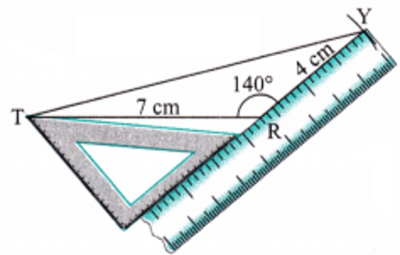
- Step 4: Join TY to get the required triangle.
- Step 5: Keep the ruler aligned to RY. Place the set square on the ruler such that one of the edges of the right angle touches the ruler.
- Step 6: Slide the set square along the ruler till the perpendicular edge of the set square touches the vertex T.
- Step 7: Extend the line YR and then draw the altitude through T on YR using the perpendicular edge of the set square.
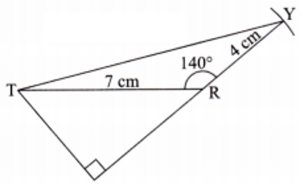
Text Solution by Our Experts:
Here are the steps to construct the triangle TRY and draw an altitude from T to RY:
- Construct side TR:
First, draw a line segment TR that is 7 cm long. This will be one side of your triangle.
- Construct angle at R:
Place the protractor at point R with its base aligned with TR. Measure and mark an angle of 140°. Then, draw a ray starting from R through this mark. This forms the second arm of angle R.
- Mark point Y:
Along the ray you just drew (the second arm of angle R), measure 4 cm from point R and mark point Y. So, RY will be 4 cm long.
- Complete the triangle:
Join point T to point Y with a straight line segment. You have now constructed the triangle TRY with the given measurements.
- Extend side RY:
Since angle R is an obtuse angle (140°), the altitude from T to RY will fall outside the triangle. Therefore, extend the line segment RY beyond R.
- Draw the altitude using a set square:
- Place a ruler along the extended line YR.
- Hold a set square such that one of its edges forming the right angle (90°) rests on the ruler.
- Slide the set square along the ruler until the other edge forming the right angle touches the vertex T.
- Draw a line segment from T along the perpendicular edge of the set square to meet the extended line YR. Let the point where it meets be M.
The line segment TM is the altitude from vertex T to side RY (extended).
Figure it out (Page 171)
Question:
Construct a triangle ABC with BC = 5 cm, AB = 6 cm, CA = 5 cm. Construct an altitude from A to BC.
Correct Answer is:
Steps of Construction:
- Step 1: Draw the base AB = 6 cm.
- Step 2: Using a compass, construct a sufficiently long arc of radius 5 cm from A.
- Step 3: Construct another arc of radius 5 cm from B such that it intersects the first arc.
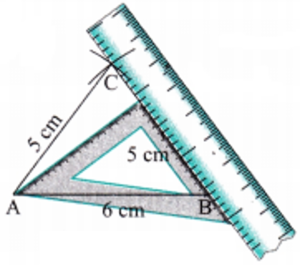
- Step 4: The point where both the arcs meet is the required third vertex C. Join AC and BC to get ΔABC.
- Step 5: Keep the ruler aligned to BC. Place the set square on the ruler such that one of the edges of the right angle touches the ruler.
- Step 6: Slide the set square along the ruler till the perpendicular edge of the set square touches the vertex A.
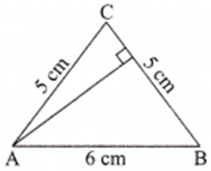
- Step 7: Draw the altitude through A to BC using the perpendicular edge of the set square.
Text Solution by Our Experts:
Here are the steps to construct the triangle ABC and its altitude from A to BC:
- Draw the base AB of length 6 cm using a ruler.
- From point A, open your compass to a radius of 5 cm (since CA = 5 cm). Place the compass needle on A and draw an arc that is long enough to potentially intersect another arc.
- From point B, open your compass to a radius of 5 cm (since BC = 5 cm). Place the compass needle on B and draw another arc. This arc should intersect the first arc you drew from A.
- The point where these two arcs intersect is the third vertex, C. Join points A to C and B to C with a ruler to complete the triangle ABC.
- To construct the altitude from A to BC, first align your ruler along the side BC of the triangle.
- Now, place a set square on the ruler. Make sure one of the edges forming the right angle of the set square is touching the ruler (and thus aligned with BC).
- Slide the set square along the ruler until the other edge forming the right angle (the perpendicular edge) touches vertex A.
- While holding the ruler and set square firmly in place, draw a line segment from A down to BC along the perpendicular edge of the set square. This line segment represents the altitude from A to BC. It will be perpendicular to BC.
In-Text Questions (Page 170)
Question:
What could an acute-angled triangle be? Can we define it as a triangle with one acute angle? Why not?
Correct Answer is:
A triangle with all three angles acute is called an acute-angled triangle. We cannot define it with one acute angle because a right or an obtuse triangle also has two acute angles.
Text Solution by Our Experts:
Here is the explanation for the given question:
- To understand what an acute-angled triangle is, let us first recall the types of angles:
An angle less than 90° is called an acute angle.
An angle equal to 90° is called a right angle.
An angle greater than 90° but less than 180° is called an obtuse angle.
- A triangle is classified as an acute-angled triangle if all three of its interior angles are acute angles.
For example, a triangle with angles 60°, 70°, and 50° is an acute-angled triangle because all three angles are less than 90°.
- You cannot define an acute-angled triangle as simply a triangle with one acute angle.
This is because other types of triangles, such as right-angled triangles and obtuse-angled triangles, also have acute angles.
- Consider these examples:
A right-angled triangle has one right angle (90°) and two acute angles.
For example, a triangle with angles 90°, 40°, and 50° has two acute angles.
An obtuse-angled triangle has one obtuse angle and two acute angles.
For example, a triangle with angles 110°, 30°, and 40° has two acute angles.
- Therefore, if you were to define an acute-angled triangle as having just one acute angle, this definition would also apply to right-angled and obtuse-angled triangles, which is incorrect.
The defining characteristic of an acute-angled triangle is that every single angle within it must be acute.
In-Text Questions (Page 168)
Question:
Cut out a paper triangle. Fix one of the sides as the base. Fold it in such a way that the resulting crease is an altitude from the top vertex to the base. Justify why the crease formed should be perpendicular to the base.
Correct Answer is:
The perpendicularity happens because the shortest distance between a point, i.e., a vertex, and a line, i.e., the base is always a perpendicular line. By folding the paper, we construct the shortest distance, ensuring the crease is perpendicular to the base.
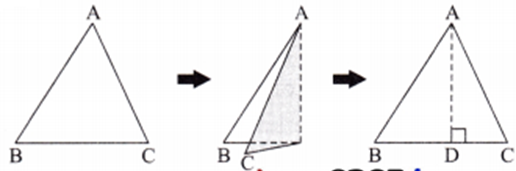
Text Solution by Our Experts:
- Understand the definition of an altitude:
In geometry, an altitude of a triangle is a line segment drawn from a vertex perpendicular to the opposite side (or its extension). The length of this segment is also called the height of the triangle from that vertex to that side.
- Relate altitude to shortest distance:
The altitude represents the shortest distance from a vertex (which is a point) to its opposite side (which is a line). Imagine you are standing at point A and want to reach the line segment BC. The quickest way to get there is to walk straight across, forming a right angle with the line. Any other path would be longer.
- Connect folding to shortest distance:
When you fold the paper triangle such that the crease forms an altitude from the top vertex (say, A) to the base (say, BC), you are essentially creating the shortest path from vertex A to the line segment BC.
- Justify perpendicularity:
Geometrically, the shortest distance from any point to a line is always along the line segment that is perpendicular to the original line. Therefore, since the crease formed by folding represents the shortest distance from the vertex to the base, it must be perpendicular to the base.
This means the angle formed between the crease and the base will be 90°.
In-Text Questions (Page 167)
Question:
Find the exterior angle for different measures of ∠A and ∠B.
Do you see any relation between the exterior angle and these two angles?
[Hint: From the angle sum property, we have ∠A + ∠B + ∠ACB = 180°.] We also have ∠ACD + ∠ACB = 180°, since they form a straight angle.
What does this show?
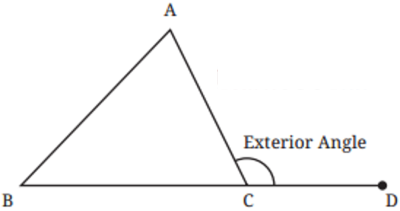
Correct Answer is:
Here, ∠A + ∠B + ∠ACB = 180° ……….(i)
Also, ∠ACD + ∠ACB = 180°
So, ∠ACB = 180° – ∠ACD ……….(ii)
Using (ii) in (i), we get
∠A + ∠B + 180° – ∠ACD = 180°
⇒ ∠A + ∠B = ∠ACD [Exterior angle]
In-Text Questions (Page 167)
Question:
The angle formed between the extension of a side of a triangle and the other side is called an exterior angle of the triangle. In this figure, ∠ACD is an exterior angle.
Find ∠ACD, if ∠A = 50°, and ∠B = 60°.
Correct Answer is:
- From the angle sum property, we know that
- 50° + 60° + ∠ACB = 180°
- 110° + ∠ACB = 180°
- So, ∠ACB = 70°
- So, ∠ACD = 180° - 70° = 110°
Since ∠ACB and ∠ACD together form a straight angle.
Text Solution by Our Experts:
To find the measure of the exterior angle ∠ACD, you can follow these steps:
- First, find the measure of the interior angle ∠ACB of the triangle ABC.
You know that the sum of all angles in a triangle is 180° (Angle Sum Property of a triangle).
So,
∠A + ∠B + ∠ACB = 180°
Substitute the given values for ∠A and ∠B:
50° + 60° + ∠ACB = 180°
110° + ∠ACB = 180°
To find ∠ACB, subtract 110° from 180°:
∠ACB = 180° - 110°
∠ACB = 70°
- Next, find the measure of the exterior angle ∠ACD.
Observe the figure: the angle ∠ACB and the exterior angle ∠ACD form a linear pair.
This means they lie on a straight line (BD) and their sum is 180°.
So,
∠ACB + ∠ACD = 180°
Substitute the value of ∠ACB that you just found:
70° + ∠ACD = 180°
To find ∠ACD, subtract 70° from 180°:
∠ACD = 180° - 70°
∠ACD = 110°
Therefore, the measure of the exterior angle ∠ACD is 110°.
You can also notice a special relationship here: The exterior angle of a triangle is equal to the sum of its two opposite interior angles.
In this case,
∠ACD = ∠A + ∠B
∠ACD = 50° + 60°
∠ACD = 110°
This property gives you a quicker way to find the exterior angle.
Figure it out (Page 165)
Question:
Here is a triangle in which we know ∠B = ∠C and ∠A = 50°. Can you find ∠B and ∠C?
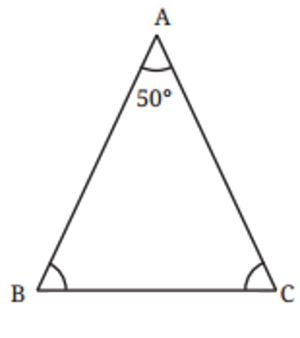
Correct Answer is:
Given ∠A = 50° and ∠B = ∠C.
Draw a line XY that is parallel to BC.
Now, ∠XAB = ∠B and ∠YAC = ∠C [Alternate angles] …… (i)
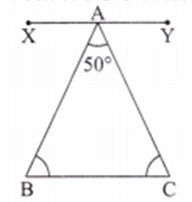
Also, ∠XAB + ∠BAC + ∠YAC = 180°
⇒ ∠B + 50° + ∠C = 180° [Using (i)]
∠B + ∠C = 180° – 50° = 130°
⇒ 2∠B = 130°
⇒ ∠B = 65° = ∠C
Text Solution by Our Experts:
Here’s how you can find the measures of ∠B and ∠C in the given triangle:
- You are given a triangle ABC where ∠A = 50° and ∠B = ∠C.
- Imagine drawing a line XY that passes through point A and is parallel to the base BC.
- Now, consider the parallel lines XY and BC, and the transversal line AB.
The angle ∠XAB and ∠B are alternate interior angles. When two parallel lines are cut by a transversal, alternate interior angles are equal.
Therefore, you can say that:
∠XAB = ∠B ...(i)
- Similarly, consider the parallel lines XY and BC, and the transversal line AC.
The angle ∠YAC and ∠C are also alternate interior angles.
Therefore, you can say that:
∠YAC = ∠C ...(ii)
- Observe the angles on the straight line XY at point A. The sum of the angles on a straight line is 180°.
So,
∠XAB + ∠BAC + ∠YAC = 180°
- Substitute the values and relationships you found into this equation:
From step 3, you know ∠XAB = ∠B.
From step 4, you know ∠YAC = ∠C.
You are given ∠BAC = ∠A = 50°.
So, the equation becomes:
∠B + 50° + ∠C = 180°
- Rearrange the equation to find the sum of ∠B and ∠C:
∠B + ∠C = 180° - 50°
∠B + ∠C = 130°
- You are given that ∠B = ∠C.
Substitute ∠C with ∠B in the equation from step 7:
∠B + ∠B = 130°
2∠B = 130°
- Solve for ∠B:
∠B = 130° ÷ 2
∠B = 65°
- Since ∠B = ∠C, then ∠C is also 65°.
Thus,
∠B = 65° and ∠C = 65°.
Figure it out (Page 165)
Question:
Can you construct a triangle all of whose angles are equal to 70°? If two of the angles are 70°, what would the third angle be? If all the angles in a triangle have to be equal, then what must its measure be? Explore and find out.
Correct Answer is:
No, it is not possible to construct a triangle with all angles equal to 70°.
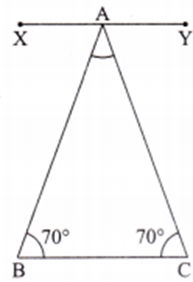
If we take two base angles as 70° that is, ∠B and ∠C = 70°, then we have to find ∠BAC.
Since XY is parallel to BC.
So, ∠XAB = ∠B = 70° ….. (i)
and ∠YAC = ∠C = 70° …… (ii)
Also, ∠XAB + ∠BAC + ∠YAC = 180°
⇒ 70° + ∠BAC + 70° = 180° [Using (i) and (ii)]
⇒ ∠BAC = 180° – 140° = 40°.
So, the third angle would be 40°.
If all the angles in a triangle have to be equal, then each angle must measure 60°. This type of triangle is called an equilateral triangle.
Text Solution by Our Experts:
Here is a detailed explanation of the solution:
- Can you construct a triangle all of whose angles are equal to 70°?
You know that the sum of all angles in any triangle is always 180°. This is known as the Angle Sum Property of a triangle.
If all three angles were equal to 70°, then their sum would be:
70° + 70° + 70° = 210°
Since 210° is not equal to 180°, it is not possible to construct a triangle with all angles equal to 70°.
Therefore, the answer to the first part is No.
- If two of the angles are 70°, what would the third angle be?
Let us consider a triangle ABC. You are given that two of the angles are 70°. Let us assume ∠B = 70° and ∠C = 70°.
You need to find the third angle, ∠BAC.
Using the Angle Sum Property of a triangle:
∠BAC + ∠B + ∠C = 180°
Substitute the given values:
∠BAC + 70° + 70° = 180°
∠BAC + 140° = 180°
To find ∠BAC, subtract 140° from both sides:
∠BAC = 180° - 140°
∠BAC = 40°
So, the third angle would be 40°.
The image also demonstrates this using properties of parallel lines:
If line XY is drawn parallel to BC through point A, then:
a. ∠XAB = ∠B = 70° (Alternate interior angles, since XY is parallel to BC and AB is a transversal).
b. ∠YAC = ∠C = 70° (Alternate interior angles, since XY is parallel to BC and AC is a transversal).
The angles on the straight line XY at point A add up to 180°:
∠XAB + ∠BAC + ∠YAC = 180°
70° + ∠BAC + 70° = 180°
140° + ∠BAC = 180°
∠BAC = 180° - 140°
∠BAC = 40°
This confirms that the third angle is 40°.
- If all the angles in a triangle have to be equal, then what must its measure be?
Let each equal angle be x. In a triangle, there are three angles.
Using the Angle Sum Property of a triangle:
x + x + x = 180°
3x = 180°
To find x, divide both sides by 3:
x = 180° ÷ 3
x = 60°
So, if all the angles in a triangle have to be equal, then each angle must measure 60°.
This type of triangle, where all three angles are equal (and thus all three sides are also equal), is called an equilateral triangle.
In Summary:
- You cannot construct a triangle with all angles equal to 70° because their sum would be 210°, not 180°.
- If two angles in a triangle are 70° each, the third angle would be 40°.
- If all angles in a triangle are equal, each angle must measure 60°, and such a triangle is called an equilateral triangle.
Figure it out (Page 165)
Question:
Find the third angle of a triangle (using a parallel line) when two of the angles are:
(a) 36°, 72°
(b) 150°, 15°
(c) 90°, 30°
(d) 75°, 45°
Correct Answer is:
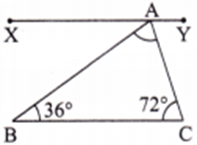
(a) Here ∠B = 36° and ∠C = 72°.
Since the line BC is parallel to XY.
So, ∠XAB = ∠B = 36° [Alternate angles] ….. (i)
and ∠YAC = ∠C = 72° [Alternate angles] …… (ii)
Also, ∠XAB + ∠BAC + ∠YAC = 180° [∵ ∠XAY is a straight angle]
⇒ 36° + ∠BAC + 72° = 180° [Using (i) and (ii)]
⇒ ∠BAC = 180° - 108° = 72°.
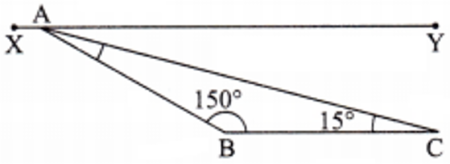
(b) Here ∠B = 150° and ∠C = 15°.
Since the line BC is parallel to XY.
So, ∠XAB = ∠B = 150° [Alternate angles] ….. (i)
and ∠YAC = ∠C = 15° [Alternate angles] …… (ii)
Also, ∠XAB + ∠BAC + ∠YAC = 180° [∠XAY is a straight angle]
⇒ 150° + ∠BAC + 15° = 180° [Using (i) and (ii)]
⇒ ∠BAC = 180° – 165° = 15°
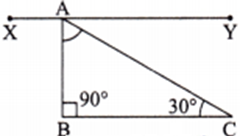
(c) Here ∠B = 90° and ∠C = 30°.
Since the line BC is parallel to XY.
So, ∠XAB = ∠B = 90° [Alternate angles] …… (i)
and ∠YAC = ∠C = 30° [Alternate angles] …… (ii)
Also, ∠XAB + ∠BAC + ∠YAC = 180° [∠XAY is a straight angle]
⇒ 90° + ∠BAC + 30° = 180° [Using (i) and (ii)]
⇒ ∠BAC = 180° - 120° = 60°
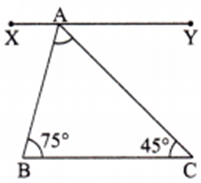
(d) Here ∠B = 75° and ∠C = 45°.
Since the line BC is parallel to XY.
So, ∠XAB = ∠B = 75° [Alternate angles] ….. (i)
and ∠YAC = ∠C = 45° [Alternate angles] ….. (ii)
Also, ∠XAB + ∠BAC + ∠YAC = 180° [∠XAY is a straight angle]
⇒ 75° + ∠BAC + 45° = 180° [Using (i) and (ii)]
⇒ ∠BAC = 180° – 120° = 60°
Text Solution by Our Experts:
Here is a detailed explanation to find the third angle of a triangle using parallel lines:
The key idea is that the sum of angles on a straight line is 180° and when two parallel lines are intersected by a transversal, alternate interior angles are equal.
In the given figures, line XY is parallel to line BC.
Also, ∠XAY is a straight angle, so:
∠XAB + ∠BAC + ∠YAC = 180°
- For part (a):
Given angles are ∠B = 36° and ∠C = 72°.
Since XY is parallel to BC, and AB is a transversal:
∠XAB = ∠B [Alternate interior angles]
∠XAB = 36° ...(i)
Since XY is parallel to BC, and AC is a transversal:
∠YAC = ∠C [Alternate interior angles]
∠YAC = 72° ...(ii)
Now, use the straight angle property at point A:
∠XAB + ∠BAC + ∠YAC = 180°
Substitute the values from (i) and (ii):
36° + ∠BAC + 72° = 180°
108° + ∠BAC = 180°
∠BAC = 180° - 108°
∠BAC = 72°
So, the third angle is 72°.
- For part (b):
Given angles are ∠B = 150° and ∠C = 15°.
Since XY is parallel to BC, and AB is a transversal:
∠XAB = ∠B [Alternate interior angles]
∠XAB = 150° ...(i)
Since XY is parallel to BC, and AC is a transversal:
∠YAC = ∠C [Alternate interior angles]
∠YAC = 15° ...(ii)
Now, use the straight angle property at point A:
∠XAB + ∠BAC + ∠YAC = 180°
Substitute the values from (i) and (ii):
150° + ∠BAC + 15° = 180°
165° + ∠BAC = 180°
∠BAC = 180° - 165°
∠BAC = 15°
So, the third angle is 15°.
- For part (c):
Given angles are ∠B = 90° and ∠C = 30°.
Since XY is parallel to BC, and AB is a transversal:
∠XAB = ∠B [Alternate interior angles]
∠XAB = 90° ...(i)
Since XY is parallel to BC, and AC is a transversal:
∠YAC = ∠C [Alternate interior angles]
∠YAC = 30° ...(ii)
Now, use the straight angle property at point A:
∠XAB + ∠BAC + ∠YAC = 180°
Substitute the values from (i) and (ii):
90° + ∠BAC + 30° = 180°
120° + ∠BAC = 180°
∠BAC = 180° - 120°
∠BAC = 60°
So, the third angle is 60°.
- For part (d):
Given angles are ∠B = 75° and ∠C = 45°.
Since XY is parallel to BC, and AB is a transversal:
∠XAB = ∠B [Alternate interior angles]
∠XAB = 75° ...(i)
Since XY is parallel to BC, and AC is a transversal:
∠YAC = ∠C [Alternate interior angles]
∠YAC = 45° ...(ii)
Now, use the straight angle property at point A:
∠XAB + ∠BAC + ∠YAC = 180°
Substitute the values from (i) and (ii):
75° + ∠BAC + 45° = 180°
120° + ∠BAC = 180°
∠BAC = 180° - 120°
∠BAC = 60°
So, the third angle is 60°.
In-Text Questions (Page 164)
Question:
Let us take two angles, say 60° and 70°, whose sum is less than 180°. Let the included side be 5 cm.
What could the measure of the third angle be? Does this measure change if the base length is changed to some other value, say 7 cm? Construct and find out.
Correct Answer is:
Given, the measure of two angles is 60° and 70°.
So, the measure of third angle = 180° – 60° – 70° = 50°.
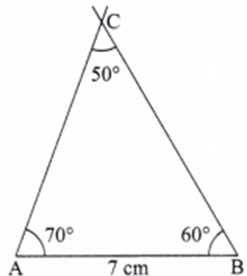
No, the measure of the third angle will not change if the base length is changed to some other value, say 7 cm.
Text Solution by Our Experts:
- Understand the property of angles in a triangle:
You know that the sum of all interior angles in any triangle is always 180°.
- Calculate the measure of the third angle:
You are given two angles of the triangle: 60° and 70°.
To find the third angle, you subtract the sum of these two angles from 180°.
Sum of given angles = 60° + 70° = 130°
Measure of the third angle = 180° - (60° + 70°)
= 180° - 130°
= 50°
So, the measure of the third angle is 50°.
- Consider the effect of changing the base length:
The question asks if the measure of the third angle changes if the base length is changed from 5 cm to 7 cm (or any other value).
The sum of the angles in a triangle is a fundamental property that depends only on the angles themselves, not on the lengths of the sides.
As long as the two given angles remain 60° and 70°, the third angle will always be 50°, regardless of the length of the included side.
Changing the base length will result in a similar triangle (a triangle with the same angles but possibly different side lengths), not a triangle with different angle measures.
- Conclusion:
No, the measure of the third angle will not change if the base length is changed to some other value, say 7 cm. It will remain 50°.
Figure it out (Page 163)
Question:
Determine which of the following pairs can be the angles of a triangle and which cannot:
(a) 35°, 150°
(b) 70°, 30°
(c) 90°, 85°
(d) 50°, 150°
Correct Answer is:
(a) The sum of the given angles = 35° + 150° = 185°. This is not possible because the total exceeds 180°.
(b) The sum of the given angles = 70° + 30° = 100°. Possible third angle = 180° – 100° = 80°. The pairs can be the angles of a triangle.
(c) The sum of the given angles = 90° + 85° = 175°. Possible third angle = 180° – 175° = 5°. The pairs can be the angles of a triangle.
(d) The sum of the given angles = 50° + 150° = 200°. This is not possible because the total exceeds 180°.
Text Solution by Our Experts:
To determine if a pair of angles can be the angles of a triangle, you need to remember a fundamental property of triangles: the sum of the three interior angles of any triangle is always 180°.
If you are given two angles, you can find their sum. If this sum is less than 180°, then a third positive angle can exist such that all three angles add up to 180°. If the sum of the two given angles is 180° or greater, then a triangle cannot be formed with those angles.
- For part (a):
Given angles are 35° and 150°.
First, find the sum of these two angles:
35° + 150° = 185°
Since 185° is greater than 180°, it is not possible for these two angles to be part of a triangle, as the sum of all three angles must be exactly 180°.
Therefore, these angles cannot be the angles of a triangle.
- For part (b):
Given angles are 70° and 30°.
First, find the sum of these two angles:
70° + 30° = 100°
Since 100° is less than 180°, a third angle can exist.
To find this possible third angle, subtract the sum from 180°:
Possible third angle = 180° - 100°
= 80°
Since a positive third angle of 80° can be formed, this pair of angles can be the angles of a triangle.
- For part (c):
Given angles are 90° and 85°.
First, find the sum of these two angles:
90° + 85° = 175°
Since 175° is less than 180°, a third angle can exist.
To find this possible third angle, subtract the sum from 180°:
Possible third angle = 180° - 175°
= 5°
Since a positive third angle of 5° can be formed, this pair of angles can be the angles of a triangle.
- For part (d):
Given angles are 50° and 150°.
First, find the sum of these two angles:
50° + 150° = 200°
Since 200° is greater than 180°, it is not possible for these two angles to be part of a triangle, as the sum of all three angles must be exactly 180°.
Therefore, these angles cannot be the angles of a triangle.
Figure it out (Page 163)
Question:
For each of the following angles, find another angle for which a triangle is (a) possible, (b) not possible. Find at least two different angles for each category:
(a) 30°
(b) 70°
(c) 54°
(d) 144°
Correct Answer is:
- (a) Another angle for which a triangle is possible will be any angle less than 150°.
- Two different angles are 60°, 90°.
- Another angle for which a triangle is not possible will be any angle greater than or equal to 150°.
- Two different angles are 170°, 160°.
- (b) Another angle for which a triangle is possible will be any angle less than 110°.
- Two different angles are 70°, 40°.
- Another angle for which a triangle is not possible will be any angle greater than or equal to 110°.
- Two different angles are 120°, 150°.
- (c) Another angle for which a triangle is possible will be any angle less than 126°.
- Two different angles are 72°, 54°.
- Another angle for which a triangle is not possible will be any angle greater than or equal to 126°.
- Two different angles are 140°, 130°.
- (d) Another angle for which a triangle is possible will be any angle less than 36°.
- Two different angles are 10°, 26°.
- Another angle for which a triangle is not possible will be any angle greater than or equal to 36°.
- At least two different angles are 40°, 50°.
Text Solution by Our Experts:
For a triangle to be possible, the sum of its three angles must be 180°.
1. Given angle = 30°
For a triangle:
30° + B < 180°
Therefore:
0° < B < 150°
Examples:
- B = 60° → C = 90° (Possible)
- B = 90° → C = 60° (Possible)
- B = 160° → Sum = 190° (Not possible)
- B = 170° → Sum = 200° (Not possible)
2. Given angle = 70°
0° < B < 110°
Examples:
- B = 70° → C = 40° (Possible)
- B = 40° → C = 70° (Possible)
- B = 120° → Sum = 190° (Not possible)
- B = 150° → Sum = 220° (Not possible)
3. Given angle = 54°
0° < B < 126°
Examples:
- B = 72° → C = 54° (Possible)
- B = 54° → C = 72° (Possible)
- B = 140° → Sum = 194° (Not possible)
- B = 130° → Sum = 184° (Not possible)
4. Given angle = 144°
0° < B < 36°
Examples:
- B = 10° → C = 26° (Possible)
- B = 26° → C = 10° (Possible)
- B = 40° → Sum = 184° (Not possible)
- B = 50° → Sum = 194° (Not possible)
Conclusion:
A triangle is possible only when the sum of the two given angles is less than 180°, so that the third angle is positive.
Figure it out (Page 162)
Question:
Construct triangles for the following measurements:
(a) 75°, 5 cm, 75°
(b) 25°, 3 cm, 60°
(c) 120°, 6 cm, 30°
Correct Answer is:
- (a) Step 1: Draw the base AB of length 5 cm.
- Step 2: Draw ∠A and ∠B of measure 75° each.
- Step 3: The point of intersection of the two new arms of ∠A and ∠B is the third vertex, C.
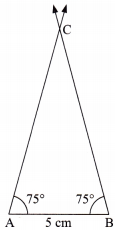
- (b) Step 1: Draw the base AB of length 3 cm.
- Step 2: Draw ∠A and ∠B of measure 25°, and 60° respectively.
- Step 3: The point of intersection of the two new arms of ∠A and ∠B is the third vertex, C.
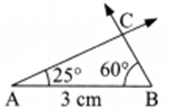
- (c) Step 1: Draw the base AB of length 6 cm.
- Step 2: Draw ∠A and ∠B of measure 30°, and 120° respectively.
- Step 3: The point of intersection of the two new arms of ∠A and ∠B is the third vertex, C.
Yes, triangles always exist.
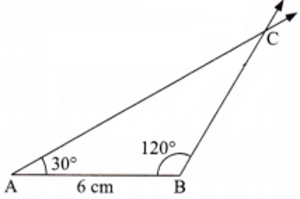
Text Solution by Our Experts:
Here are the steps to construct the triangles for the given measurements:
(a) For measurements: 75°, 5 cm, 75°
- First, draw a line segment AB of length 5 cm. This will be the base of your triangle.
- At point A, use a protractor to draw an angle of 75°. Extend this ray.
- At point B, use a protractor to draw another angle of 75°. Extend this ray.
- The point where these two rays intersect is the third vertex. Label it as C.
- You have now constructed triangle ABC with the given measurements.
(b) For measurements: 25°, 3 cm, 60°
- First, draw a line segment AB of length 3 cm. This will be the base of your triangle.
- At point A, use a protractor to draw an angle of 25°. Extend this ray.
- At point B, use a protractor to draw an angle of 60°. Extend this ray.
- The point where these two rays intersect is the third vertex. Label it as C.
- You have now constructed triangle ABC with the given measurements.
(c) For measurements: 120°, 6 cm, 30°
- First, draw a line segment AB of length 6 cm. This will be the base of your triangle.
- At point A, use a protractor to draw an angle of 30°. Extend this ray.
- At point B, use a protractor to draw an angle of 120°. Extend this ray.
- The point where these two rays intersect is the third vertex. Label it as C.
- You have now constructed triangle ABC with the given measurements.
Note:
A triangle can be constructed when two angles and the included side are given (ASA criterion), provided that the sum of the two given angles is less than 180°.
In all the given cases, the sum of the two angles is less than 180°, so the triangles can be constructed.
Figure it out (Page 161)
Question:
Construct triangles for the following measurements, where the angle is included between the sides:
(a) 3 cm, 75°, 7 cm
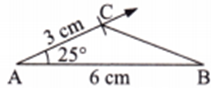
(b) 6 cm, 25°, 3 cm
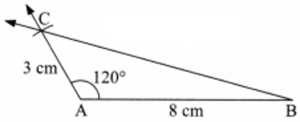
(c) 3 cm, 120°, 8 cm
Correct Answer is:
- (a) Step 1: Construct a side AB of length 7 cm.
- Step 2: Construct ∠A = 75° by drawing the other arm of the angle.
- Step 3: Mark the point C on the other arm such that AC = 3 cm.
- Step 4: Join BC to get the required triangle.
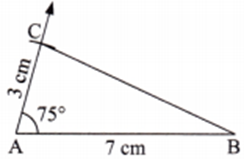
- (b) Step 1: Construct a side AB of length 6 cm.
- Step 2: Construct ∠A = 25° by drawing the other arm of the angle.
- Step 3: Mark the point C on the other arm such that AC = 3 cm.
- Step 4: Join BC to get the required triangle.
- (c) Step 1: Construct a side AB of length 8 cm.
- Step 2: Construct ∠A = 120° by drawing the other arm of the angle.
- Step 3: Mark the point C on the other arm such that AC = 3 cm.
- Step 4: Join BC to get the required triangle.
Text Solution by Our Experts:
To construct a triangle when two sides and the included angle (SAS criterion) are given, follow these steps for each part:
(a) For measurements: 3 cm, 75°, 7 cm
- First, draw a line segment AB of length 7 cm using a ruler.
- At point A, construct an angle of 75° using a protractor. Draw a ray from A at this angle.
- Along the arm of the 75° angle, measure and mark a point C such that AC = 3 cm.
- Finally, join point B to point C with a straight line segment.
- You now have the required triangle ABC.
(b) For measurements: 6 cm, 25°, 3 cm
- First, draw a line segment AB of length 6 cm using a ruler.
- At point A, construct an angle of 25° using a protractor. Draw a ray from A at this angle.
- Along the arm of the 25° angle, measure and mark a point C such that AC = 3 cm.
- Join point B to point C with a straight line segment.
- You now have the required triangle ABC.
(c) For measurements: 3 cm, 120°, 8 cm
- First, draw a line segment AB of length 8 cm using a ruler.
- At point A, construct an angle of 120° using a protractor. Draw a ray from A at this angle.
- Along the arm of the 120° angle, measure and mark a point C such that AC = 3 cm.
- Join point B to point C with a straight line segment.
- You now have the required triangle ABC.
Note:
In each case, the triangle is constructed using the SAS (Side-Angle-Side) criterion, where two sides and the included angle are given.
Figure it out (Page 159)
Question:
For each of the following, give at least 5 possible values for the third length so there exists a triangle having these as sidelengths (decimal values could also be chosen):
(a) 1, 100
(b) 5, 5
(c) 3, 7
See if you can describe all possible lengths of the third side in each case, so that a triangle exists with those side lengths. For example, in case (a), all numbers strictly between 99 and 101 would be possible.
Correct Answer is:
When two sides are given, then the third side must lie between the sum and the difference of the two lengths for the existence of a triangle.
Therefore, (b) numbers will lie between 0 and 10, and (c) numbers will be between 4 and 10.
Text Solution by Our Experts:
Here is how you can determine the possible lengths of the third side of a triangle:
- Understand the Triangle Inequality Theorem:
For any three lengths to form a triangle, the sum of the lengths of any two sides must be greater than the length of the third side.
If two sides are a and b and the third side is c, then:
|a - b| < c < a + b
This means that the third side must be greater than the difference between the two given sides and less than their sum.
- Apply the theorem to part (b) with given sides 5 cm and 5 cm:
Let the two given sides be:
a = 5 cm
b = 5 cm
Let the third side be c.
Difference:
|5 - 5| = 0
Sum:
5 + 5 = 10
Therefore:
0 < c < 10
So, the third side must be greater than 0 cm and less than 10 cm.
Some possible values are:
1 cm, 2 cm, 5 cm, 8 cm, 9.5 cm
Therefore, all possible lengths of the third side are numbers strictly between 0 cm and 10 cm.
- Apply the theorem to part (c) with given sides 3 cm and 7 cm:
Let the two given sides be:
a = 3 cm
b = 7 cm
Let the third side be c.
Difference:
|3 - 7| = 4
Sum:
3 + 7 = 10
Therefore:
4 < c < 10
So, the third side must be greater than 4 cm and less than 10 cm.
Some possible values are:
4.5 cm, 5 cm, 6 cm, 8 cm, 9.9 cm
Therefore, all possible lengths of the third side are numbers strictly between 4 cm and 10 cm.
Summary:
When two sides of a triangle are given, the third side must satisfy:
|a - b| < c < a + b
(b) For sides 5 cm and 5 cm:
0 < c < 10
The third side can be any length strictly between 0 cm and 10 cm.
(c) For sides 3 cm and 7 cm:
4 < c < 10
The third side can be any length strictly between 4 cm and 10 cm.
Figure it Out (Page 159)
Question:
For each of the following, give at least 5 possible values for the third length so there exists a triangle having these as sidelengths (decimal values could also be chosen):
(a) 1, 100
(b) 5, 5
(c) 3, 7
Correct Answer is:
- (a) 5 possible values for the third length would be 99.5, 99.8, 100, 100.5, 100.9
Since, 100 < 1 + 99.5, 100 < 1 + 99.8, 100 < 1 + 100, 100 < 1 + 100.5, and 100 < 1 + 100.9 - (b) 5 possible values for the third length would be 1, 3.5, 5, 7.5, 8.9
Since, 5 < 1 + 5, 5 < 5 + 3.5, 5 < 5 + 5, 5 < 5 + 7.5, and 5 < 5 + 8.9 - (c) 5 possible values for the third length would be 4.5, 5, 6.9, 8, 9.8
Since, 7 < 3 + 4.5, 7 < 5 + 3, 7 < 3 + 6.9, 7 < 3 + 8, 7 < 3 + 9.8
Text Solution by Our Experts:
To form a triangle with three given side lengths, we use the Triangle Inequality Theorem.
The Triangle Inequality Theorem states that the sum of the lengths of any two sides of a triangle must be greater than the length of the third side.
Let the two given side lengths be a and b, and let the third side be x.
The following conditions must be satisfied:
- a + b > x
- a + x > b
- b + x > a
Therefore, the third side must satisfy:
|a - b| < x < a + b
(a) Given side lengths: 1 and 100
Let:
- a = 1
- b = 100
Using the formula:
- |a - b| < x < a + b
- |1 - 100| < x < 1 + 100
- 99 < x < 101
Therefore, the third side x must be greater than 99 and less than 101.
Five possible values of x are:
99.5, 99.8, 100, 100.5, 100.9
Verification for x = 99.5:
- 1 + 100 > 99.5 → 101 > 99.5 → True
- 1 + 99.5 > 100 → 100.5 > 100 → True
- 100 + 99.5 > 1 → 199.5 > 1 → True
Therefore, x = 99.5 is possible.
(b) Given side lengths: 5 and 5
Let:
- a = 5
- b = 5
Using the formula:
- |a - b| < x < a + b
- |5 - 5| < x < 5 + 5
- 0 < x < 10
Therefore, the third side x must be greater than 0 and less than 10.
Five possible values of x are:
1, 3.5, 5, 7.5, 8.9
Verification for x = 3.5:
- 5 + 5 > 3.5 → 10 > 3.5 → True
- 5 + 3.5 > 5 → 8.5 > 5 → True
- 5 + 3.5 > 5 → 8.5 > 5 → True
Therefore, x = 3.5 is possible.
(c) Given side lengths: 3 and 7
Let:
- a = 3
- b = 7
Using the formula:
- |a - b| < x < a + b
- |3 - 7| < x < 3 + 7
- 4 < x < 10
Therefore, the third side x must be greater than 4 and less than 10.
Five possible values of x are:
4.5, 5, 6.9, 8, 9.8
Verification for x = 4.5:
- 3 + 7 > 4.5 → 10 > 4.5 → True
- 3 + 4.5 > 7 → 7.5 > 7 → True
- 7 + 4.5 > 3 → 11.5 > 3 → True
Therefore, x = 4.5 is possible.
Final Answer:
(a) For sides 1 and 100:
99 < x < 101
Possible values: 99.5, 99.8, 100, 100.5, 100.9
(b) For sides 5 and 5:
0 < x < 10
Possible values: 1, 3.5, 5, 7.5, 8.9
(c) For sides 3 and 7:
4 < x < 10
Possible values: 4.5, 5, 6.9, 8, 9.8
Figure it out (Page 159)
Question:
Does there exist an equilateral triangle with sides 50, 50, 50? In general, does there exist an equilateral triangle of any side length? Justify your answer.
Correct Answer is:
- Yes, an equilateral triangle with sides 50, 50, 50 exists because the sum of two sides is greater than the third side.
- In an equilateral triangle, all sides are equal, so this condition is satisfied.
- Yes, an equilateral triangle always exists for any positive side length.
- For any positive number, say x > 0, an equilateral triangle with all side lengths x exists.
Text Solution by Our Experts:
To determine if a triangle can exist with given side lengths, we need to check the Triangle Inequality Theorem.
- Understanding the Triangle Inequality Theorem
The Triangle Inequality Theorem states that the sum of the lengths of any two sides of a triangle must be greater than the length of the third side.
If the side lengths are a, b, and c, then all three conditions must be true:
i) a + b > c
ii) a + c > b
iii) b + c > a
- Checking an Equilateral Triangle with Sides 50, 50, 50
An equilateral triangle has all three sides of equal length.
Here, the side lengths are:
50, 50, 50
Let's apply the Triangle Inequality Theorem:
i) 50 + 50 > 50
100 > 50 → True
ii) 50 + 50 > 50
100 > 50 → True
iii) 50 + 50 > 50
100 > 50 → True
Since all three conditions are satisfied, an equilateral triangle with sides 50, 50, and 50 exists.
- Checking an Equilateral Triangle of Any Side Length
Let x be any positive side length of an equilateral triangle.
Then all three sides will have length x.
Applying the Triangle Inequality Theorem:
- x + x > x
- 2x > x
Subtract x from both sides:
- 2x - x > x - x
- x > 0
Since x represents a side length, it must be positive. Therefore, x > 0 is always true.
The other two conditions will also be true for the same reason:
x + x > x
Therefore, an equilateral triangle can be formed with any positive side length.
- Conclusion
Yes, an equilateral triangle with sides 50, 50, and 50 exists because the sum of any two sides is greater than the third side.
50 + 50 = 100 > 50
In general, an equilateral triangle can always be formed for any positive side length x because:
x + x > x
which simplifies to:
2x > x
This is true for every positive value of x.
Figure it out (Page 159)
Question:
Check if a triangle exists for each of the following set of lengths:
(a) 1, 100, 100
(b) 3, 6, 9
(c) 1, 1, 5
(d) 5, 10, 12
Correct Answer is:
- We know that when each length is smaller than the sum of the other two, we say that the lengths satisfy the triangle inequality, and when a set of lengths satisfies the triangle inequality, then a triangle exists.
- (a) Here 1 < 100 + 100, 100 < 100 + 1
So, for sidelengths 1, 100, 100, a triangle exists. - (b) 3 < 6 + 9, 6 < 3 + 9, but 9 = 6 + 3
So, for sidelengths 3, 6, 9, a triangle does not exist. - (c) 1 < 1 + 5, but 5 > 1 + 1
So, for sidelengths 1, 1, 5, a triangle does not exist. - (d) 5 < 10 + 12, 10 < 5 + 12, 12 < 10 + 5
So, for sidelengths 5, 10, and 12, a triangle exists.
Text Solution by Our Experts:
To check if a triangle exists for a given set of lengths, we use the Triangle Inequality Theorem. This theorem states that the sum of the lengths of any two sides of a triangle must be greater than the length of the third side. If this condition is met for all three pairs of sides, then a triangle can be formed.
Let’s check each set of lengths:
- For side lengths (a) 1, 100, 100:
We need to check three conditions:
a. Is the sum of the first two sides greater than the third side?
1 + 100 = 101
Is 101 > 100? Yes.
b. Is the sum of the second and third sides greater than the first side?
100 + 100 = 200
Is 200 > 1? Yes.
c. Is the sum of the first and third sides greater than the second side?
1 + 100 = 101
Is 101 > 100? Yes.
Since all three conditions are satisfied, a triangle exists for these lengths.
- For side lengths (b) 3, 6, 9:
Let’s check the conditions:
Is 3 + 6 > 9?
3 + 6 = 9
Since 9 is equal to 9 and not greater than 9, the Triangle Inequality Theorem is not satisfied.
Therefore, a triangle does not exist for these lengths.
- For side lengths (c) 1, 1, 5:
Let’s check the conditions:
Is 1 + 1 > 5?
1 + 1 = 2
Is 2 > 5? No.
Since the sum of two sides is not greater than the third side, the Triangle Inequality Theorem is not satisfied.
Therefore, a triangle does not exist for these lengths.
- For side lengths (d) 5, 10, 12:
Let’s check the conditions:
a. Is 5 + 10 > 12?
15 > 12 — Yes.
b. Is 5 + 12 > 10?
17 > 10 — Yes.
c. Is 10 + 12 > 5?
22 > 5 — Yes.
Since all three conditions are satisfied, a triangle exists for these lengths.
Summary:
(a) A triangle exists for 1, 100, 100.
(b) A triangle does not exist for 3, 6, 9.
(c) A triangle does not exist for 1, 1, 5.
(d) A triangle exists for 5, 10, 12.
In-text questions (Page 159)
Question:
How will the two circles turn out for a set of lengths that do not satisfy the triangle inequality? Find 3 examples of sets of lengths for which the circles:
(a) touch each other at a point,
(b) do not intersect.
Correct Answer is:
When a set of three segment lengths does not satisfy the triangle inequality, it means those segments cannot form a triangle. However, two circles with these lengths as distances between their centres and points on their circumference can behave differently.
(a) (i) 3, 4, 7 (ii) 5, 2, 3 (iii) 6, 2, 4
(b) (i) 3, 4, 8 (ii) 6, 2, 3 (iii) 5, 1, 2
Text Solution by Our Experts:
Let’s understand the concept of the Triangle Inequality first.
The Triangle Inequality states that the sum of the lengths of any two sides of a triangle must be greater than the length of the third side. If this condition is not met, a triangle cannot be formed.
When we talk about two circles, we consider two radii, r₁ and r₂, and the distance between their centres, d.
So, the three lengths are r₁, r₂, and d.
- When the circles touch each other at a point (tangent circles):
This can happen in two ways:
(a) Externally tangent:
If the circles touch externally, the distance between their centres d is equal to the sum of their radii:
d = r₁ + r₂
In this case, the strict Triangle Inequality is not satisfied because:
r₁ + r₂ = d
Examples:
(i) 3, 4, 7
Here, 3 + 4 = 7.
If r₁ = 3, r₂ = 4, then d = 7. The circles touch externally.
(ii) 5, 2, 3
Here, 2 + 3 = 5.
If r₁ = 2, r₂ = 3, then d = 5. The circles touch externally.
(iii) 6, 2, 4
Here, 2 + 4 = 6.
If r₁ = 2, r₂ = 4, then d = 6. The circles touch externally.
(b) Internally tangent:
If one circle touches another internally, the distance between their centres d is equal to the absolute difference of their radii:
d = |r₁ - r₂|
For example, if r₁ = 5, r₂ = 2, and d = 3:
|5 - 2| = 3
Here, 2 + 3 = 5, so the strict Triangle Inequality is not satisfied.
- When the circles do not intersect:
This means the circles are either completely separate or one circle is completely inside the other without touching it.
(a) Circles are separate:
If the circles are completely separate, the distance between their centres is greater than the sum of their radii:
d > r₁ + r₂
Examples:
(i) 3, 4, 8
Here, 3 + 4 = 7.
Since 8 > 7, the circles do not intersect.
(ii) 6, 2, 3
Here, 2 + 3 = 5.
Since 6 > 5, the circles do not intersect.
(iii) 5, 1, 2
Here, 1 + 2 = 3.
Since 5 > 3, the circles do not intersect.
(b) One circle is completely inside the other without touching:
If one circle is inside the other without touching, the distance between their centres is less than the absolute difference of their radii:
d < |r₁ - r₂|
For example, if r₁ = 5, r₂ = 2, and d = 1:
|5 - 2| = 3
Since 1 < 3, the smaller circle is inside the larger circle without touching it.
In this case, the Triangle Inequality is also not satisfied.
Summary:
The Triangle Inequality:
- a + b > c
- b + c > a
- c + a > b
ensures that three segments can form a triangle.
For two circles with radii r₁ and r₂ and centre distance d:
(a) Circles touch each other at one point when:
d = r₁ + r₂ → External tangency
or
d = |r₁ - r₂| → Internal tangency
(b) Circles do not intersect when:
d > r₁ + r₂ → Circles are completely separate
or
d < |r₁ - r₂| → One circle is completely inside the other without touching.
Figure it out (Page 156)
Question:
Which of the following lengths can be the sidelengths of a triangle? Explain your answers. Note that for each set, the three lengths have the same unit of measure.
(a) 2, 2, 5
(b) 3, 4, 6
(c) 2, 4, 8
(d) 5, 5, 8
(e) 10, 20, 25
(f) 10, 20, 35
(g) 24, 26, 28
We observe from the previous problems that whenever there is a set of lengths satisfying the triangle inequality (each length < sum of the other two lengths), there is a triangle with those three lengths as sidelengths.
Correct Answer is:
- A set of lengths can be the sidelengths of a triangle if each length < the sum of the other two lengths.
(a) 2 < 5 + 2 but 5 > 2 + 2
So, 2, 2, 5 cannot be the sidelengths of a triangle. - (b) 3 < 4 + 6, 4 < 3 + 6, 6 < 4 + 3
So, 3, 4, 6 can be the sidelengths of a triangle. - (c) 2 < 4 + 8, 4 < 2 + 8, but 8 > 4 + 2
So, 2, 4, 8 cannot be the sidelengths of a triangle. - (d) 5 < 5 + 8, 8 < 5 + 5
So, 5, 5, 8 can be the sidelengths of a triangle. - (e) 10 < 20 + 25, 20 < 25 + 10, 25 < 10 + 20
So, 10, 20, 25 can be the sidelengths of a triangle. - (f) 10 < 20 + 35, 20 < 10 + 35, but 35 > 10 + 20
So, 10, 20, 35 cannot be the sidelengths of a triangle. - (g) 24 < 26 + 28, 26 < 24 + 28, 28 < 24 + 26
So, 24, 26, 28 can be the sidelengths of a triangle.
Text Solution by Our Experts:
To determine if a set of lengths can form a triangle, we use the Triangle Inequality Theorem.
The theorem states that the sum of the lengths of any two sides of a triangle must be greater than the length of the third side. If this condition is not met for even one pair of sides, a triangle cannot be formed.
Let’s check each set of lengths:
- For the lengths 2, 2, 5:
a) Is 2 < 2 + 5?
Yes, 2 < 7.
b) Is 2 < 2 + 5?
Yes, 2 < 7.
c) Is 5 < 2 + 2?
No, 5 > 4.
Since one of the conditions is not satisfied, the lengths 2, 2, 5 cannot form a triangle.
- For the lengths 3, 4, 6:
a) Is 3 < 4 + 6?
Yes, 3 < 10.
b) Is 4 < 3 + 6?
Yes, 4 < 9.
c) Is 6 < 3 + 4?
Yes, 6 < 7.
Since all three conditions are satisfied, the lengths 3, 4, 6 can form a triangle.
- For the lengths 2, 4, 8:
a) Is 2 < 4 + 8?
Yes, 2 < 12.
b) Is 4 < 2 + 8?
Yes, 4 < 10.
c) Is 8 < 2 + 4?
No, 8 > 6.
Since one of the conditions is not satisfied, the lengths 2, 4, 8 cannot form a triangle.
- For the lengths 5, 5, 8:
a) Is 5 < 5 + 8?
Yes, 5 < 13.
b) Is 5 < 5 + 8?
Yes, 5 < 13.
c) Is 8 < 5 + 5?
Yes, 8 < 10.
Since all three conditions are satisfied, the lengths 5, 5, 8 can form a triangle.
- For the lengths 10, 20, 25:
a) Is 10 < 20 + 25?
Yes, 10 < 45.
b) Is 20 < 10 + 25?
Yes, 20 < 35.
c) Is 25 < 10 + 20?
Yes, 25 < 30.
Since all three conditions are satisfied, the lengths 10, 20, 25 can form a triangle.
- For the lengths 10, 20, 35:
a) Is 10 < 20 + 35?
Yes, 10 < 55.
b) Is 20 < 10 + 35?
Yes, 20 < 45.
c) Is 35 < 10 + 20?
No, 35 > 30.
Since one of the conditions is not satisfied, the lengths 10, 20, 35 cannot form a triangle.
- For the lengths 24, 26, 28:
a) Is 24 < 26 + 28?
Yes, 24 < 54.
b) Is 26 < 24 + 28?
Yes, 26 < 52.
c) Is 28 < 24 + 26?
Yes, 28 < 50.
Since all three conditions are satisfied, the lengths 24, 26, 28 can form a triangle.
Summary:
- 2, 2, 5 → No
- 3, 4, 6 → Yes
- 2, 4, 8 → No
- 5, 5, 8 → Yes
- 10, 20, 25 → Yes
- 10, 20, 35 → No
- 24, 26, 28 → Yes
Figure it Out (Page 154)
Question:
For a given set of lengths in a triangle, is it possible to identify which lengths will immediately be less than the sum of the other two, without calculations?
[Hint: Consider the direct lengths in the increasing order]
Correct Answer is:
Yes, it is possible to identify which lengths will immediately be less than the sum of the other two, if we take the direct lengths in increasing order.
Text Solution by Our Experts:
To form a triangle, the sum of the lengths of any two sides must be greater than the length of the third side. This is known as the Triangle Inequality Theorem.
- Consider a set of three lengths, let’s call them a, b, and c.
- Arrange these lengths in increasing order. Let the sorted lengths be x, y, and z, such that:
x ≤ y ≤ z
- According to the Triangle Inequality Theorem, three conditions must be met for a triangle to be formed:
a) x + y > z
b) x + z > y
c) y + z > x
- Since we have arranged the lengths in increasing order (x ≤ y ≤ z), the conditions x + z > y and y + z > x will always be true if x, y, and z are positive lengths.
For example, since z ≥ y, x + z will definitely be greater than y because x is a positive length. Similarly, since z ≥ x, y + z will definitely be greater than x because y is a positive length.
- Therefore, the only condition we need to check to determine if a triangle can be formed is:
x + y > z
- If this condition (x + y > z) is true, then all three lengths (x, y, and z) will be less than the sum of the other two sides.
So, by arranging the lengths in increasing order, you can immediately identify the two shortest lengths (x and y) and the longest length (z). The crucial check is whether the sum of the two shortest lengths is greater than the longest length.
If it is, then all three lengths satisfy the Triangle Inequality Theorem, meaning each length is less than the sum of the other two.
Thus, to determine whether three given lengths can form a triangle, arrange them in increasing order and check whether the sum of the two shortest lengths is greater than the longest length.
In-Text Questions (Page 154)
Question:
Will this always happen? That is, for any set of lengths, will there be at least two comparisons where the direct length is less than the sum of the other two? Explore different sets of lengths.
Correct Answer is:
- (i) 5 mm, 10 mm, 20 mm.
There are two comparisons where this happens:
10 < 5 + 20 and 5 < 10 + 20, but 20 > 10 + 5 - (ii) 12 cm, 20 cm and 40 cm.
There are two comparisons where this happens:
12 < 20 + 40 and 20 < 12 + 40, but 40 > 12 + 20
Text Solution by Our Experts:
Here’s how you can explore different sets of lengths to understand the given condition:
Step 1: Understand the Condition
You need to check if, for any three given lengths, at least two of these lengths are less than the sum of the other two lengths.
This condition is related to the Triangle Inequality Theorem, which states that the sum of the lengths of any two sides of a triangle must be greater than the length of the third side.
If you can form a triangle with these lengths, then all three conditions will be true:
a < b + c
b < a + c
c < a + b
However, the question asks if at least two comparisons will hold true.
Step 2: Examine the First Set of Lengths: 5 mm, 10 mm, 20 mm
Let the lengths be:
a = 5 mm, b = 10 mm, c = 20 mm
Perform the three possible comparisons:
- Is a < b + c?
5 < 10 + 20
5 < 30
This is true.
- Is b < a + c?
10 < 5 + 20
10 < 25
This is true.
- Is c < a + b?
20 < 5 + 10
20 < 15
This is false.
In this set, two comparisons are true and one is false. Therefore, there are two comparisons where the direct length is less than the sum of the other two.
Step 3: Examine the Second Set of Lengths: 12 cm, 20 cm, 40 cm
Let the lengths be:
a = 12 cm, b = 20 cm, c = 40 cm
Perform the three possible comparisons:
- Is a < b + c?
12 < 20 + 40
12 < 60
This is true.
- Is b < a + c?
20 < 12 + 40
20 < 52
This is true.
- Is c < a + b?
40 < 12 + 20
40 < 32
This is false.
In this set, two comparisons are true and one is false. Therefore, there are two comparisons where the direct length is less than the sum of the other two.
Step 4: Conclusion
In both examples, there are always at least two comparisons where the direct length is less than the sum of the other two.
This happens because the two smaller lengths will always be less than the sum of the other two lengths, which includes the largest length.
The only comparison that may be false is when the largest length is compared with the sum of the two smaller lengths.
For example:
20 > 10 + 5
40 > 12 + 20
Therefore, for any set of three positive lengths, there will always be at least two comparisons where the direct length is less than the sum of the other two.
If we take any three positive lengths x, y, and z such that:
x ≤ y ≤ z
then:
- x < y + z will always be true because y and z are positive.
- y < x + z will always be true because x and z are positive.
- z < x + y may or may not be true.
Since the first two conditions are always true for positive lengths, there will always be at least two such comparisons.
Figure it Out (Page 154)
Question:
For each set of lengths seen so far, you might have noticed that in at least two of the comparisons, the direct length was less than the sum of the other two (if not, check again!).
For example, for the set of lengths 10 cm, 15 cm, and 30 cm, there are two comparisons where this happens:
- 10 < 15 + 30
- 15 < 10 + 30
But this doesn’t happen for the third length: 30 > 10 + 15.
Correct Answer is:
- In the example, two comparisons satisfy the inequality and one does not.
- This confirms that at least two comparisons will have the sum greater, but for a valid triangle, all three must be greater.
Text Solution by Our Experts:
This problem explores a fundamental property of triangles, known as the Triangle Inequality Theorem.
1. Understanding the Triangle Inequality Theorem
For any three lengths to form a triangle, the sum of the lengths of any two sides must always be greater than the length of the third side.
If this condition is not met for even one pair of sides, then a triangle cannot be formed with those lengths.
2. Analyzing the Given Example
The three given lengths are:
10 cm, 15 cm, and 30 cm
Let’s check the three possible comparisons based on the Triangle Inequality Theorem.
a) Is the sum of the first two lengths greater than the third length?
10 + 15 = 25
Compare 25 with 30 cm:
25 < 30
Therefore, 10 + 15 > 30 is false. This condition is not satisfied.
b) Is the sum of the first and third lengths greater than the second length?
10 + 30 = 40
Compare 40 with 15 cm:
40 > 15
Therefore, 10 + 30 > 15 is true. This condition is satisfied.
c) Is the sum of the second and third lengths greater than the first length?
15 + 30 = 45
Compare 45 with 10 cm:
45 > 10
Therefore, 15 + 30 > 10 is true. This condition is satisfied.
3. Interpreting the Results
From the three comparisons, two of them satisfy the condition that a length is less than the sum of the other two:
10 < 15 + 30
15 < 10 + 30
However, the third comparison does not satisfy the condition:
30 > 10 + 15
Since:
30 > 25
the condition 30 < 10 + 15 is false.
4. Conclusion
For three lengths to form a valid triangle, all three conditions must be satisfied.
For sides a, b, and c:
a + b > c
a + c > b
b + c > a
In the given example:
10 + 15 = 25 < 30
Therefore, the condition 10 + 15 > 30 is not satisfied.
Hence, 10 cm, 15 cm, and 30 cm cannot form a triangle.
Thus, even though two conditions are satisfied, a triangle cannot be formed unless all three conditions are satisfied.
In-text questions (Page 154)
Question:
Can we say anything about the existence of a triangle for each of the following sets of lengths?
(a) 10 km, 10 km, and 25 km
(b) 5 mm, 10 mm, and 20 mm
(c) 12 cm, 20 cm, and 40 cm
You would have realised that using a rough figure and comparing the direct path lengths with their corresponding roundabout path lengths is the same as comparing each length with the sum of the other two lengths. There are three such comparisons to be made.
Correct Answer is:
- (a) When we take the direct path = 25 km.
Then the roundabout path = 10 km + 10 km = 20 km.
Since the direct path is longer than the roundabout path.
So, the existence of a triangle is not possible. - (b) When we take the direct path = 20 mm.
Then the roundabout path = 10 mm + 5 mm = 15 mm.
Since the direct path is longer than the roundabout path.
So, the existence of a triangle is not possible. - (c) When we take the direct path = 40 cm.
Then the roundabout path = 12 cm + 20 cm = 32 cm.
Since the direct path is longer than the roundabout path.
So, the existence of a triangle is not possible.
Text Solution by Our Experts:
To determine if a triangle can be formed with given side lengths, you need to apply the Triangle Inequality Theorem.
This theorem states that the sum of the lengths of any two sides of a triangle must be greater than the length of the third side. If this condition is not met for even one combination of sides, then a triangle cannot be formed.
The question describes this as comparing a “direct path” (the longest side) with a “roundabout path” (the sum of the other two sides). For a triangle to exist, the direct path must be shorter than the roundabout path.
1. (a) Given lengths: 10 km, 10 km, and 25 km
The longest side (direct path) is 25 km.
The sum of the other two sides (roundabout path) is:
10 km + 10 km = 20 km
Compare the direct path and the roundabout path:
25 km > 20 km
Since the direct path (25 km) is longer than the roundabout path (20 km), a triangle cannot be formed with these lengths.
2. (b) Given lengths: 5 mm, 10 mm, and 20 mm
The longest side (direct path) is 20 mm.
The sum of the other two sides (roundabout path) is:
5 mm + 10 mm = 15 mm
Compare the direct path and the roundabout path:
20 mm > 15 mm
Since the direct path (20 mm) is longer than the roundabout path (15 mm), a triangle cannot be formed with these lengths.
3. (c) Given lengths: 12 cm, 20 cm, and 40 cm
The longest side (direct path) is 40 cm.
The sum of the other two sides (roundabout path) is:
12 cm + 20 cm = 32 cm
Compare the direct path and the roundabout path:
40 cm > 32 cm
Since the direct path (40 cm) is longer than the roundabout path (32 cm), a triangle cannot be formed with these lengths.
Conclusion
In all three cases, the sum of the two shorter sides is not greater than the longest side.
Therefore, a triangle cannot be formed for any of the given sets of lengths.
Figure it Out (Page 154)
Question:
We checked by construction that there are no triangles having sidelengths 3 cm, 4 cm, and 8 cm; and 2 cm, 3 cm, and 6 cm. Check if you could have found this without trying to construct the triangle.
Correct Answer is:
(a) Consider AB = 4 cm, BC = 3 cm and AC = 8 cm.
Now, direct path length = BC = 3 cm
And, roundabout path length = BA + AC = 4 cm + 8 cm = 12 cm
The direct path length is shorter than the roundabout path length.
Also, direct path length = AB = 4 cm
Roundabout path length = AC + BC = 8 cm + 3 cm = 11 cm
The direct path length is shorter than the roundabout path length.
Again, direct path length = AC = 8 cm
Then, roundabout path length = AB + BC = 4 cm + 3 cm = 7 cm
In this case, the direct path is longer than the roundabout path.
So, a triangle cannot exist.
(b) Consider AB = 3 cm, BC = 2 cm, AC = 6 cm
If we take the direct path = AC = 6 cm.
And, roundabout path length = AB + BC = 3 cm + 2 cm = 5 cm
Since the direct path is longer than the roundabout path. So, a triangle cannot exist.
Text Solution by Our Experts:
To determine if a triangle can be formed with given side lengths without constructing it, we use the Triangle Inequality Theorem.
The Triangle Inequality Theorem states that the sum of the lengths of any two sides of a triangle must be greater than the length of the third side. If this condition is not met for even one pair of sides, a triangle cannot be formed.
Let's check the given cases.
1. For side lengths 3 cm, 4 cm, and 8 cm
Let the sides be:
AB = 4 cm, BC = 3 cm, and AC = 8 cm.
Step 1: Check the first condition
Take BC = 3 cm as the direct path.
The roundabout path is:
BA + AC = 4 cm + 8 cm = 12 cm
Since:
3 cm < 12 cm
the direct path is shorter than the roundabout path. This condition is satisfied.
Step 2: Check the second condition
Take AB = 4 cm as the direct path.
The roundabout path is:
AC + BC = 8 cm + 3 cm = 11 cm
Since:
4 cm < 11 cm
the direct path is shorter than the roundabout path. This condition is also satisfied.
Step 3: Check the third condition
Take AC = 8 cm as the direct path.
The roundabout path is:
AB + BC = 4 cm + 3 cm = 7 cm
Here:
8 cm > 7 cm
So, the direct path is longer than the roundabout path.
According to the Triangle Inequality Theorem:
AB + BC > AC
But:
4 cm + 3 cm = 7 cm < 8 cm
Therefore, this condition is not satisfied.
Hence, a triangle cannot be formed with side lengths 3 cm, 4 cm, and 8 cm.
2. For side lengths 2 cm, 3 cm, and 6 cm
Let the sides be:
AB = 3 cm, BC = 2 cm, and AC = 6 cm.
Step 1: Check the Triangle Inequality Theorem
Consider the longest side, AC = 6 cm, as the direct path.
The roundabout path is:
AB + BC = 3 cm + 2 cm = 5 cm
Here:
6 cm > 5 cm
This means the direct path is longer than the roundabout path.
Since:
AB + BC = 5 cm < AC = 6 cm
the Triangle Inequality Theorem is not satisfied.
Therefore, a triangle cannot be formed with side lengths 2 cm, 3 cm, and 6 cm.
Conclusion
In both cases, we can determine whether a triangle can be formed simply by checking the Triangle Inequality Theorem.
If the sum of any two sides is not greater than the third side, a triangle cannot be formed.
Therefore:
- 3 cm, 4 cm, and 8 cm → Triangle cannot be formed
- 2 cm, 3 cm, and 6 cm → Triangle cannot be formed
In-text questions (Page 153)
Question:
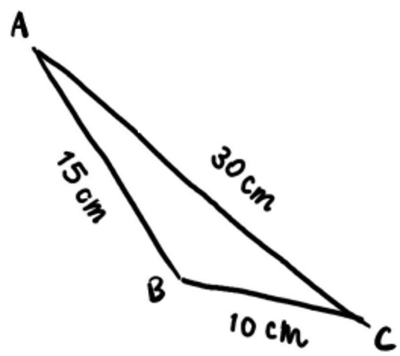
“In the rough diagram given alongside, is it possible to assign lengths in a different order such that the direct paths are always coming out to be shorter than the roundabout paths? If this is possible, then a triangle might exist.”
Correct Answer is:
No, it is not possible.
Text Solution by Our Experts:
To determine if a triangle can exist with given side lengths, we use the Triangle Inequality Theorem. This theorem states that the sum of the lengths of any two sides of a triangle must be greater than the length of the third side.
Let the three side lengths be a, b, and c. For a triangle to exist, the following three conditions must be satisfied:
- a + b > c
- a + c > b
- b + c > a
In the given diagram, the lengths of the sides are 15 cm, 10 cm, and 30 cm.
Let's check these lengths against the Triangle Inequality Theorem.
Step 1: Consider the sum of the two shorter sides
15 cm + 10 cm = 25 cm
Now, compare this sum with the longest side, which is 30 cm:
25 cm is not greater than 30 cm.
Therefore:
15 + 10 < 30
Since the sum of the two shorter sides is less than the longest side, the Triangle Inequality Theorem is not satisfied.
Conclusion
A triangle cannot be formed with side lengths 15 cm, 10 cm, and 30 cm.
It is not possible to assign these lengths in any order to form a triangle because the sum of the two shorter sides must always be greater than the longest side.
Therefore, the answer is: No, a triangle cannot be formed.
In-text questions (Page 148)
Question:
Here is another set of lengths: 2 cm, 3 cm, and 6 cm. Check if a triangle is possible for these side lengths.
Correct Answer is:
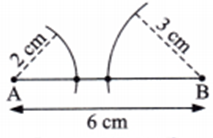
The arcs from points A and B do not meet. So, a triangle is not possible for sidelengths 2 cm, 3 cm, and 6 cm.
Text Solution by Our Experts:
To determine if a triangle can be formed with the given side lengths of 2 cm, 3 cm, and 6 cm, we use the Triangle Inequality Theorem.
The Triangle Inequality Theorem states that the sum of the lengths of any two sides of a triangle must be greater than the length of the third side.
Let's check this condition with the given side lengths.
Step 1: Add the two shorter sides
2 cm + 3 cm = 5 cm
Compare this sum with the third side:
5 cm > 6 cm
This statement is false because 5 cm is less than 6 cm.
Therefore:
2 cm + 3 cm < 6 cm
Step 2: Apply the Triangle Inequality Theorem
Since the sum of the two shorter sides is not greater than the longest side, the Triangle Inequality Theorem is not satisfied.
Therefore, a triangle cannot be formed with side lengths 2 cm, 3 cm, and 6 cm.
Step 3: Geometrical Explanation
The image also demonstrates this concept visually.
If we draw a line segment of 6 cm, say AB, and then draw:
- An arc of radius 2 cm from point A.
- An arc of radius 3 cm from point B.
These two arcs will not intersect.
For a triangle to be formed, the two arcs must intersect at a point, which would represent the third vertex of the triangle.
Since the arcs do not meet, there is no point that is simultaneously:
- 2 cm away from A, and
- 3 cm away from B.
This confirms that a triangle cannot be constructed with these side lengths.
Conclusion
Since:
2 cm + 3 cm = 5 cm < 6 cm
the Triangle Inequality Theorem is not satisfied.
Therefore, a triangle cannot be formed with side lengths 2 cm, 3 cm, and 6 cm.
In-text questions (Page 148)
Question:
Construct a triangle with sidelengths 3 cm, 4 cm, and 8 cm.
What is happening? Are you able to construct the triangle?
Correct Answer is:
Since the arcs from the points A and B do not meet. So, we are not able to construct the triangle with sidelengths 3 cm, 4 cm, and 8 cm.
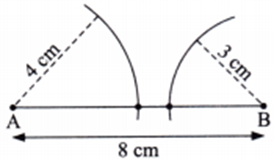
Text Solution by Our Experts:
To construct a triangle, a fundamental rule known as the Triangle Inequality Theorem must be satisfied. This theorem states that the sum of the lengths of any two sides of a triangle must be greater than the length of the third side. If this condition is not met, a triangle cannot be formed.
Let's check this condition for the given side lengths:
- Side 1 (a) = 3 cm
- Side 2 (b) = 4 cm
- Side 3 (c) = 8 cm
Step 1: Check the Triangle Inequality
We need to check whether:
a + b > c
Substituting the given values:
3 cm + 4 cm = 7 cm
Now compare:
7 cm > 8 cm
This is false because 7 cm is less than 8 cm.
Therefore:
3 cm + 4 cm < 8 cm
Since the sum of the two shorter sides (3 cm and 4 cm) is not greater than the longest side (8 cm), it is not possible to construct a triangle with these side lengths.
Construction Explanation
To attempt the construction:
- Draw a line segment AB = 8 cm.
- From point A, draw an arc with a radius of 4 cm.
- From point B, draw an arc with a radius of 3 cm.
- The two arcs do not meet because 3 cm + 4 cm < 8 cm.
Therefore, the third vertex cannot be obtained.
Conclusion
A triangle cannot be constructed with side lengths 3 cm, 4 cm, and 8 cm because the arcs drawn from points A and B do not meet.
Hence, the given side lengths cannot form a triangle.
Figure it Out (Page 150)
Question:
Use the points on the circles and/or their centres to form isosceles and equilateral triangles. The circles are of the same size.
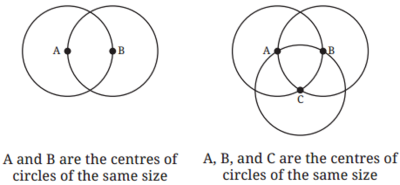
Correct Answer is:
An isosceles triangle can be formed by connecting the intersecting points of two circles and the centres of either circle. Here, isosceles triangles are AXY and BXY.
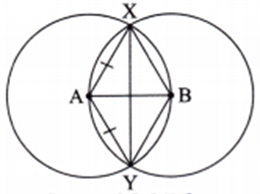
- An equilateral triangle can be formed by connecting the centres of the 2 equal circles and one of their intersecting points. Here, triangle AXB or triangle AYB is an equilateral triangle.
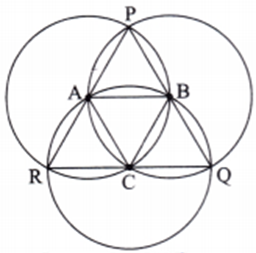
An equilateral triangle can be formed by connecting the centres of the 3 equal circles. Here, triangle ABC is an equilateral triangle.
In addition, ΔPAB, ΔQBC, and ΔRAC are also equilateral triangles.
Also, the equilateral triangle is a special case of an isosceles triangle. So, all these equilateral triangles are also isosceles.
Text Solution by Our Experts:
To form isosceles and equilateral triangles using the points on the circles and/or their centres, let's examine the properties of the given figures.
1. Forming Isosceles Triangles
Consider the first figure, where two circles with centres A and B intersect at points X and Y.
Since both circles are of the same size, let their radius be r.
For the circle with centre A, the distance from the centre A to any point on its circumference is r.
Therefore:
AX = AY = r
Now, consider triangle AXY.
Since two sides of triangle AXY are equal:
AX = AY
therefore, triangle AXY is an isosceles triangle.
Similarly, for the circle with centre B:
BX = BY = r
Therefore, in triangle BXY:
BX = BY
Hence, triangle BXY is an isosceles triangle.
2. Forming Equilateral Triangles Using Two Circles
When two circles of the same radius r intersect such that the distance between their centres is also equal to r, i.e.,
AB = r
consider the points A, B, and X, where X is one of the intersection points.
From the circle with centre A:
AX = r
From the circle with centre B:
BX = r
Also:
AB = r
Therefore, in triangle AXB:
AX = BX = AB = r
Hence, triangle AXB is an equilateral triangle.
Similarly, for the other intersection point Y:
AY = BY = AB = r
Therefore, triangle AYB is also an equilateral triangle.
3. Forming Equilateral Triangles Using Three Circles
Consider the second figure, where three circles with centres A, B, and C are of the same size. Let their radius be r.
If the circles are arranged such that each centre lies on the circumference of the other two circles, then the distance between any two centres is equal to r.
Therefore:
AB = BC = CA = r
Hence, in triangle ABC, all three sides are equal.
Therefore, triangle ABC is an equilateral triangle.
Now, consider the intersection points P, Q, and R.
Point P is an intersection of the circles with centres A and B.
Since:
AB = r
and P lies on both circles:
PA = PB = r
Therefore:
PA = PB = AB = r
Hence, triangle PAB is an equilateral triangle.
Similarly:
For triangle QBC:
QB = QC = BC = r
Therefore, triangle QBC is an equilateral triangle.
For triangle RAC:
RA = RC = AC = r
Therefore, triangle RAC is an equilateral triangle.
4. Relationship Between Equilateral and Isosceles Triangles
An equilateral triangle has all three sides equal.
An isosceles triangle has at least two sides equal.
Since an equilateral triangle has all three sides equal, it automatically has at least two equal sides.
Therefore, every equilateral triangle is also a special type of isosceles triangle.
Thus, all the equilateral triangles identified above, such as:
- Triangle AXB
- Triangle AYB
- Triangle ABC
- Triangle PAB
- Triangle QBC
- Triangle RAC
are also isosceles triangles.
Figure it Out (Page 150)
Question:
Use the points on the circle and/or the centre to form isosceles triangles.
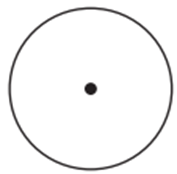
Correct Answer is:
Select any two points on the circle and connect them to the centre of the circle. Also, join these points to each other. This will form an isosceles triangle as the two radii are equal in length.
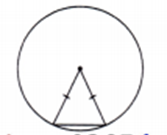
Text Solution by Our Experts:
To Form an Isosceles Triangle Using Points on a Circle and/or the Centre
Follow these steps:
- Start with a given circle and its centre.
- Select any two distinct points on the circumference (boundary) of the circle.
- Connect each of these two selected points to the centre of the circle. These two line segments are radii of the circle.
- Since all radii of a given circle have the same length, these two radii will be equal in length.
- Connect the two selected points on the circumference to each other. This line segment forms the third side of the triangle.
- You have now formed a triangle in which two sides are radii of the circle. Since these two sides are equal in length, the triangle formed is an isosceles triangle.
Example
Suppose you choose two points A and B on the circle, and O is the centre of the circle.
- OA is a radius.
- OB is a radius.
- Since OA = OB (both are radii), triangle OAB is an isosceles triangle.
Therefore, by joining the centre of a circle to any two distinct points on its circumference, an isosceles triangle can be formed.
Construct (Page 150)
Question:
Construct triangles having the following sidelengths (all the units are in cm):
(a) 4, 4, 6
(b) 3, 4, 5
(c) 1, 5, 5
(d) 4, 6, 8
(e) 3.5, 3.5, 3.5
Correct Answer is:
(a) Steps of Construction:
- Step 1: Construct the base AB with one of the side lengths. Let us choose AB = 6 cm.
- Step 2: From A, construct a long arc of radius 4 cm.
- Step 3: From B, construct an arc of radius 4 cm such that it intersects the first arc.
- Step 4: The point where both the arcs meet is the required third vertex C. Join AC and BC to get ΔABC.
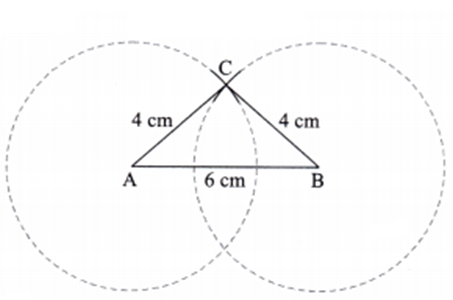
(b) Steps of Construction:
- Step 1: Construct the base AB with one of the side lengths. Let us choose AB = 3 cm.
- Step 2: From A, construct a sufficiently long arc of radius 4 cm.
- Step 3: From B, construct an arc of radius 5 cm such that it intersects the first arc.
- Step 4: The point where both the arcs meet is the required third vertex C. Join AC and BC to get ΔABC.
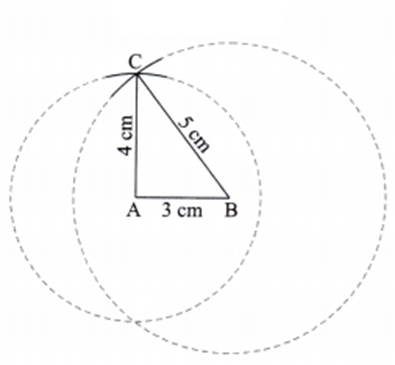
(c) Steps of Construction:
- Step 1: Construct the base AB with one of the side lengths. Let us choose AB = 5 cm.
- Step 2: From A, construct a long arc of radius 1 cm.
- Step 3: From B, construct an arc of radius 5 cm such that it intersects the first arc.
- Step 4: The point where both the arcs meet is the required third vertex C. Join AC and BC to get ΔABC.
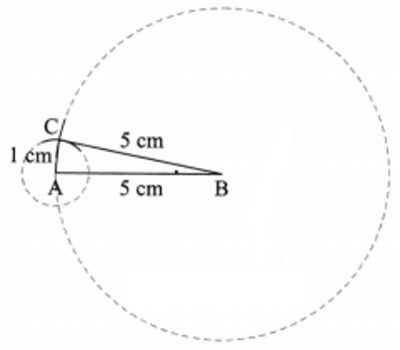
(d) Steps of Construction:
- Step 1: Construct the base AB with one of the side lengths. Let us choose AB = 8 cm.
- Step 2: From A, construct a long arc of radius 4 cm.
- Step 3: From B, construct an arc of radius 6 cm such that it intersects the first arc.
- Step 4: The point where both the arcs meet is the required third vertex C. Join AC and BC to get ΔABC.
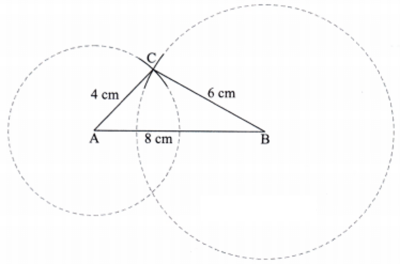
(e) Steps of Construction:
- Step 1: Construct the base AB with a side length of 3.5 cm.
- Step 2: From A, construct a long arc of radius 3.5 cm.
- Step 3: Construct another arc of radius 3.5 cm from B.
- Step 4: The point where both the arcs meet is the required third vertex C. Join AC and BC to get ΔABC.
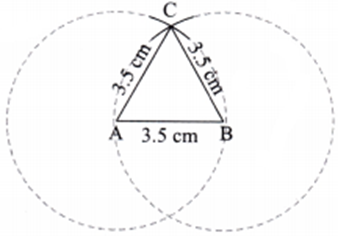
Text Solution by Our Experts:
To construct a triangle given its side lengths, use a ruler and a compass. The basic method is to draw one side as the base, then use the other two side lengths as radii to draw arcs from the endpoints of the base. The intersection of these arcs gives the third vertex of the triangle.
(a) Constructing a triangle with side lengths 4 cm, 4 cm, and 6 cm
- Draw a line segment AB of length 6 cm. This will be the base of the triangle.
- With A as the centre, set the compass to a radius of 4 cm and draw an arc.
- With B as the centre, set the compass to a radius of 4 cm and draw another arc intersecting the first arc.
- Mark the point of intersection as C. This is the third vertex of the triangle.
- Join A to C and B to C to complete triangle ABC.
(b) Constructing a triangle with side lengths 3 cm, 4 cm, and 5 cm
- Draw a line segment AB of length 3 cm. This will be the base.
- With A as the centre, set the compass to a radius of 4 cm and draw an arc.
- With B as the centre, set the compass to a radius of 5 cm and draw an arc intersecting the first arc.
- Mark the point of intersection as C. This is the third vertex.
- Join A to C and B to C to form triangle ABC.
(c) Constructing a triangle with side lengths 1 cm, 5 cm, and 5 cm
- Draw a line segment AB of length 5 cm. This will be the base of the triangle.
- With A as the centre, set the compass to a radius of 1 cm and draw an arc.
- With B as the centre, set the compass to a radius of 5 cm and draw an arc intersecting the first arc.
- Mark the point of intersection as C. This is the third vertex.
- Join A to C and B to C to complete triangle ABC.
(d) Constructing a triangle with side lengths 4 cm, 6 cm, and 8 cm
- Draw a line segment AB of length 8 cm. This will be the base.
- With A as the centre, set the compass to a radius of 4 cm and draw an arc.
- With B as the centre, set the compass to a radius of 6 cm and draw an arc intersecting the first arc.
- Mark the point of intersection as C. This is the third vertex.
- Join A to C and B to C to complete triangle ABC.
(e) Constructing a triangle with side lengths 3.5 cm, 3.5 cm, and 3.5 cm
- Draw a line segment AB of length 3.5 cm. This will be the base.
- With A as the centre, set the compass to a radius of 3.5 cm and draw an arc.
- With B as the centre, set the compass to a radius of 3.5 cm and draw another arc intersecting the first arc.
- Mark the point of intersection as C. This is the third vertex.
- Join A to C and B to C to form triangle ABC. Since all three sides are equal, this is an equilateral triangle.
In-text questions (Page 146)
Question:
What happens when the three vertices lie on a straight line?
Correct Answer is:
When the three vertices lie on a straight line, they become collinear. This means they no longer form a triangle because the three points do not enclose any area; they simply align along the same straight path.
Text Solution by Our Experts:
When you have three points that can form the vertices of a shape, they can either form a triangle or not.
1. Understanding Vertices and Triangles
A triangle is a closed figure formed by three line segments connecting three non-collinear points.
These three points are called the vertices of the triangle. For a triangle to be formed, the three points must not lie on the same straight line.
2. What Happens if the Vertices Lie on a Straight Line?
If the three vertices (points) lie on a single straight line, they are said to be collinear.
Imagine drawing a line. If you place all three points on this line, they will simply be lined up, one after another.
3. Why Is No Triangle Formed?
For a triangle to exist, its sides must enclose an area. When three points are collinear, they do not create any enclosed space.
Instead, they simply form a segment of a straight line.
Therefore, when the three vertices lie on a straight line, they are collinear and cannot form a triangle because no area is enclosed. They simply align along the same straight path.
In-text questions (Page 164)
Question:
Let us take two angles, say 60° and 70°, whose sum is less than 180°. Let the included side be 5 cm.
What could the measure of the third angle be? Does this measure change if the base length is changed to some other value, say 7 cm? Construct and find.
Correct Answer is:
If the two angles of a triangle are 60° and 70°, and the included side is 5 cm.
Then, the third angle = 180° – (60° + 70°) = 180° – 130° = 50°.
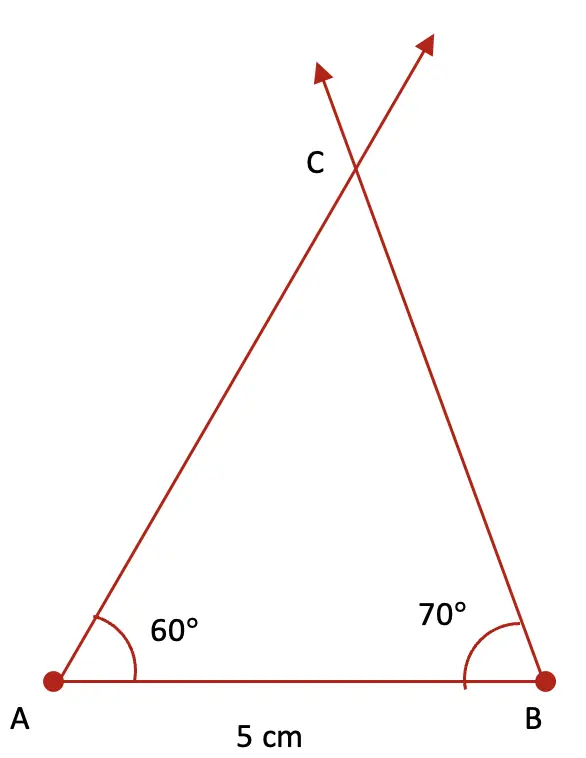
Also, if the two angles of a triangle are 60° and 70° and the included side is 7 cm.
Then, the third angle = 180° – (60° + 70°) = 180° – 130° = 50°.
Thus, changing the base length doesn’t change the measure of the third angle of a triangle.
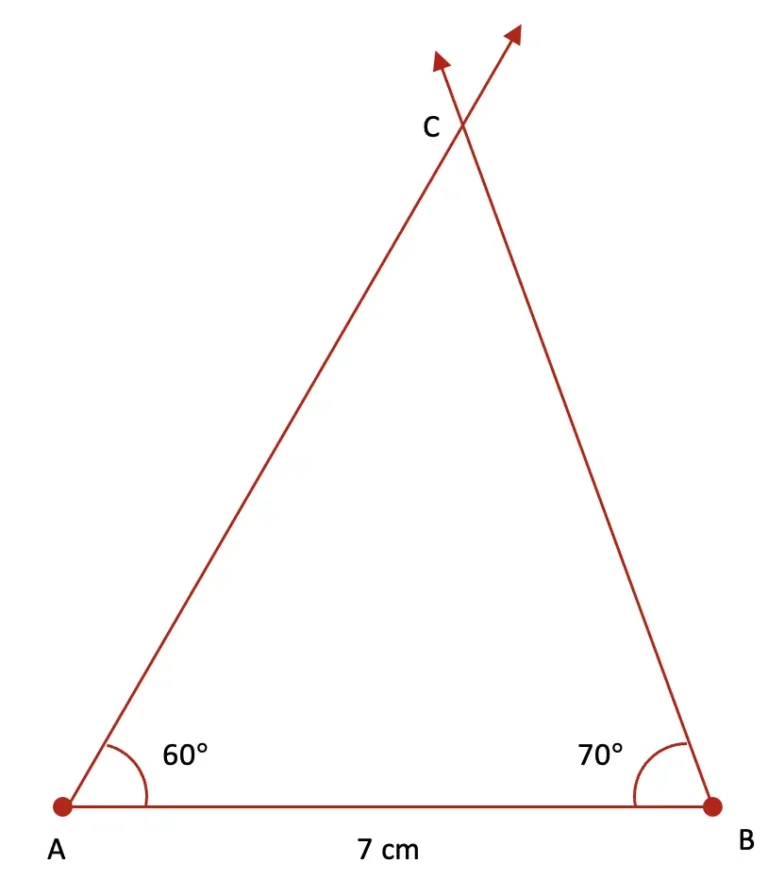
Text Solution by Our Experts:
Here’s a detailed explanation to help you understand the solution.
1. Understanding the Angle Sum Property of a Triangle
The sum of all three interior angles in any triangle is always 180°. This is a fundamental property of triangles.
2. Calculating the Third Angle with a Base of 5 cm
You are given two angles of a triangle as 60° and 70°. To find the third angle, use the angle sum property:
- Third angle = 180° − (First angle + Second angle)
- Third angle = 180° − (60° + 70°)
- Third angle = 180° − 130°
- Third angle = 50°
So, the measure of the third angle is 50° when the included side is 5 cm.
3. Considering a Change in Base Length
The question then asks what happens if the base length is changed to 7 cm. The two given angles are still 60° and 70°.
4. Recalculating the Third Angle with a Base of 7 cm
Since the two given angles remain the same, the calculation for the third angle also remains the same:
- Third angle = 180° − (First angle + Second angle)
- Third angle = 180° − (60° + 70°)
- Third angle = 180° − 130°
- Third angle = 50°
Even with the included side changed to 7 cm, the third angle is still 50°.
5. Conclusion
The measure of the third angle depends only on the measures of the other two angles. It does not depend on the length of the side included between those two angles.
Therefore, changing the base length from 5 cm to 7 cm (or any other value) does not change the measure of the third angle of the triangle.
Answer: The third angle remains 50°.
Extra Practice Questions
Question:
Name each of the following triangles in two different ways: (you may judge the nature of the angle by observation)
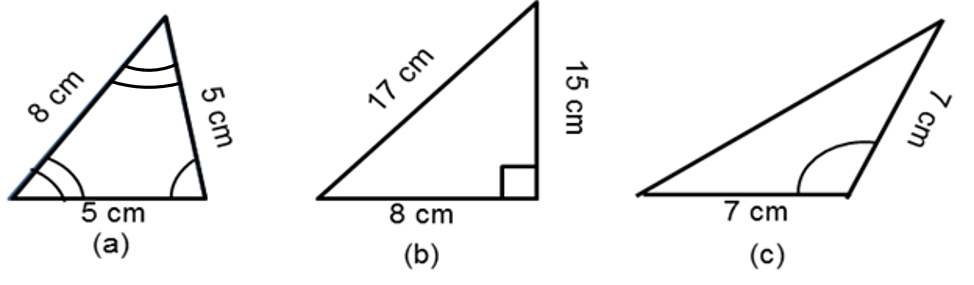
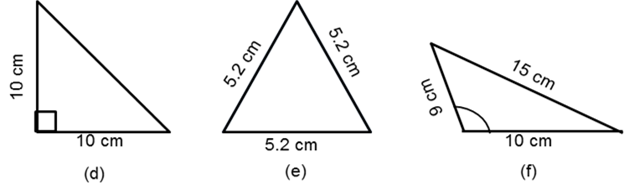
Correct Answer is:
(a) This triangle has two sides of equal length and all angles are acute. So, it is an isosceles acute triangle.
(b) This triangle has all sides unequal and one right angle. So, it is a scalene right triangle.
(c) This triangle has two equal sides and one obtuse angle. So, it is an obtuse isosceles triangle.
(d) This triangle has two equal sides and one right angle. So, it is an isosceles right triangle.
(e) This triangle has all sides equal. So, it is an equilateral acute triangle.
(f) This triangle has all sides unequal and one obtuse angle. So, it is a scalene obtuse triangle.
Text Solution by Our Experts:
A triangle can be named or classified in two different ways: based on its sides and based on its angles.
1. Classification Based on Sides
- A triangle with all three sides of different lengths is called a Scalene triangle.
- A triangle with two sides of equal length is called an Isosceles triangle.
- A triangle with all three sides of equal length is called an Equilateral triangle.
2. Classification Based on Angles
- A triangle with all three angles less than 90° is called an Acute-angled triangle.
- A triangle with one angle exactly 90° is called a Right-angled triangle.
- A triangle with one angle greater than 90° is called an Obtuse-angled triangle.
Classification of Each Triangle
(a)
The triangle has two sides of equal length, so it is an Isosceles triangle.
All its angles are acute (less than 90°), so it is an Acute-angled triangle.
Therefore, it is an Isosceles acute triangle.
(b)
The triangle has all three sides of different lengths, so it is a Scalene triangle.
It has one right angle (exactly 90°), so it is a Right-angled triangle.
Therefore, it is a Scalene right triangle.
(c)
The triangle has two equal sides, so it is an Isosceles triangle.
It has one obtuse angle (greater than 90°), so it is an Obtuse-angled triangle.
Therefore, it is an Obtuse isosceles triangle.
(d)
The triangle has two equal sides, so it is an Isosceles triangle.
It has one right angle (exactly 90°), so it is a Right-angled triangle.
Therefore, it is an Isosceles right triangle.
(e)
The triangle has all three sides equal, so it is an Equilateral triangle.
An equilateral triangle always has all three angles equal to 60°, which are acute angles. Therefore, it is also an Acute-angled triangle.
Hence, it is an Equilateral acute triangle.
(f)
The triangle has all three sides of different lengths, so it is a Scalene triangle.
It has one obtuse angle (greater than 90°), so it is an Obtuse-angled triangle.
Therefore, it is a Scalene obtuse triangle.
Question:
Match the following:
| Measures of Triangle | Type of Triangle |
|---|---|
| (i) 3 sides of equal length | (a) Scalene |
| (ii) 2 sides of equal length | (b) Isosceles right angled |
| (iii) All sides are of different length | (c) Obtuse angled |
| (iv) 3 acute angles | (d) Right angled |
| (v) 1 right angle | (e) Equilateral |
| (vi) 1 obtuse angle | (f) Acute angled |
| (vii) 1 right angle with two sides of equal length | (g) Isosceles |
Correct Answer is:
| Measures of Triangle | Type of Triangle |
|---|---|
| (i) 3 sides of equal length | (e) Equilateral |
| (ii) 2 sides of equal length | (g) Isosceles |
| (iii) All sides are of different length | (a) Scalene |
| (iv) 3 acute angles | (f) Acute angled |
| (v) 1 right angle | (d) Right angled |
| (vi) 1 obtuse angle | (c) Obtuse angled |
| (vii) 1 right angle with two sides of equal length | (b) Isosceles right angled |
Text Solution by Our Experts:
Here is the explanation for matching the measures of triangles with their types.
Triangles can be classified based on the length of their sides or the measure of their angles.
1. Three sides of equal length
Type of Triangle: Equilateral triangle
Explanation: A triangle with all three sides having the same length is called an equilateral triangle.
2. Two sides of equal length
Type of Triangle: Isosceles triangle
Explanation: A triangle with at least two sides having the same length is called an isosceles triangle.
3. All sides are of different lengths
Type of Triangle: Scalene triangle
Explanation: A triangle with all three sides having different lengths is called a scalene triangle.
4. Three acute angles
Type of Triangle: Acute-angled triangle
Explanation: An acute angle is an angle less than 90°. A triangle in which all three angles are acute is called an acute-angled triangle.
5. One right angle
Type of Triangle: Right-angled triangle
Explanation: A right angle is an angle exactly equal to 90°. A triangle with one right angle is called a right-angled triangle.
6. One obtuse angle
Type of Triangle: Obtuse-angled triangle
Explanation: An obtuse angle is an angle greater than 90°. A triangle with one obtuse angle is called an obtuse-angled triangle.
7. One right angle with two sides of equal length
Type of Triangle: Isosceles right-angled triangle
Explanation: This type of triangle has two characteristics: it has one right angle (90°), and the two sides that form the right angle (the legs) are equal in length. Thus, it combines the properties of a right-angled triangle and an isosceles triangle.
Question:
Name the types of following triangles:
(a) Triangle with lengths of sides 7 cm, 8 cm and 9 cm.
(b) ΔABC with AB = 8.7 cm, AC = 7 cm and BC = 6 cm.
(c) ΔPQR such that PQ = QR = PR = 5 cm.
(d) ΔDEF with m∠D = 90°
(e) ΔXYZ with m∠Y = 90° and XY = YZ.
(f) ΔLMN with m∠L = 30°, m∠M = 70° and m∠N = 80°.
Correct Answer is:
(a) All the sides of the triangle are unequal, so it is a scalene triangle.
(b) All the sides of triangle ABC are unequal, so triangle ABC is a scalene triangle.
(c) All the sides of triangle PQR are equal, so it is an equilateral triangle.
(d) In triangle DEF, angle D is of 90°, so it is a right-angled triangle.
(e) In triangle XYZ, two sides XY and YZ are equal and angle Y is of 90°, so it is an isosceles right triangle.
(f) In triangle LMN, all the angles are acute, so it is an acute-angled triangle.
Text Solution by Our Experts:
Here’s how to determine the type of each triangle:
- (a) Triangle with side lengths 7 cm, 8 cm, and 9 cm
The three side lengths are 7 cm, 8 cm, and 9 cm. Since all three sides have different lengths, the triangle is a scalene triangle.
Therefore, this is a scalene triangle.
- (b) ΔABC with AB = 8.7 cm, AC = 7 cm, and BC = 6 cm
The side lengths of triangle ABC are 8.7 cm, 7 cm, and 6 cm. Since all three sides have different lengths, the triangle is a scalene triangle.
Therefore, triangle ABC is a scalene triangle.
- (c) ΔPQR such that PQ = QR = PR = 5 cm
The side lengths of triangle PQR are:
PQ = 5 cm
QR = 5 cm
PR = 5 cm
Since all three sides are equal in length, the triangle is an equilateral triangle.
Therefore, triangle PQR is an equilateral triangle.
- (d) ΔDEF with m∠D = 90°
The measure of angle D is 90°. An angle measuring exactly 90° is called a right angle.
A triangle with one right angle is called a right-angled triangle.
Therefore, triangle DEF is a right-angled triangle.
- (e) ΔXYZ with m∠Y = 90° and XY = YZ
The measure of angle Y is 90°, so triangle XYZ is a right-angled triangle.
Also, XY = YZ, so two sides of the triangle are equal. Therefore, it is an isosceles triangle.
Since triangle XYZ has one right angle and two equal sides, it is an isosceles right triangle.
- (f) ΔLMN with m∠L = 30°, m∠M = 70°, and m∠N = 80°
The three angles of triangle LMN are:
∠L = 30°
∠M = 70°
∠N = 80°
All three angles are less than 90°, so all of them are acute angles.
Therefore, triangle LMN is an acute-angled triangle.
Question:
Copy the triangle in each of the following figures on squared paper. In each case, draw the line(s) of symmetry, if any and identify the type of triangle. (Some of you may like to trace the figures and try paper-folding first!)
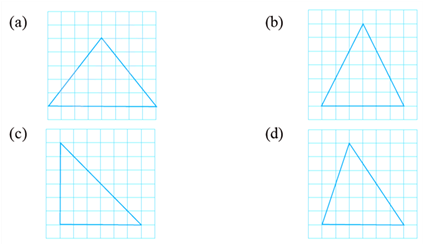
Correct Answer is:
(a)
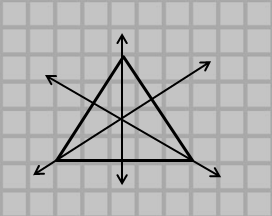
This is an equilateral triangle and has three lines of symmetry.
(b)
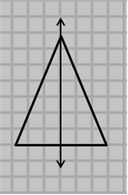
This is an isosceles triangle and has one line of symmetry.
(c)
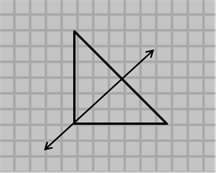
This is an isosceles right angled triangle and has one line of symmetry.
(d) There is no line of symmetry in a scalene triangle.
Text Solution by Our Experts:
Here’s a step-by-step explanation to understand the solution for identifying the types of triangles and their lines of symmetry.
1. Understanding Line of Symmetry
A line of symmetry is a line that divides a figure into two identical halves that are mirror images of each other. If you fold the figure along this line, the two halves will perfectly overlap.
2. Analyzing Triangle (a)
Observe the triangle in figure (a). By counting the units on the squared paper, you will find that all three sides of this triangle are equal in length. All three angles are also equal to 60°.
A triangle with all three sides equal and all three angles equal is called an equilateral triangle.
An equilateral triangle has three lines of symmetry. Each line of symmetry passes through a vertex and the midpoint of the opposite side.
Therefore, triangle (a) is an equilateral triangle with 3 lines of symmetry.
3. Analyzing Triangle (b)
Look at the triangle in figure (b). By counting the units, you can see that two sides of this triangle are equal in length. The angles opposite to these equal sides are also equal.
A triangle with two equal sides and two equal angles is called an isosceles triangle.
An isosceles triangle has only one line of symmetry. This line passes through the vertex where the two equal sides meet and goes to the midpoint of the third side, which is the base.
Therefore, triangle (b) is an isosceles triangle with 1 line of symmetry.
4. Analyzing Triangle (c)
Consider the triangle in figure (c). This triangle has a right angle of 90°, so it is a right-angled triangle.
By counting the units, you will notice that the two sides forming the right angle are equal in length. A right-angled triangle with two equal sides is called an isosceles right-angled triangle.
An isosceles right-angled triangle has one line of symmetry. This line passes through the vertex with the right angle and the midpoint of the hypotenuse, which is the side opposite the right angle.
Therefore, triangle (c) is an isosceles right-angled triangle with 1 line of symmetry.
5. Analyzing Triangle (d)
Examine the triangle in figure (d). By measuring the sides using the grid, you will find that all three sides of this triangle have different lengths.
A triangle with all three sides of different lengths is called a scalene triangle.
A scalene triangle has no lines of symmetry because there is no line that can divide it into two identical mirror-image halves.
Therefore, triangle (d) is a scalene triangle with 0 lines of symmetry.
Final Answer
- (a) Equilateral triangle → 3 lines of symmetry
- (b) Isosceles triangle → 1 line of symmetry
- (c) Isosceles right-angled triangle → 1 line of symmetry
- (d) Scalene triangle → 0 lines of symmetry
Related Ganita Prakash Class 7 Chapters:
- NCERT Solutions for Class 7 Maths Chapter 1 – Large Numbers Around Us
- NCERT Solutions for Class 7 Maths Chapter 2 – Arithmetic Expressions
- NCERT Solutions for Class 7 Maths Chapter 3 – A Peek Beyond the Point
- NCERT Solutions for Class 7 Maths Chapter 4 – Expressions Using Letter-Numbers
- NCERT Solutions for Class 7 Maths Chapter 5 – Parallel and Intersecting Lines
- NCERT Solutions for Class 7 Maths Chapter 6 – Number Play
- NCERT Solutions for Class 7 Maths Chapter 7 – A Tale of Three Intersecting Lines
- NCERT Solutions for Class 7 Maths Chapter 8 – Working with Fractions
- NCERT Solutions for Class 7 Maths Chapter 9 – Geometric Twins
- NCERT Solutions for Class 7 Maths Chapter 10 – Another Peek Beyond the Point
- NCERT Solutions for Class 7 Maths Chapter 11 – Three-Dimensional Shapes
- NCERT Solutions for Class 7 Maths Chapter 12 – Playing with Constructions
- NCERT Solutions for Class 7 Maths Chapter 13 – Finding the Unknown
- NCERT Solutions for Class 7 Maths Chapter 14 – From Numbers to Letters
FAQs (Frequently Asked Questions)
Ans. Two triangles are said to be congruent to each other if the three sides and the three angles of the triangles are equal in some orientation. They superimpose each other. In other words, we can say that their shape and dimensions are the same. The symbol ≅ is used to indicate the congruence between them.
CPCT stands for Corresponding Parts of Congruent triangles. According to CPCT, if two or more triangles which are congruent to each other are taken, then their corresponding angles and the sides will also be congruent to each other.
There are 5 main rules of congruence:
SSS rule: Side-Side-Side
SAS rule: Side-Angle-Side
ASA rule: Angle-Side-Angle
AAS rule: Angle-Angle-Side
RHS rule: Right angle- Hypotenuse-Side