Class 9 Maths Ganita Manjari Chapter 14 Exercise 14.1 Solutions Math of Space: Surface Area and Volume
NCERT Solutions for Class 9 Maths Ganita Manjari Chapter 14 Exercise 14.1 Math of Space: Surface Area and Volume helps students understand the concepts of surface area and volume of different three-dimensional shapes. These solutions provide step-by-step explanations in simple language to help students solve problems accurately and understand the formulas used in the exercise.
Students can access the solutions in PDF format for easy download, offline study, and revision. These solutions are useful for strengthening mathematical concepts, practising important questions, and preparing effectively for exams.
NCERT Class 9 Maths Ganita Manjari Chapter 14 Exercise Set 14.1
1. The volume of a cube is 64 cm³. What is its total surface area?
Answer:
For a cube,
Volume = a³
Given:
a³ = 64
So,
a = 4 cm
Total surface area of a cube:
TSA = 6a²
= 6 × 4²
= 6 × 16
= 96 cm²
Therefore, the total surface area of the cube is 96 cm².
2. How many small cubes with side 20 cm can be packed tight in a cubical box with side 2 m?
Answer:
Side of the cubical box:
2 m = 200 cm
Side of each small cube = 20 cm
Number of cubes along one edge:
200 ÷ 20 = 10
Therefore, total number of small cubes:
10 × 10 × 10 = 1000
Hence, 1000 small cubes can be packed tightly in the cubical box.
3. The dimensions of a godown are 40 m × 25 m × 10 m. If it is filled with cuboidal boxes, each of dimensions 2 m × 1.25 m × 1 m, then find the number of boxes.
Answer:
Volume of the godown:
40 × 25 × 10 = 10,000 m³
Volume of one box:
2 × 1.25 × 1 = 2.5 m³
Number of boxes:
10,000 ÷ 2.5 = 4000
Therefore, the godown can hold 4000 boxes.
4. Two cubes each of volume 125 cm³ are joined end to end. Find the surface area of the resulting cuboid.
Answer:
Each cube has side
cm. Joined end to end, they form a cuboid
cm:
5. A cube of side 4 cm is cut into cubes of side 1 cm. What is the ratio of the surface areas of the original cube and all the cut-out cubes?
Answer:
There are
small cubes, each with area
cm²:
The volume is the same (64 cm³), but cutting into smaller pieces makes the surface area 4 times larger. (This is why small animals lose heat faster, and why crushed food dissolves faster.)
6. The surface areas of the three faces of a cuboid that meet at one of the corners of the cuboid are 6 cm², 15 cm², and 10 cm² respectively. What is the volume of the cuboid?
Answer:
Let the edges be
,
,
, with
,
,
. Multiplying the three:
∴ The volume is 30 cm³. (The edges are 2 cm, 3 cm and 5 cm.)
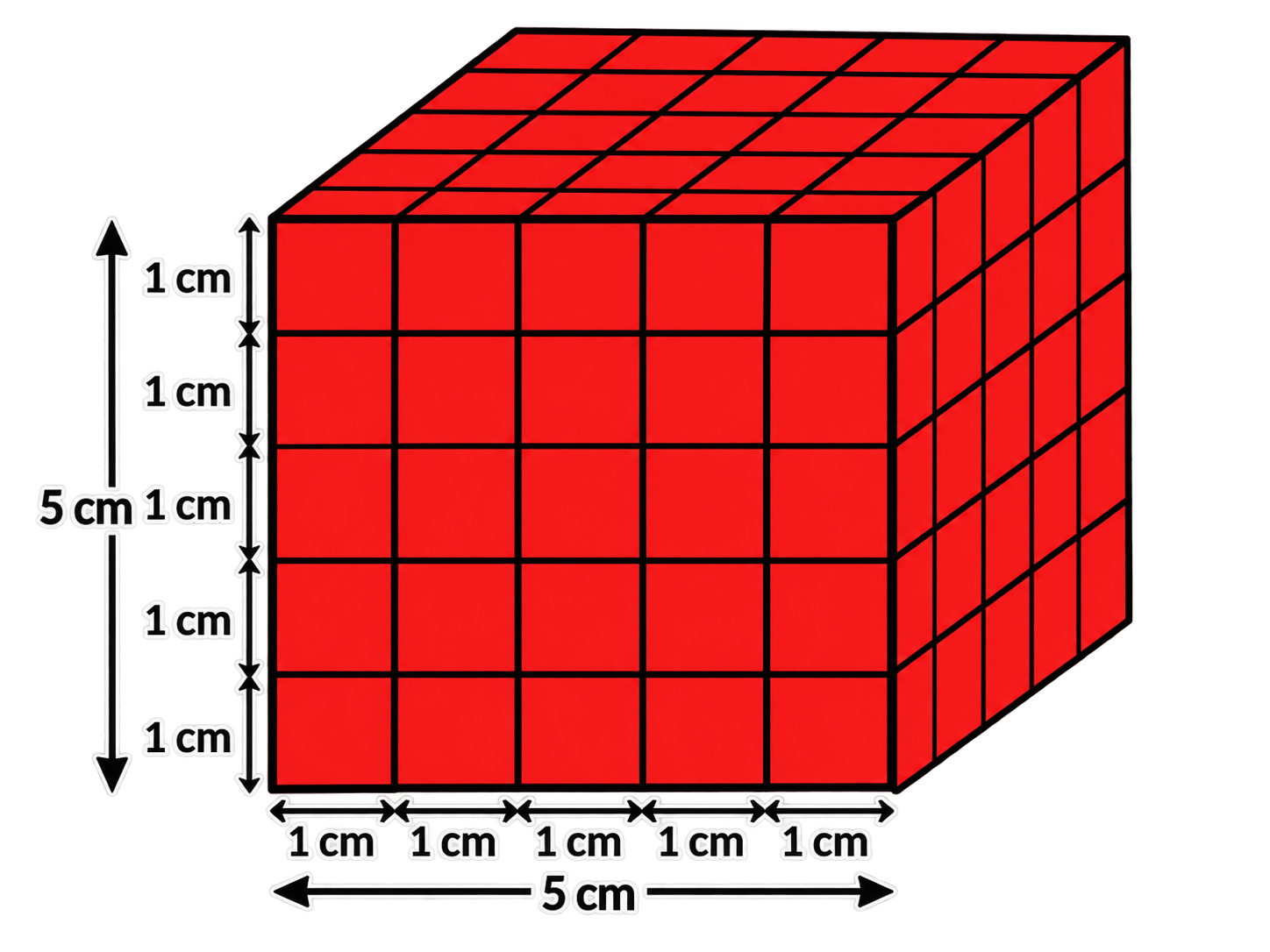
7. A cube of side 5 cm is painted on all its faces. If it is sliced into 1 cm³ cubes, how many of these 1 cm³ cubes have
(i) exactly three faces painted?
(ii) exactly two faces painted?
(iii) exactly one face painted?
(iv) no face painted?
Answer:
A cube of side 5 cm is divided into 1 cm³ cubes.
So, the number of small cubes along each edge is:
5 ÷ 1 = 5
(i) Exactly three faces painted
These are the cubes at the 8 corners.
Number of cubes = 8
(ii) Exactly two faces painted
These lie along the edges, excluding the corner cubes.
Each edge has:
5 − 2 = 3 cubes
There are 12 edges.
Number of cubes = 12 × 3 = 36
(iii) Exactly one face painted
These lie in the interior of each face, excluding edges.
On each face:
(5 − 2)² = 3² = 9 cubes
There are 6 faces.
Number of cubes = 6 × 9 = 54
(iv) No face painted
These are completely inside the cube.
Number of cubes = (5 − 2)³ = 3³ = 27
Therefore:
(i) 8
(ii) 36
(iii) 54
(iv) 27
8. Find a cuboid with edges whose lengths are integers (in cm), given that it has a total surface area of exactly 100 cm².
(i) Is there more than one such cuboid?
(ii) Can you find them all?
(iii) Show that you have found them all.
Answer:
Let the integer edge lengths of the cuboid be a, b, c cm.
Total surface area of a cuboid is:
2(ab + bc + ca) = 100
So,
ab + bc + ca = 50 ...(1)
Assume a ≤ b ≤ c.
(i) Is there more than one such cuboid?
Yes. There are two different cuboids with integer edge lengths.
(ii) Find all such cuboids
Since a ≤ b ≤ c,
ab + ac + bc ≥ 3a²
Using (1),
3a² ≤ 50
So,
a ≤ 4
Therefore, we only need to check a = 1, 2, 3, 4.
For a = 1:
b + c + bc = 50
Adding 1 to both sides in factorised form:
(b + 1)(c + 1) = 51
Since 51 = 3 × 17,
b + 1 = 3, c + 1 = 17
So,
b = 2, c = 16
Hence, one cuboid is:
1 cm × 2 cm × 16 cm
For a = 2:
2b + 2c + bc = 50
Adding 4:
(b + 2)(c + 2) = 54
Using 54 = 6 × 9,
b + 2 = 6, c + 2 = 9
So,
b = 4, c = 7
Hence, another cuboid is:
2 cm × 4 cm × 7 cm
For a = 3:
bc + 3b + 3c = 50
So,
(b + 3)(c + 3) = 59
Since 59 is prime, there is no valid integer solution.
For a = 4:
bc + 4b + 4c = 50
So,
(b + 4)(c + 4) = 66
There is no factor pair of 66 satisfying 4 ≤ b ≤ c, so there is no valid solution.
(iii) Show that all have been found
We proved that a ≤ 4, so every possible cuboid must occur among the four cases above. Only two cases give positive integer dimensions.
Therefore, all possible cuboids are:
1 cm × 2 cm × 16 cm
and
2 cm × 4 cm × 7 cm
Checking:
For 1 × 2 × 16:
TSA = 2(2 + 16 + 32) = 2 × 50 = 100 cm²
For 2 × 4 × 7:
TSA = 2(8 + 14 + 28) = 2 × 50 = 100 cm²
Hence, there are exactly two such cuboids.