NCERT Solutions Class 8 Maths Direct And Inverse Proportions Exercise 11.1
NCERT Solutions for Class 8 Maths Chapter 11 – Direct and Inverse Proportions Ex 11.1 are given here in simple, step-by-step form. NCERT stands for National Council of Educational Research and Training, the body that makes your textbook. This chapter teaches how two quantities change together. Exercise 11.1 is about direct proportion. Two quantities are in direct proportion when they go up together and come down together. If one becomes double, the other also becomes double. If one becomes half, the other also becomes half.
This exercise has 10 questions. They are all from daily life, such as a model of a car, sugar in packets, distance on a map, columns of print, sag in a beam, kilograms of sugar, an electric pole and its shadow, and a truck on a highway. Every question below is solved in short steps, with the final answer in bold. Students can use this page for homework and revision, parents can use it to check the work at home, and teachers can use it in class. A free printable PDF of these solutions is also available for offline study.
NCERT Solutions Class 8 Maths Direct And Inverse Proportions Exercise 11.1
 Direct and Inverse Proportions
 Medium
4 hours ₹ 60
8 hours ₹ 100
12 hours ₹ 140
24 hours ₹ 180

Check if the parking charges are in direct proportion to the parking time.
Direct and Inverse Proportions
Medium
Direct and Inverse Proportions
Medium
Direct and Inverse Proportions
Medium
Direct and Inverse Proportions
 Difficult
 Direct and Inverse Proportions
Medium
Direct and Inverse Proportions
Medium
Direct and Inverse Proportions
Difficult
Direct and Inverse Proportions
Difficult
Direct and Inverse Proportions
Medium
Direct and Inverse Proportions
Medium
Direct and Inverse Proportions
Difficult
Direct and Inverse Proportions
Difficult
Exercise 11.1 – Questions and Answers
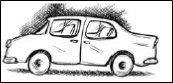
Q 1. Following are the car parking charges near a railway station upto
| 4 hours | ₹ 60 |
| 8 hours | ₹ 100 |
| 12 hours | ₹ 140 |
| 24 hours | ₹ 180 |
Check if the parking charges are in direct proportion to the parking time.
Answer:
The given information is represented in a table.
| Number of hours | 4 | 8 | 12 | 24 |
|---|---|---|---|---|
| Parking charges (in ₹) | 60 | 100 | 140 | 180 |
The ratios of the parking charges to the number of hours are as follows:
60/4 = 15, 100/8 = 25/2, 140/12 = 35/3, 180/24 = 15/2
Since all the ratios are different from each other, the parking charges are not in direct proportion to the parking time.
Q 2. A mixture of paint is prepared by mixing 1 part of red pigments with 8 parts of base. In the following table, find the parts of base that need to be added.
| Parts of red pigment | 1 | 4 | 7 | 12 | 20 |
|---|---|---|---|---|---|
| Parts of base | 8 | … | … | … | … |
Answer:
The given mixture of paint is prepared by mixing 1 part of red pigments with 8 parts of base. Since the ratio of red pigment and the base is the same every time, therefore, the parts of red pigments and the parts of base are in direct proportion.
Let us take the unknown values as x₁, x₂, x₃ and x₄.
| Parts of red pigment | 1 | 4 | 7 | 12 | 20 |
|---|---|---|---|---|---|
| Parts of base | 8 | x₁ | x₂ | x₃ | x₄ |
According to direct proportion,
1/8 = 4/x₁ ⇒ x₁ = 8 × 4 ⇒ x₁ = 32
1/8 = 7/x₂ ⇒ x₂ = 8 × 7 ⇒ x₂ = 56
1/8 = 12/x₃ ⇒ x₃ = 8 × 12 ⇒ x₃ = 96
1/8 = 20/x₄ ⇒ x₄ = 8 × 20 ⇒ x₄ = 160
Therefore, the parts of base to be added are shown as follows:
| Parts of red pigment | 1 | 4 | 7 | 12 | 20 |
|---|---|---|---|---|---|
| Parts of base | 8 | 32 | 56 | 96 | 160 |
Q 3. In Question 2 above, if 1 part of a red pigment requires 75 mL of base, how much red pigment should we mix with 1800 mL of base?
Answer:
Let the parts of red pigment required to mix with 1800 mL of base be x.
| Parts of red pigment | 1 | x |
|---|---|---|
| Parts of base (in mL) | 75 | 1800 |
The parts of red pigment and the parts of base are in direct proportion. Therefore, we obtain
1/75 = x/1800 ⇒ 75x = 1800 ⇒ x = 24
Thus, 24 parts of red pigment should be mixed with 1800 mL of base.
Q 4. A machine in a soft drink factory fills 840 bottles in six hours. How many bottles will it fill in five hours?
Answer:
Let the number of bottles filled by the machine in five hours be x.
| Number of bottles | 840 | x |
|---|---|---|
| Time taken (in hours) | 6 | 5 |
The number of bottles and the time taken to fill these bottles are in direct proportion. Therefore, we obtain
840/6 = x/5 ⇒ 6x = 840 × 5
⇒ 6x = 4200
⇒ x = 700
Thus, 700 bottles will be filled in 5 hours.
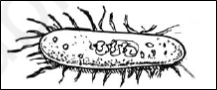
Q 5. A photograph of a bacterium enlarged 50,000 times attains a length of 5 cm as shown in the diagram. What is the actual length of the bacterium? If the photograph is enlarged 20,000 times only, what would be its enlarged length?
Answer:
Let the actual length of the bacterium be x cm.
| Length of the bacterium (in cm) | 5 | x |
|---|---|---|
| Number of times photograph of the bacterium was enlarged | 50000 | 1 |
The number of times the photograph of the bacterium was enlarged and the lengths of the bacterium are in direct proportion. Therefore, we obtain
5/50000 = x/1
⇒ 50000x = 5
⇒ x = 1/10000
⇒ x = 10⁻⁴
Hence, the actual length of the bacterium is 10⁻⁴ cm.
Now, we have to find its enlarged length if the photograph is enlarged 20,000 times only.
Let the enlarged length of the bacterium be y cm.
| Length of the bacterium (in cm) | 5 | y |
|---|---|---|
| Number of times photograph of the bacterium was enlarged | 50000 | 20000 |
The number of times the photograph of the bacterium was enlarged and the lengths of bacterium are in direct proportion. Therefore, we obtain
5/50000 = y/20000
⇒ 100000 = 50000y
⇒ y = 100000/50000
⇒ y = 2
Hence, the enlarged length of the bacterium is 2 cm.
Q 6. In a model of a ship, the mast is 9 cm high, while the mast of the actual ship is 12 m high. If the length of the ship is 28 m, how long is the model ship?
Answer:
Let the length of the model ship be x cm.
| Height of mast | Length of ship | |
|---|---|---|
| Model of ship | 9 | x |
| Actual ship | 12 | 28 |
The dimensions of the actual ship and the model ship are directly proportional to each other. Therefore, we obtain:
9/12 = x/28
⇒ 9 × 28 = 12x
⇒ x = 252/12
⇒ x = 21
Thus, the length of the model ship is 21 cm.
Q 7. Suppose 2 kg of sugar contains 9 × 10⁶ crystals. How many sugar crystals are there in
(i) 5 kg of sugar? (ii) 1.2 kg of sugar?
Answer:
(i) Let the number of sugar crystals in 5 kg of sugar be x.
| Amount of sugar (in kg) | 2 | 5 |
|---|---|---|
| Number of crystals | 9 × 10⁶ | x |
The amount of sugar and the number of crystals it contains are directly proportional to each other. Therefore, we obtain
2 / (9 × 10⁶) = 5/x
⇒ 2x = 5 × 9 × 10⁶
⇒ x = (5 × 9 × 10⁶)/2
⇒ x = 22.5 × 10⁶
⇒ x = 2.25 × 10⁷
Hence, the number of sugar crystals is 2.25 × 10⁷.
(ii) Let the number of sugar crystals in 1.2 kg of sugar be y.
| Amount of sugar (in kg) | 2 | 1.2 |
|---|---|---|
| Number of crystals | 9 × 10⁶ | y |
The amount of sugar and the number of crystals it contains are directly proportional to each other. Therefore, we obtain
2 / (9 × 10⁶) = 1.2/y
⇒ 2y = 1.2 × 9 × 10⁶
⇒ y = (1.2 × 9 × 10⁶)/2
⇒ y = 5.4 × 10⁶
Hence, the number of sugar crystals is 5.4 × 10⁶.
Q 8. Rashmi has a road map with a scale of 1 cm representing 18 km. She drives on a road for 72 km. What would be her distance covered in the map?
Answer:
Let the distance represented on the map be x cm.
| Distance covered on map (in cm) | 1 | x |
|---|---|---|
| Distance covered on road (in km) | 18 | 72 |
The distances covered on road and represented on map are directly proportional to each other. Therefore, we obtain
1/18 = x/72
⇒ 72 = 18x
⇒ x = 72/18
⇒ x = 4
Hence, the distance represented on the map is 4 cm.
Q 9. A 5 m 60 cm high vertical pole casts a shadow 3 m 20 cm long. Find at the same time
(i) the length of the shadow cast by another pole 10 m 50 cm high
(ii) the height of a pole which casts a shadow 5 m long
Answer:
(i) Let the length of the shadow of the other pole be x m.
| Height of the pole (in m) | 5.60 | 10.50 |
|---|---|---|
| Length of the shadow (in m) | 3.20 | x |
The height of an object and length of its shadow are directly proportional to each other. Therefore, we obtain
5.60/3.20 = 10.50/x
⇒ 5.60x = 10.50 × 3.20
⇒ x = 33.6/5.60
⇒ x = 6
Hence, the length of the shadow will be 6 m.
(ii) Let the height of the pole be y m.
| Height of the pole (in m) | 5.60 | y |
|---|---|---|
| Length of the shadow (in m) | 3.20 | 5 |
The height of an object and length of its shadow are directly proportional to each other. Therefore, we obtain
5.60/3.20 = y/5
⇒ 5.60 × 5 = 3.20y
⇒ y = (5.60 × 5)/3.20
⇒ y = 8.75
Thus, the height of the pole is 8.75 m or 8 m 75 cm.
Q 10. A truck travels 14 km in 25 minutes. If the speed remains the same, how far can it travel in 5 hours?
Answer:
Time taken by truck to cover 14 km = 25 min
25 minutes in hours = 25/60 = 5/12 hours
Now, speed of the truck = Distance / Time = 14 / (5/12) = 14 × 12/5 = 168/5 km/h
So, the distance covered by the truck in 5 hours = Speed × Time = 168/5 × 5 = 168 km
Therefore, the truck can travel 168 km in 5 hours at the same speed.
Related Links