NCERT Solutions Class 9 Maths Ch 9 Ex 9.3 – Circle Angles
Exercise 9.3 of Class 9 Maths Chapter 9 Circles is about the angles made by an arc of a circle and about cyclic quadrilaterals. A cyclic quadrilateral is a four-sided figure whose four corners all lie on the same circle. Two simple rules do most of the work in this exercise. First, the angle an arc makes at the centre is double the angle it makes at any point on the rest of the circle. Second, the two opposite angles of a cyclic quadrilateral always add up to 180 degrees. Once these two rules are clear, the questions become easy.
This exercise has 12 questions. Some ask you to find a missing angle, and some ask you to prove a statement. Every question is solved here in simple steps, with the reason written next to each step, which is how marks are given in the exam. Students can revise on their own, teachers can use the same steps in class, and parents can check homework at home. A free printable PDF of the full exercise is also available.
NCERT Solutions Class 9 Maths Chapter 9 Circles: Exercise 9.3
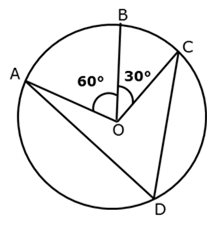
Q1. In the figure below, A, B and C are three points on a circle with centre O such that ∠BOC = 30° and ∠AOB = 60°. If D is a point on the circle other than the arc ABC, find ∠ADC.
Answer:
Given: In a circle with centre O, ∠BOC = 30° and ∠AOB = 60°.
To find: ∠ADC
∠AOC = 60° + 30°
= 90°
Since the angle subtended by an arc at the centre is double the angle subtended by it at any point on the remaining part of the circle,
∠AOC = 2∠ADC
90° = 2∠ADC
∠ADC = 90°/2
= 45°
Thus, the required angle is 45°.
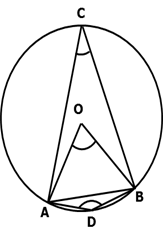
Q2. A chord of a circle is equal to the radius of the circle. Find the angle subtended by the chord at a point on the minor arc and also at a point on the major arc.
Answer:
Given: O is the centre of the circle and chord AB is equal to the radius of the circle.
To find: ∠ACB and ∠ADB
Proof: In triangle AOB, OA = AB = OB.
So ∠AOB = 60° (angle of an equilateral triangle).
∠ACB = ½ ∠AOB (by theorem)
= ½ × 60°
= 30°
Since ADBC is a cyclic quadrilateral,
∠ACB + ∠ADB = 180°
30° + ∠ADB = 180°
∠ADB = 180° − 30°
= 150°
The chord subtends 30° at a point on the major arc and 150° at a point on the minor arc.
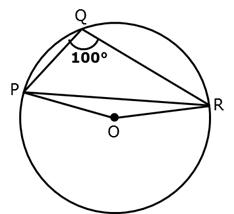
Q3. In the figure below, ∠PQR = 100°, where P, Q and R are points on a circle with centre O. Find ∠OPR.
Answer:
Given: In a circle with centre O, ∠PQR = 100°.
To find: ∠OPR
Since the angle subtended by an arc at the centre is double the angle subtended by it at any point on the remaining part of the circle,
Reflex ∠POR = 2∠PQR
= 2 × 100°
= 200°
Now, ∠POR + Reflex ∠POR = 360°
∠POR + 200° = 360°
∠POR = 360° − 200°
= 160°
In triangle OPR, OP = OR
So ∠ORP = ∠OPR (angles opposite equal sides are equal)
∠ORP + ∠OPR + ∠POR = 180° (angle sum property)
∠OPR + ∠OPR + 160° = 180°
2∠OPR = 180° − 160°
2∠OPR = 20°
∠OPR = 10°
Thus, ∠OPR is 10°.
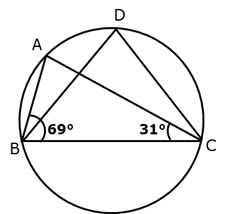
Q4. In the figure below, ∠ABC = 69° and ∠ACB = 31°. Find ∠BDC.
Answer:
Given: In a circle, ∠ABC = 69° and ∠ACB = 31°.
To find: ∠BDC
In triangle ABC,
∠BAC + ∠ABC + ∠ACB = 180°
∠BAC + 69° + 31° = 180°
∠BAC = 180° − 100°
= 80°
Since angles in the same segment of a circle are equal,
∠BDC = ∠BAC
= 80°
Thus, ∠BDC is 80°.
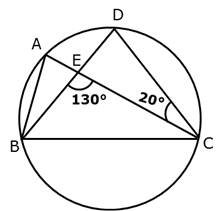
Q5. In the figure below, A, B, C and D are four points on a circle. AC and BD intersect at a point E such that ∠BEC = 130° and ∠ECD = 20°. Find ∠BAC.
Answer:
Given: In a circle, chords AC and BD intersect at E. ∠BEC = 130° and ∠ECD = 20°.
To find: ∠BAC
∠CEB + ∠CED = 180° (linear pair of angles)
130° + ∠CED = 180°
∠CED = 180° − 130°
= 50°
In triangle DEC,
∠ECD + ∠CED + ∠CDE = 180°
20° + 50° + ∠CDE = 180°
∠CDE = 180° − 70°
= 110°
So ∠BDC = 110°
Since angles in the same segment of a circle are equal,
∠BAC = ∠BDC
= 110°
Thus, the required angle ∠BAC is 110°.
Q6. ABCD is a cyclic quadrilateral whose diagonals intersect at a point E. If ∠DBC = 70° and ∠BAC is 30°, find ∠BCD. Further, if AB = BC, find ∠ECD.
Answer:
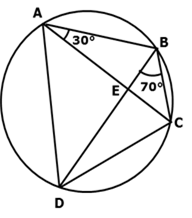
Given: ABCD is a cyclic quadrilateral. ∠DBC = 70° and ∠BAC = 30°.
To find: ∠BCD, and ∠ECD if AB = BC
Since angles in the same segment of a circle are equal,
∠DAC = ∠DBC
= 70°
So ∠DAB = ∠DAC + ∠BAC
= 70° + 30°
= 100°
Since the sum of opposite angles in a cyclic quadrilateral is 180°,
∠DAB + ∠DCB = 180°
100° + ∠DCB = 180°
∠DCB = 180° − 100°
∠BCD = 80°
If AB = BC, then
∠BAC = ∠BCA (angles opposite equal sides are equal)
30° = ∠BCA
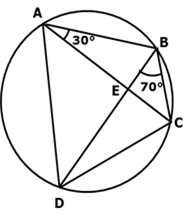
Since ∠BCD = 80°,
∠BCA + ∠ACD = 80°
30° + ∠ECD = 80°
∠ECD = 80° − 30°
= 50°
Thus, ∠BCD = 80° and ∠ECD = 50°.
Q7. If diagonals of a cyclic quadrilateral are diameters of the circle through the vertices of the quadrilateral, prove that it is a rectangle.
Answer:
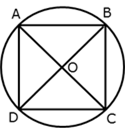
Given: ABCD is a cyclic quadrilateral. AC and BD are the diameters of the circle.
To prove: ABCD is a rectangle.
Proof: Since the angle in a semicircle is a right angle,
∠ABC = 90° (AC is a diameter)
and ∠ADC = 90° (AC is a diameter)
Now, ∠BAD = 90° (BD is a diameter)
and ∠BCD = 90° (BD is a diameter)
Since each angle of ABCD is 90°, ABCD is a rectangle.
Hence proved.
Q8. If the non-parallel sides of a trapezium are equal, prove that it is cyclic.
Answer:
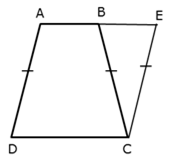
Given: ABCD is a trapezium in which AB is parallel to DC, and the non-parallel sides are equal, that is AD = BC.
To prove: ABCD is a cyclic quadrilateral.
Construction: Draw a line through C parallel to AD, meeting AB produced at E.
Proof:
AE is part of AB, and AB is parallel to DC, so AE is parallel to DC.
By construction, AD is parallel to EC.
Both pairs of opposite sides of AECD are parallel, so AECD is a parallelogram.
In a parallelogram, opposite sides are equal, so AD = EC.
It is given that AD = BC.
Therefore EC = BC.
In triangle CEB, EC = BC, so it is an isosceles triangle.
∠CBE = ∠CEB (angles opposite equal sides are equal)
∠CBE + ∠CBA = 180° (linear pair on the straight line AE)
∠CEB + ∠CBA = 180° (since ∠CBE = ∠CEB)
∠CEA + ∠CBA = 180° (since B lies on AE)
In parallelogram AECD, opposite angles are equal, so ∠CEA = ∠CDA.
∠CDA + ∠CBA = 180°
One pair of opposite angles of quadrilateral ABCD adds up to 180°.
Therefore ABCD is a cyclic quadrilateral. Hence proved.
Q9. Two circles intersect at two points B and C. Through B, two line segments ABD and PBQ are drawn to intersect the circles at A, D and P, Q respectively (see the figure below). Prove that ∠ACP = ∠QCD.
Answer:
Given: The intersection points of two circles are B and C. Two line segments ABD and PBQ are drawn to intersect the circles at A, D and P, Q respectively.
To prove: ∠ACP = ∠QCD
Proof: Since angles in the same segment of a circle are equal,
∠ACP = ∠ABP ... (i)
and ∠QCD = ∠QBD ... (ii)
But ∠ABP = ∠QBD ... (iii) (vertically opposite angles)
From (i), (ii) and (iii),
∠ACP = ∠QCD
Hence proved.
Q10. If circles are drawn taking two sides of a triangle as diameters, prove that the point of intersection of these circles lie on the third side.
Answer:
Given: ABC is a triangle. Two circles are drawn with diameters AB and AC respectively.
To prove: The point of intersection D of the circles lies on BC.
Proof:
∠ADC = 90° (angle in a semicircle is 90°)
and ∠ADB = 90° (angle in a semicircle is 90°)
∠ADB + ∠ADC = 90° + 90°
∠BDC = 180°
So BDC is a straight line.
So D lies on BC, that is on the third side of the triangle.
Thus, the point of intersection of both circles lies on the third side of the triangle. Hence proved.
Q11. ABC and ADC are two right triangles with common hypotenuse AC. Prove that ∠CAD = ∠CBD.
Answer:
Given: Triangle ABC and triangle ADC have the common hypotenuse AC, so ∠ABC = 90° and ∠ADC = 90°.
To prove: ∠CAD = ∠CBD
Proof: In quadrilateral ABCD,
∠B + ∠D = 90° + 90° = 180°
So quadrilateral ABCD is cyclic.
Then ∠CAD = ∠CBD (angles in the same segment of a circle are equal)
Hence proved.
Q12. Prove that a cyclic parallelogram is a rectangle.
Answer:
Given: ABCD is a cyclic parallelogram.
To prove: ABCD is a rectangle.
Proof:
∠A + ∠C = 180° (ABCD is a cyclic quadrilateral)
∠A = ∠C (opposite angles of a parallelogram)
Then ∠A = ∠C = 90°
Since a parallelogram is a rectangle if any one angle is a right angle, ABCD is a rectangle.
Hence proved.
NCERT Solutions for Class 9 Maths Chapter 9 Circles: All Exercises
- NCERT Solutions Class 9 Maths Chapter 9: Exercise 9.1
- NCERT Solutions Class 9 Maths Chapter 9: Exercise 9.2
- NCERT Solutions Class 9 Maths Chapter 9: Exercise 9.3