Class 9 Maths Ganita Manjari Chapter 13 End of Chapter Exercises Two Variables, One Line
Class 9 Maths Ganita Manjari Chapter 13 End of Chapter Exercises – Two Variables, One Line provide students with comprehensive practice of the key concepts covered throughout the chapter. These exercises include questions on linear equations in two variables, graphical representation, slope, pairs of linear equations, intersecting, parallel and coincident lines, and real-life applications.
The step-by-step solutions help students revise important concepts, improve problem-solving skills, and prepare effectively for examinations. Students can also refer to the Class 9 Maths Ganita Manjari Chapter 13 End of Chapter Exercises Solutions PDF for convenient revision and practice.
NCERT Class 9 Maths Ganita Manjari Chapter 13 End-of-Chapter Exercises
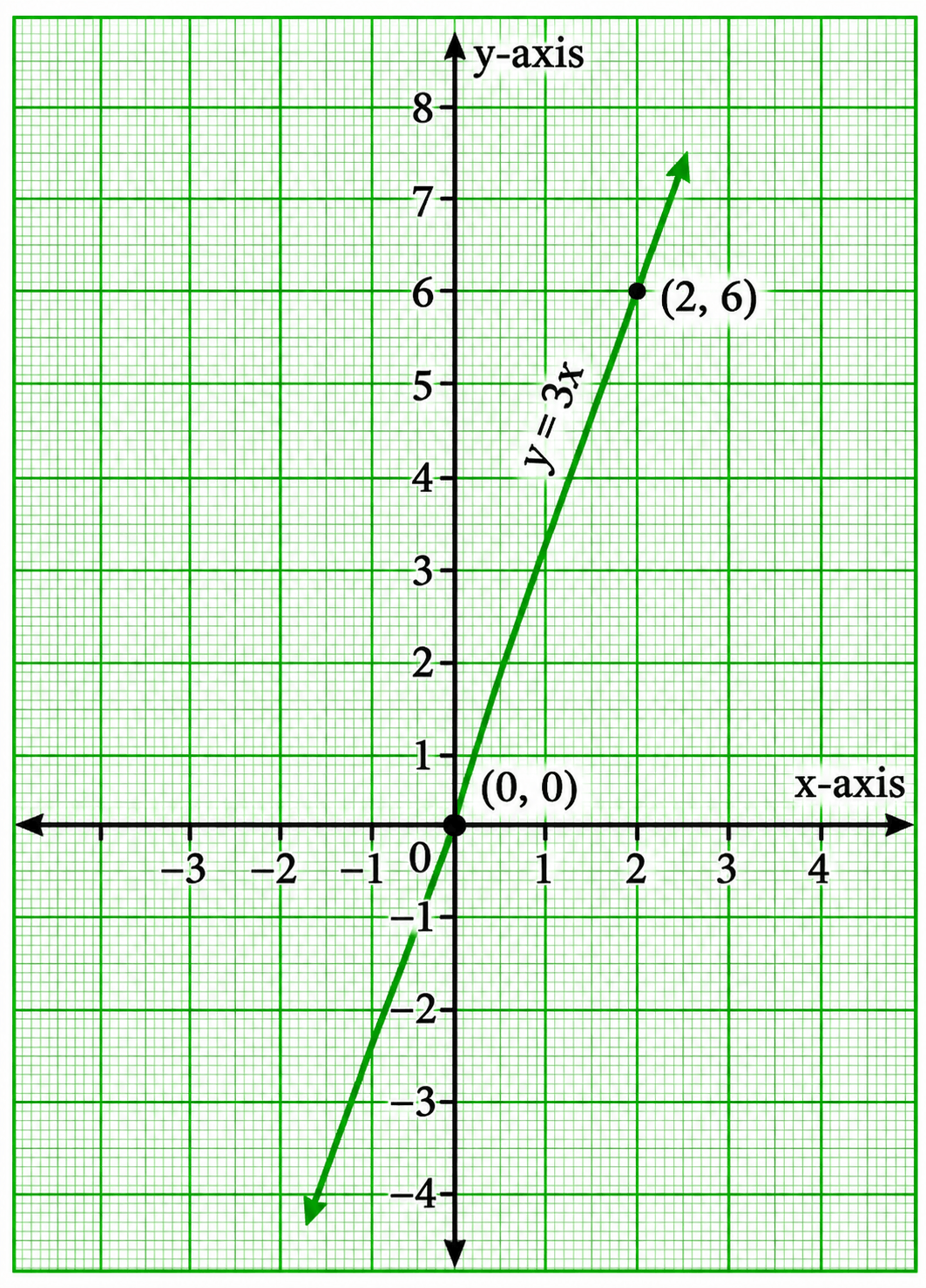
1. The graph of the line y = 3x, passing through (0, 0) and (2, 6) is given below.
(i) Identify the slope of the line from the graph and explain how you calculated it using the two points on the line.
(ii) What is the y-intercept of the line? Explain its significance.
(iii) A water tank is being filled so that the water level y (in cm) after x minutes follows this graph.
(a) How high is the water after 5 minutes?
(b) How many minutes will it take for the water to reach a height of 21 cm?
(iv) Without drawing a new graph, determine whether the point (4, 10) lies on this line. Justify your answer.
(v) Plot the point where this line intersects the line x = 3. Explain how you found the coordinates.
Answer:
(i) Find the slope
Using the two points (0, 0) and (2, 6):
Slope = (y₂ − y₁)/(x₂ − x₁)
Slope = 6/2 = 3
Therefore, the slope of the line is 3. This means that for every increase of 1 unit in x, y increases by 3 units.
(ii) Find the y-intercept
The line passes through (0, 0).
Therefore, the y-intercept is 0.
Its significance is that when x = 0, y = 0. In the water-tank situation, this means the water level is 0 cm at the start.
(iii) Water tank
The water level follows:
y = 3x
(a) After 5 minutes:
Putting x = 5:
y = 3(5) = 15
Therefore, the water is 15 cm high after 5 minutes.
(b) When the water reaches 21 cm:
Putting y = 21:
21 = 3x
x = 7
Therefore, it takes 7 minutes for the water to reach a height of 21 cm.
(iv) Does (4, 10) lie on the line?
For x = 4, the equation gives:
y = 3(4) = 12
But the given point has y = 10.
Since 10 ≠ 12, the point (4, 10) does not lie on the line.
(v) Intersection with x = 3
For the line x = 3, substitute x = 3 into y = 3x:
y = 3(3) = 9
Therefore, the two lines intersect at:
(3, 9)
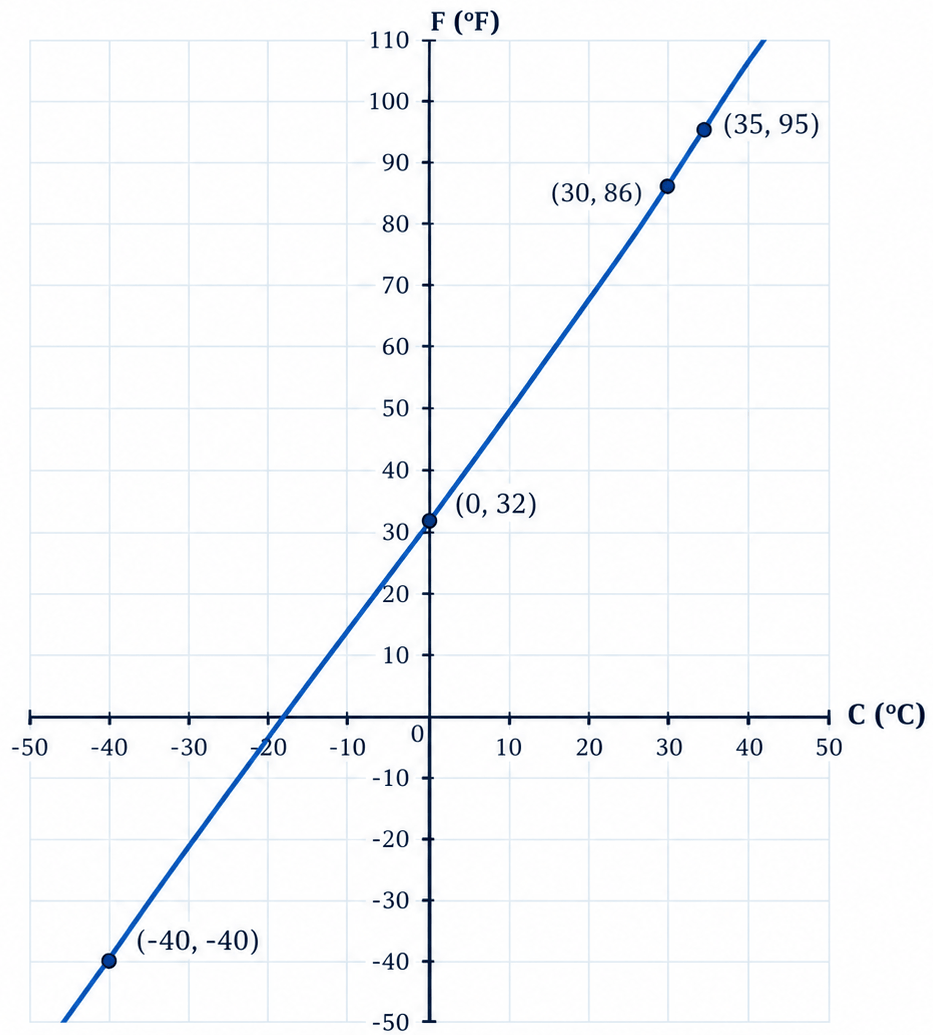
2. In countries like the USA, temperature is measured in Fahrenheit, whereas in countries like India, it is measured in Celsius. Here is a linear equation that converts Celsius to Fahrenheit: F = (9/5)C + 32
(i) Draw the graph of the linear equation above using Celsius on the x-axis and Fahrenheit on the y-axis.
(ii) If the temperature is 30 °C, what is the temperature in Fahrenheit?
(iii) If the temperature is 95 °F, what is the temperature in Celsius?
(iv) If the temperature is 0 °C, what is the temperature in Fahrenheit and if the temperature is 0 °F, what is the temperature in Celsius?
(v) Is there a temperature which is numerically the same in both Fahrenheit and Celsius? If yes, find it.
Answer:
For the conversion,
F = (9/5)C + 32
where C is temperature in Celsius and F is temperature in Fahrenheit.
(i) Graph of the equation
Taking Celsius on the x-axis and Fahrenheit on the y-axis, the graph is a straight line.
Some convenient points are:
| C (°C) | F (°F) |
|---|---|
| −40 | −40 |
| 0 | 32 |
| 20 | 68 |
| 30 | 86 |
Plot these points and join them to obtain the straight line.
(ii) Temperature when C = 30°C
Substituting C = 30:
F = (9/5)(30) + 32
F = 54 + 32 = 86
Therefore,
30°C = 86°F
(iii) Temperature when F = 95°F
Substituting F = 95:
95 = (9/5)C + 32
63 = (9/5)C
C = 63 × 5/9 = 35
Therefore,
95°F = 35°C
(iv) Temperatures corresponding to 0°C and 0°F
When C = 0:
F = (9/5)(0) + 32 = 32
So,
0°C = 32°F
When F = 0:
0 = (9/5)C + 32
(9/5)C = −32
C = −32 × 5/9 = −160/9
C ≈ −17.8°C
So,
0°F ≈ −17.8°C
(v) Temperature that is numerically the same in Celsius and Fahrenheit
Let the common temperature be T.
Then,
T = (9/5)T + 32
T − (9/5)T = 32
−4/5 T = 32
T = −40
Therefore, the temperature that has the same numerical value on both scales is:
−40°C = −40°F
3. Solve the following system of equations graphically: 2x + y = 6, 2x − y − 2 = 0.
Answer:
Rewrite the equations as:
y = 6 − 2x
y = 2x − 2
Some points for plotting are:
| x | y = 6 − 2x | y = 2x − 2 |
|---|---|---|
| 0 | 6 | −2 |
| 1 | 4 | 0 |
| 2 | 2 | 2 |
| 3 | 0 | 4 |
Plotting these points and drawing the two straight lines, we see that they intersect at (2, 2).
Therefore, the graphical solution is:
x = 2, y = 2.

4. Find the point of intersection of the lines shown on the cover page.
Answer:
It is an activity. Do yourself.
5. Give a formula to find the x-intercept of the line y = mx + c.
Answer:
For the line:
y = mx + c
At the x-intercept, y = 0.
So,
0 = mx + c
mx = −c
Therefore,
x = −c/m, provided m ≠ 0.
Hence, the x-intercept is:
(−c/m, 0).
6. A person is choosing between two mobile plans.
Plan A: ₹50 monthly fee + ₹0.20 per minute of call time.
Plan B: ₹30 monthly fee + ₹0.30 per minute of call time.
For how many minutes of calling per month is Plan A cheaper than Plan B? For how many minutes is Plan B cheaper? Also find the number of minutes at which both plans cost the same.
Answer:
Let the number of calling minutes per month be x.
Cost of Plan A:
A = 50 + 0.20x
Cost of Plan B:
B = 30 + 0.30x
To find when both plans cost the same:
50 + 0.20x = 30 + 0.30x
20 = 0.10x
x = 200
So, at 200 minutes, both plans cost the same:
₹50 + ₹0.20(200) = ₹90
₹30 + ₹0.30(200) = ₹90
For Plan A to be cheaper:
50 + 0.20x < 30 + 0.30x
20 < 0.10x
x > 200
Therefore, Plan A is cheaper for more than 200 minutes of calling per month.
For Plan B to be cheaper:
30 + 0.30x < 50 + 0.20x
0.10x < 20
x < 200
Therefore, Plan B is cheaper for fewer than 200 minutes of calling per month.
Hence:
- Less than 200 minutes: Plan B is cheaper.
- Exactly 200 minutes: Both cost the same, ₹90.
- More than 200 minutes: Plan A is cheaper.
7. How many lines exist that
(i) have a given slope?
(ii) have a given slope and pass through a given point?
Answer:
(i) have a given slope?
There are infinitely many lines with a given slope, because parallel lines can have the same slope but different intercepts.
(ii) have a given slope and pass through a given point?
There is exactly one line with a given slope passing through a given point.
Therefore:
(i) Infinitely many lines
(ii) One line
8. For what values of p does the pair of equations given below have a unique solution?
4x + py + 8 = 0; 2x + 2y + 2 = 0.
Answer:
For the pair of linear equations
4x + py + 8 = 0
2x + 2y + 2 = 0
a unique solution exists when:
a₁/a₂ ≠ b₁/b₂
Here,
a₁ = 4, a₂ = 2
b₁ = p, b₂ = 2
So,
4/2 ≠ p/2
2 ≠ p/2
Therefore,
p ≠ 4
Hence, the pair of equations has a unique solution for all values of p except 4.
9. Find the values of a and b for which the following system of equations has infinitely many solutions:
(a + b)x − 2by = 5a + 2b + 1; 3x − y = 14.
Answer:
For the system to have infinitely many solutions, the two equations must represent the same line.
Given:
(a + b)x − 2by = 5a + 2b + 1
3x − y = 14
Writing them in standard form:
(a + b)x − 2by − (5a + 2b + 1) = 0
3x − y − 14 = 0
For infinitely many solutions:
(a + b)/3 = (−2b)/(−1) = −(5a + 2b + 1)/(−14)
Thus,
(a + b)/3 = 2b
So,
a + b = 6b
a = 5b ...(1)
Also,
2b = (5a + 2b + 1)/14
28b = 5a + 2b + 1
26b = 5a + 1 ...(2)
Substituting a = 5b in (2):
26b = 25b + 1
b = 1
Therefore,
a = 5
Hence, the required values are:
a = 5, b = 1.
10. Find the value of ‘k’ for which the following system of equations represents a pair of coincident lines:
x + 2y = 3; (k − 1)x + (k + 1)y = k + 3.
Answer:
For the equations to represent coincident lines, their corresponding coefficients must be proportional.
Given:
x + 2y = 3
(k − 1)x + (k + 1)y = k + 3
Writing in standard form:
x + 2y − 3 = 0
(k − 1)x + (k + 1)y − (k + 3) = 0
For coincident lines:
1/(k − 1) = 2/(k + 1) = 3/(k + 3)
Using the first two ratios:
1/(k − 1) = 2/(k + 1)
Cross-multiplying:
k + 1 = 2(k − 1)
k + 1 = 2k − 2
k = 3
Checking:
1/(3 − 1) = 2/(3 + 1) = 3/(3 + 3) = 1/2
Hence, the required value is:
k = 3.
Related Links:
- NCERT Solutions for Class 9 Maths Ganita Manjari Chapter 13
- NCERT Solutions for Class 9 Maths Ganita Manjari Exercise Set 13.1
- NCERT Solutions for Class 9 Maths Ganita Manjari Exercise Set 13.2
- NCERT Solutions for Class 9 Maths Ganita Manjari Exercise Set 13.3
- NCERT Solutions for Class 9 Maths Ganita Manjari Exercise Set 13.4
- NCERT Solutions for Class 9 Maths Ganita Manjari Exercise Set 13.5