Class 9 Maths Ganita Manjari Chapter 13 Exercise 13.2 Solutions Two Variables, One Line
Class 9 Maths Ganita Manjari Chapter 13 Exercise 13.2 Solutions – Two Variables, One Line help students practise finding and verifying solutions of linear equations in two variables. This exercise focuses on checking whether an ordered pair satisfies a given equation, finding different solutions, and using given conditions to determine unknown values.
The step-by-step solutions help students strengthen their understanding of how points and equations are related and prepare them for graphical representation in the next part of the chapter.
NCERT Class 9 Maths Ganita Manjari Chapter 13 Exercise Set 13.2
1. Verify if the ordered pair (4, 3) is a solution of 5x − 6y = 2. Explain your reasoning.
Answer:
To verify whether (4, 3) is a solution of 5x − 6y = 2, substitute x = 4 and y = 3 into the equation.
5(4) − 6(3) = 20 − 18 = 2
The left-hand side is equal to the right-hand side.
Therefore, (4, 3) is a solution of 5x − 6y = 2.
2. Find any two solutions for each of the following equations: (i) 7x − 3y = 21 (ii) 2x + 3y = 5
Answer:
(i) 7x − 3y = 21
For x = 3:
7(3) − 3y = 21
21 − 3y = 21
y = 0
So, one solution is (3, 0).
For x = 0:
7(0) − 3y = 21
−3y = 21
y = −7
So, another solution is (0, −7).
Therefore, two solutions are:
(3, 0) and (0, −7)
(ii) 2x + 3y = 5
For x = 1:
2(1) + 3y = 5
2 + 3y = 5
y = 1
So, one solution is (1, 1).
For x = 4:
2(4) + 3y = 5
8 + 3y = 5
y = −1
So, another solution is (4, −1).
Therefore, two solutions are:
(1, 1) and (4, −1).
3. In the equations given below, m and n are unknown constants: 2mx + 3y = 7; 4x + ny = −10. If (2, −1) is the solution of both equations, find the values of m and n.
Answer:
Since (2, −1) is a solution of both equations, substitute x = 2 and y = −1 into each equation.
For the first equation:
2mx + 3y = 7
Substituting:
2m(2) + 3(−1) = 7
4m − 3 = 7
4m = 10
m = 5/2
For the second equation:
4x + ny = −10
Substituting:
4(2) + n(−1) = −10
8 − n = −10
−n = −18
n = 18
Therefore,
m = 5/2 and n = 18.
4. Find two solutions which lie in different quadrants for each of the following linear equations. Identify the quadrants in which the points lie.
(i) 5x + 3y = 7 (ii) 5x − 3y = 7
(iii) −5x + 3y = 7 (iv) −5x − 3y = 7
Verify your solutions by representing the linear equations on a graph paper.
Answer:
(i) 5x + 3y = 7
For x = −1:
5(−1) + 3y = 7
−5 + 3y = 7
3y = 12
y = 4
So, (−1, 4) is a solution and lies in Quadrant II.
For x = 2:
5(2) + 3y = 7
10 + 3y = 7
3y = −3
y = −1
So, (2, −1) is a solution and lies in Quadrant IV.
Solutions: (−1, 4) – Quadrant II and (2, −1) – Quadrant IV
(ii) 5x − 3y = 7
For x = 2:
5(2) − 3y = 7
10 − 3y = 7
−3y = −3
y = 1
So, (2, 1) lies in Quadrant I.
For x = −1:
5(−1) − 3y = 7
−5 − 3y = 7
−3y = 12
y = −4
So, (−1, −4) lies in Quadrant III.
Solutions: (2, 1) – Quadrant I and (−1, −4) – Quadrant III
(iii) −5x + 3y = 7
For x = 1:
−5(1) + 3y = 7
−5 + 3y = 7
3y = 12
y = 4
So, (1, 4) lies in Quadrant I.
For x = −2:
−5(−2) + 3y = 7
10 + 3y = 7
3y = −3
y = −1
So, (−2, −1) lies in Quadrant III.
Solutions: (1, 4) – Quadrant I and (−2, −1) – Quadrant III
(iv) −5x − 3y = 7
For x = −2:
−5(−2) − 3y = 7
10 − 3y = 7
−3y = −3
y = 1
So, (−2, 1) lies in Quadrant II.
For x = 1:
−5(1) − 3y = 7
−5 − 3y = 7
−3y = 12
y = −4
So, (1, −4) lies in Quadrant IV.
Solutions: (−2, 1) – Quadrant II and (1, −4) – Quadrant IV
Summary
| Equation | First solution | Quadrant | Second solution | Quadrant |
|---|---|---|---|---|
| 5x + 3y = 7 | (−1, 4) | II | (2, −1) | IV |
| 5x − 3y = 7 | (2, 1) | I | (−1, −4) | III |
| −5x + 3y = 7 | (1, 4) | I | (−2, −1) | III |
| −5x − 3y = 7 | (−2, 1) | II | (1, −4) | IV |
Plotting the two points obtained for each equation and joining them gives the corresponding straight line, verifying that both points satisfy the equation.

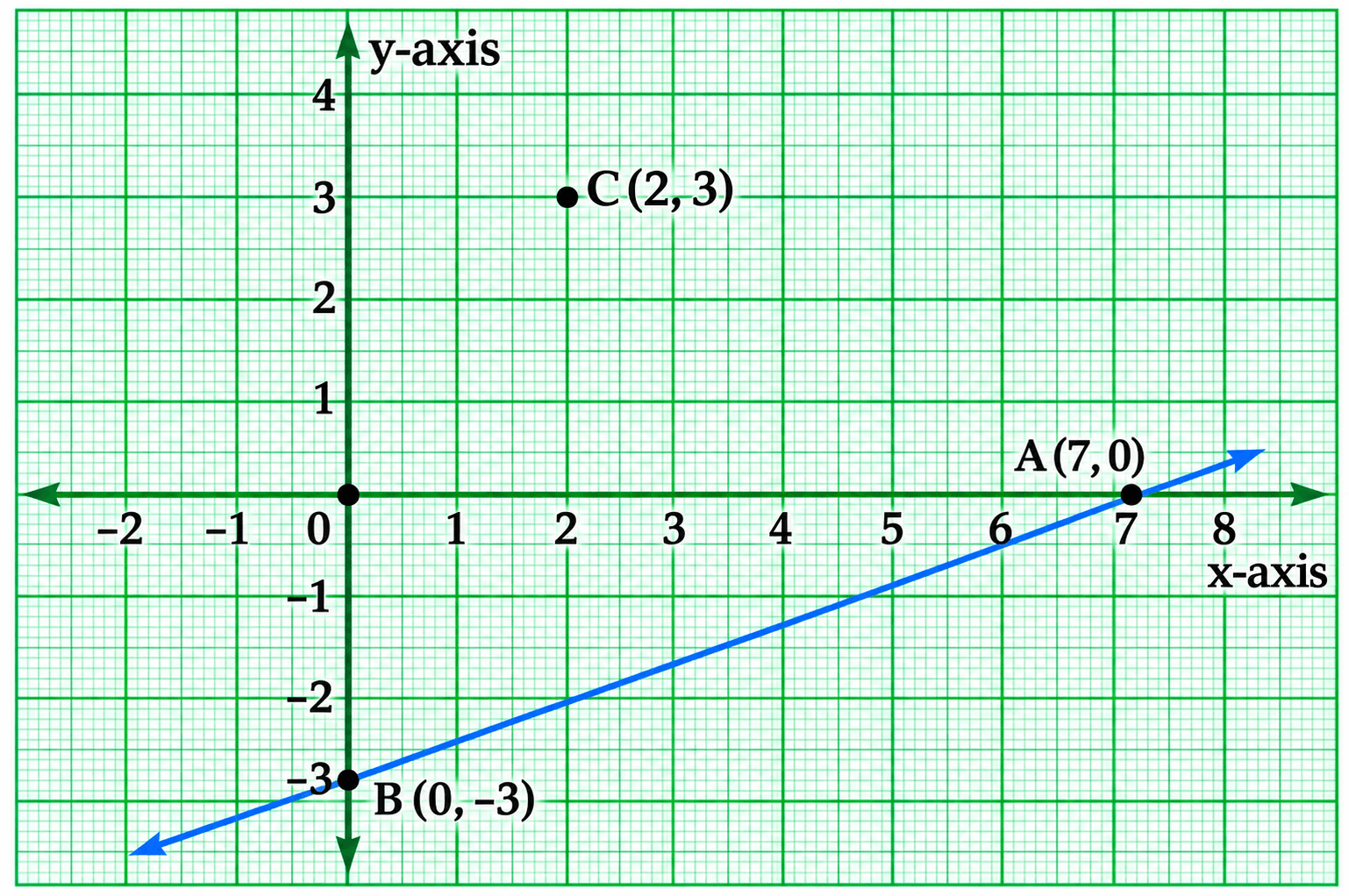
5. Consider the graph of the equation 3x − 7y = 21 shown below. Does the point C (2, 3) lie on the line? Does it satisfy the equation? Can points that do not lie on the line satisfy the equation?
Answer:
No, C(2, 3) does not lie on the line.
At C,
3x − 7y = 3(2) − 7(3) = 6 − 21 = −15
Since −15 ≠ 21, C does not satisfy the equation.
The line represents exactly those points whose coordinates satisfy 3x − 7y = 21. Therefore, a point that does not lie on the line cannot satisfy the equation.
To draw the line, we can use its intercepts A(7, 0) and B(0, −3).
6. State whether the following sentences are True or False. Justify your answer.
(i) A linear equation in two variables has only one solution.
(ii) The graph of a linear equation in two variables always passes through the origin.
(iii) A linear equation in two variables can never have rational solutions.
(iv) x = 3 is a valid linear equation in two variables.
(v) The equation 2x + 3y = 7 has infinitely many solutions.
(vi) The point (1, 2) is a solution of the equation 2x + 3y = 7.
Answer:
(i) A linear equation in two variables has only one solution.
False. A linear equation in two variables generally has infinitely many solutions.
(ii) The graph of a linear equation in two variables always passes through the origin.
False. It passes through the origin only when (0, 0) satisfies the equation.
(iii) A linear equation in two variables can never have rational solutions.
False. A linear equation in two variables can have rational solutions.
(iv) x = 3 is a valid linear equation in two variables.
True. It can be written as:
x + 0y − 3 = 0
So, it is a linear equation in two variables.
(v) The equation 2x + 3y = 7 has infinitely many solutions.
True. Different values of x can give corresponding values of y, producing infinitely many ordered pairs that satisfy the equation.
(vi) The point (1, 2) is a solution of the equation 2x + 3y = 7.
False.
Substituting x = 1 and y = 2:
2(1) + 3(2) = 2 + 6 = 8
Since 8 ≠ 7, (1, 2) is not a solution of the equation.
7. (i) Compare the solutions of the equations 3x + 4y = 7 and 6x + 8y = 14. Argue that they have the same set of solutions, that is, every solution of one is also a solution of the other. (ii) Show that the equations ax + by = c and kax + kby = kc, with k ≠ 0, have the same set of solutions.
Answer:
(i) Compare the solutions of 3x + 4y = 7 and 6x + 8y = 14.
The second equation is obtained by multiplying the first equation by 2:
3x + 4y = 7
Multiplying both sides by 2:
6x + 8y = 14
So, any ordered pair (x, y) that satisfies 3x + 4y = 7 will also satisfy 6x + 8y = 14.
Similarly, dividing 6x + 8y = 14 by 2 gives:
3x + 4y = 7
Therefore, every solution of one equation is also a solution of the other.
Hence, both equations have the same set of solutions.
(ii) Show that ax + by = c and kax + kby = kc, where k ≠ 0, have the same set of solutions.
Suppose (x, y) satisfies:
ax + by = c
Multiplying both sides by k:
k(ax + by) = kc
So,
kax + kby = kc
Hence, every solution of ax + by = c is also a solution of kax + kby = kc.
Conversely, if:
kax + kby = kc
then, since k ≠ 0, dividing both sides by k gives:
ax + by = c
Therefore, every solution of the second equation is also a solution of the first.
Hence, ax + by = c and kax + kby = kc have the same set of solutions.
Related Links:
- NCERT Solutions for Class 9 Maths Ganita Manjari Chapter 13
- NCERT Solutions for Class 9 Maths Ganita Manjari Exercise Set 13.1
- NCERT Solutions for Class 9 Maths Ganita Manjari Exercise Set 13.3
- NCERT Solutions for Class 9 Maths Ganita Manjari Exercise Set 13.4
- NCERT Solutions for Class 9 Maths Ganita Manjari Exercise Set 13.5
- NCERT Solutions for Class 9 Maths Ganita Manjari End of Chapter Exercises