NCERT Solutions for Class 6 Maths Ganita Prakash Chapter 5 – Prime Time
NCERT Solutions for Class 6 Maths Chapter 5 – Prime Time explain the "Prime Time" chapter of the Ganita Prakash book in plain, simple language. This chapter is about factors and multiples — the building blocks of every whole number. Students learn what a factor is, what a multiple is, and how to find the numbers that two or more numbers share.
The chapter then introduces prime numbers, which have exactly two factors, and composite numbers, which have more than two. It covers common factors, common multiples, twin primes, co-prime numbers, perfect numbers, prime factorisation, and simple divisibility tests. Many of the questions come from the 'idli-vada' counting game and the treasure hunting game, which make these ideas easy to picture. These solutions are useful for students starting the chapter, for parents helping at home, and for teachers preparing class work. A free printable PDF of these solutions is also available for download.
NCERT Solutions for Class 6 Maths Ganita Prakash Chapter 5 – Prime Time
 Prime Time (New NCERT)
 Medium
Prime Time (New NCERT)
Medium
Prime Time (New NCERT)
Medium
Prime Time (New NCERT)
Medium
Prime Time (New NCERT)
Medium
Prime Time (New NCERT)
Medium
Prime Time (New NCERT)
Medium
Prime Time (New NCERT)
Medium
Prime Time (New NCERT)
Medium
Prime Time (New NCERT)
Medium
Prime Time (New NCERT)
Medium
Prime Time (New NCERT)
Medium
Prime Time (New NCERT)
Medium
Prime Time (New NCERT)
Medium
Prime Time (New NCERT)
Medium
Prime Time (New NCERT)
Medium
Prime Time (New NCERT)
Medium
Prime Time (New NCERT)
Medium
Prime Time (New NCERT)
Medium
Prime Time (New NCERT)
Medium
Prime Time (New NCERT)
Medium
Prime Time (New NCERT)
Medium
Prime Time (New NCERT)
Medium
Prime Time (New NCERT)
Medium
Prime Time (New NCERT)
Medium
Prime Time (New NCERT)
Medium
Prime Time (New NCERT)
Medium
Prime Time (New NCERT)
Medium
Prime Time (New NCERT)
Medium
 Prime Time (New NCERT)
Medium
Prime Time (New NCERT)
Medium
Prime Time (New NCERT)
Medium
 Prime Time (New NCERT)
Medium
Prime Time (New NCERT)
Medium
Prime Time (New NCERT)
Medium
Prime Time (New NCERT)
 Difficult
Prime Time (New NCERT)
Difficult
Prime Time (New NCERT)
Medium
Prime Time (New NCERT)
Medium
Prime Time (New NCERT)
Medium
 Prime Time (New NCERT)
Medium
Prime Time (New NCERT)
Medium
Prime Time (New NCERT)
Medium
Prime Time (New NCERT)
Medium
Prime Time (New NCERT)
Medium
Prime Time (New NCERT)
Medium
Prime Time (New NCERT)
Medium
Prime Time (New NCERT)
Medium
Prime Time (New NCERT)
Medium


Class 6 Maths Chapter 5 Prime Time Solutions
Figure it Out (Page 108)
Q1. At what number is 'idli-vada' said for the 10th time?
Answer:
The first number for which the players should say 'idli-vada' is 15 as 3 × 5, which is a multiple of 3 and 5.
So,
15 × 1 = 15
15 × 2 = 30
15 × 3 = 45
...................
...................
15 × 10 = 150
Thus, 150 is the number that will be said 'idli-vada' for the 10th time.
Q2. If the game is played for the numbers from 1 till 90, find out:
(a) How many times would the children say 'idli' (including the times they say 'idli-vada')?
(b) How many times would the children say 'vada' (including the times they say 'idli-vada')?
(c) How many times would the children say 'idli-vada'?
Answer:
(a) Multiples of 3 from number 1 till 90: 3, 6, 9, 12, 15, 18, 21, 24, 27, 30, 33, 36, 39, 42, 45, 48, 51, 54, 57, 60, 63, 66, 69, 72, 75, 78, 81, 84, 87, 90
Total number of multiples of 3 from number 1 to 90 = 30
Thus, the children would say 30 times 'idli' (including the times they say 'idli-vada').
(b) Multiples of 5 from number 1 till 90: 5, 10, 15, 20, 25, 30, 35, 40, 45, 50, 55, 60, 65, 70, 75, 80, 85 and 90.
Total number of multiples of 5 from number 1 to 90 = 18
Thus, the children would say 18 times 'vada' (including the times they say 'idli-vada').
(c) Numbers that are multiples of 3 and 5 both from 1 to 90 are: 15, 30, 45, 60, 75, and 90.
Total number of multiples of 15 from number 1 to 90 = 6.
Thus, the children would say 'idli-vada' 6 times.
Q3. What if the game was played till 900? How would your answers change?
Answer:
If the game was played till 900, that is 90 × 10.
Then, total number of multiples of 3 from number 1 to 900 = 30 × 10 = 300
Thus, the children would say 300 times 'idli' (including the times they say 'idli-vada').
Similarly, total number of multiples of 5 from number 1 to 900 = 18 × 10 = 180
Thus, the children would say 180 times 'vada' (including the times they say 'idli-vada').
And, total number of multiples of 15 from number 1 to 900 = 6 × 10 = 60
Thus, the children would say 60 times 'idli-vada'.
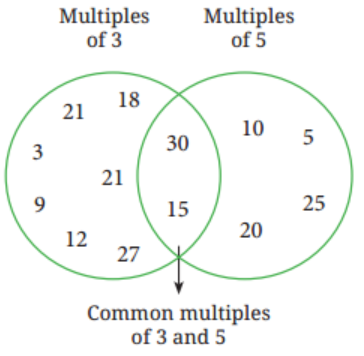
Q4. Is this figure somehow related to the 'idli-vada' game?
Hint: Imagine playing the game till 30. Draw the figure if the game is played till 60.
Answer:
Yes, the given figure is related to the 'idli-vada' game. The numbers for 'idli' are given in the left circle, the numbers for 'vada' are given in the right circle, and the numbers common in both the circles are for 'idli-vada'.
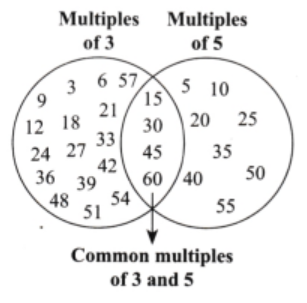
Figure it Out (Page 110 – 111)
Q5. Find all multiples of 40 that lie between 310 and 410.
Answer:
All multiples of 40 that lie between 310 and 410:
40 × 8 = 320, 40 × 9 = 360, and 40 × 10 = 400
Thus, all multiples of 40 that lie between 310 and 410 are 320, 360 and 400.
Q6. Who am I?
(a) I am a number less than 40. One of my factors is 7. The sum of my digits is 8.
(b) I am a number less than 100. Two of my factors are 3 and 5. One of my digits is 1 more than the other.
Answer:
(a) Numbers that are less than 40 and have 7 as a factor:
7 × 1 = 7,
7 × 2 = 14,
7 × 3 = 21,
7 × 4 = 28,
7 × 5 = 35
Here, only 35 is the number whose sum of the digits is 8, as 3 + 5 = 8.
Hence, the number is 35.
(b) Numbers less than 100 having two of their factors 3 and 5 are:
1 × (3 × 5) = 15, 2 × (3 × 5) = 30, 3 × (3 × 5) = 45,
4 × (3 × 5) = 60, 5 × (3 × 5) = 75, 6 × (3 × 5) = 90
Here, 45 is the only number whose one of the digits is 1 more than the other (4 + 1 = 5).
Q7. A number for which the sum of all its factors is equal to twice the number is called a perfect number. The number 28 is a perfect number. Its factors are 1, 2, 4, 7, 14 and 28. Their sum is 56 which is twice 28. Find a perfect number between 1 and 10.
Answer:
There is only one number 6 between 1 to 10 which is a perfect number.
As, the factors of 6 are 1, 2, 3 and 6.
Their sum is 1 + 2 + 3 + 6 = 12, which is twice the number 6.
Therefore, 6 is a perfect number.
Q8. Find the common factors of:
(a) 20 and 28 (b) 35 and 50 (c) 4, 8 and 12 (d) 5, 15 and 25
Answer:
(a) 20 and 28
We have: 20 = 1 × 20, 20 = 2 × 10, 20 = 4 × 5
∴ All the factors of 20 are: 1, 2, 4, 5, 10 and 20 …(i)
Again, 28 = 1 × 28, 28 = 2 × 14, 28 = 4 × 7
∴ All the factors of 28 are: 1, 2, 4, 7, 14 and 28 …(ii)
From (i) and (ii), common factors of 20 and 28 are 1, 2 and 4.
(b) 35 and 50
Since 35 = 1 × 35, 35 = 5 × 7
All the factors of 35 are: 1, 5, 7 and 35 …(i)
Again, 50 = 1 × 50, 50 = 2 × 25, 50 = 5 × 10
All the factors of 50 are: 1, 2, 5, 10, 25, 50 …(ii)
From (i) and (ii), common factors of 35 and 50 are 1 and 5.
(c) 4, 8 and 12
∵ Factors of 4 are: 1, 2 and 4
Factors of 8 are: 1, 2, 4 and 8
Factors of 12 are: 1, 2, 3, 4, 6 and 12
Common factors of 4, 8 and 12 are 1, 2 and 4.
(d) 5, 15 and 25
∵ Factors of 5 are 1 and 5
Factors of 15 are: 1, 3, 5 and 15
Factors of 25 are: 1, 5 and 25
∴ Common factors of 5, 15 and 25 are 1 and 5.
Q9. Find any three numbers that are multiples of 25 but not multiples of 50.
Answer:
Multiples of 25 are: 25, 50, 75, 100, 125, 150, 175, …
Multiples of 50 are: 50, 100, 150, 200, 250, …
∴ The numbers that are multiples of 25 but not multiples of 50 are 25, 75, 125, 175, …
Q10. Anshu and his friends play the 'idli-vada' game with two numbers, which are both smaller than 10. The first time anybody says 'idli-vada' is after the number 50. What could the two numbers which are assigned 'idli' and 'vada' be?
Answer:
The pair of numbers smaller than 10 with first common multiple greater than 50 are (7, 8), (8, 9) and (7, 9).
For (7, 8):
If 7, 14, 21, 28, 35, …, 49, 56, 63, … are said 'idli'.
And 8, 16, 24, 32, …, 48, 56, 64, … are said 'vada'.
Then 56 is the first number (first common multiple of 7 and 8) greater than 50 which would be said 'idli-vada'.
For (8, 9):
If 8, 16, 24, 32, …, 48, 56, 64, 72, … are said 'idli'.
And 9, 18, 27, 36, …, 54, 63, 72, … are said 'vada'.
Then 72 is the first number (first common multiple of 8 and 9) greater than 50 which would be said 'idli-vada'.
For (7, 9):
If 7, 14, 21, 28, …, 49, 56, 63, 70, … are said 'idli'.
And 9, 18, 27, 36, …, 54, 63, 72, … are said 'vada'.
Then 63 is the first number (first common multiple of 7 and 9) greater than 50 which would be said 'idli-vada'.
Q11. In the treasure hunting game, Grumpy has kept treasures on 28 and 70. What jump sizes will land on both the numbers?
Answer:
In the treasure hunting game, if Grumpy has kept treasures on 28 and 70, then the common factors of 28 and 70 will be the jump sizes to land on both the numbers.
Therefore,
Factors of 28 are: 1, 2, 4, 7, 14, and 28.
Factors of 70 are: 1, 2, 5, 7, 10, 14, 35 and 70.
The common factors of 28 and 70 are: 1, 2, 7, and 14. Thus, the possible jump sizes to land on both the numbers will be 1, 2, 7, and 14.
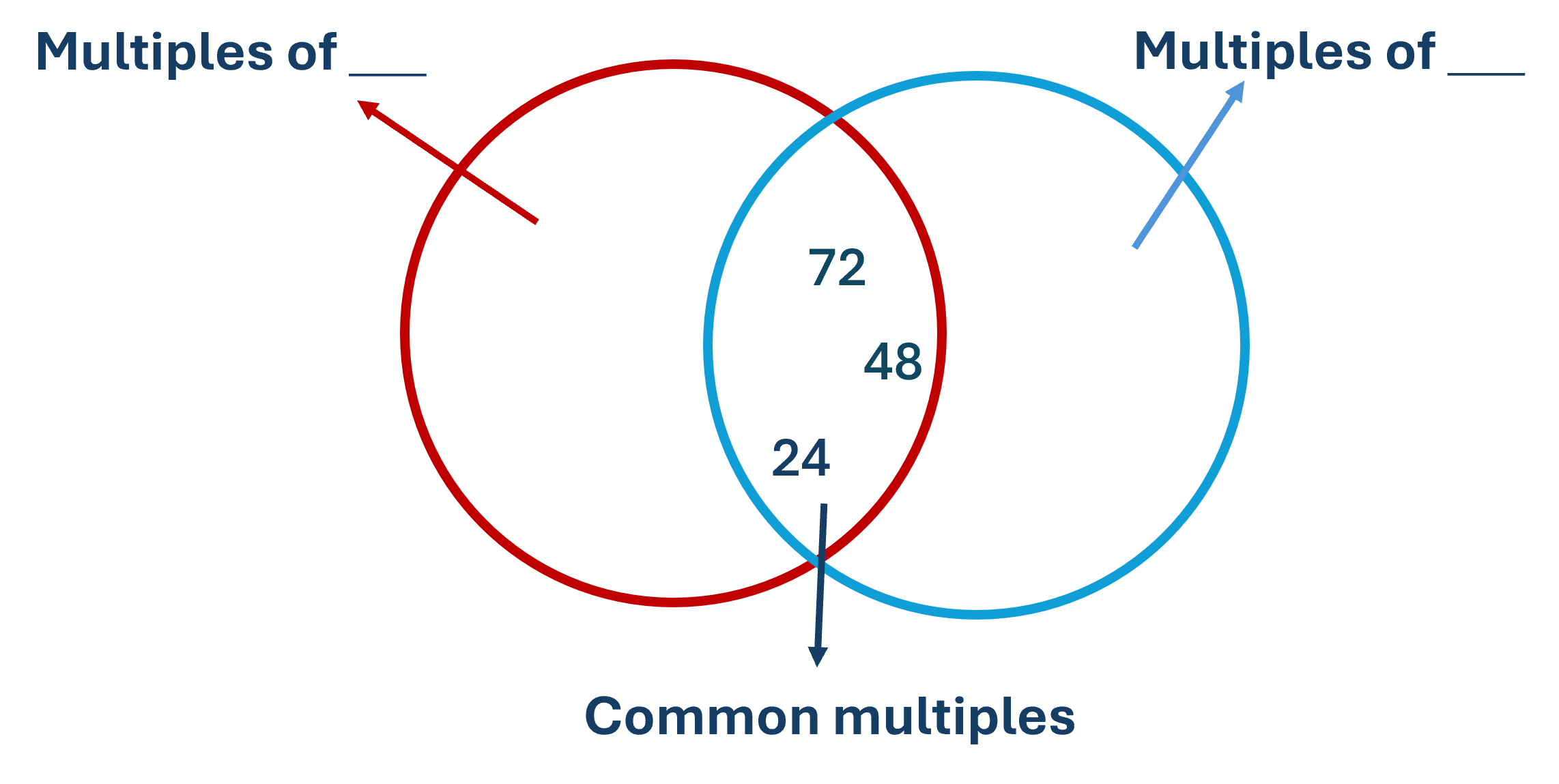
Q12. In the diagram below, Guna has erased all the numbers except the common multiples. Find out what those numbers could be and fill in the missing numbers in the empty regions.
Answer:
A pair of possible numbers whose common multiples are 24, 48 and 72 would be 6 and 8.
Multiples of 6 = 6, 12, 18, 24, 30, 36, 42, 48, 54, 60, 66, 72, …
Multiples of 8 = 8, 16, 24, 32, 40, 48, 56, 64, 72, …
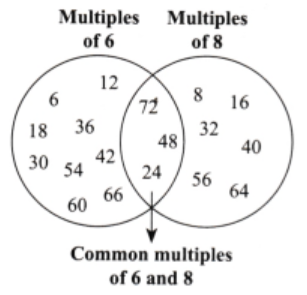
Other possible pairs are 3 and 8; 8 and 12.
Q13. Find the smallest number that is a multiple of all the numbers from 1 to 10 except for 7.
Answer:
For the number to be divisible by 2, it must have a factor as 2,
for the number to be divisible by 3, it must have a factor as 3,
for 4, we need 2 × 2, and we have already included 2, so one extra 2 is needed.
For the number to be divisible by 5, it must have a factor as 5,
for 6, we need 2 × 3, and we have already included those.
For 8, we need 2 × 2 × 2; we have already included 2 × 2, so one extra 2 is needed.
For 9, we need 3 × 3, and we have already included 3, so one extra 3 is needed.
For 10, we need 2 × 5, we have already included it.
So, the smallest number will be 2 × 3 × 2 × 5 × 2 × 3 = 360

Thus, the smallest number that is a multiple of all the numbers from 1 to 10 except for 7 will be 360.
Q14. Find the smallest number that is a multiple of all the numbers from 1 to 10.
Answer:
For the number to be divisible by 2, it must have a factor as 2,
for the number to be divisible by 3, it must have a factor as 3,
for 4, we need 2 × 2, and we have already included 2, so one extra 2 is needed.
For the number to be divisible by 5, it must have a factor as 5,
for 6, we need 2 × 3, and we have already included those.
For the number to be divisible by 7, it must have a factor as 7,
for 8, we need 2 × 2 × 2; we have already included 2 × 2, so one extra 2 is needed.
For 9, we need 3 × 3, and we have already included 3, so one extra 3 is needed.
For 10, we need 2 × 5, we have already included it.
So, the smallest number will be 2 × 3 × 2 × 5 × 7 × 2 × 3 = 2520

Thus, the smallest number that is a multiple of all the numbers from 1 to 10 will be 2520.
Figure it Out (Page 114 – 115)

Figure it Out (Page 114 – 115)
Q15. We see that 2 is a prime and also an even number. Is there any other even prime?
Answer:
No, 2 is the only prime which is even also.
Q16. Look at the list of primes till 100. What is the smallest difference between two successive primes? What is the largest difference?
Answer:
Looking at the list of primes till 100, we have
The smallest difference between two successive primes is 1, as 3 − 2 = 1.
And the largest difference between two successive primes is 8, as 97 − 89 = 8.
Q17. Are there an equal number of primes occurring in every row in the table on the previous page? Which decades have the least number of primes? Which have the most number of primes?
Answer:
(i) No
(ii) From 91 to 100, there is only 1 prime number which is 97.
(iii) From 1 to 10 and 11 to 20, there are 4 prime numbers in each of the two rows.
Q18. Which of the following numbers are prime: 23, 51, 37, 26?
Answer:
Among the given numbers 23 and 37 are prime numbers as they have only two factors 1 and the numbers themselves.
Q19. Write three pairs of prime numbers less than 20 whose sum is a multiple of 5.
Answer:
The pairs of prime numbers less than 20 whose sum is a multiple of 5 are as follows:
(2, 3) as 2 + 3 = 5 which is a multiple of 5.
(3, 7) as 3 + 7 = 10 which is a multiple of 5.
(2, 13) as 2 + 13 = 15 which is a multiple of 5.
(7, 13) as 7 + 13 = 20 which is a multiple of 5.
(3, 17) as 3 + 17 = 20 which is a multiple of 5.
(Answer may vary)
Q20. The numbers 13 and 31 are prime numbers. Both these numbers have the same digits 1 and 3. Find such pairs of prime numbers up to 100.
Answer:
Required pairs of prime numbers up to 100 having the same digits are: 17 and 71; 37 and 73; 79 and 97.
Q21. Find seven consecutive composite numbers between 1 and 100.
Answer:
Seven consecutive composite numbers between 1 and 100 are: 90, 91, 92, 93, 94, 95, and 96.
Q22. Twin primes are pairs of primes having a difference of 2. For example, 3 and 5 are twin primes. So are 17 and 19. Find the other twin primes between 1 and 100.
Answer:
The twin primes (other than 3 and 5; 17 and 19) between 1 and 100 are: (5, 7), (11, 13), (29, 31), (41, 43), (59, 61), and (71, 73).
Q23. Identify whether each statement is true or false. Explain.
(a) There is no prime number whose units digit is 4.
(b) A product of primes can also be prime.
(c) Prime numbers do not have any factors.
(d) All even numbers are composite numbers.
(e) 2 is a prime and so is the next number, 3. For every other prime, the next number is composite.
Answer:
(a) True. A number ending with 4 is an even number and every even number is a multiple of 2. So, no prime number is possible with units digit 4.
(b) False. The product of two primes can't be a prime, because it violates the definition of the prime number as it will be divided by the prime numbers which are multiplied rather than the number itself. So the number is not prime; it will become a composite number instead.
(c) False. Prime numbers have only two factors: 1 and the number itself.
(d) False. 2 is the smallest even prime number.
(e) True. Every number is either even or odd, and 2 is the only even prime number. Every other even number is divisible by 2, so it can't be a prime number. The rest of the prime numbers are odd and therefore, the next number is composite for every other prime.
Q24. Which of the following numbers is the product of exactly three distinct prime numbers: 45, 60, 91, 105, 330?
Answer:
45 = 3 × 3 × 5. They are not distinct as it has two 3's.
60 = 2 × 2 × 3 × 5. They are not distinct as it has two 2's.
91 = 7 × 13. It has only two distinct prime factors.
105 = 3 × 5 × 7. It has three distinct prime factors 3, 5, and 7.
330 = 2 × 3 × 5 × 11. It has four distinct prime factors.
Thus, only 105 is the product of 3 distinct prime numbers.
Q25. How many three-digit prime numbers can you make using each of 2, 4 and 5 once?
Answer:
The possible numbers formed by 2, 4 and 5 are: 245, 254, 425, 452, 524, 542.
These all are composite numbers, not prime numbers. So, no prime number can be made using each of 2, 4 and 5 once.
Q26. Observe that 3 is a prime number, and 2 × 3 + 1 = 7 is also a prime. Are there other primes for which doubling and adding 1 gives another prime? Find at least five such examples.
Answer:
We can have primes as:
2 × 2 + 1 = 5, prime number;
2 × 5 + 1 = 11, prime number;
2 × 11 + 1 = 23, prime number;
2 × 23 + 1 = 47, prime number;
2 × 29 + 1 = 59, prime number;
and 2 × 41 + 1 = 83, prime number.
Thus, 2, 5, 11, 23, 29 and 41 are required primes. (Answer may vary)
Figure it Out (Page 120)
Q27. Find the prime factorisations of the following numbers: 64, 104, 105, 243, 320, 141, 1728, 729, 1024, 1331, 1000.
Answer:
Prime factorisation of the given numbers are:
64 = 2 × 2 × 2 × 2 × 2 × 2
104 = 2 × 2 × 2 × 13
105 = 3 × 5 × 7
243 = 3 × 3 × 3 × 3 × 3
320 = 2 × 2 × 2 × 2 × 2 × 2 × 5
141 = 3 × 47
1728 = 2 × 2 × 2 × 2 × 2 × 2 × 3 × 3 × 3
729 = 3 × 3 × 3 × 3 × 3 × 3
1024 = 2 × 2 × 2 × 2 × 2 × 2 × 2 × 2 × 2 × 2
1331 = 11 × 11 × 11
1000 = 2 × 2 × 2 × 5 × 5 × 5
Q28. The prime factorisation of a number has one 2, two 3s, and one 11. What is the number?
Answer:
The prime factorisation of a number has one 2, two 3s, and one 11.
Therefore, required number = 2 × 3 × 3 × 11 = 198
Q29. Find three prime numbers, all less than 30, whose product is 1955.
Answer:
Prime factorisation of 1955 is
1955 = 5 × 17 × 23
Thus, 5, 17 and 23 are three prime numbers less than 30 whose product is 1955.
Q30. Find the prime factorisation of these numbers without multiplying first:
(a) 56 × 25 (b) 108 × 75 (c) 1000 × 81
Answer:
We can find the prime factorisation of these numbers without multiplying first as follows:
(a) 56 × 25 = (2 × 2 × 2 × 7) × (5 × 5) = 2 × 2 × 2 × 5 × 5 × 7
(b) 108 × 75 = (2 × 2 × 3 × 3 × 3) × (3 × 5 × 5) = 2 × 2 × 3 × 3 × 3 × 3 × 5 × 5
(c) 1000 × 81 = (2 × 2 × 2 × 5 × 5 × 5) × (3 × 3 × 3 × 3) = 2 × 2 × 2 × 3 × 3 × 3 × 3 × 5 × 5 × 5
Q31. What is the smallest number whose prime factorisation has:
(a) three different prime numbers?
(b) four different prime numbers?
Answer:
(a) The smallest number whose prime factorisation has three different prime numbers = 2 × 3 × 5 = 30
(b) The smallest number whose prime factorisation has four different prime numbers = 2 × 3 × 5 × 7 = 210
Figure it Out (Page 125 – 126)
Q32. 2024 is a leap year (as February has 29 days). Leap years occur in the years that are multiples of 4, except for those years that are evenly divisible by 100 but not 400.
(a) From the year you were born till now, which years were leap years?
(b) From the year 2024 till 2099, how many leap years are there?
Answer:
(a) If you were born in 2013, there were 3 leap years till 2025, which were: 2016, 2020 and 2024.
(b) We know that leap years occur in the years that are multiples of 4, except for those years that are evenly divisible by 100 but not 400. Therefore, multiples of 4 after 2024 will be 2028, 2032, 2036, 2040, 2044, 2048, 2052, 2056, 2060, 2064, 2068, 2072, 2076, 2080, 2084, 2088, 2092, and 2096, till 2099.
Therefore, there will be 19 leap years from the year 2024 till 2099.
Q33. Find the largest and smallest 4-digit numbers that are divisible by 4 and are also palindromes.
Answer:
A palindromic number is a number that reads the same forward and backward.
The smallest 4-digit palindrome divisible by 4 is 2112.
The greatest 4-digit palindrome which is divisible by 4 is 8888.
Q34. Explore and find out if each statement is always true, sometimes true or never true. You can give examples to support your reasoning.
(a) Sum of two even numbers gives a multiple of 4.
(b) Sum of two odd numbers gives a multiple of 4.
Answer:
(a) Sometimes true. The sum of two even numbers is not always a multiple of 4. As,
2 (even) + 4 (even) = 6 (even) which is not a multiple of 4.
2 (even) + 6 (even) = 8 (even) multiple of 4.
4 (even) + 6 (even) = 10 (even) which is not a multiple of 4.
4 (even) + 8 (even) = 12 (even) which is a multiple of 4.
(b) Sometimes true. The sum of two odd numbers is not always a multiple of 4.
3 (odd) + 5 (odd) = 8 (even) which is a multiple of 4.
5 (odd) + 7 (odd) = 12 (even) which is a multiple of 4.
1 (odd) + 5 (odd) = 6 (even) which is not divisible by 4. So, it is not a multiple of 4.
7 (odd) + 11 (odd) = 18 (even) which is not divisible by 4. So, it is not a multiple of 4.
Q35. Find the remainders obtained when each of the following numbers are divided by i) 10, ii) 5, iii) 2.
78, 99, 173, 572, 980, 1111, 2345
Answer:

Q36. 5. The teacher asked if 14560 is divisible by all of 2, 4, 5, 8 and 10. Guna checked for divisibility of 14560 by only two of these numbers and then declared that it was also divisible by all of them. What could those two numbers be?
Answer:
Since 14560 is divisible by 8, it is also divisible by 4 and 2.
Since 14560 is divisible by 5 and is an even number, it is also divisible by 10.
Hence, by checking only 8 and 5, Guna can conclude that 14560 is divisible by 2, 4, 5, 8, and 10.
Therefore, the two numbers could be 8 and 5
Q37. Which of the following numbers are divisible by all of 2, 4, 5, 8 and 10: 572, 2352, 5600, 6000, 77622160.
Answer:
(i) 572
Ends in 2: Divisible by 2.
Last two digits are 72: Divisible by 4.
Does not end in 0 or 5: Not divisible by 5.
Last three digits are 572: Not divisible by 8.
Does not end in 0: Not divisible by 10.
Therefore, 572 is not divisible by all of 2, 4, 5, 8 and 10.
(ii) 2352
Ends in 2: Divisible by 2.
Last two digits are 52: Divisible by 4.
Does not end in 0 or 5: Not divisible by 5.
Last three digits are 352: Divisible by 8.
Does not end in 0: Not divisible by 10.
Therefore, 2352 is not divisible by all of 2, 4, 5, 8 and 10.
(iii) 5600
Ends in 0: Divisible by 2.
Last two digits are 00: Divisible by 4.
Ends in 0: Divisible by 5.
Last three digits are 600: Divisible by 8.
Ends in 0: Divisible by 10.
Therefore, 5600 is divisible by all of 2, 4, 5, 8 and 10.
(iv) 6000
Ends in 0: Divisible by 2.
Last two digits are 00: Divisible by 4.
Ends in 0: Divisible by 5.
Last three digits are 000: Divisible by 8.
Ends in 0: Divisible by 10.
Therefore, 6000 is divisible by all of 2, 4, 5, 8 and 10.
(v) 77622160
Ends in 0: Divisible by 2.
Last two digits are 60: Divisible by 4.
Ends in 0: Divisible by 5.
Last three digits are 160: Divisible by 8.
Ends in 0: Divisible by 10.
Therefore, 77622160 is divisible by all of 2, 4, 5, 8 and 10.
Q38. Write two numbers whose product is 10000. The two numbers should not have 0 as the units digit.
Solution:
1000 = 2 × 2 × 2 × 2 × 5 × 5 × 5 × 5
= (2 × 2 × 2 × 2) × (5 × 5 × 5 × 5)
= 16 × 625
Therefore, the two numbers are 16 and 625.
Related Links
- Chapter 1 Patterns in Mathematics
- Chapter 2 Lines and Angles
- Chapter 3 Number Play
- Chapter 4 – Data Handling and Presentation
- Chapter 6 Perimeter and Area
- Chapter 7 Fractions
- Chapter 8 Playing with Constructions
- Chapter 9 Symmetry
- Chapter 10 The Other Side of Zero