NCERT Solutions Class 7 Maths Chapter 11 Exercise 11.2
NCERT Solutions for Class 7 Maths Chapter 11 Perimeter and Area Ex 11.2 are given here in easy, step-by-step form. NCERT stands for National Council of Educational Research and Training, the body that makes your textbook. Chapter 11 teaches perimeter, which is the length around a closed shape, and area, which is the space inside it. Exercise 11.1 covered squares and rectangles. Exercise 11.2 moves on to two new shapes: the parallelogram and the triangle. In the latest NCERT book this chapter is numbered Chapter 9, but the questions are the same.
This exercise has 8 questions. Some ask you to find the area when the base and height are given. Some give you the area and ask you to find the missing base or height. The last few are word problems on parallelograms and triangles where you find a second height using the same area. Every question below is solved in short steps, with the final answer in bold. Students can use this page for homework and revision, parents can use it to check the work at home, and teachers can use it in class. A free printable PDF of these solutions is also available for offline study.
NCERT Solutions Class 7 Maths Chapter 11 Exercise 11.2
 Perimeter and Area
 Medium
Perimeter and Area
Medium
Perimeter and Area
 Easy
Perimeter and Area
Medium
Easy
Perimeter and Area
Medium
 Perimeter and Area
Medium
Perimeter and Area
Medium
 Perimeter and Area
Medium
Perimeter and Area
Medium
 Perimeter and Area
Medium
Perimeter and Area
Medium
 Perimeter and Area
Medium
Perimeter and Area
Medium
 Perimeter and Area
Medium
Perimeter and Area
Medium
 Perimeter and Area
Medium
Perimeter and Area
Medium
 Perimeter and Area
 Difficult
 Perimeter and Area
Medium
Perimeter and Area
Medium
 Perimeter and Area
Medium
Perimeter and Area
Medium
 Perimeter and Area
Medium
Perimeter and Area
Medium
Perimeter and Area
Medium
Perimeter and Area
Medium
Perimeter and Area
Medium
Perimeter and Area
Medium
 Perimeter and Area
Medium
Perimeter and Area
Medium
 Perimeter and Area
Medium
Perimeter and Area
Medium
 Perimeter and Area
Medium
Perimeter and Area
Medium

Formulas Used in Exercise 11.2
- Area of a parallelogram = base × height
- Area of a triangle = 1/2 × base × height
- To find the height: height = area ÷ base (for a parallelogram)
- To find the height of a triangle: height = (2 × area) ÷ base
Remember one thing. The height is always the perpendicular distance from the base to the opposite side or corner. It is not the slanting side.
Exercise 11.2 – Questions and Answers
Q 1. Find the area of each of the following parallelograms:
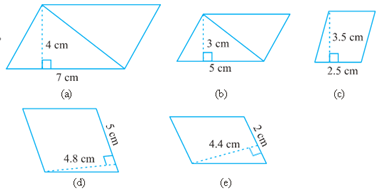
Answer:
(a) Area of parallelogram = Base × Height
Height = 4 cm, Base = 7 cm
So, area of parallelogram = 7 × 4 = 28 cm²
(b) Area of parallelogram = Base × Height
Height = 3 cm, Base = 5 cm
So, area of parallelogram = 5 × 3 = 15 cm²
(c) Area of parallelogram = Base × Height
Height = 3.5 cm, Base = 2.5 cm
So, area of parallelogram = 2.5 × 3.5 = 8.75 cm²
(d) Area of parallelogram = Base × Height
Height = 4.8 cm, Base = 5 cm
So, area of parallelogram = 5 × 4.8 = 24 cm²
(e) Area of parallelogram = Base × Height
Height = 4.4 cm, Base = 2 cm
So, area of parallelogram = 2 × 4.4 = 8.8 cm²
Q 2. Find the area of each of the following triangles:
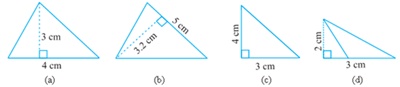
Answer:
(a) Area of a triangle = ½ × Base × Height
= ½ × 4 × 3
= ½ × 12 = 6 cm²
(b) Area of a triangle = ½ × Base × Height
= ½ × 5 × 3.2
= ½ × 16 = 8 cm²
(c) Area of a triangle = ½ × Base × Height
= ½ × 3 × 4
= ½ × 12 = 6 cm²
(d) Area of a triangle = ½ × Base × Height
= ½ × 3 × 2
= ½ × 6 = 3 cm²
Q 3. Find the missing values:
| Base | Height | Area of Triangle |
|---|---|---|
| 15 cm | …………….. | 87 cm² |
| …………….. | 31.4 mm | 1256 mm² |
| 22 cm | …………….. | 170.5 cm² |
Answer:
(a) Let the height be h and the base be b.
Area of triangle = ½ × base × height
87 cm² = ½ × 15 cm × h
h = (87 cm² × 2)/15 cm
= 11.6 cm
(b) Let the height be h and the base be b.
Area of triangle = ½ × base × height
1256 mm² = ½ × b × 31.4 mm
b = (1256 mm² × 2)/31.4 mm
= 80 mm
(c) Let the height be h and the base be b.
Area of triangle = ½ × base × height
170.5 cm² = ½ × 22 cm × h
h = (170.5 cm² × 2)/22 cm
= 15.5 cm
So we get the completed table:
| Base | Height | Area of Triangle |
|---|---|---|
| 15 cm | 11.6 cm | 87 cm² |
| 80 mm | 31.4 mm | 1256 mm² |
| 22 cm | 15.5 cm | 170.5 cm² |
Q 4. PQRS is a parallelogram. QM is the height from Q to SR and QN is the height from Q to PS. If SR = 12 cm and QM = 7.6 cm, find:
(a) the area of the parallelogram PQRS
(b) QN, if PS = 8 cm
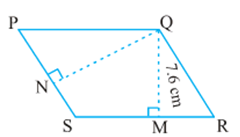
Answer:
(a) Area of a parallelogram = Base × Height
= SR × QM
= 12 × 7.6
= 91.2 cm²
(b) Area of a parallelogram = Base × Height
= PS × QN
91.2 = QN × 8
QN = 91.2/8
= 11.4 cm
Q 5. DL and BM are the heights on sides AB and AD respectively of parallelogram ABCD. If the area of the parallelogram is 1470 cm², AB = 35 cm and AD = 49 cm, find the length of BM and DL.
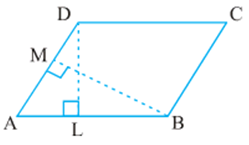
Answer:
Area of parallelogram = Base × Height
= AB × DL
1470 = 35 × DL
DL = 1470/35
= 42 cm
Also,
1470 = AD × BM
1470 = 49 × BM
BM = 1470/49
= 30 cm
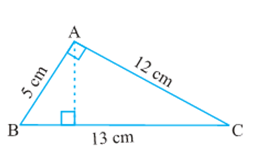
Q 6. △ABC is right angled at A. AD is perpendicular to BC. If AB = 5 cm, BC = 13 cm and AC = 12 cm, find the area of △ABC. Also find the length of AD.
Answer:
Since ∠A = 90°, AB and AC are perpendicular to each other. So AB is the base and AC is the height.
Area = ½ × Base × Height
= ½ × 5 × 12
= 30 cm²
Also, area of triangle = ½ × AD × BC
30 = ½ × AD × 13
AD = (30 × 2)/13
= 4.6 cm (approximately)
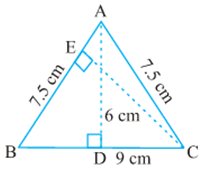
Q 7. △ABC is isosceles with AB = AC = 7.5 cm and BC = 9 cm. The height AD from A to BC is 6 cm. Find the area of △ABC. What will be the height from C to AB, i.e., CE?
Answer:
Area of △ABC = ½ × Base × Height
= ½ × BC × AD
= ½ × 9 × 6
= 27 cm²
Also, area of △ABC = ½ × Base × Height
= ½ × AB × CE
27 = ½ × 7.5 × CE
CE = (27 × 2)/7.5
= 7.2 cm
Related Links
- NCERT Solutions Class 7 Maths Chapter 11 Exercise 11.1
- NCERT Solutions Class 7 Maths Chapter 11 Exercise 11.3
- NCERT Solutions Class 7 Maths Chapter 11 Exercise 11.4
- NCERT Solutions Class 7 Maths Chapter 11 – Perimeter and Area
- NCERT Solutions Class 7 Maths Chapter 6 – The Triangle and its Properties
- NCERT Solutions Class 7 Maths Chapter 10 – Practical Geometry
- NCERT Solutions Class 7 Maths – All Chapters
- NCERT Solutions Class 7 – All Subjects