NCERT Solutions for Class 9 Maths Chapter 10 – Circles Ex 10.5
NCERT Solutions for Class 9 Maths Chapter 10 – Circles Ex 10.5 are given here in simple, step-by-step form. NCERT stands for National Council of Educational Research and Training, the body that makes your textbook. A circle is a round shape in which every point on the edge is the same distance from the centre. Exercise 10.5 is about the angle made by an arc of a circle and about cyclic quadrilaterals, which are four-sided shapes whose corners all lie on a circle.
This exercise has 12 questions. Most of them ask you to find an unknown angle or to prove a result. You will use two very important rules again and again: the angle at the centre is twice the angle at the circle, and the opposite angles of a cyclic quadrilateral add up to 180°. Every question below is solved in short steps, with the final answer in bold. Students can use this page for homework and revision, parents can use it to check the work at home, and teachers can use it in class. A free printable PDF of these solutions is also available for offline study.
Theorems and Rules Used in Exercise 10.5
- Angle at the centre is double the angle at the circle. The angle an arc makes at the centre is twice the angle it makes at any point on the remaining part of the circle.
- Angles in the same segment are equal. Angles made by the same arc at different points on the circle are equal.
- Angle in a semicircle is 90°. The angle in a semicircle (made by a diameter) is a right angle.
- Cyclic quadrilateral: the sum of each pair of opposite angles is 180°.
- The three angles of a triangle add up to 180°, and the base angles of an isosceles triangle are equal.
Exercise 10.5 – Questions and Answers
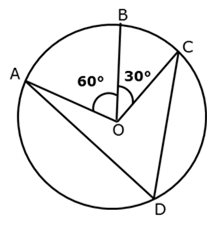
Q1. In the figure below, A, B and C are three points on a circle with centre O such that ∠BOC = 30° and ∠AOB = 60°. If D is a point on the circle other than the arc ABC, find ∠ADC.
Answer:
Given: In a circle with centre O, ∠BOC = 30° and ∠AOB = 60°.
To find: ∠ADC
Solution:
∠AOC = 60° + 30°
= 90°
Since the angle subtended by an arc at the centre is double the angle subtended by it at any point on the remaining part of the circle,
∴ ∠AOC = 2∠ADC
⇒ 90° = 2∠ADC
⇒ ∠ADC = 90°/2
= 45°
Thus, the required angle is 45°.
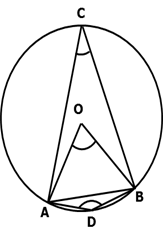
Q2. A chord of a circle is equal to the radius of the circle. Find the angle subtended by the chord at a point on the minor arc and also at a point on the major arc.
Answer:
Given: Let O be the centre of the circle and chord AB be equal to the radius of the circle.
To find: ∠ACB and ∠ADB
Proof: In ΔAOB, OA = AB = OB.
So, ΔAOB is an equilateral triangle.
So, ∠AOB = 60° [Angle of an equilateral triangle.]
∠ACB = ½ ∠AOB [By theorem]
= ½ × 60°
= 30°
Since ADBC is a cyclic quadrilateral, so
∠ACB + ∠ADB = 180°
⇒ 30° + ∠ADB = 180°
⇒ ∠ADB = 180° − 30°
= 150°
Thus, the angle subtended by the chord at a point on the major arc is 30°, and at a point on the minor arc is 150°.
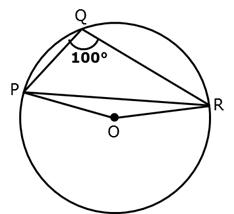
Q3. In the figure below, ∠PQR = 100°, where P, Q and R are points on a circle with centre O. Find ∠OPR.
Answer:
Given: In a circle with centre O, ∠PQR = 100°.
To find: ∠OPR
Solution: Since the angle subtended by an arc at the centre is double the angle subtended by it at any point on the remaining part of the circle,
∴ Reflex ∠POR = 2∠PQR
= 2 × 100°
= 200°
Now, ∠POR + Reflex ∠POR = 360°
∠POR + 200° = 360°
∠POR = 360° − 200°
= 160°
In ΔOPR, OP = OR [Radii of the same circle]
⇒ ∠ORP = ∠OPR [Angles opposite to equal sides are equal.]
∠ORP + ∠OPR + ∠POR = 180° [By angle sum property.]
∠OPR + ∠OPR + 160° = 180°
2∠OPR = 180° − 160°
2∠OPR = 20°
⇒ ∠OPR = 10°
Thus, ∠OPR is 10°.
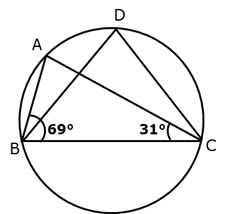
Q4. In the figure below, ∠ABC = 69°, ∠ACB = 31°, find ∠BDC.
Answer:
Given: In a circle, ∠ABC = 69°, ∠ACB = 31°.
To find: ∠BDC
Solution: In ΔABC,
∠BAC + ∠ABC + ∠ACB = 180°
∠BAC + 69° + 31° = 180°
∠BAC = 180° − 100°
= 80°
Since angles in the same segment of a circle are equal,
∠BDC = ∠BAC
= 80°
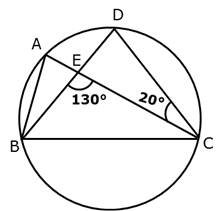
Q5. In the figure below, A, B, C and D are four points on a circle. AC and BD intersect at a point E such that ∠BEC = 130° and ∠ECD = 20°. Find ∠BAC.
Answer:
Given: In a circle, chords AC and BD intersect at E. ∠BEC = 130° and ∠ECD = 20°.
To find: ∠BAC
Solution:
∠CEB + ∠CED = 180° [Linear pair of angles.]
130° + ∠CED = 180°
∠CED = 180° − 130°
= 50°
In ΔDEC,
∠ECD + ∠CED + ∠CDE = 180°
20° + 50° + ∠CDE = 180°
∠CDE = 180° − 70°
= 110°
⇒ ∠BDC = 110°
Since angles in the same segment of a circle are equal,
∠BAC = ∠BDC
= 110°
Thus, the required angle ∠BAC is 110°.
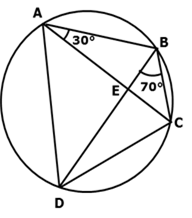
Q6. ABCD is a cyclic quadrilateral whose diagonals intersect at a point E. If ∠DBC = 70°, ∠BAC is 30°, find ∠BCD. Further, if AB = BC, find ∠ECD.
Answer:
Given: ABCD is a cyclic quadrilateral. ∠DBC = 70°, ∠BAC = 30°.
To find: ∠BCD, and ∠ECD (if AB = BC)
Since angles in the same segment of the circle are equal,
So, ∠DAC = ∠DBC
= 70°
∴ ∠DAB = ∠DAC + ∠BAC
= 70° + 30°
= 100°
Since the sum of opposite angles in a cyclic quadrilateral is 180°,
Then, ∠DAB + ∠DCB = 180°
100° + ∠DCB = 180°
∠DCB = 180° − 100°
or ∠BCD = 80°
If AB = BC
Then, ∠BAC = ∠BCA [Angles opposite to equal sides are equal.]
30° = ∠BCA
Since ∠BCD = 80°,
and ∠BCD = ∠BCA + ∠ACD
Then, 30° + ∠ACD = 80°
Since E lies on AC, ∠ACD is the same as ∠ECD.
⇒ ∠ECD = 80° − 30°
= 50°
Q7. If diagonals of a cyclic quadrilateral are diameters of the circle through the vertices of the quadrilateral, prove that it is a rectangle.
Answer:
Given: ABCD is a cyclic quadrilateral. AC and BD are the diameters of the circle.
To prove: ABCD is a rectangle.
Proof: Since the angle in a semicircle is a right angle,
So, ∠ABC = 90° [AC is a diameter.]
and ∠ADC = 90° [AC is a diameter.]
Now, ∠BAD = 90° [BD is a diameter.]
and ∠BCD = 90° [BD is a diameter.]
Since each angle of ABCD is 90°, so ABCD is a rectangle. Hence proved.
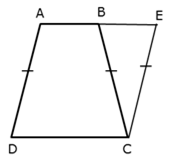
Q8. If the non-parallel sides of a trapezium are equal, prove that it is cyclic.
Answer:
Given: Let ABCD be a trapezium in which AB ∥ DC and AD = BC.
To prove: ABCD is a cyclic quadrilateral.
Construction: Draw EC ∥ AD and produce AB up to E.
Proof: Since AE ∥ DC and AD ∥ EC,
So, AECD is a parallelogram.
Then, AD = EC, but AD = BC
⇒ EC = BC
And ∠CEA = ∠CDA [Opposite angles of a parallelogram are equal.]
In ΔCEB, ∠CBE = ∠CEB [Angles opposite to equal sides are equal.]
∠CBE + ∠CBA = 180° [Linear pair of angles]
∠CEB + ∠CBA = 180° [∵ ∠CBE = ∠CEB]
⇒ ∠CEA + ∠CBA = 180°
⇒ ∠CDA + ∠CBA = 180° [∵ ∠CEA = ∠CDA]
∵ ∠CDA + ∠CBA + ∠ABC + ∠ADC = 360° [Angle sum property in a quadrilateral.]
180° + ∠ABC + ∠ADC = 360°
∠ABC + ∠ADC = 360° − 180°
∠ABC + ∠ADC = 180°
Since the sum of opposite angles is 180°, so ABCD is a cyclic quadrilateral. Hence proved.
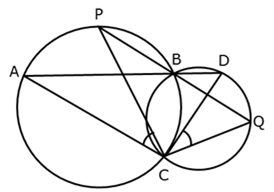
Q9. Two circles intersect at two points B and C. Through B, two line segments ABD and PBQ are drawn to intersect the circles at A, D and P, Q respectively (see the figure below). Prove that ∠ACP = ∠QCD.
Answer:
Given: The intersection points of two circles are B and C. Two line segments ABD and PBQ are drawn to intersect the circles at A, D and P, Q respectively.
To prove: ∠ACP = ∠QCD
Proof: Since angles in the same segment of a circle are equal,
∠ACP = ∠ABP … (i)
and ∠QCD = ∠QBD … (ii)
But ∠ABP = ∠QBD … (iii) [Vertically opposite angles]
⇒ ∠ACP = ∠QCD [From equation (i), equation (ii) and equation (iii)]
Hence proved.
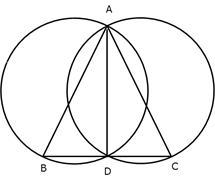
Q10. If circles are drawn taking two sides of a triangle as diameters, prove that the point of intersection of these circles lies on the third side.
Answer:
Given: ABC is a triangle. Two circles are drawn with diameter AB and AC respectively.
To prove: The point of intersection (D) of the circles lies on BC.
Proof: ∠ADC = 90° [Angle in a semicircle is 90°.]
and ∠ADB = 90° [Angle in a semicircle is 90°.]
∠ADB + ∠ADC = 90° + 90°
∠BDC = 180°
⇒ BDC is a straight line.
⇒ D lies on BC, i.e., the third side of the triangle.
Thus, the point of intersection of both circles lies on the third side of the triangle. Hence proved.
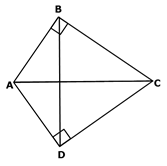
Q11. ABC and ADC are two right triangles with common hypotenuse AC. Prove that ∠CAD = ∠CBD.
Answer:
Given: ΔABC and ΔADC have a common hypotenuse AC.
To prove: ∠CAD = ∠CBD
Proof: Since both triangles are right angled, ∠B = 90° and ∠D = 90°.
In quadrilateral ABCD,
∠B + ∠D = 90° + 90° = 180°
So, quadrilateral ABCD is cyclic.
Then, ∠CAD = ∠CBD [Angles in the same segment of a circle are equal, both being subtended by the chord CD.]
Hence Proved.
Related Links
Q.1 In figure below, A,B and C are three points on a circle with center O such that ∠BOC = 30° and ∠AOB = 60°.
If D is a point on the circle other than the arc ABC, find ∠ADC.

Ans
Q.2 A chord of a circle is equal to the radius of the circle. Find the angle subtended by the chord at a point on the minor arc and also at a point on the major arc.
Ans

Q.3 In the figure below, ∠PQR = 100°, where P, Q and R are points on a circle with centre O. Find ∠OPR.

Ans
Q.4 In the figure below, ∠ABC = 69°, ∠ACB=31°, find ∠BDC.

Ans
Q.5 In the figure below A, B, C and D are four points on a circle. AC and BD intersect at a point E such that ∠BEC = 130° and ∠ECD = 20°. Find ∠BAC.

Ans
Q.6 ABCD is a cyclic quadrilateral whose diagonals intersect at a point E. If ∠DBC = 70°, ∠BAC is 30°, find ∠BCD. Further, if AB = BC, find ∠ECD.
Ans


Q.7 If diagonals of a cyclic quadrilateral are diameters of the circle through the vertices of the quadrilateral, prove that it is a rectangle.
Ans

Q.8 If the non-parallel sides of a trapezium are equal, prove that it is cyclic.
Ans

Q.9 Two circles intersect at two points B and C. Through B, two line segments ABD and PBQ are drawn to intersect the circles at A, D and P, Q respectively (see the figure below). Prove that ∠ACP=∠QCD.

Ans
Q.10 If circles are drawn taking two sides of a triangle as diameters, prove that the point of intersection of these circles lie on the third side.
Ans

Q.11 ABC and ADC are two right triangles with common hypotenuse AC. Prove that ∠CAD=∠CBD.
Ans

Q.12 Prove that a cyclic parallelogram is a rectangle.
Ans
