NCERT Solutions for Class 9 Maths Chapter 10 Circles Ex -10.4
NCERT Solutions for Class 9 Maths Chapter 10 – Circles Ex 10.4 are given here in simple, step-by-step form. NCERT stands for National Council of Educational Research and Training, the body that makes your textbook. A circle is a round shape in which every point on the edge is the same distance from the centre. A chord is a straight line joining two points on the circle. Exercise 10.4 is about equal chords and how far they lie from the centre.
This exercise has 6 questions. Most of them are proofs and application problems. You will find the length of a common chord where two circles cross, prove that equal chords are cut into equal parts, and use the two main theorems of this section. Students can use this page for homework and revision, parents can use it to check the work at home, and teachers can use it in class. A free printable PDF of these solutions is also available for offline study.
Theorems and Rules Used in Exercise 10.4
- Theorem 1: Equal chords of a circle are equidistant (the same distance) from the centre.
- Theorem 2: Chords that are equidistant from the centre of a circle are equal in length. This is the reverse of Theorem 1.
- The perpendicular from the centre to a chord bisects the chord. So the foot of the perpendicular is the mid-point of the chord.
- Pythagoras property: in a right-angled triangle, the square of the longest side equals the sum of the squares of the other two sides.
- CPCT stands for Corresponding Parts of Congruent Triangles. Once two triangles are proved congruent, all their matching sides and angles are equal
Exercise 10.4 – Questions and Answers
Exercise 10.4 – Questions and Answers
Q1. Two circles of radii 5 cm and 3 cm intersect at two points and the distance between their centres is 4 cm. Find the length of the common chord.
Answer:
Let the assumed figure be as given below:
Given: Radius OA = 5 cm, O'A = 3 cm and OO' = 4 cm.
To find: AB
Let OC = x cm and O'C = (4 − x) cm.
In ΔACO, ∠ACO = 90°
By Pythagoras theorem,
OA² = AC² + OC²
5² = AC² + x²
⇒ AC² = 25 − x² … (i)
In ΔACO', ∠ACO' = 90°
By Pythagoras theorem,
O'A² = AC² + O'C²
3² = AC² + (4 − x)²
⇒ AC² = 9 − (4 − x)² … (ii)
From equation (i) and equation (ii), we have
25 − x² = 9 − (4 − x)²
⇒ 25 − x² = 9 − (16 − 8x + x²)
⇒ 25 − x² = 9 − 16 + 8x − x²
⇒ 25 = −7 + 8x
⇒ 25 + 7 = 8x
⇒ x = 32/8
⇒ x = 4 cm
Substituting the value of x in equation (i), we get
AC² = 25 − 4²
= 25 − 16
= 9
⇒ AC = √9 = 3 cm
Since OO' is the perpendicular bisector of AB,
So, AB = 2 × AC
= 2 × 3 = 6 cm
Thus, the length of the common chord is 6 cm.
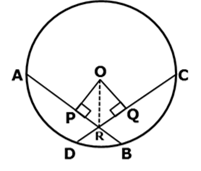
Q2. If two equal chords of a circle intersect within the circle, prove that the segments of one chord are equal to corresponding segments of the other chord.
Answer:
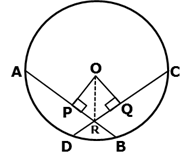
Given: Chord AB = Chord CD, and both chords intersect at R.
To prove: AR = RC and RB = RD
Construction: Draw OP ⊥ AB and OQ ⊥ CD. Join OR.
Proof: In ΔOPR and ΔOQR,
OP = OQ [Equal chords are equidistant from the centre.]
∠OPR = ∠OQR [Each 90°]
OR = OR [Common]
∴ ΔOPR ≅ ΔOQR [By R.H.S.]
So, PR = QR … (i) [By C.P.C.T.]
Since PB = QD … (ii) [Perpendicular from the centre bisects the chord.]
Subtracting equation (i) from equation (ii), we get
PB − PR = QD − QR
⇒ RB = RD … (iii)
Also, AB = CD … (iv) [Given]
Equation (iv) − equation (iii), we get
AB − RB = CD − RD
⇒ AR = RC
and RB = RD. Hence Proved.
Q3. If two equal chords of a circle intersect within the circle, prove that the line joining the point of intersection to the centre makes equal angles with the chords.
Answer:
Given: Chord AB = Chord CD, and both chords intersect at R.
To prove: ∠ORA = ∠ORC
Construction: Draw OP ⊥ AB and OQ ⊥ CD. Join OR.
Proof: In ΔOPR and ΔOQR,
OP = OQ [Equal chords are equidistant from the centre.]
∠OPR = ∠OQR [Each 90°]
OR = OR [Common]
∴ ΔOPR ≅ ΔOQR [By R.H.S.]
So, ∠ORA = ∠ORC [By C.P.C.T.]
Hence Proved.
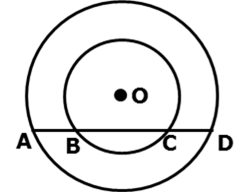
Q4. If a line intersects two concentric circles (circles with the same centre) with centre O at A, B, C and D, prove that AB = CD (see Fig. 10.25).
Answer:
Given: Two concentric circles with centre O. A common chord intersects these circles at A, D and B, C.
To prove: AB = CD
Construction: Draw OP ⊥ AD
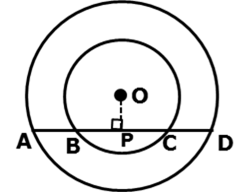
Proof: Since the perpendicular from the centre to a chord of a circle bisects the chord, so
AP = PD … (i)
and BP = PC … (ii)
Subtracting equation (ii) from equation (i), we get
AP − BP = PD − PC
⇒ AB = CD
Hence proved.
Q5. Three girls Reshma, Salma and Mandip are playing a game by standing on a circle of radius 5 m drawn in a park. Reshma throws a ball to Salma, Salma to Mandip, Mandip to Reshma. If the distance between Reshma and Salma and between Salma and Mandip is 6 m each, what is the distance between Reshma and Mandip?
Answer:
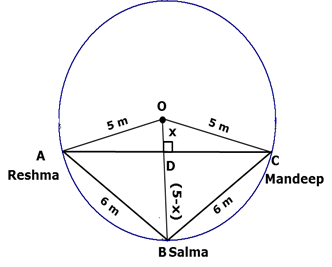
Given: Radius of the circular park is 5 m, and the distance between Reshma and Salma (AB) and the distance between Salma and Mandip (BC) is equal to 6 m each.
To find: Distance between Reshma and Mandip, i.e., AC.
Proof: In ΔODC, ∠ODC = 90°
So, by Pythagoras theorem,
OC² = OD² + DC²
DC² = OC² − OD²
DC² = 5² − x² … (i)
In ΔBDC, ∠BDC = 90°
So, by Pythagoras theorem,
BC² = BD² + DC²
DC² = BC² − BD²
DC² = 6² − (5 − x)² … (ii)
From equation (i) and equation (ii), we get
5² − x² = 6² − (5 − x)²
⇒ 25 − x² = 36 − 25 + 10x − x²
⇒ 25 − 11 = 10x
⇒ x = 14/10 = 1.4
Substituting the value of x in equation (i), we get
DC² = 5² − (1.4)²
= 25 − 1.96
= 23.04
DC = √23.04
= 4.8 m
Thus, AC = 2 DC
= 2 × 4.8 m
= 9.6 m
Therefore, the distance between Reshma and Mandip is 9.6 m.
Q6. A circular park of radius 20 m is situated in a colony. Three boys Ankur, Syed and David are sitting at equal distance on its boundary each having a toy telephone in his hands to talk to each other. Find the length of the string of each phone.
Answer:
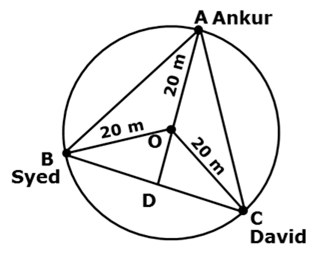
Let A, B and C be the positions of Ankur, Syed and David respectively. The radius of the circle is 20 m.
Since the three boys are at equal distances from one another, ΔABC is an equilateral triangle. Let each side of ΔABC be 2x.
AD is the median of the triangle. O is the centre of the circle as well as the point of intersection of the medians (the centroid).
Since the centroid divides a median in the ratio 2 : 1, then
AO/OD = 2/1 ⇒ 20/OD = 2/1
⇒ OD = 20/2 = 10 m
In ΔBOD, ∠ODB = 90°
So, by Pythagoras theorem,
OB² = OD² + BD²
(20)² = (10)² + x²
x² = 400 − 100
= 300
⇒ x = √300
= 10√3
So, BC = 2x
= 2 × 10√3
= 20√3
Thus, the length of the string of each phone is 20√3 m.
Related Links
Q.1 Two circles of radii 5 cm and 3 cm intersect at two points and the distance between their centres is 4 cm. Find the length of the common chord.
Ans
Let the assumed figure is as given below:

Q.2 If two equal chords of a circle intersect within the circle, prove that the segments of one chord are equal to corresponding segments of the other chord.
Ans

Q.3 If two equal chords of a circle intersect within the circle, prove that the line joining the point of intersection to the centre makes equal angles with the chords.
Ans

Q.4 If a line intersects two concentric circles (circles with the same centre) with centre O at A, B, C and D, prove that AB = CD (see Fig. 10.25).

Ans

Q.5 Three girls Reshma, Salma and Mandip are playing a game by standing on a circle of radius 5m drawn in a park. Reshma throws a ball to Salma, Salma to Mandip, Mandip to Reshma. If the distance between Reshma and Salma and between Salma and Mandip is 6m each, what is the distance between Reshma and Mandip?
Ans

Q.6 A circular park of radius 20 m is situated in a colony. Three boys Ankur, Syed and David are sitting at equal distance on its boundary each having a toy telephone in his hands to talk each other. Find the length of the string of each phone.
Ans
