NCERT Solutions for Class 6 Maths Ganita Prakash Chapter 3 – Number Play
NCERT Solutions for Class 6 Maths Ganita Prakash Chapter 3 – Number Play are given here in easy, step-by-step form. NCERT stands for National Council of Educational Research and Training, the body that makes your textbook. Ganita Prakash is the new Class 6 Maths book. This chapter shows that numbers are not only for counting and calculating. They also hide patterns, puzzles and clever tricks. You will meet supercells, digit sums, palindromes, the famous Kaprekar constant, clock and calendar patterns, estimation and even an unsolved mystery called the Collatz conjecture.
The chapter is made of “Figure it Out” activity boxes and some in-text questions. All of them are solved below, section by section, in simple language. Students can use this page for homework and revision, parents can use it to check the work at home, and teachers can use it in class. A free printable PDF is also available for offline study.
NCERT Solutions for Class 6 Maths Ganita Prakash Chapter 3 – Number Play
 Number Play (New NCERT)
 Medium
Number Play (New NCERT)
Medium
Number Play (New NCERT)
Medium
Number Play (New NCERT)
Medium
Number Play (New NCERT)
Medium
Number Play (New NCERT)
Medium
Number Play (New NCERT)
Medium
Number Play (New NCERT)
Medium
Number Play (New NCERT)
Medium
 Number Play (New NCERT)
Medium


 Number Play (New NCERT)
Medium
Number Play (New NCERT)
Medium
Number Play (New NCERT)
Medium
Number Play (New NCERT)
Medium
Number Play (New NCERT)
Medium
Number Play (New NCERT)
Medium
Number Play (New NCERT)
Medium
Number Play (New NCERT)
Medium
Number Play (New NCERT)
Medium
Number Play (New NCERT)
Medium
Number Play (New NCERT)
Medium
 Number Play (New NCERT)
Medium
Number Play (New NCERT)
Medium
Number Play (New NCERT)
Medium
Number Play (New NCERT)
Medium
Number Play (New NCERT)
Medium
Number Play (New NCERT)
Medium
Number Play (New NCERT)
Medium
Number Play (New NCERT)
Medium
Number Play (New NCERT)
Medium
Number Play (New NCERT)
Medium
 Number Play (New NCERT)
Medium


 Number Play (New NCERT)
Medium
Number Play (New NCERT)
Medium
Number Play (New NCERT)
Medium
Number Play (New NCERT)
Medium
Number Play (New NCERT)
Medium
Number Play (New NCERT)
Medium
Number Play (New NCERT)
Medium
NCERT Solutions for Class 6 Maths Ganita Prakash Chapter 3 Number Play
3.1 Numbers can Tell us Things 3.2 Supercells Figure it Out (Page No. 57-58)
Q1. Colour or mark the supercells in the table below.
| 6828 | 670 | 9435 | 3780 | 3708 | 7308 | 8000 | 5583 | 52 |
|---|
Answer:
A supercell is a cell whose number is greater than all the numbers next to it.
| 6828 | 670 | 9435 | 3780 | 3708 | 7308 | 8000 | 5583 | 52 |
|---|---|---|---|---|---|---|---|---|
| marked | marked | marked |
The supercells are 6828, 9435 and 8000.
Q2. Fill the table below with only 4-digit numbers such that the supercells are exactly the coloured cells.

Answer:
| 5346 | 5439 | 1211 | 1258 | 1010 | 1000 | … |
|---|
The coloured cells are 5439 and 1258. Each of them is bigger than the number on its left and the number on its right, so they are supercells, while none of the white cells is.

Q3. Fill the table below such that we get as many supercells as possible. Use numbers between 100 and 1000 without repetitions.
Answer:
| 999 | 101 | 555 | 444 | 666 | 298 | 498 | 397 | 501 |
|---|
Q4. Out of the 9 numbers, how many supercells are there in the table above?
Answer:
There are 5 supercells in the above table of 9 numbers.
Q5. Find out how many supercells are possible for different numbers of cells. Do you notice any pattern? What is the method to fill a given table to get the maximum number of supercells? Explore and share your strategy.
Answer:
To explore this, let's consider square grids of different sizes — such as 1 × 1, 2 × 2, 3 × 3, 4 × 4, etc. A supercell is a number that is greater than all of its immediate neighbours (up, down, left, right).
For 1 × 1 grid:
Only 1 cell → 1 supercell (no neighbours to compare)
For 2 × 2 grid:
Each cell has only 2 neighbours.
Maximum number of supercells = 2, since two can be larger than its 2 neighbours.
For 3 × 3 grid:
Corners have 2 neighbours.
Edges have 3 neighbours.
Centre has 4 neighbours.
Maximum supercells possible = 5
Yes, a pattern is noticed — supercells tend to occur more frequently in the middle of the grid, where a cell has more neighbouring cells to compare with.
By strategically placing the largest numbers in the central positions, we can maximise the number of supercells in the table.
Q6. Can you fill a supercell table without repeating numbers such that there are no supercells? Why or why not?
Answer:
No, if we fill with numbers increasing by 1, we get at least one supercell, i.e., the last number.
Q7. Will the cell having the largest number in a table always be a supercell? Can the cell having the smallest number in a table be a supercell? Why or why not?
Answer:
Yes, the cell having the largest number in a table will always be a supercell, and the cell having the smallest number in a table will never be a supercell, as its adjacent cell has a bigger number.
Q8. Fill a table such that the cell having the second largest number is not a supercell.
Answer:
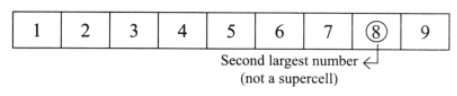
In this table the numbers are 1 to 9. The second largest number is 8, and it sits next to 9, so it is not a supercell.
Q9. Fill a table such that the cell having the second largest number is not a supercell but the second smallest number is a supercell. Is it possible?
Answer:
Yes, this is possible.
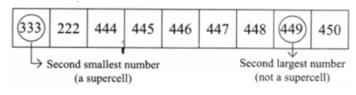
Here the second smallest number 333 is a supercell, and the second largest number 449 is not a supercell.
Q10. Make other variations of this puzzle and challenge your classmates.
Answer:
Answers may vary.
Fill a table such that:
The largest number is a supercell, and
The smallest number is not a supercell.
Challenge: Is this possible? Prove or disprove with an example.
3.3 Patterns of Numbers on the Number Line Figure it Out (Page No. 59)
Q11. Identify the numbers marked on the number lines below, and label the remaining positions. Put a circle around the smallest number and a box around the largest number in each of the sequences above.




Answer:
(a) 1990, 1995, 2000, 2005, 2010, 2015, 2020, 2025, 2030, 2035 — the numbers go up by 5 each time. Circle 1990, box 2035.

(b) 9993, 9994, 9995, 9996, 9997, 9998, 9999, 10000, 10001, 10002 — the numbers go up by 1 each time. Circle 9993, box 10002.

(c) 15,077, 15,078, 15,079, 15,080, 15,081, 15,082, 15,083, 15,084, 15,085, 15,086 — the numbers go up by 1 each time. Circle 15,077, box 15,086.

(d) 83,705, 84,705, 85,705, 86,705, 87,705, 88,705, 89,705, 90,705, 91,705, 92,705 — the numbers go up by 1,000 each time. Circle 83,705, box 92,705.

3.4 Playing with Digits (Page No. 60)
Q12. Digit sum 14
(a) Write other numbers whose digits add up to 14.
(b) What is the smallest number whose digit sum is 14?
(c) What is the largest 5-digit number whose digit sum is 14?
(d) How big a number can you form having the digit sum 14? Can you make an even bigger number?
Answer:
(a) 59, 68, 77, 86, 95, 149, 158, 167, 176, …… (Answer may vary)
(b) 59, is the smallest number whose digit sum is 14.
(c) 95,000, is the largest 5-digit number whose digit sum is 14.
(d) We can make an infinite number whose digit sum is 14.
For example: 11111111111111, 11111111111111000 and so on.
Yes, we can make an even bigger number having the digit sum 14.
Q13. Find the digit sums of all the numbers from 40 to 70. Share your observations with the class.
Answer:
| Number | Digit Sum | Number | Digit Sum |
|---|---|---|---|
| 40 | 4 + 0 = 4 | 56 | 5 + 6 = 11 |
| 41 | 4 + 1 = 5 | 57 | 5 + 7 = 12 |
| 42 | 4 + 2 = 6 | 58 | 5 + 8 = 13 |
| 43 | 4 + 3 = 7 | 59 | 5 + 9 = 14 |
| 44 | 4 + 4 = 8 | 60 | 6 + 0 = 6 |
| 45 | 4 + 5 = 9 | 61 | 6 + 1 = 7 |
| 46 | 4 + 6 = 10 | 62 | 6 + 2 = 8 |
| 47 | 4 + 7 = 11 | 63 | 6 + 3 = 9 |
| 48 | 4 + 8 = 12 | 64 | 6 + 4 = 10 |
| 49 | 4 + 9 = 13 | 65 | 6 + 5 = 11 |
| 50 | 5 + 0 = 5 | 66 | 6 + 6 = 12 |
| 51 | 5 + 1 = 6 | 67 | 6 + 7 = 13 |
| 52 | 5 + 2 = 7 | 68 | 6 + 8 = 14 |
| 53 | 5 + 3 = 8 | 69 | 6 + 9 = 15 |
| 54 | 5 + 4 = 9 | 70 | 7 + 0 = 7 |
| 55 | 5 + 5 = 10 |
Observations:
From 40 to 49, digit sum increases from 4 to 13.
From 50 to 59, digit sum starts from 5 and increases to 14.
From 60 to 69, it increases from 6 to 15.
At 70, the digit sum drops again to 7.
Maximum digit sum is 15 (for 69).
Minimum digit sum is 4 (for 40).
Q14. Calculate the digit sums of 3-digit numbers whose digits are consecutive (for example, 345). Do you see a pattern? Will this pattern continue?
Answer:
1 + 2 + 3 = 6
2 + 3 + 4 = 9
3 + 4 + 5 = 12
4 + 5 + 6 = 15
5 + 6 + 7 = 18
6 + 7 + 8 = 21
7 + 8 + 9 = 24
Yes, there is a pattern. It is a table of 3 from 3 × 2 to 3 × 8.
We cannot continue this pattern after 789.
3.5 Pretty Palindromic Patterns 3.6 The Magic Number of Kaprekar 3.7 Clock and Calendar Numbers Figure it Out (Page No. 64-65)
Q15. Pratibha uses the digits '4', '7', '3' and '2' and makes the smallest and largest 4-digit numbers with them: 2347 and 7432. The difference between these two numbers is 7432 − 2347 = 5085. The sum of these two numbers is 9779. Choose 4-digits to make:
(a) the difference between the largest and smallest numbers greater than 5085.
(b) the difference between the largest and smallest numbers less than 5085.
(c) the sum of the largest and smallest numbers greater than 9779.
(d) the sum of the largest and smallest numbers less than 9779.
Answer:
(a) 5, 8, 3, 2; largest 4-digit number: 8532, smallest 4-digit number: 2358
Difference: 8532 − 2358 = 6174 > 5085
(b) 4, 6, 3, 2; largest 4-digit number: 6432, smallest 4-digit number: 2346
Difference: 6432 − 2346 = 4086 < 5085
(c) 5, 8, 3, 2 → 8532 + 2358 = 10890 > 9779
(d) 4, 6, 3, 2 → 6432 + 2346 = 8778 < 9779
Q16. What is the sum of the smallest and largest 5-digit palindrome? What is their difference?
Answer:
Largest 5-digit palindromic number = 99999
Smallest 5-digit palindromic number = 10001
Sum = 99999 + 10001 = 110000
Difference = 99999 − 10001 = 89998
Q17. The time now is 10 : 01. How many minutes until the clock shows the next palindromic time? What about the one after that?
Answer:
Next palindromic time 10 : 01 is 11 : 11 after 70 minutes. After that next palindromic time will be 12:21.
Q18. How many rounds does the number 5683 take to reach the Kaprekar constant?
Answer:
Given number: 5683
| Round | Largest (A) | Smallest (B) | C = A − B |
|---|---|---|---|
| 1 | 8653 | 3568 | 8653 − 3568 = 5085 |
| 2 | 8550 | 0558 | 8550 − 0558 = 7992 |
| 3 | 9432 | 2349 | 9432 − 2349 = 7083 |
| 4 | 8730 | 0378 | 8730 − 0378 = 8352 |
| 5 | 8532 | 2358 | 8532 − 2358 = 6174 |
Hence, the number 5683 takes 5 rounds to reach the Kaprekar constant.
3.8 Mental Math Figure it Out (Page No. 66 – 67)
Q19. Write an example for each of the below scenarios whenever possible. Could you find examples for all the cases? If not, think and discuss what could be the reason. Make other such questions and challenge your classmates.
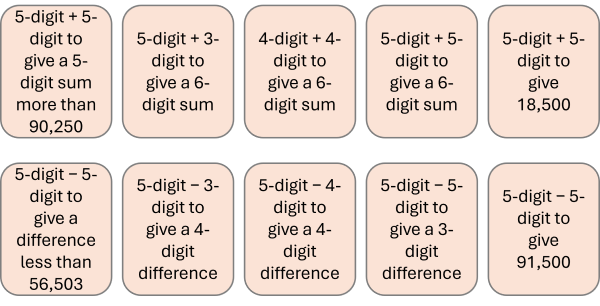
Answer:
| Scenario | Example |
|---|---|
| 5-digit + 5-digit to give a 5-digit sum more than 90,250 | 1st 5-digit number: 23,456; 2nd 5-digit number: 66,795. Sum = 23,456 + 66,795 = 90,251 > 90,250. |
| 5-digit + 3-digit to give a 6-digit sum | 5-digit number: 99,456; 3-digit number: 795. Sum = 99,456 + 795 = 1,00,251 (a 6-digit sum). |
| 4-digit + 4-digit to give a 6-digit sum | Not possible, because if we take both the numbers as largest 4-digit number 9999, then the sum = 9999 + 9999 = 19,998; a 5-digit sum. |
| 5-digit + 5-digit to give a 5-digit sum | 1st 5-digit number: 63,456; 2nd 5-digit number: 66,795. Sum = 63,456 + 66,795 = 1,30,251; a 6-digit sum. |
| 5-digit + 5-digit to give 18,500 | Not possible, because if we take the 1st 5-digit number as the smallest 5-digit number, i.e., 10,000, then the second number will be 8,500 to get the required sum, which is a 4-digit number. |
| 5-digit − 5-digit to give a difference less than 56,503 | 1st 5-digit number: 93,456; 2nd 5-digit number: 36,995. Difference = 56,461 < 56,503. |
| 5-digit − 3-digit to give a 4-digit difference | 5-digit number: 10,000; 3-digit number: 999. Difference = 10,000 − 999 = 9,001; a 4-digit difference. |
| 5-digit − 4-digit to give a 4-digit difference | 5-digit number: 10,000; 4-digit number: 1,000. Difference = 10,000 − 1,000 = 9,000; a 4-digit difference. |
| 5-digit − 5-digit to give a 3-digit difference | 1st 5-digit number: 60,456; 2nd 5-digit number: 60,195. Difference = 60,456 − 60,195 = 261; a 3-digit difference. |
| 5-digit − 5-digit to give 91,500 | Not possible, because if we get the required difference we take the 1st 5-digit number, that will be the largest 5-digit number, i.e., 99,999, and the second number will be a 4-digit number '8499'. |
Q20. Always, Sometimes, Never? Below are some statements. Think, explore and find out if each of the statement is 'Always true', 'Only sometimes true' or 'Never true'. Why do you think so? Write your reasoning; discuss this with the class.
(a) 5-digit number + 5-digit number gives a 5-digit number
(b) 4-digit number + 2-digit number gives a 4-digit number
(c) 4-digit number + 2-digit number gives a 6-digit number
(d) 5-digit number − 5-digit number gives a 5-digit number
(e) 5-digit number − 2-digit number gives a 3-digit number
Answer:
| Statement | Verdict | Reasoning |
|---|---|---|
| 5-digit number + 5-digit number gives a 5-digit number | Only sometimes true | If we take the 1st 5-digit number: 13,456; 2nd 5-digit number: 56,795. Then sum = 13,456 + 56,795 = 70,251 (a 5-digit number). But if we take the 1st 5-digit number: 13,456 and 2nd 5-digit number: 96,795, then sum = 13,456 + 96,795 = 1,10,251 (a 6-digit number). |
| 4-digit number + 2-digit number gives a 4-digit number | Only sometimes true | If we take the 4-digit number: 3,456. Then sum = 3,456 + 95 = 3,551 (a 4-digit number). But if we take the 4-digit number: 9,999 and 2-digit number: 95, then sum = 10,094 (a 5-digit number). |
| 4-digit number + 2-digit number gives a 6-digit number | Never true | If we even take the largest 4-digit number: 9,999 and the largest 2-digit number: 99, then sum = 9,999 + 99 = 10,098 (a 5-digit number). |
| 5-digit number − 5-digit number gives a 5-digit number | Only sometimes true | If we take the 1st 5-digit number: 53,456 and the 2nd 5-digit number: 16,795, then the difference = 53,456 − 16,795 = 36,661 (a 5-digit number). But if we take the 1st 5-digit number: 13,456 and the 2nd 5-digit number: 11,795, then the difference = 13,456 − 11,795 = 1,661 (a 4-digit number). |
| 5-digit number − 2-digit number gives a 3-digit number | Never true | If we take the smallest 5-digit number: 10,000 and the largest 2-digit number: 99, then the difference = 10,000 − 99 = 9,901 (a 4-digit number). |
3.9 Playing with Number Patterns 3.10 An Unsolved Mystery – the Collatz Conjecture! 3.11 Simple Estimation 3.12 Games and Winning Strategies Figure it Out (Page No. 72 – 73)
Q21. There is only one supercell (number greater than all its neighbours) in this grid. If you exchange two digits of one of the numbers, there will be 4 supercells. Figure out which digits to swap.
| 16,200 | 39,344 | 29,765 |
|---|---|---|
| 23,609 | 62,871 | 45,306 |
| 19,381 | 50,319 | 38,408 |
Answer:
If we swap the digits 6 and 1 of 62,871, we get the 4 supercells.
| 16,200 | 39,344 | 29,765 |
|---|---|---|
| 23,609 | 12,876 | 45,306 |
| 19,381 | 50,319 | 38,408 |
The four supercells are now 39,344, 23,609, 45,306 and 50,319.
Q22. How many rounds does your year of birth take to reach the Kaprekar constant?
Answer:
(Taking the year 2012 as an example.)
Round 1:
Descending: 2100
Ascending: 0012 (which is 12)
2100 − 12 = 2088
Round 2:
Descending: 8820
Ascending: 0288 (which is 288)
8820 − 288 = 8532
Round 3:
Descending: 8532
Ascending: 2358
8532 − 2358 = 6174, reached the Kaprekar constant.
Q23. We are the group of 5-digit numbers between 35,000 and 75,000 such that all of our digits are odd. Who is the largest number in our group? Who is the smallest number in our group? Who among us is the closest to 50,000?
Answer:
5-digit numbers between 35,000 and 75,000 such that all of our digits are odd are as follows:
35, 111, 35, 113; 35, 115; 35, 117; 35, 119; …… 39, 999; 51, 111; 51, 113; …… 73, 999
So, the largest number of the group = 73, 999
and, the smallest number of the group = 35, 111
∴ The number closest to 50, 000 = 51, 111
Q24. Estimate the number of holidays you get in a year including weekends, festivals and vacation. Then try to get an exact number and see how close your estimate is.
Answer:
Based on general knowledge, here's a rough estimate:
Weekends: 52 weeks × 2 days = 104 days.
Public Holidays: Approximately 15 days (national and regional festivals).
School Vacations: Summer (around 45 days), Winter (about 10 days), and other breaks (approximately 5 days).
Q25. Estimate the number of litres a mug, a bucket and an overhead tank can hold.
Answer:
Mug: 1 litre
Bucket: 20 litre
Overhead tank: 20,000 litre
(Answer may vary)
Q26. Write one 5-digit number and one 3-digit number, such that their sum is 100000.
Answer:
There are many possible combinations, one possible way is
5-digit number = 99,001
3-digit number = 999
Sum = 99, 001 + 999 = 1,00,000
Related Links
- Chapter 1 Patterns in Mathematics
- Chapter 2 Lines and Angles
- Chapter 4 Data Handling and Presentation
- Chapter 5 Prime Time
- Chapter 6 Perimeter and Area
- Chapter 7 Fractions
- Chapter 8 Playing with Constructions
- Chapter 9 Symmetry
- Chapter 10 The Other Side of Zero