NCERT Solutions for Class 6 Maths Ganita Prakash Chapter 6 – Perimeter and Area
NCERT Solutions for Class 6 Maths Ganita Prakash Chapter 6 – Perimeter and Area are given here in easy, step-by-step form. NCERT stands for National Council of Educational Research and Training, the body that makes your textbook. Ganita Prakash is the new Class 6 Maths book. Perimeter is the total length around a closed shape. Area is the space inside it. This chapter teaches you to find the perimeter and area of rectangles, squares and triangles, to split odd shapes into simple ones, and to measure area by counting squares on a grid.
All the questions are solved below in simple language, with clear diagrams. Students can use this page for homework and revision, parents can use it to check the work at home, and teachers can use it in class. A free printable PDF is also available for offline study.
NCERT Solutions for Class 6 Maths Ganita Prakash Chapter 6 – Perimeter and Area
 Perimeter and Area (New NCERT)
 Medium
Perimeter and Area (New NCERT)
Medium
Perimeter and Area (New NCERT)
Medium
Perimeter and Area (New NCERT)
Medium
Perimeter and Area (New NCERT)
Medium
Perimeter and Area (New NCERT)
Medium
Perimeter and Area (New NCERT)
Medium
Perimeter and Area (New NCERT)
Medium
 Perimeter and Area (New NCERT)
Medium
 Perimeter and Area (New NCERT)
Medium

 Perimeter and Area (New NCERT)
Medium
Perimeter and Area (New NCERT)
Medium
 Perimeter and Area (New NCERT)
Medium
 Perimeter and Area (New NCERT)
Medium
Perimeter and Area (New NCERT)
Medium
Perimeter and Area (New NCERT)
Medium
 Perimeter and Area (New NCERT)
Medium
Perimeter and Area (New NCERT)
Medium
Perimeter and Area (New NCERT)
Medium
Perimeter and Area (New NCERT)
Medium
Perimeter and Area (New NCERT)
Medium
Perimeter and Area (New NCERT)
Medium
Perimeter and Area (New NCERT)
Medium
Perimeter and Area (New NCERT)
Medium
Perimeter and Area (New NCERT)
Medium
Perimeter and Area (New NCERT)
Medium
Perimeter and Area (New NCERT)
Medium
 Perimeter and Area (New NCERT)
Medium
 Perimeter and Area (New NCERT)
Medium
 Perimeter and Area (New NCERT)
Medium
 Perimeter and Area (New NCERT)
Medium
Perimeter and Area (New NCERT)
Medium
Perimeter and Area (New NCERT)
Medium
 Perimeter and Area (New NCERT)
Medium
 Perimeter and Area (New NCERT)
Medium
 Perimeter and Area (New NCERT)
Medium
 Perimeter and Area (New NCERT)
Medium
 Perimeter and Area (New NCERT)
Medium
 Perimeter and Area (New NCERT)
Medium
 Perimeter and Area (New NCERT)
Medium
Perimeter and Area (New NCERT)
Medium
Perimeter and Area (New NCERT)
Medium
Formulas You Need to Know
- Perimeter of a rectangle = 2 × (length + breadth)
- Perimeter of a square = 4 × side
- Perimeter of a regular polygon = number of sides × length of one side
- Area of a rectangle = length × breadth
- Area of a square = side × side
- To find the area of an odd shape, split it into rectangles (and triangles), find each area, then add them.
- On a grid, count full squares as 1, half squares as 1/2, more-than-half squares as 1, and ignore less-than-half squares.
Class 6 Maths Chapter 6 Perimeter and Area Solutions
6.1 Perimeter Figure it Out (Page No. 132)
Q1. Find the missing terms:
(a) Perimeter of a rectangle = 14 cm; breadth = 2 cm; length = ?
(b) Perimeter of a square = 20 cm; side of a length = ?
(c) Perimeter of a rectangle = 12 m; length = 3 m; breadth = ?
Answer:
(a) We know that perimeter of a rectangle = 2(l + b)
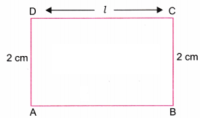
Here, the perimeter of the rectangle = 14 cm and breadth b = 2 cm, l = ?
Thus 14 = 2(l + 2)
⇒ 14 = 2l + 4
⇒ 2l = 14 − 4 = 10
⇒ l = 10/2 = 5 cm
(b) We know that the perimeter of the square = 4 × a, where a = side of the square
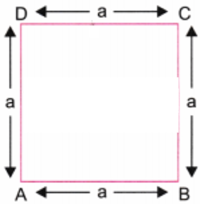
∴ 20 = 4 × a
⇒ a = 5 cm
(c) Perimeter of rectangle = 2(l + b)

⇒ 12 = 2(3 + b)
⇒ 12 = 6 + 2b
⇒ 12 − 6 = 2b
⇒ 2b = 6 m
⇒ b = 3 m
Q2. A rectangle with side lengths 5 cm and 3 cm is made using a wire. If the wire is straightened and then bent to form a square, what will be the length of the side of the square?
Answer:
Here perimeter of rectangle = 2(5 + 3)
= 2 × 8 = 16 cm
Now the wire is straightened and then bent to form a square.
∴ Perimeter of square = 16 cm
⇒ 4 × side of the square = 16 cm
⇒ side of the square = 4 cm, the required length of the side of the square

Q3. Find the length of the third side of a triangle having a perimeter of 55 cm and having two sides of length 20 cm and 14 cm, respectively.
Answer:
Let the length of the third side of the triangle be x cm, then
Perimeter of triangle = AB + BC + CA
⇒ 55 = 20 + 14 + x
⇒ 55 = 34 + x
⇒ x = 55 − 34
⇒ x = 21 cm

Q4. What would be the cost of fencing a rectangular park whose length is 150 m and breadth is 120 m if the fence costs ₹40 per metre?
Answer:
The length of the fence is the perimeter of the rectangular park.
Given that the length of the rectangular park = 150 m and breadth = 120 m
∴ Perimeter = 2(150 + 120)
= 2(270)
= 540 m
Now cost of fencing per metre = ₹40
Cost of fencing the rectangular park = ₹40 × 540 = ₹21,600

Q5. A piece of string is 36 cm long. What will be the length of each side, if it is used to form:
(a) A square,
(b) A triangle with all sides of equal length, and
(c) A hexagon (a six-sided closed figure) with sides of equal length?
Answer:
(a) Given, a piece of string is 36 cm long
∴ length of each side of the square = a cm
perimeter = 36
⇒ 4a = 36
⇒ a = 9 cm
(b) Length of each side of the triangle = a cm
perimeter = 36
⇒ 3a = 36
⇒ a = 12 cm
(c) Length of each side of hexagon = a cm
perimeter = 36
⇒ 36 = 6a
⇒ a = 6 cm

Q6. A farmer has a rectangular field with length 230 m and a breadth of 160 m. He wants to fence it with 3 rounds of rope as shown. What is the total length of rope needed?

Answer:
Perimeter of the rectangular field = 2(l + b)
Here l = 230 m, b = 160 m
∴ P = 2(230 + 160)
= 2(390)
= 780 m
Distance covered by a farmer in one round = 780 m
∴ Total length of rope needed = 3 × 780 = 2340 m
6.1 Perimeter Figure it Out (Page No. 133 – 134)
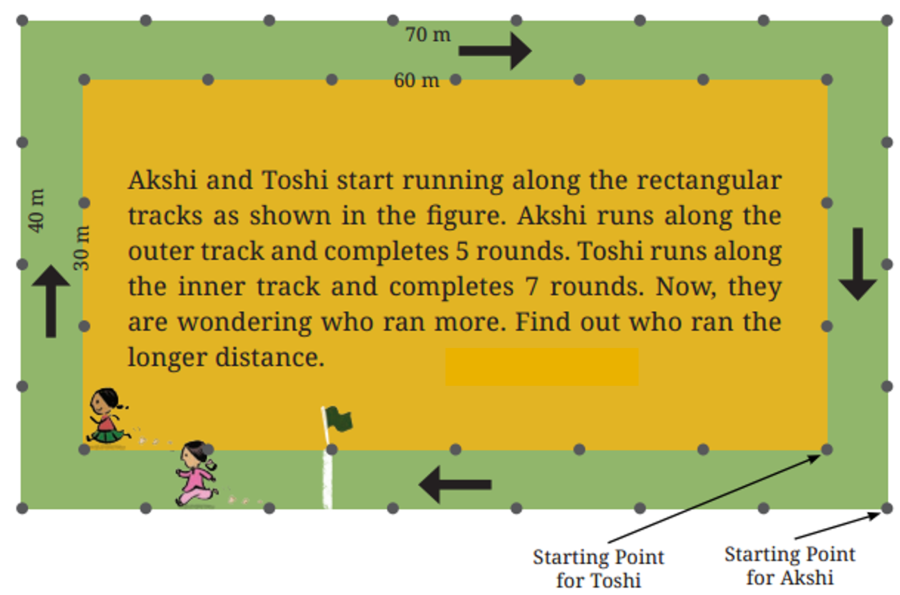
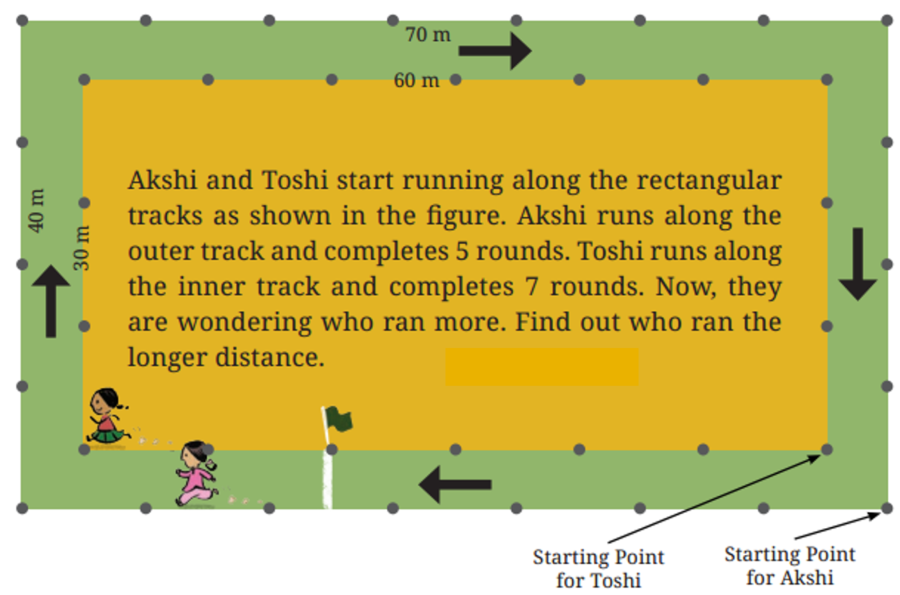
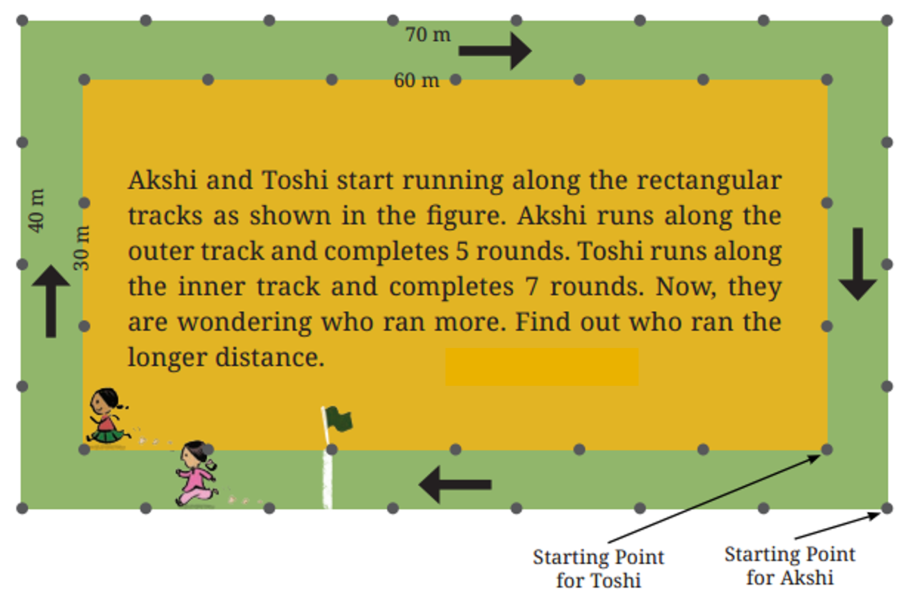
Each track is a rectangle. Akshi’s track has length 70 m and breadth 40 m. Running one complete round on this track would cover 220 m, i.e., 2 × (70 + 40) m = 220 m. This is the distance covered by Akshi in one round.

Q1: Find out the total distance Akshi has covered in 5 rounds.
Answer:
Distance covered by Akshi in 5 rounds = 5 × perimeter of PQRS
= 5 × 220
= 1100 m
Q2. Find out the total distance Toshi has covered in 7 rounds. Who ran a longer distance?
Answer:
Distance covered by Toshi in 7 rounds = 7 × 180 = 1260 m
∴ 1260 m > 1100 m
Hence Toshi ran the longer distance.
Q3. Think and mark the positions as directed:
(a) Mark 'A' at the point where Akshi will be after she runs 250 m.
(b) Mark 'B' at the point where Akshi will be after she runs 500 m.
(c) Now, Akshi ran 1000 m. How many full rounds has she finished running around her track? Mark her position as 'C'.
(d) Mark 'X' at the point where Toshi will be after she runs 250 m.
(e) Mark 'Y' at the point where Toshi will be after she runs 500 m.
(f) Now, Toshi ran 1000 m. How many full rounds has she finished running around her track? Mark her position as 'Z'.
Answer:
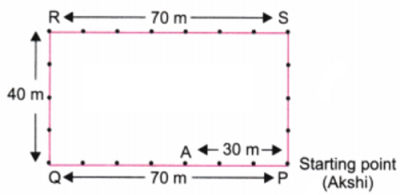
(a) Here,
- One complete round = 220 metres.
- Distance Akshi has run = 250 metres.
- Extra distance beyond one round = 250 − 220 = 30 metres.
Since Akshi has already completed one full round, she will be 30 metres into her second round. So, after running 30 metres more, she will be on the length side of the track, 30 metres from the starting point. Therefore, mark 'A' at the point 30 metres along the length of the track from the starting point.
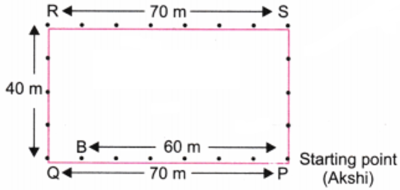
(b) Distance per round = 220 metres
Total distance Akshi runs = 500 metres.
First, we will find out how many complete rounds she runs:
Number of complete rounds = 500/220 = 2.27 (approx.)
This means Akshi completes 2 full rounds and then runs an additional distance = 500 − (2 × 220) = 60 m
Therefore, Akshi will be 60 metres along the length of the track from the starting point, and we can mark point 'B' at this position on the track.
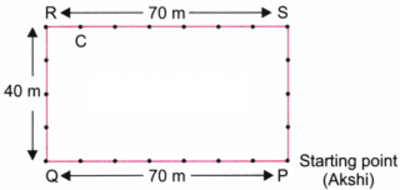
(c) Now, Akshi ran 1000 metres. To find out how many full rounds she completed, we divide the total distance she ran by the perimeter of the track:
Number of full rounds = 1000/220 = 4.545 rounds.
Akshi has completed 4 full rounds and is partway through her 5th round.
To find her position on the track, we calculate the remaining distance after 4 full rounds:
Remaining distance = 1000 m − (4 × 220 m)
= 1000 m − 880 m
= 120 m
Since she has run an additional 120 metres after completing 4 full rounds, her position will be 120 metres from the starting point 'P'. Her position after running 1000 metres can be marked as 'C'.
(d) Here,
- Perimeter of the track = 180 metres
- Distance Toshi runs = 250 metres
Since 250 metres is more than one complete round (180 metres), Toshi will have completed one full round and will have 70 metres left to run (250 − 180 = 70 metres). So, Toshi will be 70 metres along the length of the track from the starting point. You can mark 'X' at this point on the track.
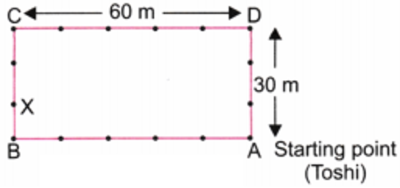
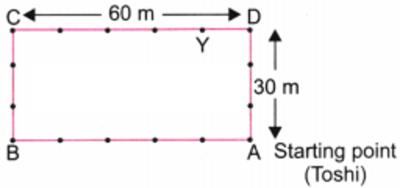
(e) Given, that Toshi has run an additional 140 metres after completing 2 rounds, her position will be 140 metres from the starting point. If we mark her starting point as 'A', her position after running 500 metres can be marked as 'Y'.
(f) Here, we need to find out how many full rounds Toshi has completed by dividing the total distance she ran by the perimeter of the track:
Number of full rounds = 1000/180 = 5.56
Toshi has finished 5 full rounds.
Remaining distance = 1000 metres − (5 × 180 metres)
= 1000 metres − 900 metres
= 100 metres
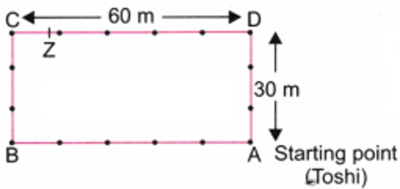
Starting from the initial point, Toshi would be 100 metres into her 6th round. Since the track is 60 metres long and 30 metres wide, she would be somewhere along the length of the track.
Let's mark this position as 'Z'.
Page 134 (Deep Dive):
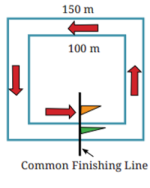
Q10. In races, usually, there is a common finish line for all the runners. Here are two square running tracks with an inner track of 100 m on each side and an outer track of 150 m on each side. The common finishing line for both runners is shown by the flags in the figure which are in the centre of one of the sides of the tracks. If the total race is 350 m, then we have to find out where the starting positions of the two runners should be on these two tracks so that they both have a common finishing line after they run for 350 m. Mark the starting points of the runner on the inner track as 'A' and the runner on the outer track as 'B'.
Answer:
Inner Track (100 m per side)
Perimeter Calculation: The perimeter of the inner track is 4 × 100 = 400 m.
Distance to Run: The runner on the inner track needs to run 350 m.
Starting Position (A): Since the perimeter is 400 metres, the runner will start 50 metres before the common finish line (400 − 350 = 50 metres).
Outer Track (150 m per side)
Perimeter Calculation: The perimeter of the outer track is 4 × 150 = 600 metres.
Distance to Run: The runner on the outer track also needs to run 350 metres.
Starting Position (B): Since the perimeter is 600 metres, the runner will start 250 metres before the common finish line (600 − 350 = 250 metres).
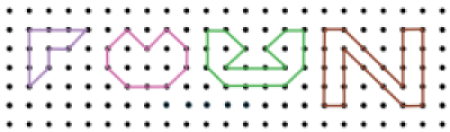
Q25. Write the perimeters of the figures below in terms of straight and diagonal units.
Answer:
Solution:
(i) Perimeter = 8 straight units + 2 diagonal units
= 8s + 2d units.
(ii) Perimeter = 4 straight units + 6 diagonal units
= 4s + 6d units.
(iii) Perimeter = 12 straight units + 6 diagonal units
= 12s + 6d units.
(iv) Perimeter = 18 straight units + 6 diagonal units
= 18s + 6d units.
Page 136
Q11. Find various objects from your surroundings that have regular shapes and find their perimeters. Also, generalise your understanding of the perimeter of other regular polygons.
Answer:
Some common objects with regular shapes and calculating their perimeters. Here are a few examples:
1. Square Table:

Shape: Square
Side Length = 1 metre
Perimeter = 4 × 1 = 4 metres
2. Equilateral Triangle Clock:
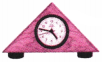
Shape: Equilateral Triangle
Side Length = 30 cm
Perimeter = 3 × 30 = 90 cm
3. Hexagonal Tile:

Shape: Regular Hexagon
Side Length = 10 cm
Perimeter = 6 × 10 = 60 cm
In general, the Perimeter of a Regular Polygon = (Number of sides) × (Side length of a polygon) units.
Split and rejoin:
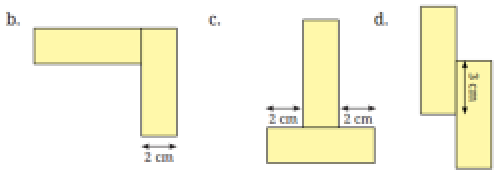
Q12. A rectangular paper chit of dimension 6 cm × 4 cm is cut as shown into two equal pieces. These two pieces are joined in different ways. For example, the arrangement a. has a perimeter of 28 cm. Find out the length of the boundary (i.e., the perimeter) of each of the other arrangements below.
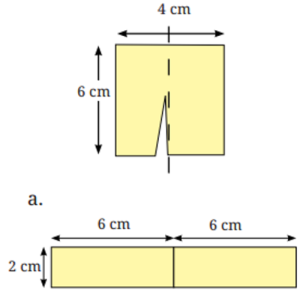
Answer:
(b)
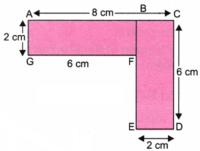
∴ Length of boundary = AB + BC + CD + DE + EF + FG + GA
= 6 + 2 + 6 + 2 + 4 + 6 + 2
= 28 cm
(c)
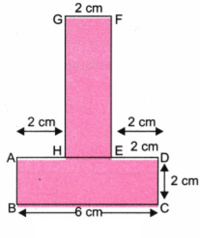
Total length of boundary = AB + BC + CD + DE + EF + FG + GH + HA
= 2 + 6 + 2 + 2 + 6 + 2 + 6 + 2
= 28 cm
(d)
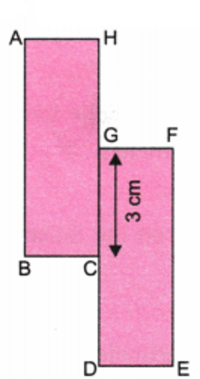
Total length of boundary = AB + BC + CD + DE + EF + FG + GH + HA
= 6 + 2 + 3 + 2 + 6 + 2 + 3 + 2
= 26 cm
Q13. Arrange the two pieces to form a figure with a perimeter of 22 cm.
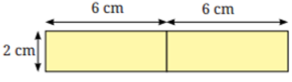
Answer:
Arranging the two pieces in such a way that they form a new shape with the desired perimeter:
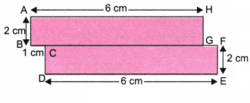
Total length of boundary = AB + BC + CD + DE + EF + FG + GH + HA
= 2 + 1 + 2 + 6 + 2 + 1 + 2 + 6
= 22 cm
6.2 Area Figure it Out (Page No. 138)
Q1. The area of a rectangular garden 25 m long is 300 sq m. What is the width of the garden?
Answer:
Given, area of rectangular garden = 300 sq. m
and length = 25 m
Area of rectangular field = length × breadth
⇒ 300 = 25 × breadth
⇒ b = 12 m
Q2. What is the cost of tiling a rectangular plot of land 500 m long and 200 m wide at the rate of ₹8 per hundred sq m?
Answer:
Here, length = 500 m and breadth = 200 m
Hence the area of the rectangular plot = length × breadth
= 500 × 200
= 1,00,000 m²
Now cost of tiling a rectangular plot per sq m = 8/100
Hence the cost of tiling 1,00,000 sq. m of rectangular plot = (8/100) × 100000 = ₹8,000
Q3. A rectangular coconut grove is 100 m long and 50 m wide. If each coconut tree requires 25 sq m, what is the maximum number of trees that can be planted in this grove?
Answer:
Area of rectangular coconut grove = 100 × 50 = 5000 m²
Given each coconut tree requires = 25 m²
Then the maximum number of trees that can be planted in this grove = 5000/25 = 200
Q4. By splitting the following figures into rectangles, find their areas (all measures are given in metres):
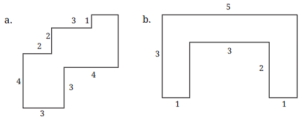
Answer:
(a) Splitting the given figure into I, II, III, and IV rectangles as shown in the figure below, we get
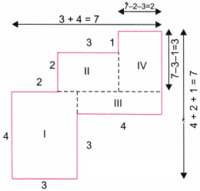
Here, the area of rectangle I = length × breadth
= 4 m × 3 m
= 12 m²
Area of rectangle II = length × breadth
= 3 m × 2 m
= 6 m²
Area of rectangle III = length × breadth
= 4 m × 1 m
= 4 m²
Area of rectangle IV = length × breadth
= 3 m × 2 m
= 6 m²
The total area of the whole figure = 12 m² + 6 m² + 4 m² + 6 m² = 28 m²
Therefore, the total area of Figure (a) is 28 m².
(b) Similarly, by splitting figure (b) into I, II, and III rectangles as shown in the figure below, we get
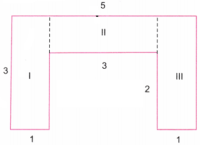
Area of the rectangle I = length × breadth
= 3 m × 1 m
= 3 m²
Area of rectangle II = length × breadth
= 3 m × 1 m
= 3 m²
Area of rectangle III = length × breadth
= 3 m × 1 m
= 3 m²
The total area of the figure = 3 m² + 3 m² + 3 m² = 9 m².
Therefore, the total area of Figure (b) is 9 m².
6.2 Area Figure it Out (Page No. 139)
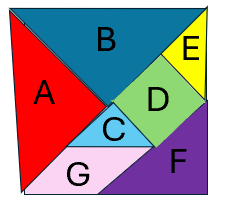
Cut out the tangram pieces given at the end of your textbook.
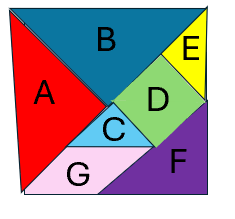
Q1. Explore and figure out how many pieces have the same area.
Answer:
There are two pieces (A and B) that have the same area.
As area of A = ¼ × Area of given figure
And area of B = ¼ × Area of given figure
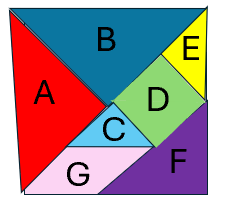
Q2. How many times bigger is Shape D as compared to Shape C? What is the relationship between Shapes C, D, and E?
Answer:
Shape D is two times bigger than shape C.
Clearly from the figure, the sum of the area of shapes C and E is equal to the area of shape D.
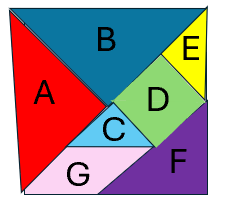
Q3. Which shape has more area: Shape F or G? Give reasons for your answer.
Answer:
Since the medium triangle and the rhomboid are each made up of two small tangram triangles, they each have an area 2 times that of the small triangle. Hence both have the same area.
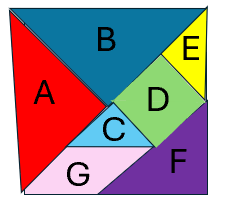
Q4. Which shape has more area: Shape D or F? Give reasons for your answer.
Answer:
Since the medium triangle and the square are each made up of two small tangram triangles, they each have an area twice that of the small triangle. Hence both have the same area.
Q5. What is the area of Shape A as compared to Shape G? Is it twice as big? Four times as big?
[Hint: In the tangram pieces, by placing the shapes over each other, we can find out that Shapes A and B have the same area, and Shapes C and E have the same area. You would have also figured out that Shape D can be exactly covered using Shapes C and E, which means Shape D has twice the area of Shape C or Shape E, etc.]
Answer:
Can you now figure out the area of the big square formed with all seven pieces in terms of the area of Shape C?
Let's say the area of C = x
Area of D = Area of 2C = 2x
Area of E = Area of C = x
Area of F = Area of 2C = 2x
Area of G = Area of 2C = 2x
Area of A = Area of 2F = 2 × 2x = 4x
Area of B = Area of A = 4x
Hence total area of big shape = Area of A + B + C + D + E + F + G
= 4x + 4x + x + 2x + x + 2x + 2x
= 16x
= 16C
That means the area of a big square is 16 times the area of shape C.
Therefore, area of A is twice the area of G.
Q6. Arrange these 7 pieces to form a rectangle. What will be the area of this rectangle in terms of the area of Shape C now? Give reasons for your answer.
Answer:
The tangram rectangle with all 7 pieces is a tangram square with 5 pieces extended with two big triangles. All seven tans fit together to form a rectangle. Hence area of this rectangle in terms of Shape C is 16 small triangles.
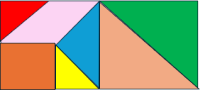
Q7. Are the perimeters of the square and the rectangle formed from these 7 pieces different or the same? Give an explanation for your answer.
Answer:
The areas of the square and the rectangle are the same, because both are made from the same 7 pieces and no piece is added or removed.
But the perimeters are different. When the pieces are rearranged, different edges end up on the outside boundary. In the square, more of the piece edges are tucked inside where they touch each other, so less edge length is left on the outside. In the long rectangle, more edge length lies on the outside boundary. So the rectangle has the larger perimeter.
This is the main idea of the chapter: two shapes can have the same area but different perimeters.
Page 140 – 144
Q. Find the area of the following figures.

Answer:
a.

Perimeter of the figure = 3 full squares + 2 half square
= 3 full squares + 1 full square
= 4 full squares
= 4 sq. units.
b.

Perimeter of the figure = 6 full squares + 6 half squares
= 6 full squares + 3 full squares
= 9 full squares
= 9 sq. units.
c.

Perimeter of the figure = 7 full squares + 6 half squares
= 7 full squares + 3 full squares
= 10 full squares
= 10 sq. units.
d.

Perimeter of the figure = 8 full squares + 6 half squares
= 8 full squares + 3 full squares
= 11 full squares
= 11 sq. units.
Let’s Explore!
Q. On a squared grid paper (1 square = 1 square unit), make as many rectangles as you can whose lengths and widths are a whole number of units such that the area of the rectangle is 12 square units.
(a) Which rectangle has the greatest perimeter?
(b) Which rectangle has the least perimeter?
(c) If you take a rectangle of area 32 sq cm, what will your answers be? Given any area, is it possible to predict the shape of the rectangle with the greatest perimeter as well as the least perimeter? Give examples and reasons for your answer.
Answer:
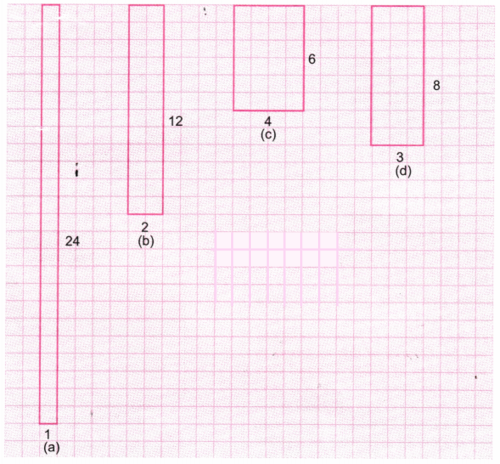
Perimeter of (a) = 2(1 + 24) = 2 × 25 = 50 units
Perimeter of (b) = 2(2 + 12) = 2 × 14 = 28 units
Perimeter of (c) = 2(4 + 6) = 2 × 10 = 20 units
Perimeter of (d) = 2(3 + 8) = 2 × 11 = 22 units
(a) Clearly rectangle (a) has the greatest perimeter.
(b) Obviously rectangle (c) has the least perimeter.
(c) Yes, it is possible to predict the shape of a rectangle with the greatest and least perimeter for a given area. Here's how:
Greatest Perimeter: For a given area, the rectangle with the greatest perimeter will have one side as small as possible. This essentially means that the rectangle becomes very elongated.
For example, if the area is 24 square units, a rectangle with dimensions 1 unit by 24 units will have the greatest perimeter.
Example: Area = 24 square units
Dimensions = 1 unit by 24 units
Perimeter = 2(1 + 24) = 50 units
Least Perimeter: The rectangle with the least perimeter for a given area will be as close to a square as possible. This is because a square has the smallest perimeter for a given area among all rectangles.
Example: Area = 24 square units
Dimensions = 4 units by 6 units (since 4 × 6 = 24)
Perimeter = 2(4 + 6) = 20 units
Reasoning
Greatest Perimeter: When one side is minimised, the other side must be maximised to maintain the same area. This increases the sum of the sides, thus increasing the perimeter.
Least Perimeter: A square or a shape close to a square minimises the sum of the sides for a given area, thus minimising the perimeter.
Q. Draw a rectangle on a piece of paper and draw one of its diagonals. Cut the rectangle along that diagonal and get two triangles. Check whether the two triangles overlap each other exactly. Do they have the same area? Can you draw any inferences from this exercise? Please write it here.
Answer:
Congruence: The triangles are congruent, meaning all corresponding sides and angles are equal.
Area: Since the triangles are congruent, their areas are identical.
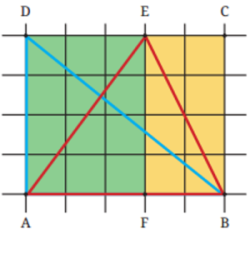
Q. Use your understanding from previous grades to calculate the area of any closed figure using grid paper and:
1. Find the area of the blue triangle BAD.
2. Find the area of the red triangle ABE.
Answer:
1. Area of blue triangle BAD
| Covered Area | Number | Area Estimated (sq. units) |
|---|---|---|
| Fully-filled squares | 6 | 6 × 1 = 6 |
| Half-filled squares | 2 | 2 × ½ = 1 |
| More than half of a square | 3 | 3 × 1 = 3 |
| Less than half of a square | 3 | 0 |
∴ Total area of BAD = 6 + 1 + 3 = 10 sq. units
2. Area of red triangle ABE
| Covered Area | Number | Area Estimated (sq. units) |
|---|---|---|
| Fully-filled squares | 5 | 5 × 1 = 5 |
| Half-filled squares | 2 | 2 × ½ = 1 |
| More than half of a square | 4 | 4 × 1 = 4 |
| Less than half of a square | 3 | 0 |
∴ Total area of ABE = 5 + 1 + 4 = 10 sq. units
Area of rectangle ABCD = Number of fully filled squares
= 20 × 1
= 20 sq. units
6.3 Area of A Triangle Figure it Out (Page 144)
Q1. Find the areas of the figures below by dividing them into rectangles and triangles.
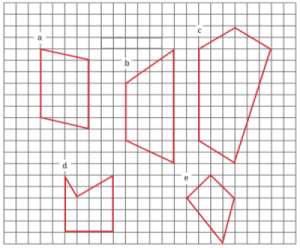
Answer:
(a)
| Covered Area | Number | Area Estimated (sq. units) |
|---|---|---|
| Fully-filled squares | 20 | 20 × 1 = 20 |
| Half-filled squares | – | – |
| More than half-filled squares | 4 | 4 × 1 = 4 |
| Less than half-filled squares | 4 | 0 |
∴ Total area of the figure = 20 + 4 = 24 sq. units
(b)
| Covered Area | Number | Area Estimated (sq. units) |
|---|---|---|
| Fully-filled squares | 25 | 25 × 1 = 25 |
| Half-filled squares | 0 | 0 |
| More than half-filled squares | 4 | 4 × 1 = 4 |
| Less than half-filled squares | 4 | 0 |
∴ Total area of the figure = 25 + 4 = 29 sq. units
(c)
| Covered Area | Number | Area Estimated (sq. units) |
|---|---|---|
| Fully-filled squares | 36 | 36 × 1 = 36 |
| Half-filled squares | 2 | 2 × ½ = 1 |
| More than half-filled squares | 8 | 8 × 1 = 8 |
| Less than half-filled squares | 6 | 6 × 0 = 0 |
∴ Total area of the figure = 36 + 1 + 8 = 45 sq. units
(d)
| Covered Area | Number | Area Estimated (sq. units) |
|---|---|---|
| Fully-filled squares | 13 | 13 × 1 = 13 |
| Half-filled squares | 0 | 0 |
| More than half-filled squares | 3 | 3 × 1 = 3 |
| Less than half-filled squares | 2 | 2 × 0 = 0 |
∴ Total area of the figure = 13 + 3 = 16 sq. units
(e)
| Covered Area | Number | Area Estimated (sq. units) |
|---|---|---|
| Fully-filled squares | 5 | 5 × 1 = 5 |
| Half-filled squares | 4 | 4 × ½ = 2 |
| More than half-filled squares | 4 | 4 × 1 = 4 |
| Less than half-filled squares | 3 | 3 × 0 = 0 |
∴ Total area of the figure = 5 + 2 + 4 = 11 sq. units
Figure it Out (Page 149)
Q1. Give the dimensions of a rectangle whose area is the sum of the areas of these two rectangles having measurements: 5 m × 10 m and 2 m × 7 m.
Answer:
Here, Area of rectangle 1 = 5 × 10 = 50 m²
Area of rectangle 2 = 2 × 7 = 14 m²
The Sum of the areas of these 2 rectangles = 50 + 14 = 64 m²
Now, the total area of the rectangle = 64 m²
Let's say the sides of the rectangle are Length = x and Width = y
Area of rectangle = x × y
Hence x × y = 64
Let's say x = 1, then y = 64/1 = 64
if x = 2, then y = 64/2 = 32
Similarly, for x = 4 and 8
Hence the dimensions of the rectangle can be (1 m × 64 m), (2 m × 32 m), (4 m × 16 m) and (8 m × 8 m).
Q2. The area of a rectangular garden that is 50 m long is 1000 sq m. Find the width of the garden.
Answer:

Width of rectangular garden = area / length of garden
= 1000/50
= 20 m
Q3. The floor of a room is 5 m long and 4 m wide. A square carpet whose sides are 3 m in length is laid on the floor. Find the area that is not carpeted.
Answer:
Area of the room
= 5 × 4 = 20 m2
Area of the square carpet
= 3 × 3 = 9 m2
Area not carpeted = 20 − 9 = 11 m2
Therefore, the area that is not carpeted is 11 m2.

Q4. Four flower beds having sides 2 m long and 1 m wide are dug at the four corners of a garden that is 15 m long and 12 m wide. How much area is now available for laying down a lawn?
Answer:
Area of the garden = 15 × 12 = 180 m2
Area of one flower bed = 2 × 1 = 2 m2
Area of 4 flower beds = 4 × 2 = 8 m2
Area available for the lawn = Area of the garden – Area of the flower beds
= 180 – 8
= 172 m2
Therefore, the area available for laying down the lawn is 172 m².

Q5. Shape A has an area of 18 square units and Shape B has an area of 20 square units. Shape A has a longer perimeter than Shape B. Draw two such shapes satisfying the given conditions.
Answer:
Possible dimensions of Shape A are 6 units and 3 units; 2 units and 9 units; 18 units and 1 unit.
Corresponding perimeters are 18 units, 22 units, and 38 units, respectively.
Possible dimensions of Shape B are 5 units and 4units; 10 units and 2 units; 20 units and 1 unit.
Corresponding perimeters are 18 units, 24 units, and 42 units, respectively.
Since P(A) > P(B).
We can take P(A) = 22 units and P(B) = 18 units.

Q6. On a page in your book, draw a rectangular border that is 1 cm from the top and bottom and 1.5 cm from the left and right sides. What is the perimeter of the border?
Answer:
Length of the page = 24 cm
Breadth of the page = 18 cm
Length of the border = 24 − (1 + 1) = 24 − 2 = 22 cm
Breadth of the border = 18 − (1.5 + 1.5) = 18 − 3 = 15 cm
Perimeter of the border = 2(22 + 15)
= 2 × 37 = 74 cm
Therefore, the perimeter of the border is 74 cm.

Q7. Draw a rectangle of size 12 units × 8 units. Draw another rectangle inside it, without touching the outer rectangle, that occupies exactly half the area.
Answer:
Area of outer rectangle = 12 units × 8 units = 96 sq. units.
Required area of inner rectangle =
× 96 sq. units = 48 sq. units.
One possible set of dimensions of the inner rectangle is 8 units × 6 units.

Q8. A square piece of paper is folded in half. The square is then cut into two rectangles along the fold. Regardless of the size of the square, one of the following statements is always true. Which statement is true here?
a. The area of each rectangle is larger than the area of the square.
b. The perimeter of the square is greater than the perimeters of both the rectangles added together.
c. The perimeters of both the rectangles added together is always 1
times the perimeter of the square.
d. The area of the square is always three times as large as the areas of both rectangles added together.
Answer:

Let the side of the square be s.
Area of the square = s2
Perimeter of the square = 4s
After folding and cutting, each rectangle has dimensions:
Length = s
Breadth =
Area of each rectangle = s ×
=
Perimeter of each rectangle =
= 3s
Sum of the perimeters of both rectangles = 3s + 3s = 6s
a. False because each rectangle has half the area of the square.
b. Perimeter of the square = 4s
Sum of the perimeters of both rectangles = 6s
Since 6s > 4s
Thus, the given statement is false.
c.
=
=
= 1
Thus, the given statement is true.
d. False, because the combined area of the two rectangles equals the area of the square.
Page 145 – 148
Q. Using 9 unit squares, solve the following.
1. What is the smallest perimeter possible?
2. What is the largest perimeter possible?
3. Make a figure with a perimeter of 18 units.
4. Can you make other shaped figures for each of the above three perimeters, or is there only one shape with that perimeter? What is your reasoning?
Answer:
1. Arrange the 9 unit squares in a 3 × 3 square.

Perimeter = 3 + 3 + 3 + 3 = 12 units.
Therefore, the smallest possible perimeter is 12 units.
2. Arrange the 9 unit squares in a straight line.

Perimeter = 1 + 9 + 1 + 9 = 20 units.
Therefore, the largest possible perimeter is 20 units.
3.

This is one possible figure in which 9 unit squares are arranged to give a perimeter of 18 units.
4. Yes, more than one shape can be made with a perimeter of 18 units and also with the largest perimeter of 20 units.
However, the smallest perimeter of 12 units can only be achieved from a 3 × 3 square.
Reasoning: The perimeter depends on how many sides of the unit squares are exposed. When more squares share sides, fewer sides are exposed, so the perimeter becomes smaller. When fewer sides are shared, more sides are exposed, so the perimeter becomes larger.
Q. Below is the house plan of Charan. It is in a rectangular plot. Look at the plan. What do you notice?

Some of the measurements are given.
1. Find the missing measurements.
2. Find out the area of his house.
Answer:
1.

2. Area of the house = 35 ft × 30 ft = 1050 sq ft.
Q. Now, find out the missing dimensions and area of Sharan’s home. Below is the plan:

Some of the measurements are given.
1. Find the missing measurements.
2. Find out the area of his house.
What are the dimensions of all the different rooms in Sharan’s house? Compare the areas and perimeters of Sharan’s house and Charan’s house.
Answer:
1.

2. Area of the house = 42 ft × 25 ft = 1050 sq ft.
Therefore, both Charan’s house and Sharan’s house have an equal area of 1050 sq ft.
Now,
Perimeter of Charan’s house = 2(35 + 30) = 2 × 65 = 130 ft.
Perimeter of Sharan’s house = 2(42 + 25) = 2 × 67 = 134 ft.
Thus, the perimeter of Sharan’s house is greater than the perimeter of Charan’s house.
Related Links
- Chapter 1 Patterns in Mathematics
- Chapter 2 Lines and Angles
- Chapter 3 Number Play
- Chapter 4 – Data Handling and Presentation
- Chapter 5 Prime Time
- Chapter 7 Fractions
- Chapter 8 Playing with Constructions
- Chapter 9 Symmetry
- Chapter 10 The Other Side of Zero