Class 9 Maths Ganita Manjari Chapter 12 Exercise 12.3 Solutions Quadrilaterals
The Class 9 Maths Ganita Manjari Chapter 12 Exercise 12.3 Solutions – Quadrilaterals help students understand the Midpoint Theorem and its applications in triangles and quadrilaterals. This exercise includes questions on midpoints, parallel lines, bisecting line segments, the Varignon parallelogram and relationships between diagonals and midpoint-formed figures.
The solutions are explained step by step to make geometric proofs easier to follow and to strengthen students’ reasoning skills. Students can also refer to the Class 9 Maths Ganita Manjari Chapter 12 Exercise 12.3 Solutions PDF for quick revision and offline study.
NCERT Class 9 Maths Ganita Manjari Chapter 12 Exercise Set 12.3
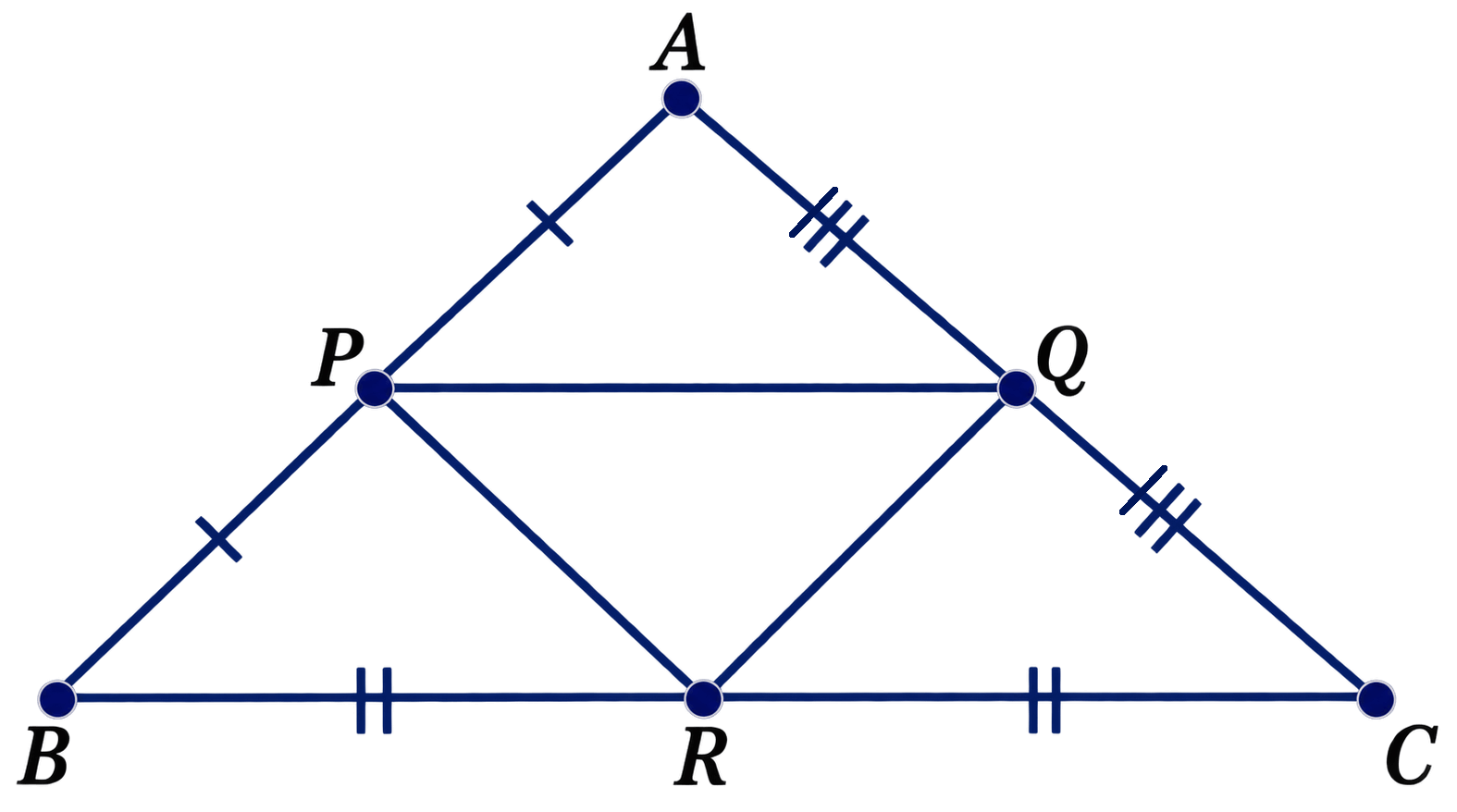
1. (i) If P, Q, R are the midpoints of sides AB, AC, BC respectively of △ABC, show that △PQR is congruent to △QPA and to two other triangles which you should identify. (ii) Suppose someone erases △ABC, leaving only △PQR on the paper. Can you reconstruct △ABC from △PQR?
Answer:
(i) Show that △PQR is congruent to △QPA and two other triangles.
Since P, Q and R are the midpoints of AB, AC and BC respectively,
AP = PB = AB/2
AQ = QC = AC/2
BR = RC = BC/2
By the Midpoint Theorem,
PQ = BC/2,
QR = AB/2,
PR = AC/2.
Now compare △PQR and △QPA:
- PQ = BC/2 = QA? Wait no, better pair by side lengths:
- PQ = BC/2
- QR = AB/2
- PR = AC/2
For △QPA:
- QP = BC/2
- PA = AB/2
- QA = AC/2
Therefore,
PQ = QP, QR = PA, PR = QA.
Hence,
△PQR ≅ △QPA by SSS congruence.
Similarly,
- △PRB has sides AB/2, BC/2 and AC/2.
- △QRC also has sides AB/2, BC/2 and AC/2.
Therefore,
△PQR ≅ △QPA ≅ △PRB ≅ △QRC.
So the two other triangles are △PRB and △QRC.
(ii) Can △ABC be reconstructed from △PQR?
Yes.
Using the Midpoint Theorem,
- QR ∥ AB
- PR ∥ AC
- PQ ∥ BC
So, starting with △PQR:
- Through P, draw a line parallel to QR.
- Through Q, draw a line parallel to PR. Their intersection gives A.
- Through R, draw a line parallel to PQ.
- The line through P parallel to QR meets the line through R parallel to PQ at B.
- The line through Q parallel to PR meets the line through R parallel to PQ at C.
Thus, the original △ABC can be reconstructed uniquely from △PQR.
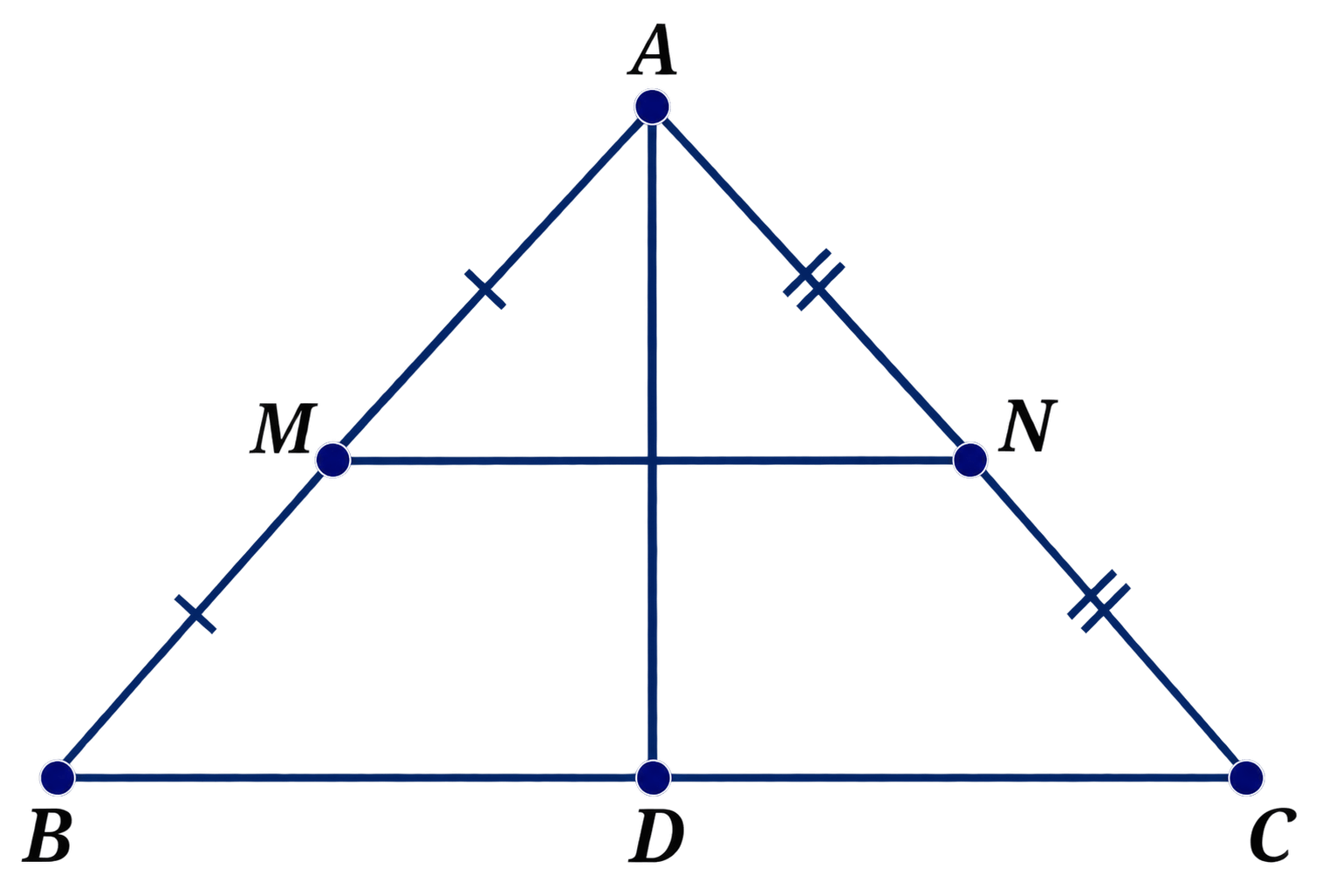
2. In △ABC, let M and N be midpoints of AB and AC respectively. Let D be any point on BC. Show that MN bisects AD.
Answer:
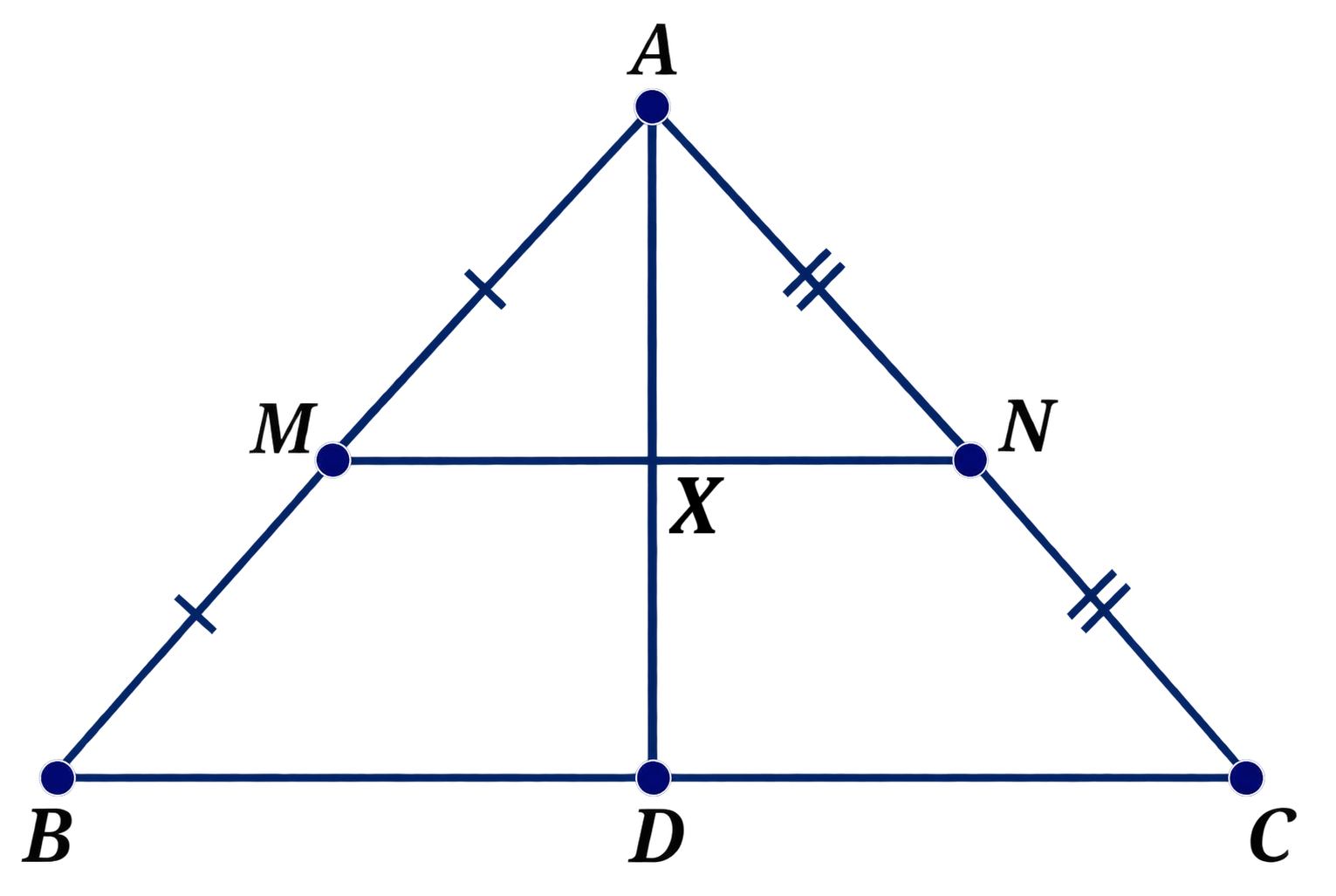
Let MN meet AD at X.
Since M and N are the midpoints of AB and AC, by the Midpoint Theorem,
MN ∥ BC
As D lies on BC, we also have
MX ∥ BD
Now consider △ABD.
M is the midpoint of AB, and the line through M parallel to BD meets AD at X.
Therefore, by the converse of the Midpoint Theorem, X is the midpoint of AD.
Hence,
AX = XD
Therefore, MN bisects AD.
If D = B or D = C, the result follows directly because M or N is already the midpoint of AD.
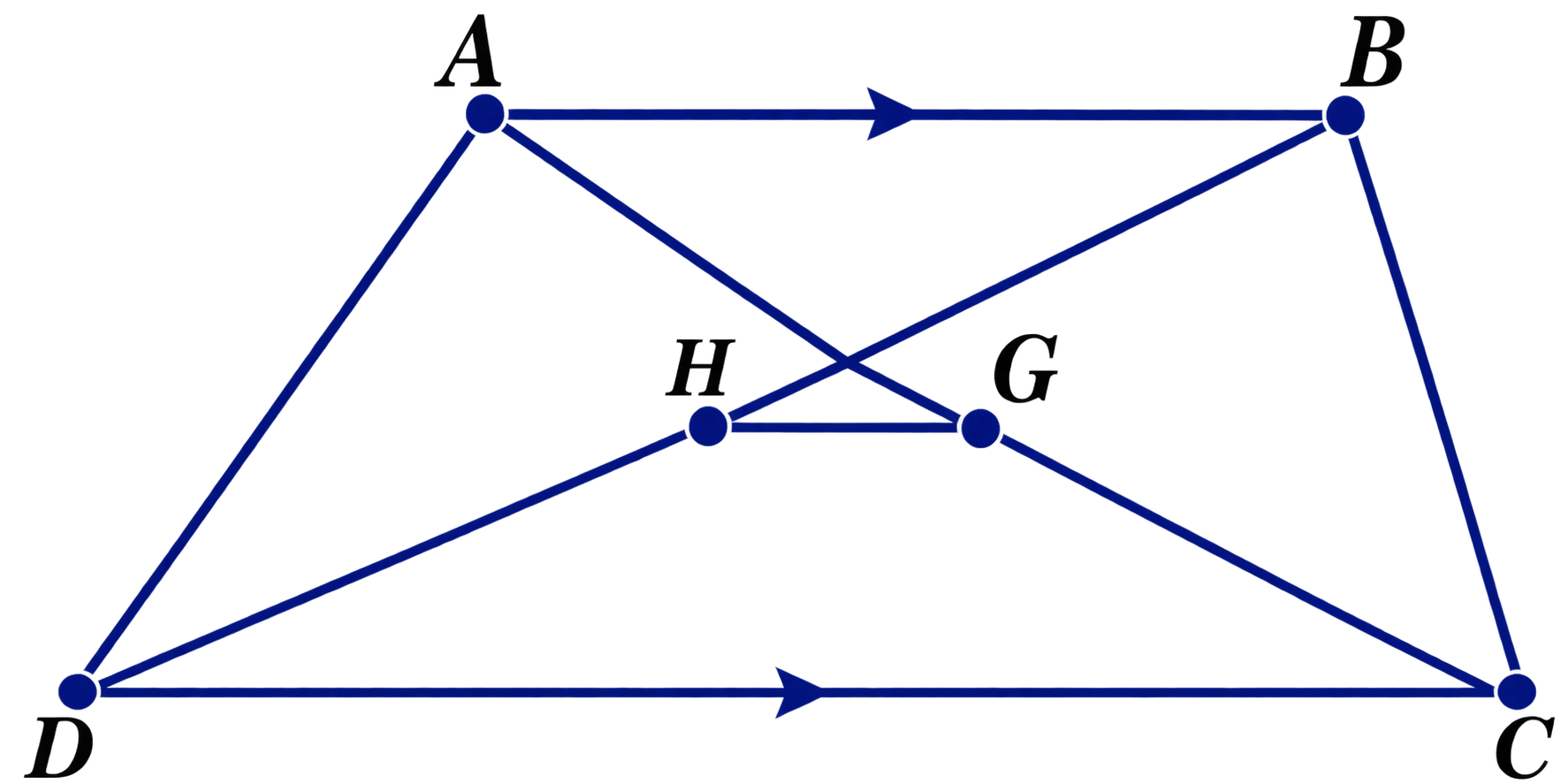
3. In a quadrilateral ABCD, suppose AB ∥ DC and AB ≠ CD. Suppose G and H are the midpoints of AC and BD respectively. Prove that GH ∥ AB. (Why did we assume AB ≠ CD?)
Answer:

Let M be the midpoint of AD.
In △ADC, M is the midpoint of AD and G is the midpoint of AC. Therefore, by the Midpoint Theorem,
MG ∥ DC and MG = DC/2.
Similarly, in △ADB, M is the midpoint of AD and H is the midpoint of DB. Hence,
MH ∥ AB and MH = AB/2.
Given that
AB ∥ DC,
we get
MG ∥ AB and MH ∥ AB.
Since both MG and MH pass through M and are parallel to AB, they lie on the same straight line. Thus, G, M and H are collinear.
Therefore,
GH ∥ AB.
Why is AB ≠ CD assumed?
If AB = CD and AB ∥ CD, then ABCD is a parallelogram. The diagonals of a parallelogram bisect each other, so the midpoint G of AC and the midpoint H of BD would be the same point.
Thus,
G = H,
and GH would have zero length, so it would not form a proper segment parallel to AB.
Hence, the condition AB ≠ CD ensures that G and H are distinct points.
4. Suppose the midpoints of sides AB, BC, CD and DA of a quadrilateral ABCD are P, Q, R and S respectively.
(i) Show that PR and QS bisect each other.
(ii) Show that if AC = BD, then PR and QS are perpendicular. Is the converse true?
Answer:
(i) Show that PR and QS bisect each other.
Since P and Q are the midpoints of AB and BC, in △ABC, by the Midpoint Theorem,
PQ ∥ AC.
Similarly, R and S are the midpoints of CD and DA. Therefore, in △ADC,
RS ∥ AC.
Hence,
PQ ∥ RS.
Now, Q and R are the midpoints of BC and CD, so in △BCD,
QR ∥ BD.
Also, P and S are the midpoints of AB and AD, so in △ABD,
PS ∥ BD.
Therefore,
QR ∥ PS.
Thus, both pairs of opposite sides of PQRS are parallel, so PQRS is a parallelogram.
The diagonals of a parallelogram bisect each other. Hence,
PR and QS bisect each other.
(ii) Show that if AC = BD, then PR ⟂ QS. Is the converse true?
By the Midpoint Theorem,
PQ = AC/2
and
QR = BD/2.
Given that
AC = BD,
we get
PQ = QR.
Since PQRS is already a parallelogram and two adjacent sides are equal, PQRS is a rhombus.
The diagonals of a rhombus are perpendicular. Therefore,
PR ⟂ QS.
Converse
Yes, the converse is also true.
Suppose
PR ⟂ QS.
Since PQRS is a parallelogram whose diagonals are perpendicular, PQRS must be a rhombus.
Therefore,
PQ = QR.
But
PQ = AC/2 and QR = BD/2.
Hence,
AC/2 = BD/2,
so
AC = BD.
Therefore, the converse is also true:
PR ⟂ QS if and only if AC = BD.
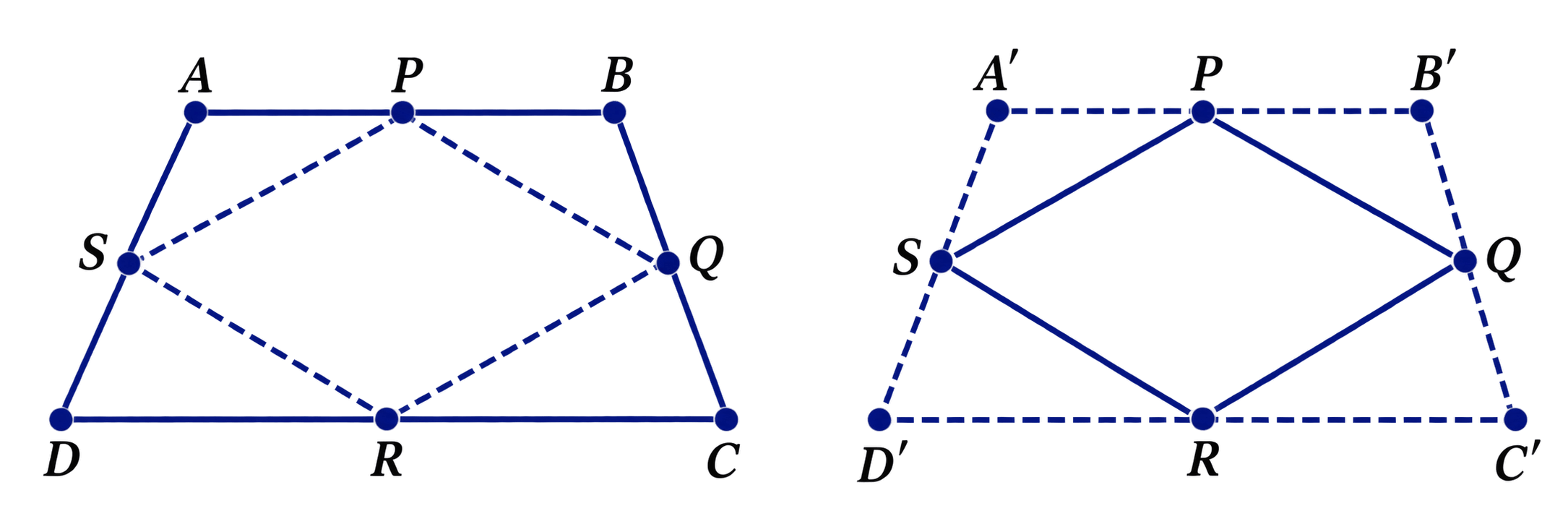
5. Suppose PQRS is the Varignon parallelogram of ABCD.
Answer:
(i) Reconstructing a congruent quadrilateral A′B′C′D′
Since P, Q, R and S are the midpoints of AB, BC, CD and DA, respectively, we can rebuild the vertices successively.
- On the copied parallelogram PQRS, construct a point A′ so that △SPA′ is congruent to the original △SPA. Choose the corresponding position of A′ relative to SP.
- Draw the line A′P and extend it beyond P. Mark B′ so that
A′P = PB′.
Thus, P is the midpoint of A′B′. - Extend B′Q beyond Q and choose C′ such that
B′Q = QC′.
Hence, Q is the midpoint of B′C′. - Extend C′R beyond R and locate D′ so that
C′R = RD′.
Thus, R is the midpoint of C′D′. - Join D′ to A′.
This gives a quadrilateral A′B′C′D′ corresponding to ABCD.
(ii) Why is A′B′C′D′ congruent to ABCD?
By construction,
△SPA′ ≅ △SPA.
Also, B′ is obtained from A′ by a half-turn about P, just as B is obtained from A about P. In the same way,
- C′ is obtained from B′ by a half-turn about Q,
- D′ is obtained from C′ by a half-turn about R.
Thus the same sequence of midpoint constructions used in ABCD is reproduced in A′B′C′D′, so corresponding lengths and angles are preserved.
It remains to check that S is also the midpoint of A′D′.
Since Q and R are the midpoints of B′C′ and C′D′, respectively, the Midpoint Theorem in △B′C′D′ gives
QR ∥ B′D′ and QR = B′D′/2.
But PQRS is a parallelogram, so
PS ∥ QR and PS = QR.
Therefore,
PS ∥ B′D′ and PS = B′D′/2.
Now P is the midpoint of A′B′. Hence the line through P parallel to B′D′ meets A′D′ at its midpoint. That point is S. Therefore,
A′, S and D′ are collinear and SA′ = SD′.
So P, Q, R and S are exactly the midpoints of the four sides of A′B′C′D′, just as in ABCD. Hence,
A′B′C′D′ ≅ ABCD.
Different valid placements of A′ can produce translated, rotated or reflected copies, but all are congruent to ABCD.
(iii) If PQRS is a square, show that AC and BD are equal and perpendicular. Prove the converse.
By the Midpoint Theorem,
PQ ∥ AC and PQ = AC/2,
while
QR ∥ BD and QR = BD/2.
If PQRS is a square, then
PQ = QR and PQ ⟂ QR.
Therefore,
AC/2 = BD/2, so AC = BD,
and since PQ ∥ AC and QR ∥ BD,
AC ⟂ BD.
Hence, the diagonals AC and BD are equal and perpendicular.
Conversely, suppose
AC = BD and AC ⟂ BD.
Then
PQ = AC/2 = BD/2 = QR,
and, because PQ ∥ AC and QR ∥ BD,
PQ ⟂ QR.
Thus the Varignon parallelogram PQRS has two equal adjacent sides and a right angle. Therefore, PQRS is a square.
Hence,
PQRS is a square if and only if AC and BD are equal and perpendicular.
Related Links:
- Class 9 Maths Ganita Manjari Chapter 12 Solutions – Quadrilaterals
- Class 9 Maths Ganita Manjari Chapter 12 Exercise 12.1 Solutions – Quadrilaterals
- Class 9 Maths Ganita Manjari Chapter 12 Exercise 12.2 Solutions – Quadrilaterals
- Class 9 Maths Ganita Manjari Chapter 12 Exercise 12.4 Solutions – Quadrilaterals
- Class 9 Maths Ganita Manjari Chapter 12 End-of-Chapter Exercises Solutions – Quadrilaterals