Class 9 Maths Ganita Manjari Chapter 12 Exercise 12.4 Solutions Quadrilaterals
The Class 9 Maths Ganita Manjari Chapter 12 Exercise 12.4 Solutions – Quadrilaterals help students understand how geometric shapes can be used to create tiling patterns and how properties of quadrilaterals and triangles support such constructions. This exercise includes questions on tiling the plane, regular and irregular polygons, non-convex quadrilaterals, triangle-based tilings and the use of parallel lines and midpoints in geometric reasoning.
The solutions are explained in a simple, step-by-step manner to help students connect geometry with visual patterns and practical applications. Students can also refer to the Class 9 Maths Ganita Manjari Chapter 12 Exercise 12.4 Solutions PDF for quick revision and offline study.
NCERT Class 9 Maths Ganita Manjari Chapter 12 Exercise Set 12.4
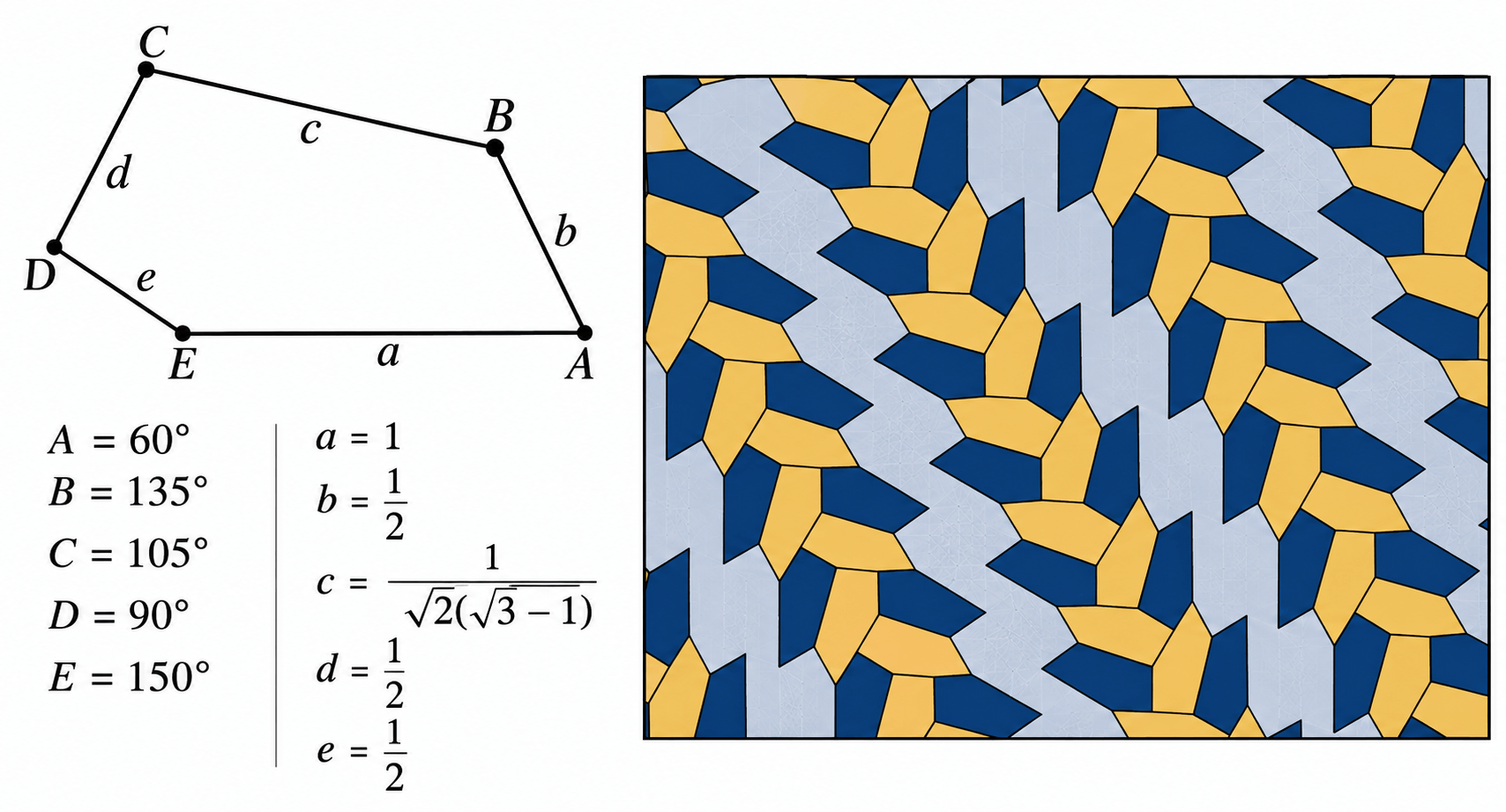
1. Justify why the plane cannot be tiled with a regular pentagon.
(Hint: Read the first 3 sentences of ‘Think and Reflect’ in the section on tiling.) (There are many ways to tile the plane using a suitable irregular pentagon. The most recent method was found in 2015.)
Answer:
A regular pentagon cannot tile the plane because its interior angles do not fit exactly around a point.
For a regular pentagon, each interior angle is
108°.
To tile the plane without gaps or overlaps, the angles meeting at a vertex must add up to exactly 360°.
But:
3 × 10⁸° = 324°, leaving a gap of 36°,
while
4 × 10⁸° = 432°, which is more than 360°.
So no whole number of regular pentagons can meet at a point and completely fill the space.
Therefore, the plane cannot be tiled using regular pentagons alone.
Irregular pentagons can tile the plane because their angles need not all be equal and can be arranged so that the angles around each vertex add up to 360°.
2. Draw a non-convex 4-gon DART. Show how we can tile the plane with copies of DART. Both methods that we discussed earlier will work. Which do you prefer?
Answer:

One example of a non-convex quadrilateral DART can be obtained by taking
D(1, 1), A(0, 3), R(0, 0) and T(3, 0),
and joining the points in the order
D – A – R – T – D.
Here D lies inside triangle ART, so the interior angle at D is greater than 180°. Hence, DART is a non-convex quadrilateral.
To tile the plane, we can use either of the following methods:
Method 1: Half-turn method
Take one copy of DART. Rotate a congruent copy through 180° about the midpoint of one of its sides. The rotated copy fits with the first one along that side. Continue the same process along the exposed sides. Repeating these half-turns produces a pattern of congruent copies that covers the plane without gaps or overlaps.
Method 2: Varignon parallelogram method
Construct the Varignon parallelogram of DART by joining the midpoints of its four sides. Copies of DART can then be arranged according to the repeating parallelogram pattern. Copies with the same orientation are placed at corresponding positions, while the remaining spaces are filled using half-turned copies.
Both constructions give a tiling of the plane even though DART is non-convex.
Preference: I prefer the half-turn method, because every new tile can be positioned simply by rotating the previous tile through 180° about the midpoint of a suitable side.
Related Links:
- Class 9 Maths Ganita Manjari Chapter 12 Solutions – Quadrilaterals
- Class 9 Maths Ganita Manjari Chapter 12 Exercise 12.1 Solutions – Quadrilaterals
- Class 9 Maths Ganita Manjari Chapter 12 Exercise 12.2 Solutions – Quadrilaterals
- Class 9 Maths Ganita Manjari Chapter 12 Exercise 12.3 Solutions – Quadrilaterals
- Class 9 Maths Ganita Manjari Chapter 12 End-of-Chapter Exercises Solutions – Quadrilaterals