NCERT Solutions for Class 9 Maths Ganita Manjari Chapter 12 Quadrilaterals
The NCERT Solutions for Class 9 Maths Ganita Manjari Chapter 12 Quadrilaterals provide complete exercise-wise question answers with clear explanations, step-by-step proofs and labelled diagrams. These solutions cover all Exercise Sets 12.1 to 12.4, and the End-of-Chapter Exercises, including starred questions. Students can learn important concepts related to parallelograms, rhombuses, rectangles, squares, the Midpoint Theorem, Centroid Theorem and tiling patterns.
Arranged according to the textbook sequence and page numbers, the solutions make it easier to locate questions, understand the reasoning behind each answer and practise writing complete mathematical solutions. Students can also use the Class 9 Maths Ganita Manjari Chapter 12 Quadrilaterals Solutions PDF for revision and offline study.
NCERT Class 9 Maths Ganita Manjari Chapter 12 Solutions
NCERT Class 9 Maths Ganita Manjari Chapter 12 Exercise Set 12.1
1. Let ABCD be a quadrilateral.
(i) List all sides of ABCD adjacent to side AB. List all sides opposite to AB.
(ii) List all angles of ABCD adjacent to ∠A. List all angles opposite to ∠A.
(iii) Define a pair of opposite sides and a pair of opposite angles without using the names of the vertices.
Answer:
1. Let ABCD be a quadrilateral.
(i) List all sides of ABCD adjacent to side AB. List all sides opposite to AB.
The sides adjacent to AB are AD and BC.
The side opposite to AB is CD.
(ii) List all angles of ABCD adjacent to ∠A. List all angles opposite to ∠A.
The angles adjacent to ∠A are ∠B and ∠D.
The angle opposite to ∠A is ∠C.
(iii) Define a pair of opposite sides and a pair of opposite angles without using the names of the vertices.
A pair of opposite sides of a quadrilateral are two sides that do not share a common vertex.
A pair of opposite angles are two angles that are not adjacent, that is, they do not share a common side.
2. You have used internal angles of quadrilaterals, but they too require an exact definition, just like how we gave one for a quadrilateral. Precisely define the internal angle of a quadrilateral at a given vertex. Your answer should work for a non-convex quadrilateral too.
(Hint: use the opposite vertex as well.)
Answer:
Consider a quadrilateral ABCD and focus on vertex A. Let θ be the smaller angle formed by the two sides AB and AD.
- If A lies outside triangle BCD, then the internal angle at A is simply θ.
- If A lies inside triangle BCD, then A is the concave vertex, so the internal angle is the reflex angle 360° − θ.
The same method can be used at any other vertex of the quadrilateral.
Thus, the internal angle is the angle between the two sides meeting at a vertex that lies inside the region of the quadrilateral. It is less than 180° at a convex vertex and greater than 180° at a concave vertex.
3. In a quadrilateral ABCD, suppose AB ∥ DC. Can ABCD be non-convex? What if we instead assume AB = CD? What if we instead assume ∠A = ∠C?
Answer:

(i) If AB ∥ DC
No. A simple quadrilateral ABCD cannot be non-convex if the opposite sides AB and DC are parallel.
Since AB and DC lie on parallel lines, the other two sides AD and BC must join the endpoints without crossing. This gives a convex quadrilateral, so no vertex can form a reflex angle.
Therefore, AB ∥ DC implies that ABCD is convex.
(ii) If AB = CD
Yes. A quadrilateral can still be non-convex even if the opposite sides AB and CD are equal.
For example, take:
A(0, 0), B(2, 0), C(1, 1), D(1, 3).
Here, AB = CD = 2 units, but C is an inward-pointing vertex, so ABCD is non-convex.
Therefore, AB = CD does not guarantee that ABCD is convex.
(iii) If ∠A = ∠C
Yes. A quadrilateral can have equal opposite angles and still be non-convex.
For example, take:
A(−2, 0), B(0, 1), C(2, 0), D(0, 3).
The figure is symmetric, so ∠A = ∠C, but B is an inward-pointing vertex and forms a reflex angle.
Therefore, ∠A = ∠C does not guarantee that ABCD is convex.
Hence:
- AB ∥ DC: ABCD must be convex.
- AB = CD: ABCD may be non-convex.
- ∠A = ∠C: ABCD may be non-convex.
4. Consider three non-collinear points A, B, C and draw the lines AB, BC, CA. For every possible location of point D in the plane outside these lines, decide if ABCD is self-intersecting, non-convex, or convex.
(Hint: the three lines divide the plane into 7 regions.)
Answer:

The three lines AB, BC and CA divide the plane into 7 regions. The type of quadrilateral ABCD depends on which region contains D.
| Position of D | Nature of ABCD | Reason |
|---|---|---|
| Inside triangle ABC | Non-convex | D becomes the inward-pointing vertex, so ∠D is reflex. |
| Across side AC, on the side opposite B | Convex | The vertices A, B, C, D occur around the boundary without any inward angle or crossing. |
| Across side AB, on the side opposite C | Self-intersecting | Side CD crosses side AB. |
| Across side BC, on the side opposite A | Self-intersecting | Side AD crosses side BC. |
| Exterior corner region near A | Non-convex | ∠A becomes a reflex angle. |
| Exterior corner region near B | Non-convex | ∠B becomes a reflex angle. |
| Exterior corner region near C | Non-convex | ∠C becomes a reflex angle. |
Thus, among the seven regions:
- 1 region gives a convex quadrilateral.
- 2 regions give a self-intersecting quadrilateral.
- 4 regions give a non-convex quadrilateral.
The asymmetry occurs because the vertices are joined specifically in the order A → B → C → D → A. Since D is adjacent to both A and C, placing D across AC produces the convex case, whereas placing it across AB or BC causes two sides to intersect.
5. Can a quadrilateral be both self-intersecting and non-planar?
Answer:
No. A quadrilateral cannot be both self-intersecting and non-planar.
If a quadrilateral is self-intersecting, a pair of its non-adjacent sides must cross each other. Two intersecting lines always lie in the same plane. Since all four vertices lie on those two intersecting sides, all four vertices must lie in that same plane.
Therefore, a self-intersecting quadrilateral is necessarily planar.
Hence, a quadrilateral cannot be both self-intersecting and non-planar.
NCERT Class 9 Maths Ganita Manjari Chapter 12 Exercise Set 12.2
1. True or false?
(i) A parallelogram with a right angle is a rectangle.
(ii) A rhombus with perpendicular diagonals is a square.
(iii) If the diagonals of a parallelogram are equal, then it is a rectangle.
Answer:
(i) A parallelogram with a right angle is a rectangle.
True.
In a parallelogram, adjacent angles are supplementary and opposite angles are equal. If one angle is 90°, then all four angles are 90°. Hence, the parallelogram is a rectangle.
(ii) A rhombus with perpendicular diagonals is a square.
False.
The diagonals of every rhombus are perpendicular, but a rhombus need not have right angles. Therefore, perpendicular diagonals alone do not make it a square.
(iii) If the diagonals of a parallelogram are equal, then it is a rectangle.
True.
A parallelogram whose diagonals are equal has all four angles equal to 90°. Therefore, it is a rectangle.
2. The diagonal AC of a parallelogram ABCD bisects ∠A. Show that it also bisects ∠C and that ABCD is a rhombus.
Answer:
Given: ABCD is a parallelogram and diagonal AC bisects ∠A.
Therefore,
∠BAC = ∠CAD. ...(1)
Since ABCD is a parallelogram,
AB ∥ CD and AD ∥ BC.
Using alternate interior angles:
∠BAC = ∠ACD ...(2)
and
∠CAD = ∠ACB. ...(3)
From (1), (2) and (3),
∠ACD = ∠ACB.
Therefore, AC also bisects ∠C.
Now, in triangle ABC,
∠BAC = ∠ACB.
Hence, the sides opposite these equal angles are equal:
AB = BC.
Also, opposite sides of a parallelogram are equal:
AB = CD and BC = AD.
Since AB = BC, we get
AB = BC = CD = AD.
Thus, all four sides of ABCD are equal.
Therefore, ABCD is a rhombus.

3. The following questions examine converses of true properties. Answer them with Yes or No. If your answer is No, what extra condition can you add so that the answer becomes Yes?
(i) If the diagonals of a quadrilateral ABCD bisect its angles, must ABCD be a rhombus?
(ii) If the diagonals of a quadrilateral ABCD bisect each other at right angles, must ABCD be a rhombus?
(iii) If the diagonals of a quadrilateral ABCD are of equal length, must ABCD be a rectangle? (In the ancient Indian study of quadrilaterals, equality of diagonals was considered significant. Quadrilaterals were first classified according to whether their diagonals were equal or not, before considering equality of sides.)
Answer:
3. Converses of Properties
(i) If the diagonals of a quadrilateral ABCD bisect its angles, must ABCD be a rhombus?
Yes.
Since diagonal AC bisects ∠A and ∠C,
∠BAC = ∠CAD
and
∠BCA = ∠ACD.
With AC common, triangles ABC and ADC are congruent. Hence,
AB = AD and BC = CD.
Similarly, since diagonal BD bisects ∠B and ∠D, we obtain
AB = BC and AD = CD.
Therefore,
AB = BC = CD = DA,
so ABCD is a rhombus.
(ii) If the diagonals of a quadrilateral ABCD bisect each other at right angles, must ABCD be a rhombus?
Yes.
If the diagonals bisect each other, then ABCD is a parallelogram. A parallelogram whose diagonals are perpendicular has all four sides equal.
Therefore, ABCD is a rhombus.
(iii) If the diagonals of a quadrilateral ABCD are of equal length, must ABCD be a rectangle?
No.
Equal diagonals alone do not guarantee that a quadrilateral is a rectangle. For example, an isosceles trapezium can have equal diagonals without being a rectangle.
An extra condition that makes the statement true is:
The diagonals must also bisect each other.
Then ABCD is a parallelogram, and a parallelogram with equal diagonals is a rectangle.
Therefore:
- (i) Yes
- (ii) Yes
- (iii) No; additionally require the diagonals to bisect each other (equivalently, ABCD should be a parallelogram).
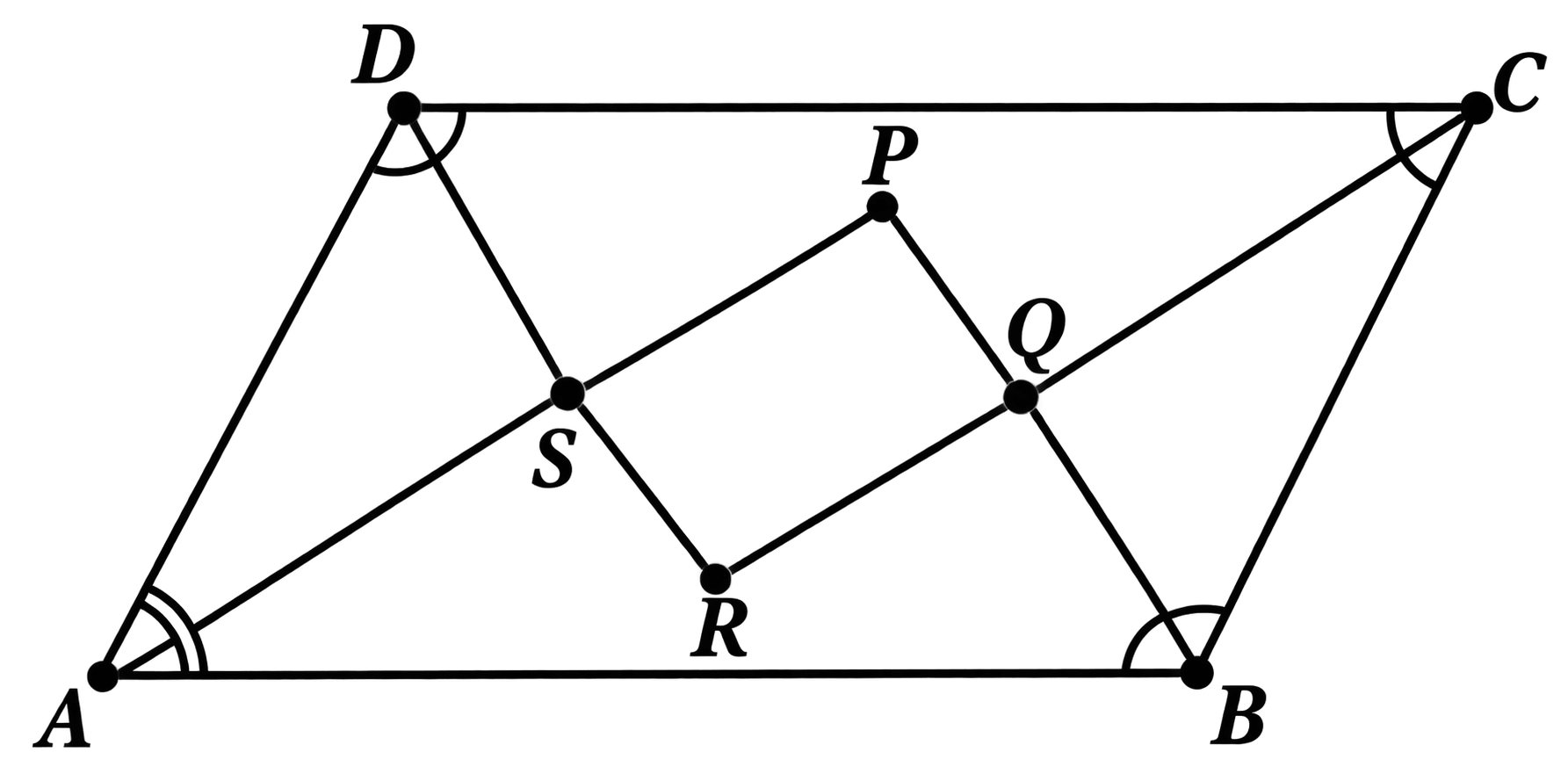
4. Let ABCD be a parallelogram with AB ≠ BC. Show that the pairwise intersection points of the four angle bisectors form the vertices of a rectangle (see Fig. 12.11). Why did we assume AB ≠ BC?
NCERT Class 9 Maths Ganita Manjari Chapter 12 Exercise Set 12.2
NCERT Class 9 Maths Ganita Manjari Chapter 12 Exercise Set 12.2
NCERT Class 9 Maths Ganita Manjari Chapter 12 Exercise Set 12.2
NCERT Class 9 Maths Ganita Manjari Chapter 12 Exercise Set 12.2
NCERT Class 9 Maths Ganita Manjari Chapter 12 Exercise Set 12.2
NCERT Class 9 Maths Ganita Manjari Chapter 12 Exercise Set 12.2
NCERT Class 9 Maths Ganita Manjari Chapter 12 Exercise Set 12.2
NCERT Class 9 Maths Ganita Manjari Chapter 12 Exercise Set 12.2
NCERT Class 9 Maths Ganita Manjari Chapter 12 Exercise Set 12.2
Answer:
Let the bisectors of the four angles of parallelogram ABCD meet consecutively to form a new quadrilateral.
Since adjacent angles of a parallelogram are supplementary,
∠A + ∠B = 180°.
So, the angle between the bisectors of ∠A and ∠B is
180° − (∠A/2 + ∠B/2)
= 180° − 90°
= 90°.
The same argument applies to every pair of neighbouring angle bisectors. Hence, each angle of the new quadrilateral is a right angle.
Also, opposite angles of a parallelogram are equal. Therefore, their angle bisectors are parallel in pairs.
Thus, the quadrilateral formed by the four intersection points has opposite sides parallel and all angles equal to 90°. Hence, it is a rectangle.
If AB = BC, then ABCD becomes a rhombus. In a rhombus, the diagonals themselves bisect the opposite angles. Therefore, the bisectors of ∠A and ∠C lie on one diagonal, while the bisectors of ∠B and ∠D lie on the other diagonal.
In that case, all the required intersection points collapse at the common point of the diagonals, so no rectangle with four distinct vertices is obtained.
Therefore, the condition AB ≠ BC is necessary to avoid this degenerate situation.
NCERT Class 9 Maths Ganita Manjari Chapter 12 Exercise Set 12.3
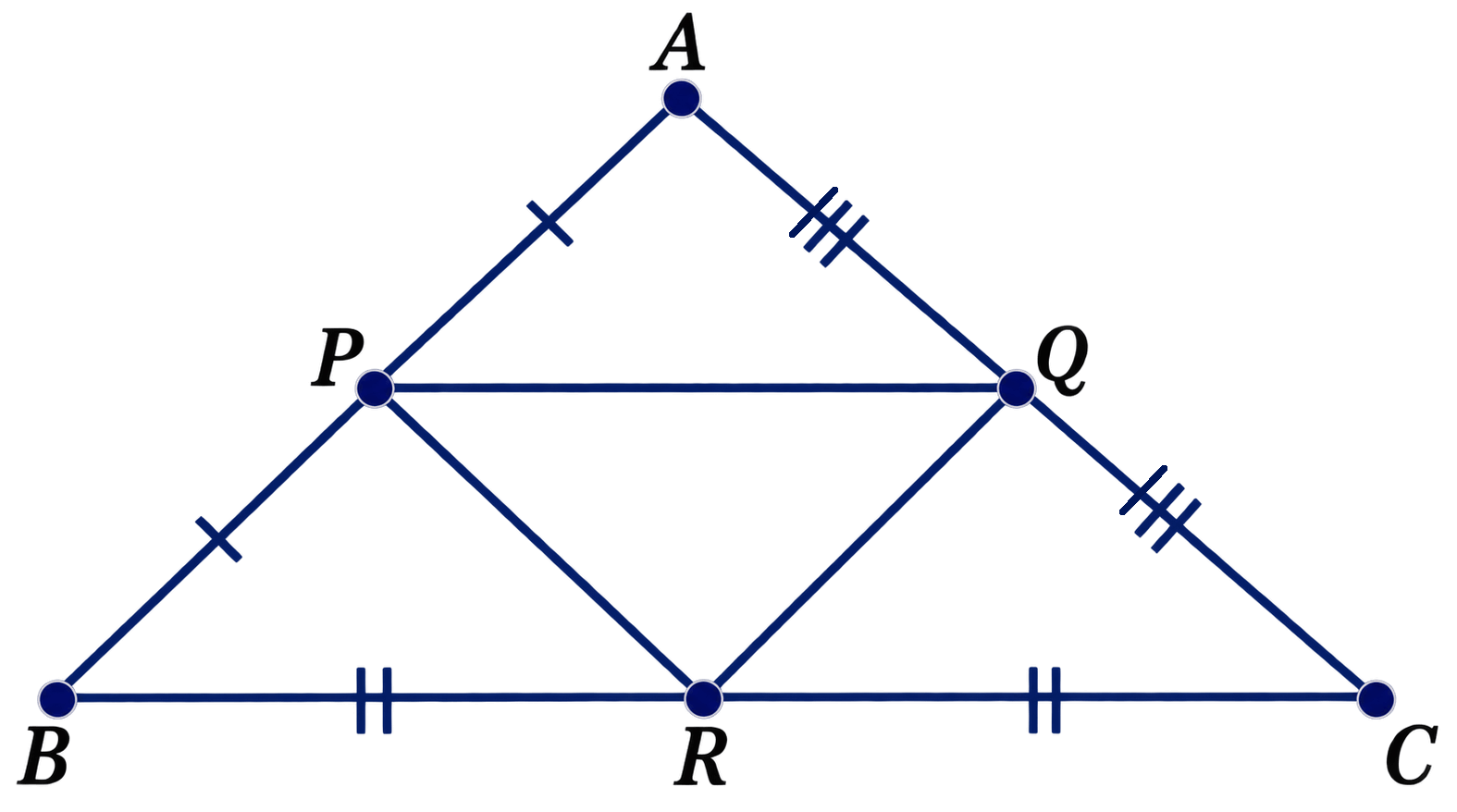
1. (i) If P, Q, R are the midpoints of sides AB, AC, BC respectively of △ABC, show that △PQR is congruent to △QPA and to two other triangles which you should identify. (ii) Suppose someone erases △ABC, leaving only △PQR on the paper. Can you reconstruct △ABC from △PQR?
Answer:
(i) Show that △PQR is congruent to △QPA and two other triangles.
Since P, Q and R are the midpoints of AB, AC and BC respectively,
AP = PB = AB/2
AQ = QC = AC/2
BR = RC = BC/2
By the Midpoint Theorem,
PQ = BC/2,
QR = AB/2,
PR = AC/2.
Now compare △PQR and △QPA:
- PQ = BC/2 = QA? Wait no, better pair by side lengths:
- PQ = BC/2
- QR = AB/2
- PR = AC/2
For △QPA:
- QP = BC/2
- PA = AB/2
- QA = AC/2
Therefore,
PQ = QP, QR = PA, PR = QA.
Hence,
△PQR ≅ △QPA by SSS congruence.
Similarly,
- △PRB has sides AB/2, BC/2 and AC/2.
- △QRC also has sides AB/2, BC/2 and AC/2.
Therefore,
△PQR ≅ △QPA ≅ △PRB ≅ △QRC.
So the two other triangles are △PRB and △QRC.
(ii) Can △ABC be reconstructed from △PQR?
Yes.
Using the Midpoint Theorem,
- QR ∥ AB
- PR ∥ AC
- PQ ∥ BC
So, starting with △PQR:
- Through P, draw a line parallel to QR.
- Through Q, draw a line parallel to PR. Their intersection gives A.
- Through R, draw a line parallel to PQ.
- The line through P parallel to QR meets the line through R parallel to PQ at B.
- The line through Q parallel to PR meets the line through R parallel to PQ at C.
Thus, the original △ABC can be reconstructed uniquely from △PQR.
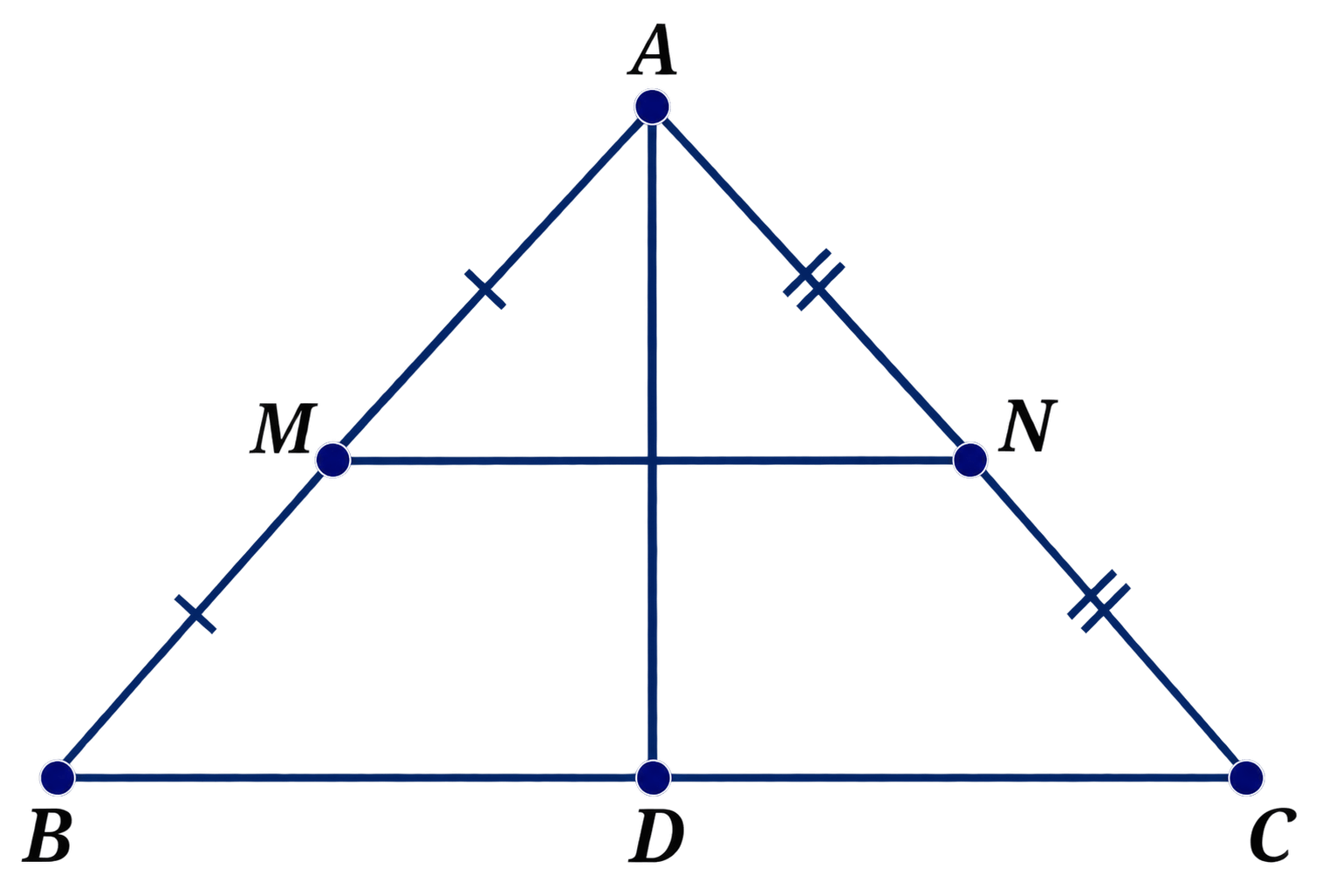
2. In △ABC, let M and N be midpoints of AB and AC respectively. Let D be any point on BC. Show that MN bisects AD.
Answer:
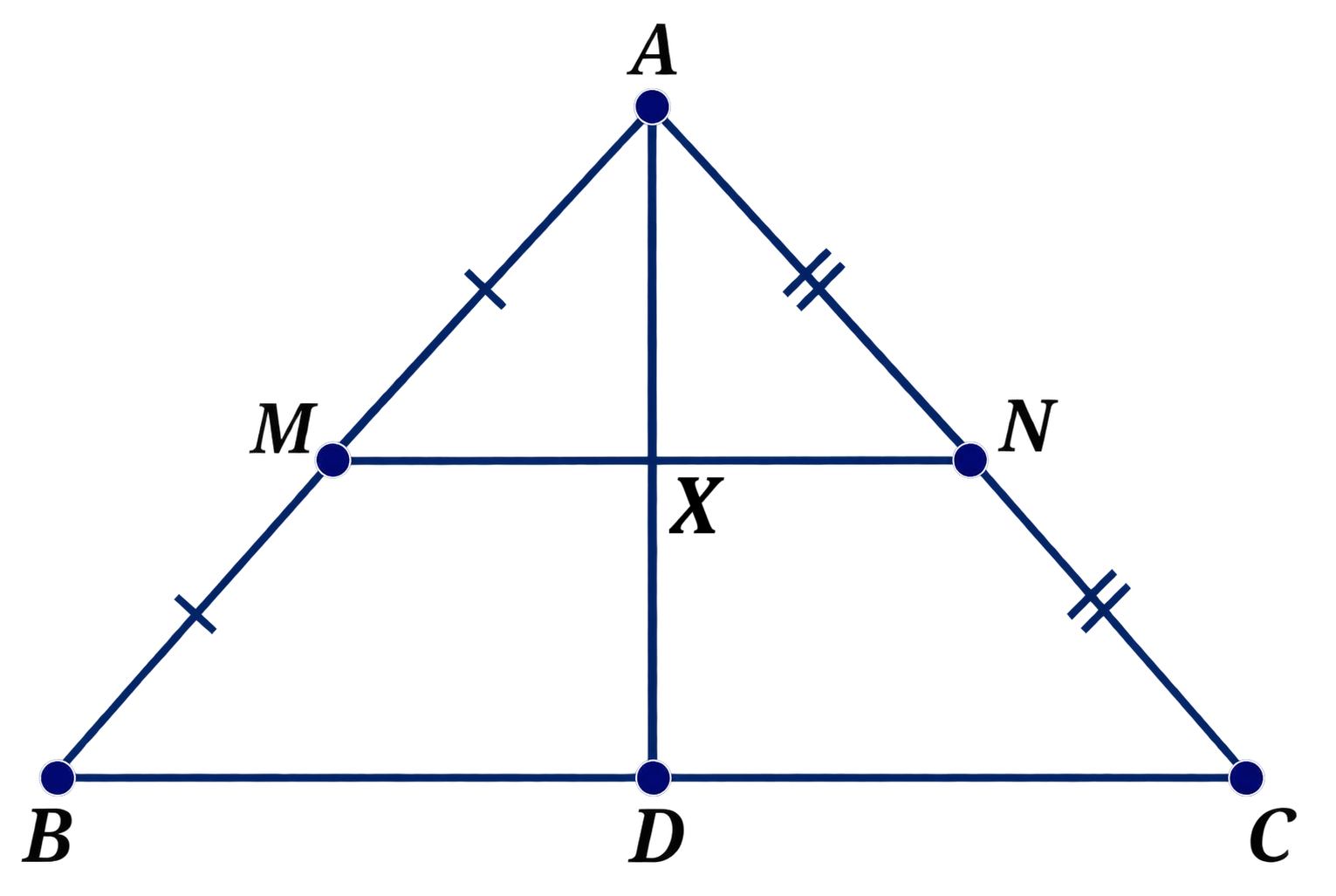
Let MN meet AD at X.
Since M and N are the midpoints of AB and AC, by the Midpoint Theorem,
MN ∥ BC
As D lies on BC, we also have
MX ∥ BD
Now consider △ABD.
M is the midpoint of AB, and the line through M parallel to BD meets AD at X.
Therefore, by the converse of the Midpoint Theorem, X is the midpoint of AD.
Hence,
AX = XD
Therefore, MN bisects AD.
If D = B or D = C, the result follows directly because M or N is already the midpoint of AD.
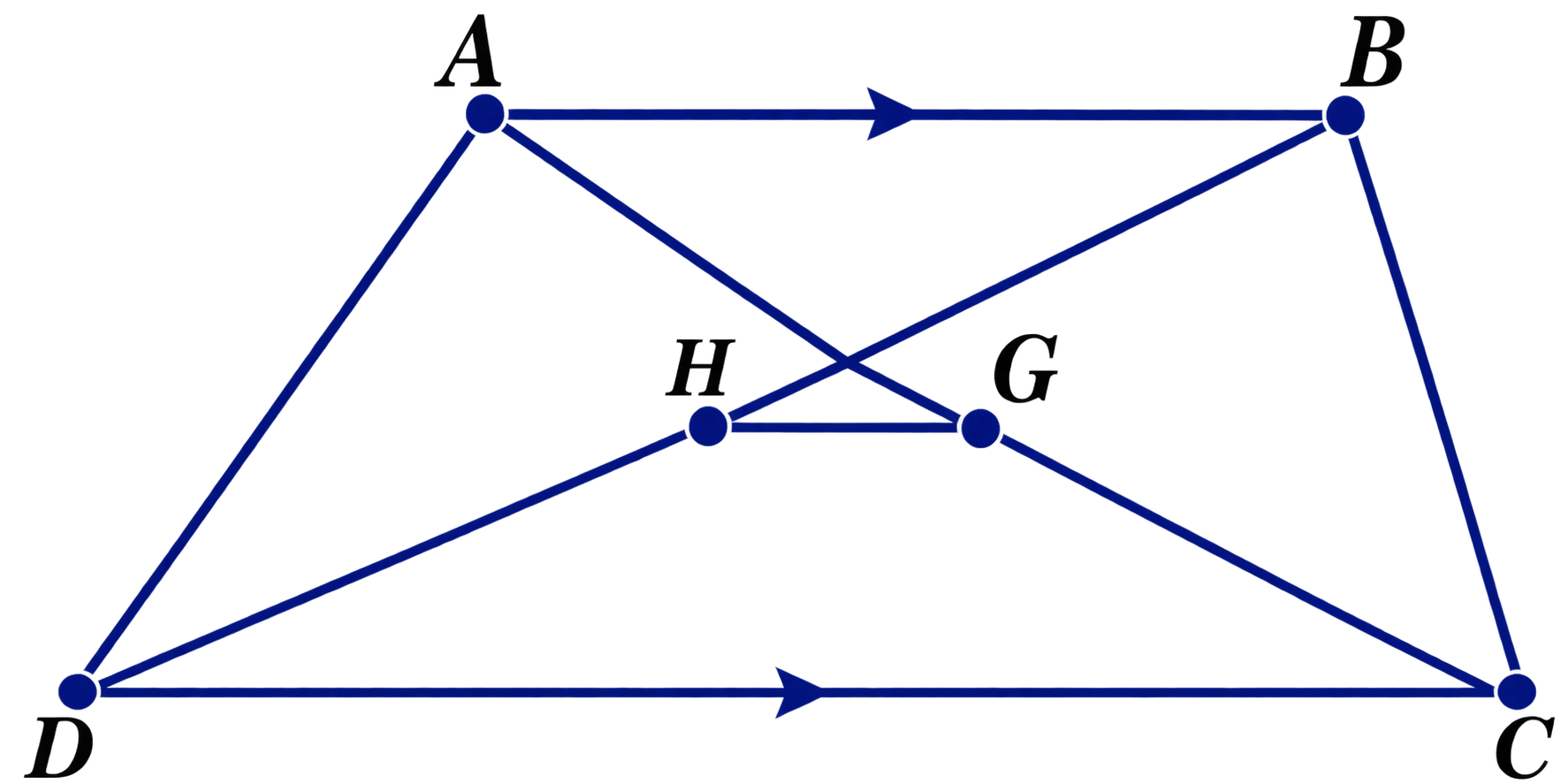
3. In a quadrilateral ABCD, suppose AB ∥ DC and AB ≠ CD. Suppose G and H are the midpoints of AC and BD respectively. Prove that GH ∥ AB. (Why did we assume AB ≠ CD?)
Answer:

Let M be the midpoint of AD.
In △ADC, M is the midpoint of AD and G is the midpoint of AC. Therefore, by the Midpoint Theorem,
MG ∥ DC and MG = DC/2.
Similarly, in △ADB, M is the midpoint of AD and H is the midpoint of DB. Hence,
MH ∥ AB and MH = AB/2.
Given that
AB ∥ DC,
we get
MG ∥ AB and MH ∥ AB.
Since both MG and MH pass through M and are parallel to AB, they lie on the same straight line. Thus, G, M and H are collinear.
Therefore,
GH ∥ AB.
Why is AB ≠ CD assumed?
If AB = CD and AB ∥ CD, then ABCD is a parallelogram. The diagonals of a parallelogram bisect each other, so the midpoint G of AC and the midpoint H of BD would be the same point.
Thus,
G = H,
and GH would have zero length, so it would not form a proper segment parallel to AB.
Hence, the condition AB ≠ CD ensures that G and H are distinct points.
4. Suppose the midpoints of sides AB, BC, CD and DA of a quadrilateral ABCD are P, Q, R and S respectively.
(i) Show that PR and QS bisect each other.
(ii) Show that if AC = BD, then PR and QS are perpendicular. Is the converse true?
Answer:
(i) Show that PR and QS bisect each other.
Since P and Q are the midpoints of AB and BC, in △ABC, by the Midpoint Theorem,
PQ ∥ AC.
Similarly, R and S are the midpoints of CD and DA. Therefore, in △ADC,
RS ∥ AC.
Hence,
PQ ∥ RS.
Now, Q and R are the midpoints of BC and CD, so in △BCD,
QR ∥ BD.
Also, P and S are the midpoints of AB and AD, so in △ABD,
PS ∥ BD.
Therefore,
QR ∥ PS.
Thus, both pairs of opposite sides of PQRS are parallel, so PQRS is a parallelogram.
The diagonals of a parallelogram bisect each other. Hence,
PR and QS bisect each other.
(ii) Show that if AC = BD, then PR ⟂ QS. Is the converse true?
By the Midpoint Theorem,
PQ = AC/2
and
QR = BD/2.
Given that
AC = BD,
we get
PQ = QR.
Since PQRS is already a parallelogram and two adjacent sides are equal, PQRS is a rhombus.
The diagonals of a rhombus are perpendicular. Therefore,
PR ⟂ QS.
Converse
Yes, the converse is also true.
Suppose
PR ⟂ QS.
Since PQRS is a parallelogram whose diagonals are perpendicular, PQRS must be a rhombus.
Therefore,
PQ = QR.
But
PQ = AC/2 and QR = BD/2.
Hence,
AC/2 = BD/2,
so
AC = BD.
Therefore, the converse is also true:
PR ⟂ QS if and only if AC = BD.
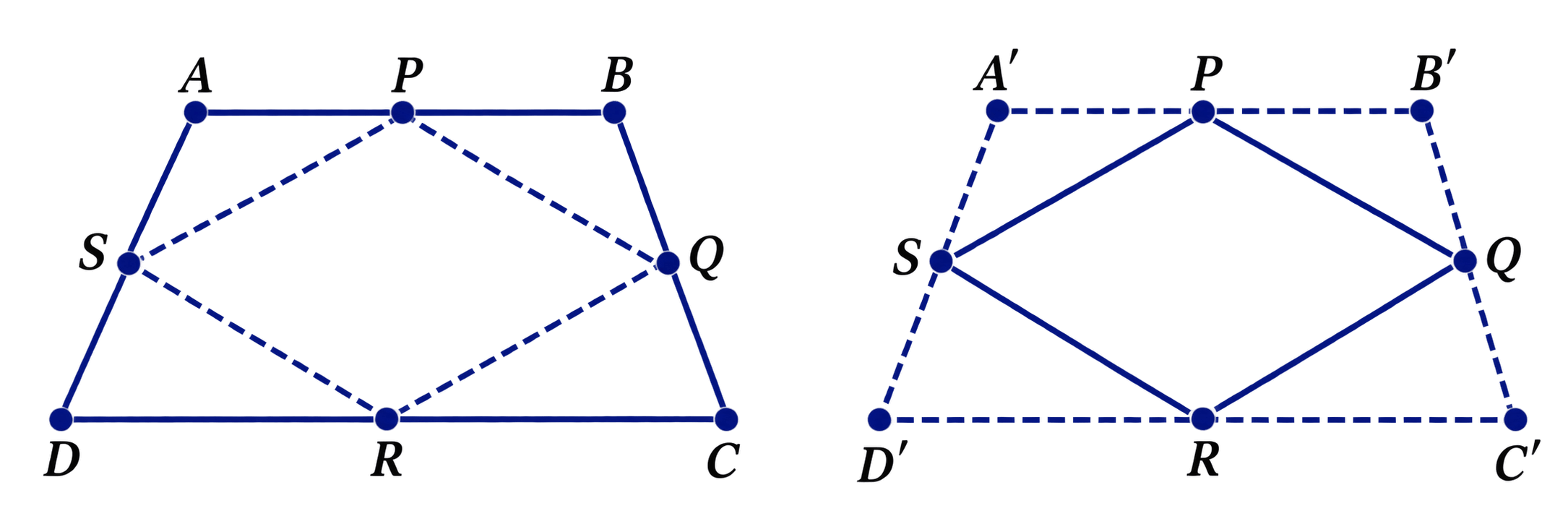
5. Suppose PQRS is the Varignon parallelogram of ABCD.
Answer:
(i) Reconstructing a congruent quadrilateral A′B′C′D′
Since P, Q, R and S are the midpoints of AB, BC, CD and DA, respectively, we can rebuild the vertices successively.
- On the copied parallelogram PQRS, construct a point A′ so that △SPA′ is congruent to the original △SPA. Choose the corresponding position of A′ relative to SP.
- Draw the line A′P and extend it beyond P. Mark B′ so that
A′P = PB′.
Thus, P is the midpoint of A′B′. - Extend B′Q beyond Q and choose C′ such that
B′Q = QC′.
Hence, Q is the midpoint of B′C′. - Extend C′R beyond R and locate D′ so that
C′R = RD′.
Thus, R is the midpoint of C′D′. - Join D′ to A′.
This gives a quadrilateral A′B′C′D′ corresponding to ABCD.
(ii) Why is A′B′C′D′ congruent to ABCD?
By construction,
△SPA′ ≅ △SPA.
Also, B′ is obtained from A′ by a half-turn about P, just as B is obtained from A about P. In the same way,
- C′ is obtained from B′ by a half-turn about Q,
- D′ is obtained from C′ by a half-turn about R.
Thus the same sequence of midpoint constructions used in ABCD is reproduced in A′B′C′D′, so corresponding lengths and angles are preserved.
It remains to check that S is also the midpoint of A′D′.
Since Q and R are the midpoints of B′C′ and C′D′, respectively, the Midpoint Theorem in △B′C′D′ gives
QR ∥ B′D′ and QR = B′D′/2.
But PQRS is a parallelogram, so
PS ∥ QR and PS = QR.
Therefore,
PS ∥ B′D′ and PS = B′D′/2.
Now P is the midpoint of A′B′. Hence the line through P parallel to B′D′ meets A′D′ at its midpoint. That point is S. Therefore,
A′, S and D′ are collinear and SA′ = SD′.
So P, Q, R and S are exactly the midpoints of the four sides of A′B′C′D′, just as in ABCD. Hence,
A′B′C′D′ ≅ ABCD.
Different valid placements of A′ can produce translated, rotated or reflected copies, but all are congruent to ABCD.
(iii) If PQRS is a square, show that AC and BD are equal and perpendicular. Prove the converse.
By the Midpoint Theorem,
PQ ∥ AC and PQ = AC/2,
while
QR ∥ BD and QR = BD/2.
If PQRS is a square, then
PQ = QR and PQ ⟂ QR.
Therefore,
AC/2 = BD/2, so AC = BD,
and since PQ ∥ AC and QR ∥ BD,
AC ⟂ BD.
Hence, the diagonals AC and BD are equal and perpendicular.
Conversely, suppose
AC = BD and AC ⟂ BD.
Then
PQ = AC/2 = BD/2 = QR,
and, because PQ ∥ AC and QR ∥ BD,
PQ ⟂ QR.
Thus the Varignon parallelogram PQRS has two equal adjacent sides and a right angle. Therefore, PQRS is a square.
Hence,
PQRS is a square if and only if AC and BD are equal and perpendicular.
NCERT Class 9 Maths Ganita Manjari Chapter 12 Exercise Set 12.4
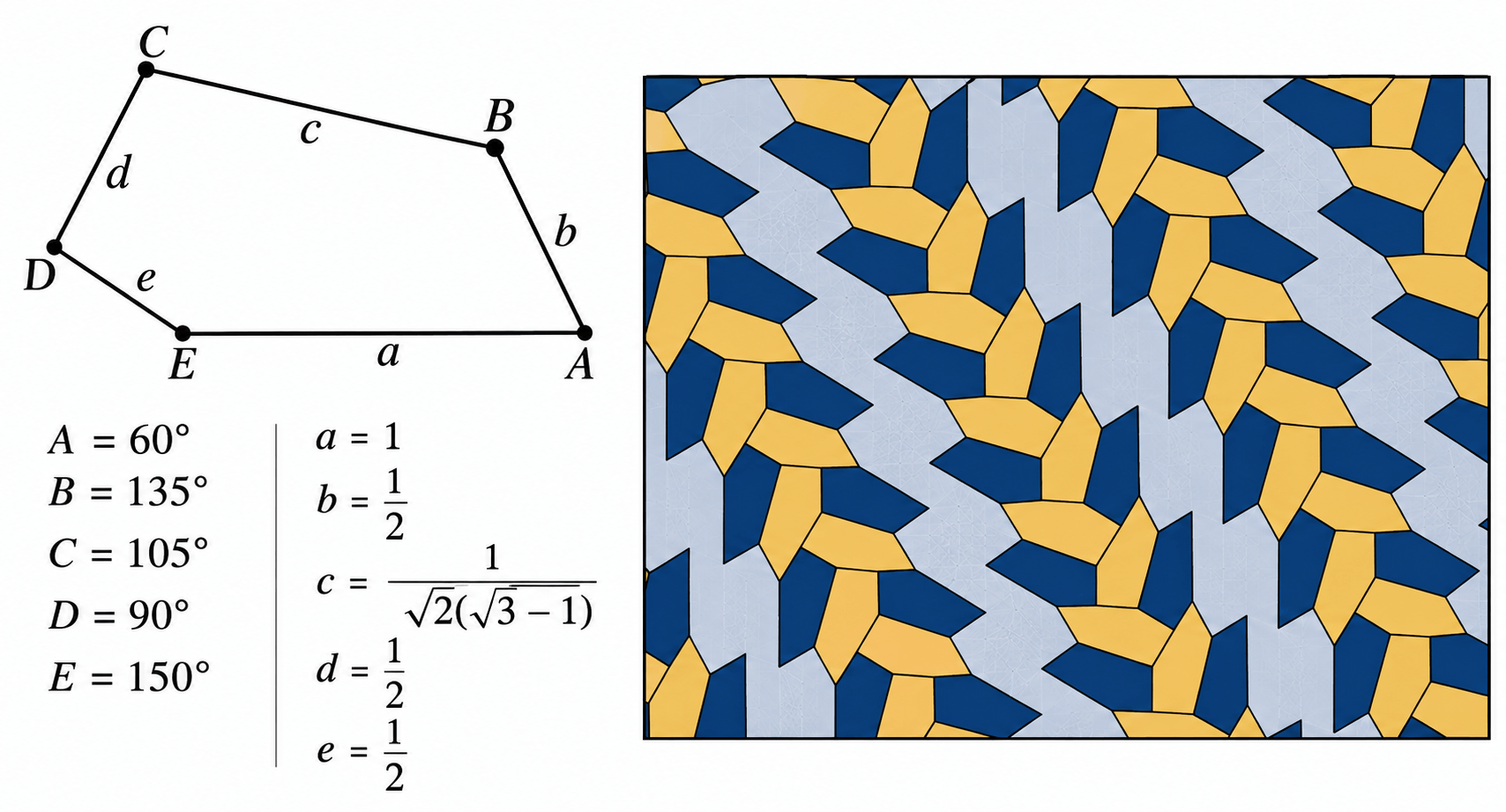
1. Justify why the plane cannot be tiled with a regular pentagon.
(Hint: Read the first 3 sentences of ‘Think and Reflect’ in the section on tiling.) (There are many ways to tile the plane using a suitable irregular pentagon. The most recent method was found in 2015.)
Answer:
A regular pentagon cannot tile the plane because its interior angles do not fit exactly around a point.
For a regular pentagon, each interior angle is
108°.
To tile the plane without gaps or overlaps, the angles meeting at a vertex must add up to exactly 360°.
But:
3 × 10⁸° = 324°, leaving a gap of 36°,
while
4 × 10⁸° = 432°, which is more than 360°.
So no whole number of regular pentagons can meet at a point and completely fill the space.
Therefore, the plane cannot be tiled using regular pentagons alone.
Irregular pentagons can tile the plane because their angles need not all be equal and can be arranged so that the angles around each vertex add up to 360°.
2. Draw a non-convex 4-gon DART. Show how we can tile the plane with copies of DART. Both methods that we discussed earlier will work. Which do you prefer?
Answer:

One example of a non-convex quadrilateral DART can be obtained by taking
D(1, 1), A(0, 3), R(0, 0) and T(3, 0),
and joining the points in the order
D – A – R – T – D.
Here D lies inside triangle ART, so the interior angle at D is greater than 180°. Hence, DART is a non-convex quadrilateral.
To tile the plane, we can use either of the following methods:
Method 1: Half-turn method
Take one copy of DART. Rotate a congruent copy through 180° about the midpoint of one of its sides. The rotated copy fits with the first one along that side. Continue the same process along the exposed sides. Repeating these half-turns produces a pattern of congruent copies that covers the plane without gaps or overlaps.
Method 2: Varignon parallelogram method
Construct the Varignon parallelogram of DART by joining the midpoints of its four sides. Copies of DART can then be arranged according to the repeating parallelogram pattern. Copies with the same orientation are placed at corresponding positions, while the remaining spaces are filled using half-turned copies.
Both constructions give a tiling of the plane even though DART is non-convex.
Preference: I prefer the half-turn method, because every new tile can be positioned simply by rotating the previous tile through 180° about the midpoint of a suitable side.
NCERT Class 9 Maths Ganita Manjari Chapter 12 End-of-Chapter Exercises
1. Using a fact about parallelograms, show how to tile the plane using any given triangle.
(Hint: Can you use the parallelogram tiling in the introduction?)
Answer:
Take any triangle ABC and let M be the midpoint of BC.
Make a congruent copy of the triangle and rotate it through 180° about M. Under this half-turn, B and C interchange, while A moves to a new point A′.
The two triangles together form a parallelogram because the corresponding opposite sides are parallel and equal.
Now repeat this parallelogram by translation in two directions. Since parallelograms can cover the plane completely without gaps or overlaps, the plane is tiled.
Each parallelogram is made up of exactly two congruent copies of the original triangle. Therefore, any triangle can be used to tile the plane.
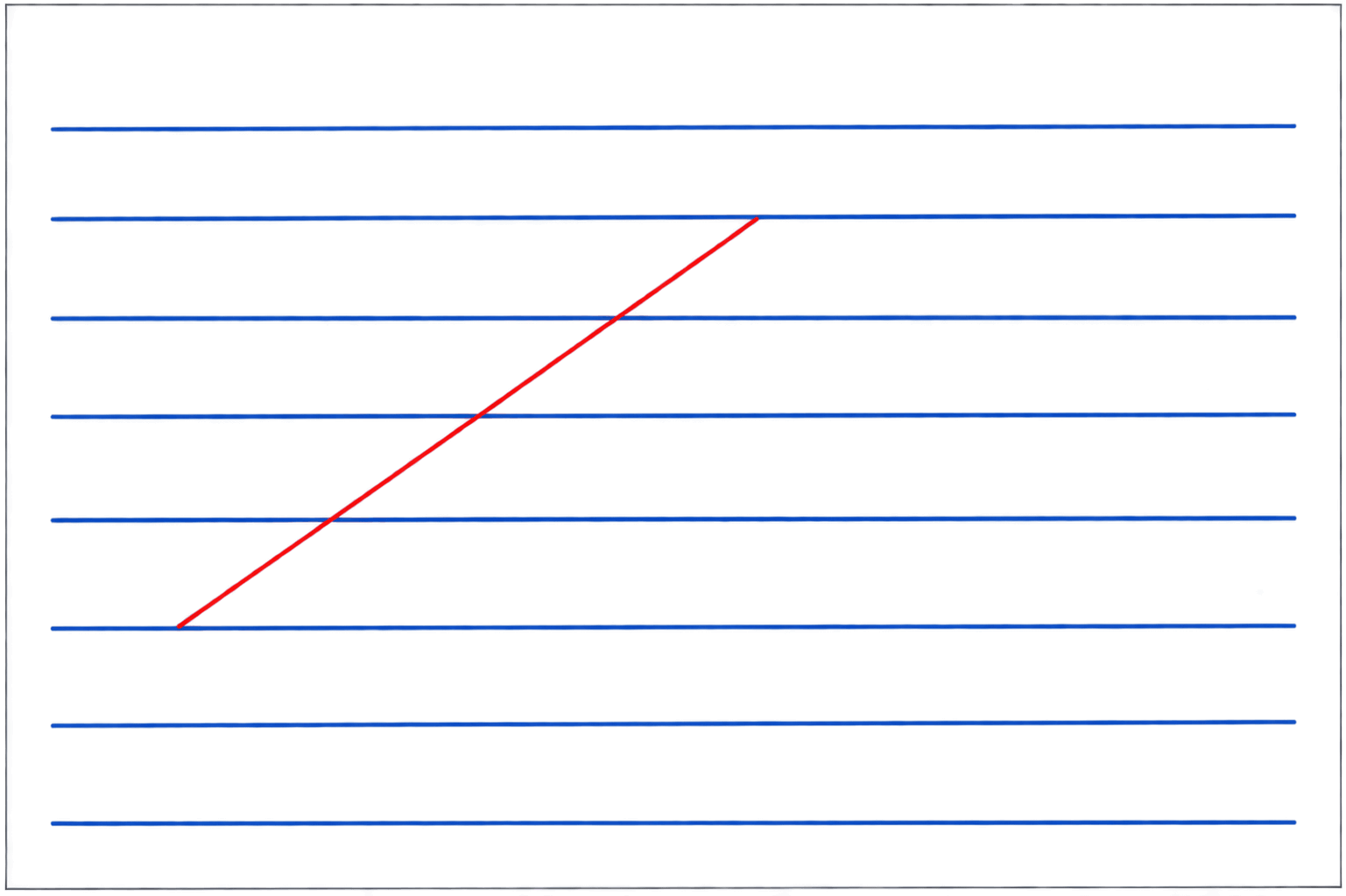
2. Mark the midpoint of the line drawn on the paper (see Fig. 12.33), given that the horizontal lines are equally spaced. Justify your answer.
Answer:
The midpoint is the point where the red line segment crosses the middle horizontal line between the two horizontal lines containing its endpoints.
The horizontal lines are parallel and equally spaced. Therefore, by the intercept theorem, they cut any transversal in equal segments.
Here, the red segment is divided into four equal parts by the equally spaced horizontal lines. Hence, the point after two equal parts from either endpoint is the midpoint.
So, mark the intersection of the red segment with the central horizontal line as its midpoint.
Related Links:
- Class 9 Maths Ganita Manjari Chapter 12 Exercise 12.1 Solutions – Quadrilaterals
- Class 9 Maths Ganita Manjari Chapter 12 Exercise 12.2 Solutions – Quadrilaterals
- Class 9 Maths Ganita Manjari Chapter 12 Exercise 12.3 Solutions – Quadrilaterals
- Class 9 Maths Ganita Manjari Chapter 12 Exercise 12.4 Solutions – Quadrilaterals
- Class 9 Maths Ganita Manjari Chapter 12 End-of-Chapter Exercises Solutions – Quadrilaterals