Class 9 Maths Ganita Manjari Chapter 12 Exercise 12.2 Solutions Quadrilaterals
The Class 9 Maths Ganita Manjari Chapter 12 Exercise 12.2 Solutions – Quadrilaterals help students understand important properties of parallelograms, rectangles, rhombuses and squares through clear proofs and logical reasoning. This exercise includes questions based on angle properties, diagonals, converses of standard results and conditions used to identify special quadrilaterals.
The solutions are presented step by step so that students can understand why each result is true and learn how to write complete geometry proofs accurately. Students can also refer to the Class 9 Maths Ganita Manjari Chapter 12 Exercise 12.2 Solutions PDF for easy revision and offline study.
NCERT Class 9 Maths Ganita Manjari Chapter 12 Exercise Set 12.2
1. True or false?
(i) A parallelogram with a right angle is a rectangle.
(ii) A rhombus with perpendicular diagonals is a square.
(iii) If the diagonals of a parallelogram are equal, then it is a rectangle.
Answer:
(i) A parallelogram with a right angle is a rectangle.
True.
In a parallelogram, adjacent angles are supplementary and opposite angles are equal. If one angle is 90°, then all four angles are 90°. Hence, the parallelogram is a rectangle.
(ii) A rhombus with perpendicular diagonals is a square.
False.
The diagonals of every rhombus are perpendicular, but a rhombus need not have right angles. Therefore, perpendicular diagonals alone do not make it a square.
(iii) If the diagonals of a parallelogram are equal, then it is a rectangle.
True.
A parallelogram whose diagonals are equal has all four angles equal to 90°. Therefore, it is a rectangle.
2. The diagonal AC of a parallelogram ABCD bisects ∠A. Show that it also bisects ∠C and that ABCD is a rhombus.
Answer:
Given: ABCD is a parallelogram and diagonal AC bisects ∠A.
Therefore,
∠BAC = ∠CAD. ...(1)
Since ABCD is a parallelogram,
AB ∥ CD and AD ∥ BC.
Using alternate interior angles:
∠BAC = ∠ACD ...(2)
and
∠CAD = ∠ACB. ...(3)
From (1), (2) and (3),
∠ACD = ∠ACB.
Therefore, AC also bisects ∠C.
Now, in triangle ABC,
∠BAC = ∠ACB.
Hence, the sides opposite these equal angles are equal:
AB = BC.
Also, opposite sides of a parallelogram are equal:
AB = CD and BC = AD.
Since AB = BC, we get
AB = BC = CD = AD.
Thus, all four sides of ABCD are equal.
Therefore, ABCD is a rhombus.

3. The following questions examine converses of true properties. Answer them with Yes or No. If your answer is No, what extra condition can you add so that the answer becomes Yes?
(i) If the diagonals of a quadrilateral ABCD bisect its angles, must ABCD be a rhombus?
(ii) If the diagonals of a quadrilateral ABCD bisect each other at right angles, must ABCD be a rhombus?
(iii) If the diagonals of a quadrilateral ABCD are of equal length, must ABCD be a rectangle? (In the ancient Indian study of quadrilaterals, equality of diagonals was considered significant. Quadrilaterals were first classified according to whether their diagonals were equal or not, before considering equality of sides.)
Answer:
3. Converses of Properties
(i) If the diagonals of a quadrilateral ABCD bisect its angles, must ABCD be a rhombus?
Yes.
Since diagonal AC bisects ∠A and ∠C,
∠BAC = ∠CAD
and
∠BCA = ∠ACD.
With AC common, triangles ABC and ADC are congruent. Hence,
AB = AD and BC = CD.
Similarly, since diagonal BD bisects ∠B and ∠D, we obtain
AB = BC and AD = CD.
Therefore,
AB = BC = CD = DA,
so ABCD is a rhombus.
(ii) If the diagonals of a quadrilateral ABCD bisect each other at right angles, must ABCD be a rhombus?
Yes.
If the diagonals bisect each other, then ABCD is a parallelogram. A parallelogram whose diagonals are perpendicular has all four sides equal.
Therefore, ABCD is a rhombus.
(iii) If the diagonals of a quadrilateral ABCD are of equal length, must ABCD be a rectangle?
No.
Equal diagonals alone do not guarantee that a quadrilateral is a rectangle. For example, an isosceles trapezium can have equal diagonals without being a rectangle.
An extra condition that makes the statement true is:
The diagonals must also bisect each other.
Then ABCD is a parallelogram, and a parallelogram with equal diagonals is a rectangle.
Therefore:
- (i) Yes
- (ii) Yes
- (iii) No; additionally require the diagonals to bisect each other (equivalently, ABCD should be a parallelogram).
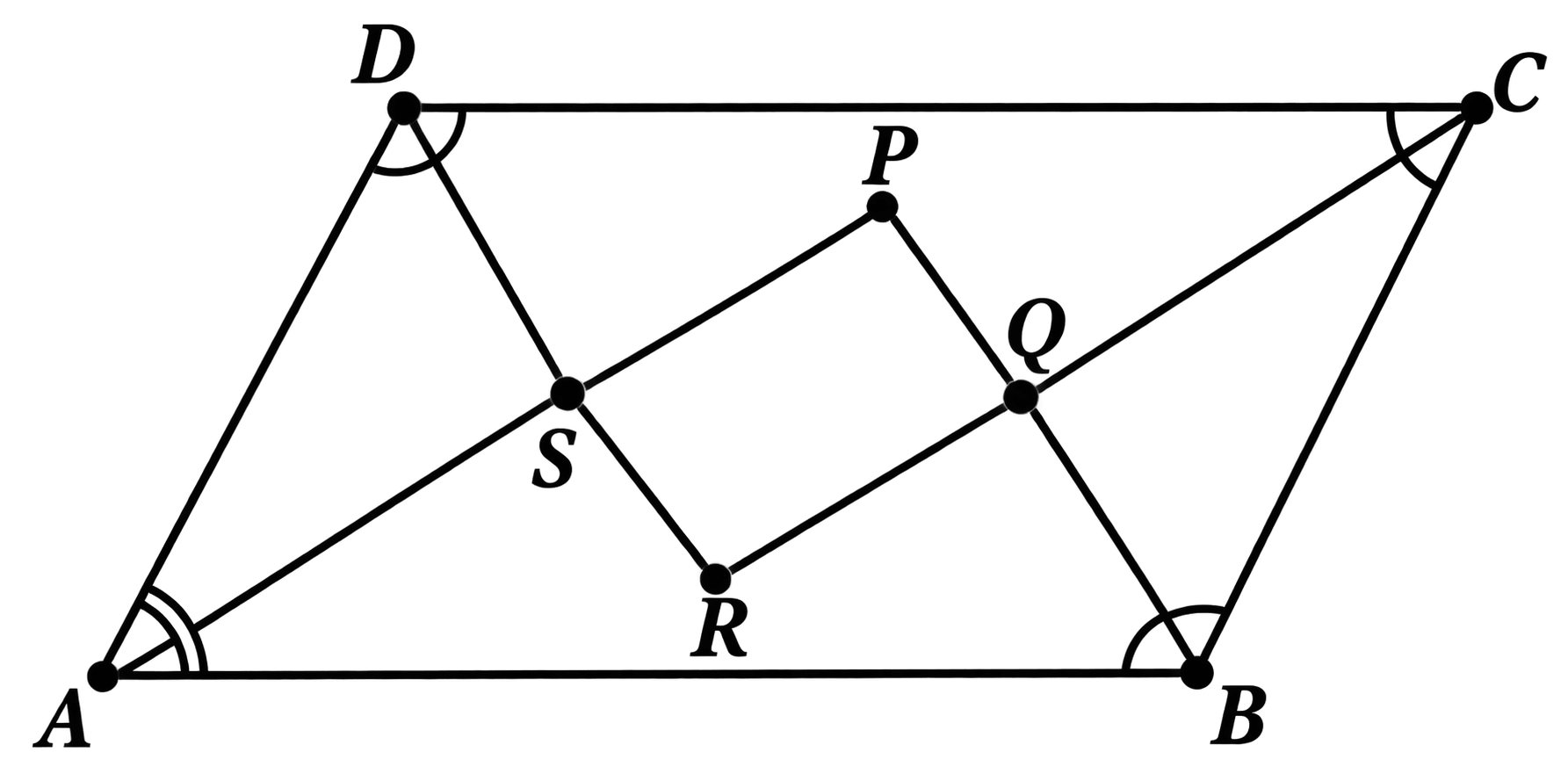
4. Let ABCD be a parallelogram with AB ≠ BC. Show that the pairwise intersection points of the four angle bisectors form the vertices of a rectangle (see Fig. 12.11). Why did we assume AB ≠ BC?
NCERT Class 9 Maths Ganita Manjari Chapter 12 Exercise Set 12.2
NCERT Class 9 Maths Ganita Manjari Chapter 12 Exercise Set 12.2
NCERT Class 9 Maths Ganita Manjari Chapter 12 Exercise Set 12.2
NCERT Class 9 Maths Ganita Manjari Chapter 12 Exercise Set 12.2
NCERT Class 9 Maths Ganita Manjari Chapter 12 Exercise Set 12.2
NCERT Class 9 Maths Ganita Manjari Chapter 12 Exercise Set 12.2
NCERT Class 9 Maths Ganita Manjari Chapter 12 Exercise Set 12.2
NCERT Class 9 Maths Ganita Manjari Chapter 12 Exercise Set 12.2
NCERT Class 9 Maths Ganita Manjari Chapter 12 Exercise Set 12.2
Answer:
Let the bisectors of the four angles of parallelogram ABCD meet consecutively to form a new quadrilateral.
Since adjacent angles of a parallelogram are supplementary,
∠A + ∠B = 180°.
So, the angle between the bisectors of ∠A and ∠B is
180° − (∠A/2 + ∠B/2)
= 180° − 90°
= 90°.
The same argument applies to every pair of neighbouring angle bisectors. Hence, each angle of the new quadrilateral is a right angle.
Also, opposite angles of a parallelogram are equal. Therefore, their angle bisectors are parallel in pairs.
Thus, the quadrilateral formed by the four intersection points has opposite sides parallel and all angles equal to 90°. Hence, it is a rectangle.
If AB = BC, then ABCD becomes a rhombus. In a rhombus, the diagonals themselves bisect the opposite angles. Therefore, the bisectors of ∠A and ∠C lie on one diagonal, while the bisectors of ∠B and ∠D lie on the other diagonal.
In that case, all the required intersection points collapse at the common point of the diagonals, so no rectangle with four distinct vertices is obtained.
Therefore, the condition AB ≠ BC is necessary to avoid this degenerate situation.
Related Links:
- Class 9 Maths Ganita Manjari Chapter 12 Solutions – Quadrilaterals
- Class 9 Maths Ganita Manjari Chapter 12 Exercise 12.1 Solutions – Quadrilaterals
- Class 9 Maths Ganita Manjari Chapter 12 Exercise 12.3 Solutions – Quadrilaterals
- Class 9 Maths Ganita Manjari Chapter 12 Exercise 12.4 Solutions – Quadrilaterals
- Class 9 Maths Ganita Manjari Chapter 12 End-of-Chapter Exercises Solutions – Quadrilaterals