NCERT Solutions for Class 7 Maths Chapter 6 The Triangle and its Properties (EX 6.5) Exercise 6.5
NCERT Solutions for Class 7 Maths Chapter 6 The Triangle and its Properties Exercise 6.5 are given here in simple, step-by-step form. NCERT stands for National Council of Educational Research and Training, the body that makes your textbook. Chapter 6 teaches the different parts of a triangle and the rules they follow. Earlier exercises covered medians, altitudes, the exterior angle, the angle sum property and the rule about the sum of two sides. Exercise 6.5 teaches the last and most useful rule of the chapter, the Pythagoras property. This rule works only in a right-angled triangle.
This exercise has 8 questions. Some ask you to find a missing side of a right-angled triangle. Some are word problems about a ladder against a wall, a broken tree, a rectangle and a rhombus. One question asks you to check whether three given lengths can form a right-angled triangle. Every question below is solved in short steps, with the final answer in bold. Students can use this page for homework and revision, parents can use it to check the work at home, and teachers can use it in class. A free printable PDF of these solutions is also available for offline study.
NCERT Solutions for Class 7 Maths Chapter 6 The Triangle and its Properties (EX 6.5) Exercise 6.5
 The Triangle and its Properties
 Medium
 The Triangle and its Properties
Medium
The Triangle and its Properties
Medium
The Triangle and its Properties
Medium
The Triangle and its Properties
Medium
The Triangle and its Properties
Medium
The Triangle and its Properties
Medium
 The Triangle and its Properties
Medium
The Triangle and its Properties
Medium
The Triangle and its Properties
Medium
The Triangle and its Properties
Medium
The Triangle and its Properties
Medium
The Triangle and its Properties
Medium
The Triangle and its Properties
Medium
The Triangle and its Properties
Medium
The Triangle and its Properties
Medium
The Triangle and its Properties
Medium
The Triangle and its Properties
Medium
The Triangle and its Properties
Medium
The Triangle and its Properties
Medium
The Triangle and its Properties
Medium
The Triangle and its Properties
Medium
The Triangle and its Properties
Medium
 The Triangle and its Properties
Medium
The Triangle and its Properties
Medium
 The Triangle and its Properties
Medium
The Triangle and its Properties
Medium
 The Triangle and its Properties
Medium
The Triangle and its Properties
Medium
The Triangle and its Properties
Medium
The Triangle and its Properties
Medium

 The Triangle and its Properties
Medium
The Triangle and its Properties
Medium
 The Triangle and its Properties
Medium
The Triangle and its Properties
Medium
 The Triangle and its Properties
Medium
The Triangle and its Properties
Medium
The Triangle and its Properties
Medium
The Triangle and its Properties
Medium
Pythagoras Property – What You Need to Know
In a right-angled triangle, the side opposite the right angle is the longest side. It is called the hypotenuse. The other two sides are called the legs.
(Hypotenuse)2 = (First leg)2 + (Second leg)2
You can use this rule in two ways:
- To find the hypotenuse: add the squares of the two legs, then take the square root.
- To find a leg: subtract the square of the known leg from the square of the hypotenuse, then take the square root.
The rule also works backwards. If the square of the longest side equals the sum of the squares of the other two sides, then the triangle is right-angled. This is called the converse of the Pythagoras property.
Exercise 6.5 – Questions and Answers
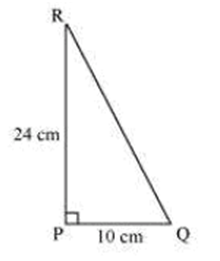
Q 1. PQR is a triangle right angled at P. If PQ = 10 cm and PR = 24 cm, find QR.
Answer:
By Pythagoras theorem in △PQR, we get
(QR)² = (PQ)² + (PR)²
= (10)² + (24)²
= 100 + 576
= 676
QR = √676
QR = 26 cm
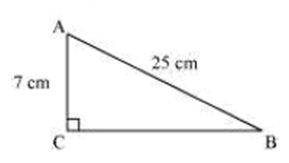
Q 2. ABC is a triangle right angled at C. If AB = 25 cm and AC = 7 cm, find BC.
Answer:
By Pythagoras theorem in △ABC, we get
(AC)² + (BC)² = (AB)²
(BC)² = (AB)² − (AC)²
= 25² − 7²
= 625 − 49 = 576
BC = 24 cm
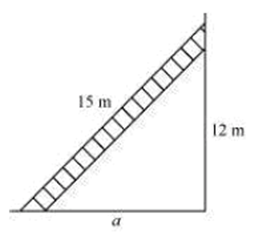
Q 3. A 15 m long ladder reached a window 12 m high from the ground on placing it against a wall at a distance 'a'. Find the distance of the foot of the ladder from the wall.
Answer:
By Pythagoras theorem
(15)² = (12)² + a²
225 − 144 = a²
81 = a²
a = 9 m
Therefore, the distance of the foot of the ladder from the wall is 9 m.
Q 4. Which of the following can be the sides of a right triangle?
(i) 2.5 cm, 6.5 cm, 6 cm
(ii) 2 cm, 2 cm, 5 cm
(iii) 1.5 cm, 2 cm, 2.5 cm
Answer:
(i) 2.5 cm, 6.5 cm, 6 cm
2.5² = 6.25, 6.5² = 42.25 and 6² = 36
Here, 2.5² + 6² = 6.5²
So, the square of the length of one side is the sum of the squares of the lengths of the remaining two sides.
Hence, these are the sides of a right-angled triangle. The right angle lies opposite the longest side, 6.5 cm.
(ii) 2 cm, 2 cm, 5 cm
2² = 4, 2² = 4 and 5² = 25
Here, 2² + 2² ≠ 5²
So, the square of the length of one side is not the sum of the squares of the lengths of the remaining two sides.
Hence, these are not the sides of a right-angled triangle.
(iii) 1.5 cm, 2 cm, 2.5 cm
1.5² = 2.25, 2² = 4 and 2.5² = 6.25
Here, 1.5² + 2² = 2.5²
So, the square of the length of one side is the sum of the squares of the lengths of the remaining two sides.
Hence, these are the sides of a right-angled triangle. The right angle lies opposite the longest side, 2.5 cm.
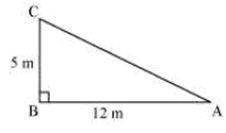
Q 5. A tree is broken at a height of 5 m from the ground and its top touches the ground at a distance of 12 m from the base of the tree. Find the original height of the tree.
Answer:
In the above figure, BC represents the unbroken part of the tree.
Point C represents the point where the tree broke, and CA represents the broken part of the tree.
Triangle ABC thus formed is a right-angled triangle.
So, applying Pythagoras theorem, we get
AC² = AB² + BC²
= 12² + 5²
= 144 + 25
= 169
AC = 13 m
Thus, the original height of the tree = AC + CB
= 13 m + 5 m
= 18 m
Q 6. Angles Q and R of a △PQR are 25° and 65°. Write which of the following is true:
(i) PQ² + QR² = RP²
(ii) PQ² + RP² = QR²
(iii) RP² + QR² = PQ²
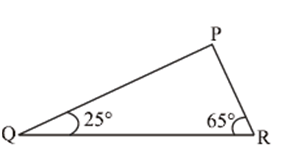
Answer:
Since the sum of all interior angles of a triangle is 180°,
25° + 65° + ∠QPR = 180°
∠QPR = 180° − 90°
= 90°
Therefore, △PQR is a right-angled triangle, right angled at P.
So QR is the hypotenuse.
Thus, PQ² + RP² = QR²
So, (ii) is true.
Q 7. Find the perimeter of the rectangle whose length is 40 cm and a diagonal is 41 cm.
Answer:
In a rectangle, all interior angles are of 90° measure.
Therefore, Pythagoras theorem can be applied here.
Let the breadth be x cm.
(41)² = (40)² + x²
1681 = 1600 + x²
x² = 1681 − 1600
= 81
x = 9 cm
So, Perimeter = 2 (Length + Breadth)
= 2 (40 + x)
= 2 (40 + 9)
= 98 cm
Q 8. The diagonals of a rhombus measure 16 cm and 30 cm. Find its perimeter.
Answer:
Let ABCD be a rhombus (all sides are of equal length) and its diagonals AC and BD are intersecting each other at point O.
Since the diagonals of a rhombus bisect each other at 90°,
OA = 16/2 = 8 cm and OB = 30/2 = 15 cm.
By applying Pythagoras theorem in △AOB,
OA² + OB² = AB²
8² + 15² = AB²
64 + 225 = AB²
289 = AB²
AB = 17 cm
Therefore, the length of the side of the rhombus is 17 cm.
Perimeter of rhombus = 4 × Side of the rhombus
= 4 × 17
= 68 cm
Related Links