NCERT Solutions for Class 8 Maths Chapter 6 – Cubes and Cube Roots Ex 6.1
NCERT Solutions for Class 8 Maths Chapter 6 – Cubes and Cube Roots Ex 6.1 are given here in simple, step-by-step form. NCERT stands for National Council of Educational Research and Training, the body that makes your textbook. Chapter 6 teaches what a cube of a number is and how to find a cube root. When you multiply a number by itself three times, you get its cube. Exercise 6.1 is about cubes and perfect cubes. Exercise 6.2 goes on to cube roots.
This exercise has 4 questions. All of them are solved using one method, called prime factorisation. You break a number into its prime factors, then group those factors in threes. If every factor forms a complete group of three, the number is a perfect cube. Students can use this page for homework and revision, parents can use it to check the work at home, and teachers can use it in class. A free printable PDF of these solutions is also
NCERT Solutions for Class 8 Maths Chapter 6 – Cubes and Cube Roots Ex 6.1
 Cubes and Cube Roots
 Medium
Cubes and Cube Roots
Medium
Cubes and Cube Roots
Medium
Cubes and Cube Roots
Medium
Cubes and Cube Roots
Medium
Cubes and Cube Roots
Medium
Cubes and Cube Roots
 Difficult
Cubes and Cube Roots
Medium
Cubes and Cube Roots
Medium
Cubes and Cube Roots
Difficult
Difficult
Cubes and Cube Roots
Medium
Cubes and Cube Roots
Medium
Cubes and Cube Roots
Difficult
Exercise 6.1 – Questions and Answers
Q 1. Which of the following numbers are not perfect cubes?
(i) 216 (ii) 128 (iii) 1000 (iv) 100 (v) 46656
Answer:
(i) The prime factorisation of 216 is as follows:
| 2 | 216 |
| 2 | 108 |
| 2 | 54 |
| 3 | 27 |
| 3 | 9 |
| 3 | 3 |
| 1 |
216 = (2 × 2 × 2) × (3 × 3 × 3)
Since all the factors appear in a group of three, so 216 is a perfect cube.
(ii) The prime factorisation of 128 is as follows:
| 2 | 128 |
| 2 | 64 |
| 2 | 32 |
| 2 | 16 |
| 2 | 8 |
| 2 | 4 |
| 2 | 2 |
| 1 |
128 = (2 × 2 × 2) × (2 × 2 × 2) × 2
Since 2 is not appearing in a group of three, so 128 is not a perfect cube.
(iii) The prime factorisation of 1000 is as follows:
| 2 | 1000 |
| 2 | 500 |
| 2 | 250 |
| 5 | 125 |
| 5 | 25 |
| 5 | 5 |
| 1 |
1000 = (2 × 2 × 2) × (5 × 5 × 5)
Since 2 and 5 appear in a group of three, so 1000 is a perfect cube.
(iv) The prime factorisation of 100 is as follows:
| 2 | 100 |
| 2 | 50 |
| 5 | 25 |
| 5 | 5 |
| 1 |
100 = 2 × 2 × 5 × 5
Since 2 and 5 are not appearing in a group of three, so 100 is not a perfect cube.
(v) The prime factorisation of 46656 is as follows:
| 2 | 46656 |
| 2 | 23328 |
| 2 | 11664 |
| 2 | 5832 |
| 2 | 2916 |
| 2 | 1458 |
| 3 | 729 |
| 3 | 243 |
| 3 | 81 |
| 3 | 27 |
| 3 | 9 |
| 3 | 3 |
| 1 |
46656 = (2 × 2 × 2) × (2 × 2 × 2) × (3 × 3 × 3) × (3 × 3 × 3)
Since all the factors appear in a group of three, so 46656 is a perfect cube.
Therefore, the numbers that are not perfect cubes are (ii) 128 and (iv) 100.
Q 2. Find the smallest number by which each of the following numbers must be multiplied to obtain a perfect cube.
(i) 243 (ii) 256 (iii) 72 (iv) 675 (v) 100
Answer:
(i) The prime factorisation of 243 is as follows:
| 3 | 243 |
| 3 | 81 |
| 3 | 27 |
| 3 | 9 |
| 3 | 3 |
| 1 |
243 = (3 × 3 × 3) × 3 × 3
Here, two 3s are left which do not appear in a group of three. To make 243 a cube, one more 3 is required.
In that case, we have to multiply 243 by 3
i.e. 243 × 3 = (3 × 3 × 3) × (3 × 3 × 3) = 729, which is a perfect cube.
Hence, the smallest natural number by which 243 should be multiplied to make it a perfect cube is 3.
(ii) The prime factorisation of 256 is as follows:
| 2 | 256 |
| 2 | 128 |
| 2 | 64 |
| 2 | 32 |
| 2 | 16 |
| 2 | 8 |
| 2 | 4 |
| 2 | 2 |
| 1 |
256 = (2 × 2 × 2) × (2 × 2 × 2) × 2 × 2
Here, two 2s are left which do not appear in a group of three. To make 256 a cube, one more 2 is required.
If we multiply 256 by 2, we get
256 × 2 = (2 × 2 × 2) × (2 × 2 × 2) × (2 × 2 × 2) = 512, which is a perfect cube.
Hence, the smallest natural number by which 256 should be multiplied to make it a perfect cube is 2.
(iii) The prime factorisation of 72 is as follows:
| 2 | 72 |
| 2 | 36 |
| 2 | 18 |
| 3 | 9 |
| 3 | 3 |
| 1 |
72 = (2 × 2 × 2) × 3 × 3
Here, two 3s are left which are not in a group of three. To make 72 a perfect cube, one more 3 is required.
Then, we obtain
72 × 3 = (2 × 2 × 2) × (3 × 3 × 3) = 216, which is a perfect cube.
Hence, the smallest natural number by which 72 should be multiplied to make it a perfect cube is 3.
(iv) The prime factorisation of 675 is as follows:
| 3 | 675 |
| 3 | 225 |
| 3 | 75 |
| 5 | 25 |
| 5 | 5 |
| 1 |
675 = (3 × 3 × 3) × 5 × 5
Here, two 5s are left which are not in a group of three. To make 675 a cube, one more 5 is required.
If we multiply 675 by 5, we get
675 × 5 = (3 × 3 × 3) × (5 × 5 × 5) = 3375, which is a perfect cube.
Hence, the smallest natural number by which 675 should be multiplied to make it a perfect cube is 5.
(v) The prime factorisation of 100 is as follows:
| 2 | 100 |
| 2 | 50 |
| 5 | 25 |
| 5 | 5 |
| 1 |
100 = 2 × 2 × 5 × 5
Here, two 2s and two 5s are left which are not in a triplet. To make 100 a cube, we require one more 2 and one more 5.
Then, we obtain
100 × 2 × 5 = (2 × 2 × 2) × (5 × 5 × 5) = 1000, which is a perfect cube.
Hence, the smallest natural number by which 100 should be multiplied to make it a perfect cube is 2 × 5 = 10.
Q 3. Find the smallest number by which each of the following numbers must be divided to obtain a perfect cube.
(i) 81 (ii) 128 (iii) 135 (iv) 192 (v) 704
Answer:
(i) The prime factorisation of 81 is as follows:
| 3 | 81 |
| 3 | 27 |
| 3 | 9 |
| 3 | 3 |
| 1 |
81 = (3 × 3 × 3) × 3
Here, one 3 is left which is not in a triplet.
If we divide 81 by 3, then it will become a perfect cube.
Therefore, 81 ÷ 3 = 27 = 3 × 3 × 3 is a perfect cube.
Hence, the smallest number by which 81 should be divided to make it a perfect cube is 3.
(ii) The prime factorisation of 128 is as follows:
| 2 | 128 |
| 2 | 64 |
| 2 | 32 |
| 2 | 16 |
| 2 | 8 |
| 2 | 4 |
| 2 | 2 |
| 1 |
128 = (2 × 2 × 2) × (2 × 2 × 2) × 2
Here, one 2 is left which is not in a group of three.
If we divide 128 by 2, then it will become a perfect cube.
Therefore, 128 ÷ 2 = 64 = (2 × 2 × 2) × (2 × 2 × 2) is a perfect cube.
Hence, the smallest number by which 128 should be divided to make it a perfect cube is 2.
(iii) The prime factorisation of 135 is as follows:
| 3 | 135 |
| 3 | 45 |
| 3 | 15 |
| 5 | 5 |
| 1 |
135 = (3 × 3 × 3) × 5
Here, one 5 is left which is not in a group of three.
If we divide 135 by 5, then it will become a perfect cube.
Thus, 135 ÷ 5 = 27 = 3 × 3 × 3 is a perfect cube.
Hence, the smallest number by which 135 should be divided to make it a perfect cube is 5.
(iv) The prime factorisation of 192 is as follows:
| 2 | 192 |
| 2 | 96 |
| 2 | 48 |
| 2 | 24 |
| 2 | 12 |
| 2 | 6 |
| 3 | 3 |
| 1 |
192 = (2 × 2 × 2) × (2 × 2 × 2) × 3
Here, one 3 is left which is not in a group of three.
If we divide 192 by 3, then it will become a perfect cube.
Thus, 192 ÷ 3 = 64 = (2 × 2 × 2) × (2 × 2 × 2) is a perfect cube.
Hence, the smallest number by which 192 should be divided to make it a perfect cube is 3.
(v) The prime factorisation of 704 is as follows:
| 2 | 704 |
| 2 | 352 |
| 2 | 176 |
| 2 | 88 |
| 2 | 44 |
| 2 | 22 |
| 11 | 11 |
| 1 |
704 = (2 × 2 × 2) × (2 × 2 × 2) × 11
Here, one 11 is left which is not in a group of three.
If we divide 704 by 11, then it will become a perfect cube.
Thus, 704 ÷ 11 = 64 = (2 × 2 × 2) × (2 × 2 × 2) is a perfect cube.
Hence, the smallest number by which 704 should be divided to make it a perfect cube is 11.
Q 4. Parikshit makes a cuboid of plasticine of sides 5 cm, 2 cm, 5 cm. How many such cuboids will he need to form a cube?
Answer:
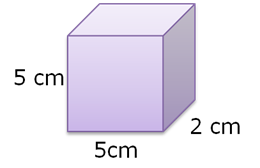
Volume of the cuboid of sides 5 cm, 2 cm, 5 cm
= 5 cm × 2 cm × 5 cm = 5 × 5 × 2 cm³
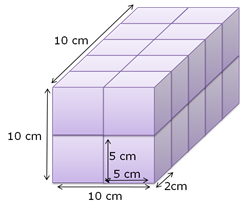
Here, two 5s and one 2 are left which are not in a triplet. If we multiply this expression by 5 × 2 × 2 = 20, then it will become a perfect cube.
Thus, 5 × 5 × 2 × 5 × 2 × 2 = (2 × 2 × 2) × (5 × 5 × 5) = 1000, which is a perfect cube.
Hence, 20 cuboids of 5 cm, 2 cm and 5 cm are required to form a cube.
FAQs (Frequently Asked Questions)
The best resources to start their Class 8 Mathematics preparation are the NCERT Solutions For Class 8 Maths Chapter 6 Exercise 6.1. In order to prevent confusion during the exam, they should attempt to cover all the topics in their learning process.
Students can use the NCERT Solutions For Class 8 Maths Chapter 6 Exercise 6.1 to perform well on the Class 8 Mathematics Exam. Students should practice as often as they can and thoroughly go over the concepts.
On the Extramarks website, candidates can access the NCERT Solutions For Class 8 Maths Chapter 6 Exercise 6.1.
Students can download the PDF versions of NCERT Solutions For Class 8 Maths Chapter 6 Exercise 6.1. These solutions are created specially by efficient instructors of Extramarks. They also offer PDF downloads of the answers to Exercise 6.1 Class 8 Maths.
Students can take help from the NCERT Solutions For Class 8 Maths Chapter 6 Exercise 6.1 to get the best marks in exams.
The Central Board of Secondary Education administers board exams for only classes 10 and 12. According to CBSE requirements for Class 8, the schools administer the exams.
On the Extramarks website, students can get the NCERT Solutions For Class 8 Maths Chapter 6 Exercise 6.1. The best way to prepare for Class 8 exams is to go through NCERT Solutions For Class 8 Maths Chapter 6 Exercise 6.1. Once students have finished the syllabus, they can practice with the aid of NCERT Solutions For Class 8 Maths Chapter 6 Exercise 6.1 to attain proficiency in the subject matter.
A chapter-by-chapter approach is the most effective way to prepare for the Class 8 annual exams. Once students have completed a chapter, they should review the chapter’s questions. After completing the entire curriculum, students can take the subject-specific practice exams. Students will undoubtedly benefit from this and perform well on their tests.
Yes, students can study NCERT Solutions For Class 8 Maths Chapter 6 Exercise 6.1 at their convenience by downloading these solutions in PDF format. The NCERT Solutions For Class 8 Maths Chapter 6 Exercise 6.1 would be helpful in assisting students to cross-check their solutions to the exercises provided in the NCERT books.
The NCERT Solutions For Class 8 Maths Chapter 6 Exercise 6.1 are crucial learning resources because they help students fully understand the chapter. The NCERT Solutions For Class 8 Maths Chapter 6 Exercise 6.1 are available for students to use as practice materials. Additionally, students can use the NCERT Solutions For Class 8 Maths Chapter 6 Exercise 6.1 to solve difficult problems simply. The NCERT Solutions For Class 8 Maths Chapter 6 Exercise 6.1, most remarkably, help students boost their confidence for the Mathematics examination.