NCERT Solutions for Class 8 Maths Chapter 9 – Mensuration Ex 9.2
NCERT Solutions for Class 8 Maths Chapter 9 – Mensuration Ex 9.2 are given here in simple, step-by-step form. NCERT stands for National Council of Educational Research and Training, the body that makes your textbook. In Exercise 9.1 you found the area of flat shapes. Exercise 9.2 moves to solid shapes and teaches surface area. Surface area is the total area of all the outer faces of a solid. This exercise covers the cuboid, the cube and the cylinder.
This exercise has 10 questions. They come from real life, such as a closed box, a cubical tank, a cylindrical pipe, a label on a can, and the cost of painting. In each question you use the correct surface area formula and put in the given measurements. Every question below is solved in short steps, with the final answer in bold. Students can use this page for homework and revision, parents can use it to check the work at home, and teachers can use it in class. A free printable PDF of these solutions is also available for offline study.
NCERT Solutions for Class 8 Maths Chapter 9 – Mensuration Ex 9.2
 Mensuration
 Medium
 Mensuration
 Difficult
 Mensuration
Difficult
Mensuration
Difficult
 Mensuration
Medium
Mensuration
Medium
 Mensuration
Medium
Mensuration
Medium
 Mensuration
Medium
Mensuration
Medium
 Mensuration
Difficult
Mensuration
Difficult
 Mensuration
Difficult
Mensuration
Difficult
 Mensuration
Difficult
Mensuration
Difficult
Mensuration
Difficult
Mensuration
Difficult
 Mensuration
Medium
Mensuration
Medium
 Mensuration
Difficult
Mensuration
Difficult
 Mensuration
Difficult
Mensuration
Difficult
 Mensuration
Difficult
Mensuration
Difficult

Surface Area Formulas Used in Exercise 9.2
- Cuboid (length l, breadth b, height h): Total surface area = 2(lb + bh + hl). Lateral surface area = 2h(l + b).
- Cube (side a): Total surface area = 6a2. Lateral surface area = 4a2.
- Cylinder (radius r, height h): Curved surface area = 2πrh. Total surface area = 2πr(r + h).
- Take π as 22/7 when the radius is a multiple of 7, otherwise use 3.14.
- Curved surface area leaves out the flat top and bottom. Total surface area includes them.
Exercise 9.2 – Questions and Answers
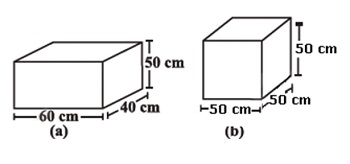
Q1. There are two cuboidal boxes as shown in the adjoining figure. Which box requires the lesser amount of material to make?
Answer:
We know that, total surface area of the cuboid = 2(lb + bh + hl)
For box (a), l = 60 cm, b = 40 cm and h = 50 cm.
Total surface area of cuboid = 2[(60)(40) + (40)(50) + (50)(60)] cm²
= 2(2400 + 2000 + 3000) cm²
= 2 × 7400 cm²
= 14800 cm²
For box (b), it is a cube of side 50 cm.
Total surface area of the cube = 6(l)²
= 6(50 cm)²
= 6 × 2500 cm²
= 15000 cm²
Since the total surface area of the cuboid (14800 cm²) is less than the total surface area of the cube (15000 cm²), therefore the cuboidal box (a) will require the lesser amount of material.
Q2. A suitcase with measures 80 cm × 48 cm × 24 cm is to be covered with a tarpaulin cloth. How many metres of tarpaulin of width 96 cm is required to cover 100 such suitcases?
Answer:
A suitcase is in the shape of a cuboid.
∴ Total surface area of a cuboid = 2(lb + bh + hl)
Hence,
Total surface area of one suitcase = 2[(80)(48) + (48)(24) + (24)(80)] cm²
= 2[3840 + 1152 + 1920] cm²
= 2 × 6912 cm²
= 13824 cm²
∴ Total surface area of 100 suitcases = (13824 × 100) cm²
= 1382400 cm²
Required tarpaulin = Length × Breadth
⇒ 1382400 cm² = Length × 96 cm
Length = 1382400 / 96 cm
= 14400 cm
= 144 m
Thus, 144 m of tarpaulin is required to cover 100 suitcases.
Q3. Find the side of a cube whose surface area is 600 cm².
Answer:
Given that, surface area of cube = 600 cm²
Let the length of each side of the cube be 'x'.
Surface area of cube = 6(Side)²
⇒ 600 cm² = 6x²
⇒ x² = 100 cm²
⇒ x = 10 cm
∴ The side of the cube is 10 cm.
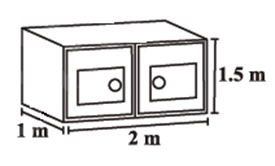
Q4. Rukhsar painted the outside of the cabinet of measure 1 m × 2 m × 1.5 m. How much surface area did she cover if she painted all except the bottom of the cabinet?
Answer:
Length of the cabinet = 2 m
Breadth of the cabinet = 1 m
Height of the cabinet = 1.5 m
The bottom is not painted, so the painted surfaces are the four walls and the top.
Area of the cabinet that was painted = 2h(l + b) + lb
= [2 × 1.5 × (2 + 1) + (2)(1)] m²
= [3(3) + 2] m²
= (9 + 2) m²
= 11 m²
∴ The area of the cabinet that was painted is 11 m².
Q5. Daniel is painting the walls and ceiling of a cuboidal hall with length, breadth and height of 15 m, 10 m and 7 m respectively. From each can of paint 100 m² of area is painted. How many cans of paint will she need to paint the room?
Answer:
Given that,
Length = 15 m
Breadth = 10 m
Height = 7 m
Area of the hall to be painted = (Area of the walls) + (Area of the ceiling)
= 2h(l + b) + lb
= [2(7)(15 + 10) + 15 × 10] m²
= [14(25) + 150] m²
= [350 + 150] m²
= 500 m²
It is given that 100 m² area can be painted from each can.
∴ Number of cans required to paint an area of 500 m² = 500 / 100 = 5
Hence, 5 cans are required to paint the walls and the ceiling of the cuboidal hall.
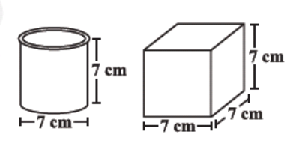
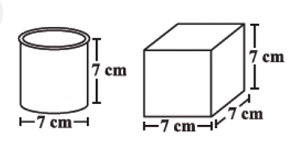
Q6. Describe how the two figures at the right are alike and how they are different. Which box has larger lateral surface area?
Answer:
Both the figures have the same height of 7 cm. The difference between the two figures is that one is a cylinder and the other is a cube.
Now,
Lateral surface area of the cube = 4l²
= 4(7 cm)²
= 196 cm²
Lateral surface area of the cylinder = 2πrh sq. units
Here the diameter is 7 cm, so the radius r = 7/2 cm.
= (2 × 22/7 × 7/2 × 7) cm²
= 154 cm²
Hence, the cube has the larger lateral surface area.
Q7. A closed cylindrical tank of radius 7 m and height 3 m is made from a sheet of metal. How much sheet of metal is required?
Answer:
Total surface area of cylinder = 2πr(r + h) sq. units
= [2 × 22/7 × 7(7 + 3)] m²
= (44 × 10) m²
= 440 m²
Thus, 440 m² sheet of metal is required.
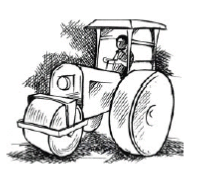
Q8. A road roller takes 750 complete revolutions to move once over to level a road. Find the area of the road if the diameter of a road roller is 84 cm and length is 1 m.
Answer:
Given:
Diameter = 84 cm ⇒ r = 42 cm = 42/100 m
Length = 1 m
In one revolution, the roller will cover an area equal to its lateral surface area.
Lateral surface area of cylinder = 2πrh
= 2 × 22/7 × 42/100 m × 1 m
= 264/100 m²
∴ In 750 revolutions, area of the road covered = 750 × 264/100 m²
= 1980 m²
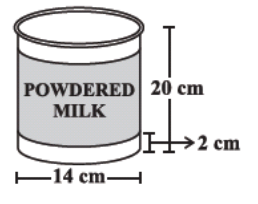
Q9. A company packages its milk powder in a cylindrical container whose base has a diameter of 14 cm and height 20 cm. Company places a label around the surface of the container (as shown in the figure). If the label is placed 2 cm from top and bottom, what is the area of the label?
Answer:
Height of the label = 20 cm − 2 cm − 2 cm = 16 cm
Diameter = 14 cm
⇒ Radius of the label = 14/2 cm = 7 cm
The label is in the form of a cylinder having its radius and height as 7 cm and 16 cm.
Area of the label = 2πrh
= (2 × 22/7 × 7 × 16) cm²
= 704 cm²
∴ Area of the label = 704 cm².