NCERT Solutions for Class 9 Maths Chapter 7 Triangles Exercise 7.2
NCERT Solutions for Class 9 Maths Chapter 7 Triangles Exercise 7.2 are given here in a simple, step-by-step form. NCERT stands for National Council of Educational Research and Training, the body that makes your textbook. Chapter 7 teaches congruence, which means two triangles are exactly equal in shape and size. Exercise 7.1 covered the SAS and ASA rules of congruence. Exercise 7.2 uses those rules to prove the properties of an isosceles triangle, that is, a triangle in which two sides are equal.
This exercise has 8 questions. Almost all of them ask you to prove something, not to find a number. You will prove that equal sides give equal angles, that equal angles give equal sides, and that the altitudes to the equal sides are also equal. The last two questions ask you to find the angles of a right isosceles triangle and of an equilateral triangle. Every proof below is written line by line, with the reason given for each step. Students can use this page for homework and revision, parents can use it to check the work at home, and teachers can use it in class. A free printable PDF of these solutions is also available for offline study.
Rules Used in Exercise 7.2
- Angles opposite equal sides are equal. If two sides of a triangle are equal, the angles opposite them are equal.
- Sides opposite equal angles are equal. This is the reverse of the rule above.
- SSS rule: if all three sides of one triangle equal the three sides of another, the triangles are congruent.
- SAS rule: two sides and the angle between them are equal.
- ASA rule: two angles and the side between them are equal.
- AAS rule: two angles and a side that is not between them are equal.
- CPCT stands for Corresponding Parts of Congruent Triangles. Once two triangles are proved congruent, all their matching sides and angles are equal.
- The three angles of any triangle add up to 180°.
Exercise 7.2 – Questions and Answers
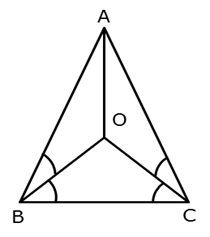
Q 1. In an isosceles triangle ABC, with AB = AC, the bisectors of ∠B and ∠C intersect each other at O. Join A to O. Show that:
(i) OB = OC
(ii) AO bisects ∠A.
Answer:
Given: In ΔABC, AB = AC and bisectors of ∠B and ∠C intersect at O.
To Prove: (i) OB = OC (ii) AO bisects ∠A
Proof:
(i) In ΔABC, AB = AC
So, ∠ACB = ∠ABC [Opposite angles of equal sides are equal.]
⇒ ½∠ACB = ½∠ABC
⇒ ∠OCB = ∠OBC [Given, as OB and OC are angle bisectors.]
⇒ OB = OC [Sides opposite to equal angles are equal.]
(ii) In ΔOAB and ΔOAC,
OA = OA [Common]
AB = AC [Given]
OB = OC [Proved above]
∴ ΔOAB ≅ ΔOAC [By S.S.S.]
Hence, ∠OAB = ∠OAC [By C.P.C.T.]
Thus, OA bisects ∠A.
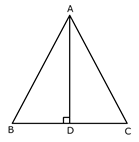
Q 2. In ΔABC, AD is the perpendicular bisector of BC (see figure below). Show that ΔABC is an isosceles triangle in which AB = AC.
Answer:
Given: In ΔABC, BD = DC and AD ⊥ BC.
To Prove: AB = AC
Proof: In ΔABD and ΔACD
AD = AD [Common]
∠ADB = ∠ADC [Each 90°, since AD ⊥ BC]
BD = DC [Given]
∴ ΔABD ≅ ΔACD [By S.A.S.]
∴ AB = AC [By C.P.C.T.]
Therefore, ΔABC is an isosceles triangle.
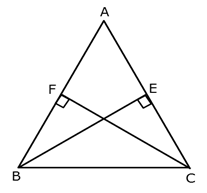
Q 3. ABC is an isosceles triangle in which altitudes BE and CF are drawn to equal sides AC and AB respectively (see figure below). Show that these altitudes are equal.
Answer:
Given: In ΔABC, AC = AB, BE ⊥ AC and CF ⊥ AB.
To Prove: BE = CF
Proof: In ΔABE and ΔACF
∠BAE = ∠CAF [Common angle]
∠BEA = ∠CFA [Each 90°]
AB = AC [Given]
∴ ΔABE ≅ ΔACF [By A.A.S.]
∴ BE = CF [By C.P.C.T.]
Hence proved.
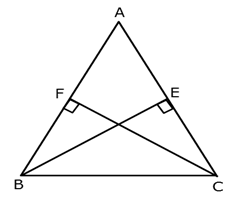
Q 4. ABC is a triangle in which altitudes BE and CF to sides AC and AB are equal (see figure below). Show that:
(i) ΔABE ≅ ΔACF
(ii) AB = AC, i.e., ABC is an isosceles triangle.
Answer:
Given: In ΔABC, BE = CF, BE ⊥ AC and CF ⊥ AB.
To Prove: (i) ΔABE ≅ ΔACF (ii) AB = AC, i.e., ABC is an isosceles triangle.
Proof:
(i) In ΔABE and ΔACF
∠BAE = ∠CAF [Common angle]
∠BEA = ∠CFA [Each 90°]
BE = CF [Given]
∴ ΔABE ≅ ΔACF [By A.A.S.]
(ii) AB = AC [By C.P.C.T.]
i.e., ABC is an isosceles triangle.
Hence proved.
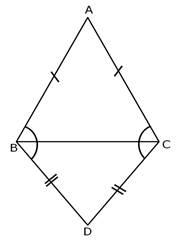
Q 5. ABC and DBC are two isosceles triangles on the same base BC (see figure below). Show that ∠ABD = ∠ACD.
Answer:
Given: In ΔABC, AB = AC and in ΔDBC, DB = DC.
To Prove: ∠ABD = ∠ACD
Proof: In ΔABC
AB = AC [Given]
∴ ∠ACB = ∠ABC … (i) [Opposite angles of equal sides are equal.]
In ΔDBC
DB = DC [Given]
∴ ∠DCB = ∠DBC … (ii) [Opposite angles of equal sides are equal.]
Adding equation (i) and equation (ii), we get
∠ACB + ∠DCB = ∠ABC + ∠DBC
∴ ∠ACD = ∠ABD
⇒ ∠ABD = ∠ACD
Hence proved.
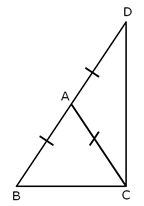
Q 6. ΔABC is an isosceles triangle in which AB = AC. Side BA is produced to D such that AD = AB (see figure below). Show that ∠BCD is a right angle.
Answer:
Given: In ΔABC, AB = AC, side BA is produced to D such that AD = AB.
To Prove: ∠BCD is a right angle.
Proof: In ΔABC,
AB = AC [Given]
∠ACB = ∠ABC [Opposite angles of equal sides are equal.]
= x (let)
In ΔACD,
AC = AD [Since AD = AB and AB = AC]
∠ADC = ∠ACD [Opposite angles of equal sides are equal.]
= y (let)
Now, in ΔBCD
∠BCD + ∠CBD + ∠BDC = 180° [Angle sum property of a triangle]
(x + y) + x + y = 180°
2 (x + y) = 180°
(x + y) = 180°/2
∠BCD = 90°
⇒ ΔBCD is a right triangle.
Q 7. ABC is a right angled triangle in which ∠A = 90° and AB = AC. Find ∠B and ∠C.
Answer:
Given: In ΔABC, ∠A = 90° and AB = AC.
To Find: ∠B and ∠C
Solution: In ΔABC,
AB = AC [Given]
So, ∠ACB = ∠ABC = x (let) [Opposite angles of equal sides are equal.]
Since, ∠A + ∠B + ∠C = 180°
90° + x + x = 180°
2x = 180° − 90°
x = 90°/2 = 45°
So, ∠B = 45° and ∠C = 45°.
Q 8. Show that the angles of an equilateral triangle are 60° each.
Answer:
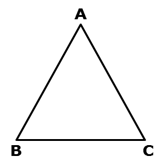 Given: ΔABC is an equilateral triangle.
To Prove: ∠A = ∠B = ∠C = 60°
Proof: In ΔABC,
AB = AC [Given]
∠C = ∠B … (i) [Angles opposite to equal sides are equal.]
AB = BC [Given]
∠C = ∠A … (ii) [Angles opposite to equal sides are equal.]
By angle sum property in a triangle,
∠A + ∠B + ∠C = 180°
∠C + ∠C + ∠C = 180° [From equation (i) and equation (ii)]
3∠C = 180°
∠C = 180°/3 = 60°
So, ∠A = 60° and ∠B = 60°.
Therefore, each angle of an equilateral triangle is 60° each.
Related Links