NCERT Solutions for Class 6 Maths Ganita Prakash Chapter 7 – Fractions
NCERT Solutions for Class 6 Maths Chapter 7 – Fractions explain the "Fractions" chapter of the Ganita Prakash book in plain, simple language. A fraction is what we use when one whole thing is shared into equal parts. This chapter starts with simple sharing — three guavas weighing 1 kg together, or three rotis shared among four children — and builds from there.
Students learn to write fractions from pictures, mark them on a number line, find how many whole units are in an improper fraction, change mixed numbers into fractions, and use a fraction wall to spot equivalent fractions. The chapter also connects fractions to division, addition and multiplication facts. These solutions are useful for students starting the chapter, for parents helping at home, and for teachers preparing class work. A free printable PDF of these solutions is also available for download.
NCERT Solutions for Class 6 Maths Ganita Prakash Chapter 7 – Fractions
 Fractions (New NCERT)
 Medium
Fractions (New NCERT)
Medium
Fractions (New NCERT)
Medium
Fractions (New NCERT)
Medium
 Fractions (New NCERT)
Medium
Fractions (New NCERT)
Medium
Fractions (New NCERT)
Medium
 Fractions (New NCERT)
Medium
Fractions (New NCERT)
Medium
Fractions (New NCERT)
Medium
Fractions (New NCERT)
Medium
Fractions (New NCERT)
Medium
Fractions (New NCERT)
Medium
Fractions (New NCERT)
Medium
Fractions (New NCERT)
Medium
Fractions (New NCERT)
Medium
Fractions (New NCERT)
Medium
Fractions (New NCERT)
Medium
Fractions (New NCERT)
Medium
Fractions (New NCERT)
Medium
 Fractions (New NCERT)
Medium
Fractions (New NCERT)
Medium
Fractions (New NCERT)
Medium
Fractions (New NCERT)
Medium
Fractions (New NCERT)
Medium
Fractions (New NCERT)
Medium
Fractions (New NCERT)
Medium
Fractions (New NCERT)
Medium
Fractions (New NCERT)
Medium
 Fractions (New NCERT)
Medium
 Fractions (New NCERT)
Medium
Fractions (New NCERT)
Medium
Fractions (New NCERT)
Medium
 Fractions (New NCERT)
Medium
Fractions (New NCERT)
Medium
Fractions (New NCERT)
Medium
Fractions (New NCERT)
Medium
 Fractions (New NCERT)
Medium
 Fractions (New NCERT)
Medium
 Fractions (New NCERT)
Medium
 Fractions (New NCERT)
Medium
Fractions (New NCERT)
Medium
Fractions (New NCERT)
Medium
Fractions (New NCERT)
Medium
Fractions (New NCERT)
Medium
Fractions (New NCERT)
Medium
Class 6 Maths Chapter 7 Fractions Solutions
Figure it Out (Page 153)
Q1. Three guavas together weigh 1 kg. If they are roughly of the same size, each guava will roughly weigh ____ kg.
Answer:
Three guavas together weigh 1 kg. If they are roughly of the same size, each guava will roughly weigh 1/3 kg.
Q2. A wholesale merchant packed 1 kg of rice in four packets of equal weight. The weight of each packet is ________ kg.
Answer:
A wholesale merchant packed 1 kg of rice in four packets of equal weight. The weight of each packet is 1/4 kg.
Q3. Four friends ordered 3 glasses of sugarcane juice and shared it equally. Each one drank _______ glass of sugarcane juice.
Answer:
As total quantity is 3 which is to be divided into four equal parts. So, the required fraction is 3/4.
Q4. The big fish weighs 1/2 kg. The small one weighs 1/4 kg. Together they weigh ____ kg.
Answer:
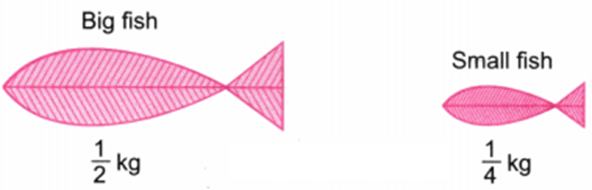
Together they weigh = 1/2 + 1/4 = 3/4 kg
Q5. Arrange these fraction words in order of size from the smallest to the biggest in the empty box below: One and a half, three quarters, one and a quarter, half, quarter, two and a half.
Answer:
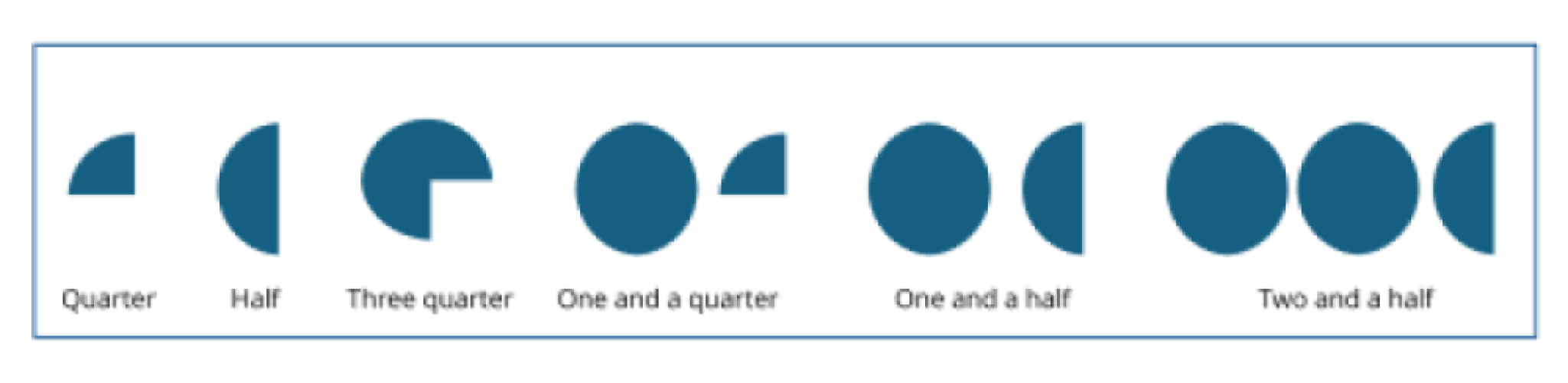
∴ The fractions from smallest to the biggest are as follows: quarter, half, three quarters, one and a quarter, one and a half, two and a half.
Q6. The figure below shows different fractional units of a whole chikki. How much of a whole chikki is each piece?
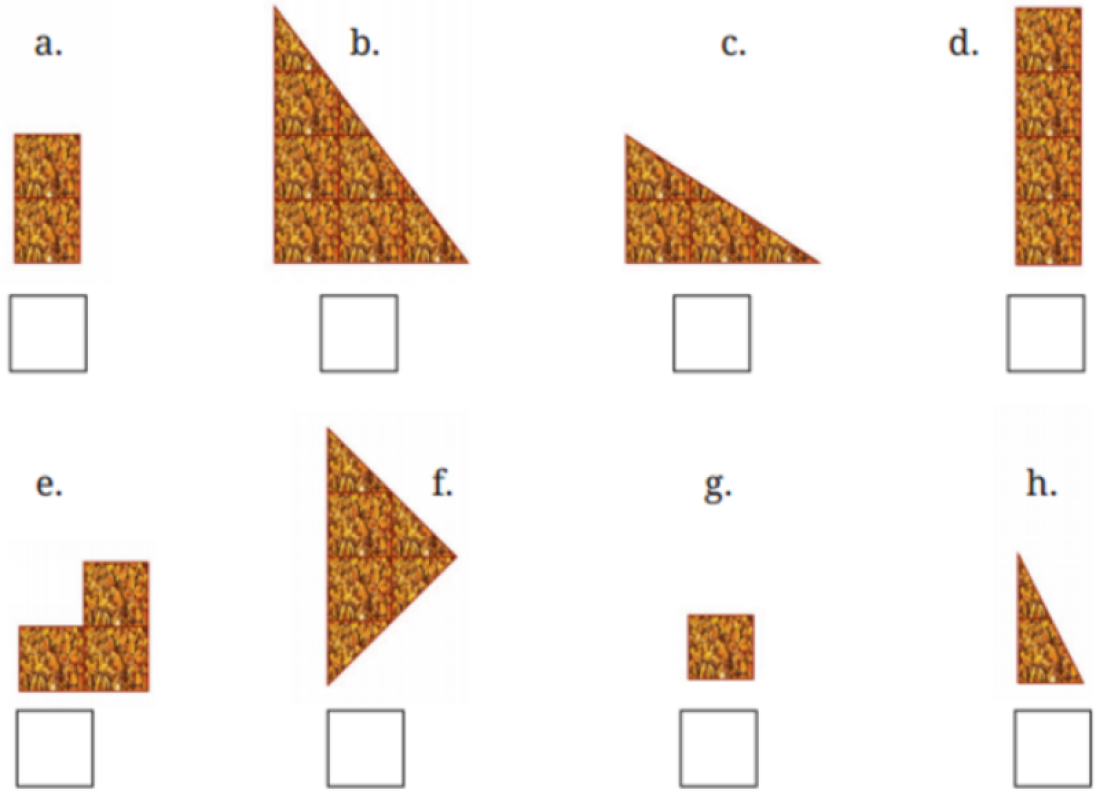
Answer:
(a)
Total no. of pieces formed of given size = 12
Required fraction = 1/12
(b)
Total no. of pieces formed of given size = 4
Required fraction = 1/4
(c)
Total no. of pieces formed of given size = 8
Required fraction = 1/8
(d)
Total no. of pieces formed of given size = 6
Required fraction = 1/6
(e)
Total no. of pieces formed of given size = 8
Required fraction = 1/8
(f)
Total no. of pieces formed of given size = 8
Required fraction = 1/8
(g)
Total no. of pieces formed of given size = 24
Required fraction = 1/24
(h)
Total no. of pieces formed of given size = 12
Required fraction = 1/12
Figure it Out (Page No. 158)
Q7. (a) Continue this table of 1/2 for 2 more steps. (b) Can you create a similar table for 1/4?
[Image: Q7_question_pictograph.png]
Answer:
(a)
1/2 + 1/2 + 1/2 + 1/2 + 1/2 + 1/2 = 6 times half
1/2 + 1/2 + 1/2 + 1/2 + 1/2 + 1/2 + 1/2 = 7 times half
(b) Yes. A similar table can be made for 1/4 by adding 1/4 to itself again and again, in the same way.
Q8. Make 1/3 using a paper strip. Can you use this to also make 1/6?
Answer:
Take a strip of paper.
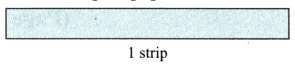
Fold the strip into three equal parts and then open up.
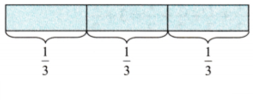
Yes, we can also make 1/6 using a paper strip by folding the above strip 6 times again.
Q9. Draw a picture and write an addition statement as above to show:
(a) 5 times 1/4 of a roti
(b) 9 times 1/4 of a roti
Answer:
(a)

5 times 1/4 of a roti
= 1/4 + 1/4 + 1/4 + 1/4 + 1/4
(b)

9 times 1/4 of a roti
= 1/4 + 1/4 + 1/4 + 1/4 + 1/4 + 1/4 + 1/4 + 1/4 + 1/4
Q10. Match each fractional unit with the correct picture:
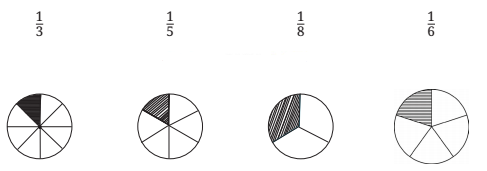
Answer:
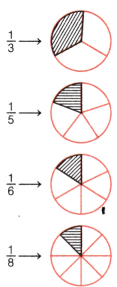
- 1/3 → the circle divided into 3 equal parts, with 1 part shaded
- 1/5 → the circle divided into 5 equal parts, with 1 part shaded
- 1/6 → the circle divided into 6 equal parts, with 1 part shaded
- 1/8 → the circle divided into 8 equal parts, with 1 part shaded
Q11. What is the length of the blue line and black line shown below? The distance between 0 and 1 is 1 unit long, and it is divided into two equal parts. The length of each part is 1/2. So, the blue line is 1/2 units long. Write the fraction that gives the length of the black line in the box.
Answer:
Length of blue line is 1/2.
Length of black line is 1/2 + 1/2 + 1/2
Fraction that gives length of black line = 3/2
Q12. Here, the fractional unit is dividing a length of 1 unit into three equal parts. Write the fraction that gives the length of the blue line in the box or in your notebook.

Answer:
Here number line OR is divided into three equal parts OP, PQ and QR.
Hence length of blue line = OP + PQ = 1/3 + 1/3 = 2/3
Q13. Here, a unit is divided into 5 equal parts. Write the fraction that gives the length of the blue lines in the respective boxes or in your notebook.

Answer:
Here number line from 0 to 1 unit is divided into five equal parts.
Hence length of the first blue line from bottom = 1/5 + 1/5 = 2/5
Now, length of the second blue line from bottom = 1/5 + 1/5 + 1/5 + 1/5 = 4/5
Q14. Now, a unit is divided into 8 equal parts. Write the appropriate fractions in your notebook.
Answer:
Here number line OH is divided into 8 equal parts OA, AB, BC, CD, DE, EF, FG and GH.

Hence, OA = 1/8, OB = 2/8, OC = 3/8, OH = 8/8 = 1
Q15. On a number line, draw lines of length 1/10, 3/10 and 4/5.
Answer:
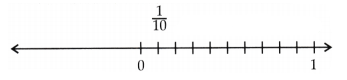
Divide the unit into 10 equal parts and point A represents 1/10.
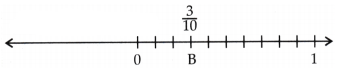
Divide a unit into 10 equal parts and point B represents 3/10.
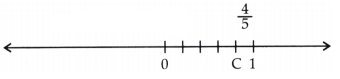
Divide a unit into 5 equal parts and point C represents 4/5.
Q16. Write five more fractions of your choice and mark them on the number line.
Answer:
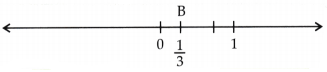
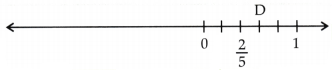
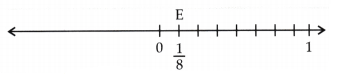
The fractions are 3/5, 1/3, 5/7, 2/5 and 1/8.
Their number line representations are:
(a) 3/5
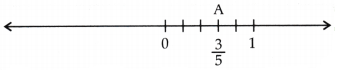
(b) 1/3
(c) 5/7

(d) 2/5
(e) 1/8
Q17. How many fractions lie between 0 and 1? Think, discuss with your classmates, and write your answer.
Answer:
There are an infinite number of fractions between 0 and 1.
Example: 3/5, 4/5, 7/10 etc.
Q18. Write the fraction that gives the lengths of the black lines in the respective boxes.

Answer:

The fractions are 6/5, 7/5, 8/5, 9/5 and 2 (or 10/5). Note that 1 can also be written as 5/5.
Q19. How many whole units are there in 7/2?
Answer:
7/2 = 1/2 + 1/2 + 1/2 + 1/2 + 1/2 + 1/2 + 1/2 = 3 + 1/2
So, there are 3 whole units in 7/2.
Q20. How many whole units are there in 4/3 and in 7/3?
Answer:
4/3 = 1/3 + 1/3 + 1/3 + 1/3 = 1 + 1/3
So, there is 1 whole unit in 4/3.
7/3 = 1/3 + 1/3 + 1/3 + 1/3 + 1/3 + 1/3 + 1/3 = 2 + 1/3
So, there are 2 whole units in 7/3.
Q21. Figure out the number of whole units in each of the following fractions:
(a) 8/3 (b) 11/5 (c) 9/4
Answer:
(a) 2
(b) 2
(c) 2
Q22. Can all fractions greater than 1 be written as such mixed numbers?
Answer:
Yes.
Q23. Write the following mixed numbers as fractions:
(a) 3¼ (b) 7⅔ (c) 9 4/9 (d) 3⅙ (e) 2 3/11 (f) 3 9/10
Answer:
(a) 3¼ = (3 × 4 + 1)/4 = 13/4
(b) 7⅔ = (7 × 3 + 2)/3 = 23/3
(c) 9 4/9 = (9 × 9 + 4)/9 = 85/9
(d) 3⅙ = (3 × 6 + 1)/6 = 19/6
(e) 2 3/11 = (2 × 11 + 3)/11 = 25/11
(f) 3 9/10 = (3 × 10 + 9)/10 = 39/10
Q24. Answer the following question after looking at the fraction wall: Are the lengths 1/2 and 3/6 equal?
Answer:
Yes, here lengths 1/2 and 3/6 = 1/2.
Lengths are equal.
Q25. Answer the following question after looking at the fraction wall: Are 2/3 and 4/6 equivalent fractions? Why?
Answer:
Yes, lengths 2/3 and 4/6 = 1/3 are equivalent fractions, as they have the same length.
Q26. Answer the following question after looking at the fraction wall: How many pieces of length 1/6 will make a length of 1/2?
Answer:
Total no. of pieces = (1/2) ÷ (1/6) = (1/2) × (6/1) = 6/2 = 3
Hence three pieces of length 1/6 will make a length of 1/2.
Q27. Answer the following question after looking at the fraction wall: How many pieces of length 1/6 will make a length of 1/3?
Answer:
Total no. of pieces = (1/3) ÷ (1/6) = (1/3) × (6/1) = 6/3 = 2
Hence two pieces of length 1/6 will make a length of 1/3.
Q28. Are 3/6, 4/8 and 5/10 equivalent fractions? Why?
Answer:
Here, simplest form of 3/6 = (3 ÷ 3)/(6 ÷ 3) = 1/2 [HCF of 3 and 6 is 3]
and simplest form of 4/8 is (4 ÷ 4)/(8 ÷ 4) = 1/2 [HCF of 4 and 8 is 4]
and simplest form of 5/10 is (5 ÷ 5)/(10 ÷ 5) = 1/2 [HCF of 5 and 10 is 5]
Hence, 3/6, 4/8 and 5/10 are equivalent fractions.
Q29. Write two equivalent fractions for 2/6.
Answer:
From the fraction wall we can choose any two fractions that denote the same length as 2/6:
2/6 = 1/3 = 3/9
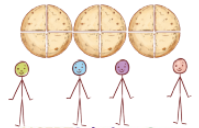
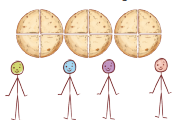
Q30. Three rotis are shared equally by four children. Show the division in the picture and write a fraction of how much each child gets. Also, write the corresponding division facts, addition facts, and multiplication facts.
Answer:
One roti is shared as shown in the figure below:
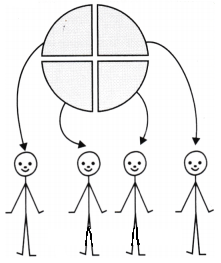
The four shares must be equal to each other!
Similar distribution will be done for the second and third roti also.
So, each child will get 3/4 a piece of roti.
The division fact is 3 ÷ 4 = 3/4
The addition fact is 3 = 3/4 + 3/4 + 3/4 + 3/4
The multiplication fact is 3 = 4 × 3/4
Q31. Draw a picture to show how much each child gets when 2 rotis are shared equally by 4 children. Also, write the corresponding division facts, addition facts, and multiplication facts.
Answer:
One roti is shared as shown in the figure below:
The four shares must be equal to each other!
A similar distribution will be done for the second roti also.
So, each child will get 1/4 part from a roti.
So, the total fraction of roti received by each child from 2 rotis = 2/4 = 1/2
The division fact is 2 ÷ 4 = 2/4
The addition fact is 2 = 2/4 + 2/4 + 2/4 + 2/4
The multiplication fact is 2 = 4 × 2/4
Q32. Anil was in a group where 2 cakes were divided equally among 5 children. How much cake would Anil get?
Answer:
Anil would get 2/5 part of the cake.
Related Links
- Chapter 1 Patterns in Mathematics
- Chapter 2 Lines and Angles
- Chapter 3 Number Play
- Chapter 4 – Data Handling and Presentation
- Chapter 5 – Prime Time
- Chapter 6 – Perimeter and Area
- Chapter 8 Playing with Constructions
- Chapter 9 Symmetry
- Chapter 10 The Other Side of Zero