Class 9 Maths Ganita Manjari Chapter 1 Exercise 1.2 Solutions: Orienting Yourself — The Use of Coordinates
Class 9 Maths Ganita Manjari Chapter 1 Exercise 1.2 Solutions cover the room-map activity from Orienting Yourself: The Use of Coordinates. In this exercise, students use the x-axis, y-axis and coordinate points to place furniture, locate bathroom corners, study door movement and sketch another room on the coordinate plane.
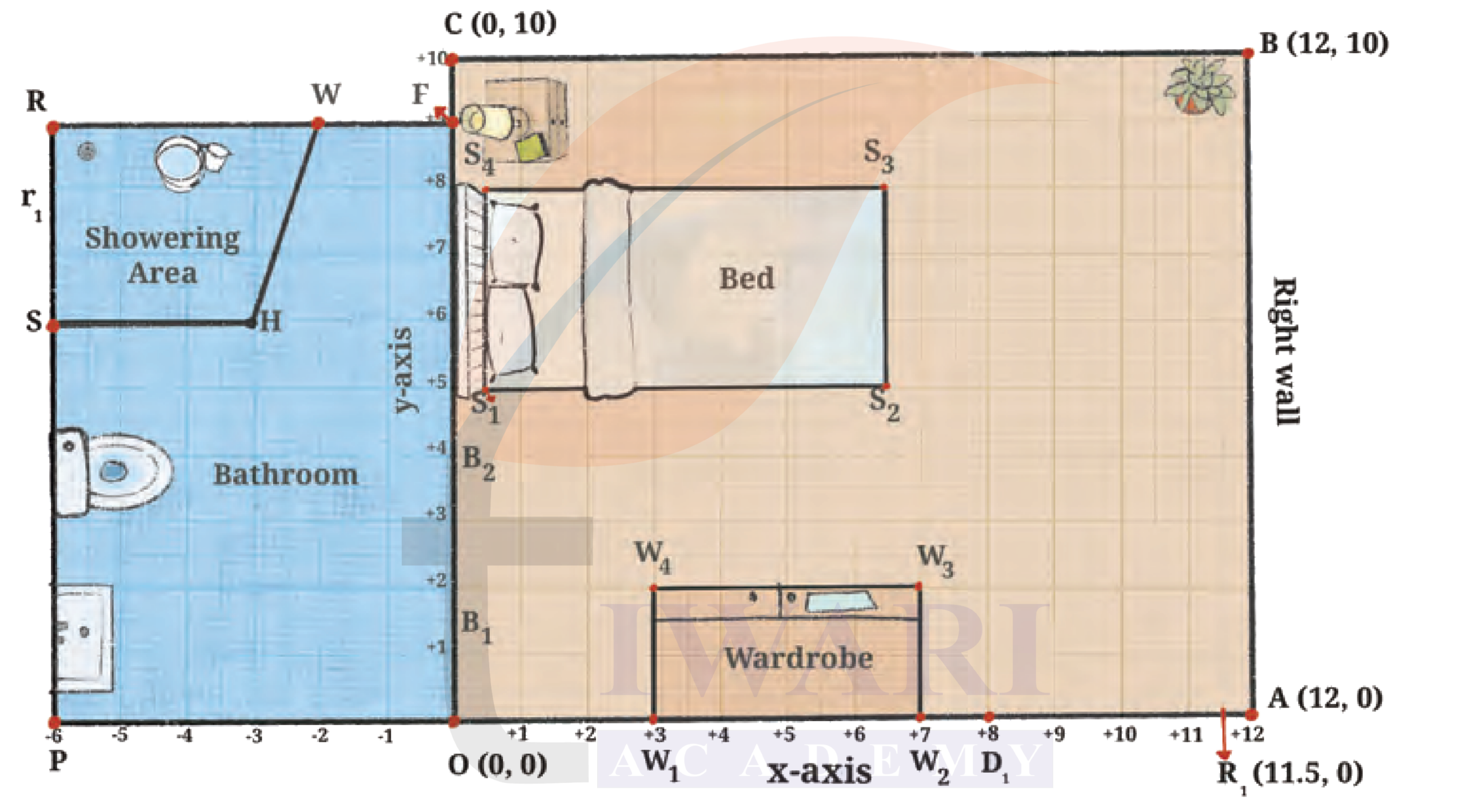
In Ganita Manjari Class 9 Chapter 1 Exercise 1.2, students move beyond simple points on the x-axis and y-axis. They use Fig. 1.5 to place a study table, check whether the bathroom door hits the wardrobe, identify bathroom and shower-area coordinates, and sketch a dining room using given dimensions. These Class 9 Maths Chapter 1 Exercise 1.2 Solutions show how the Cartesian coordinate system Class 9 concept can describe real positions, lengths and spaces in a practical floor plan.
Key Takeaways
Room Map: Coordinates can be used to locate furniture, doors and room corners.
Rectangle Completion: If three corners of a rectangle are known, the fourth can be found.
Bathroom Coordinates: Corners of rooms and areas can be written as ordered pairs.
Centre Placement: The centre of a rectangular room can be found using midpoint ideas.
Class 9 Maths Ganita Manjari Chapter 1 Exercise 1.2 Solutions Structure 2026
| Exercise No. | Topic | Question Count |
| Exercise 1.2 | Study table placement using coordinates | 1 |
| Exercise 1.2 | Bathroom door and wardrobe position | 1 |
| Exercise 1.2 | Bathroom and shower-area coordinates | 1 |
| Exercise 1.2 | Dining room and dining table coordinates | 1 |
Class 9 Maths Ganita Manjari Chapter 1 Exercise 1.2 Solutions
Exercise Set 1.2 asks students to draw the x-axis and y-axis, mark the origin O, and use the scale 1 cm = 1 unit. Students have to mark points from (–7, 0) to (13, 0) on the x-axis and from (0, –15) to (0, 12) on the y-axis. The questions are then answered using Fig. 1.5.
This exercise gives practice in Class 9 Maths coordinates exercise answers by connecting coordinate geometry with a practical room layout. Students learn how objects can be placed and measured on a coordinate plane Class 9 diagram.
Exercise 1.2 Question 1
Place Reiaan’s rectangular study table with three of its feet at the points (8, 9), (11, 9) and (11, 7).
(i) Where will the fourth foot of the table be?
Solution:
The given three feet of the rectangular study table are:
- (8, 9)
- (11, 9)
- (11, 7)
Since the table is rectangular, the fourth corner must complete the rectangle.
The missing point will have:
- x-coordinate = 8
- y-coordinate = 7
Therefore, the fourth foot of the table is:
(8, 7)
Answer: The fourth foot of the table will be at (8, 7).
(ii) Is this a good spot for the table?
Solution:
The table will occupy the rectangle with corners:
(8, 9), (11, 9), (11, 7), (8, 7)
This position is inside Reiaan’s room and away from the room door, bathroom door, bed and wardrobe. It does not block the movement space shown in Fig. 1.5.
Answer: Yes, this is a good spot for the table because it fits inside the room and does not block the doors or main movement area.
(iii) What is the width of the table? The length? Can you make out the height of the table?
Solution:
The horizontal distance is:
11 − 8 = 3 ft
The vertical distance is:
9 − 7 = 2 ft
So, the table dimensions on the floor are:
- Length = 3 ft
- Width = 2 ft
The figure is a floor map, so it shows only length and width. It does not show vertical height.
Answer: The table is 3 ft long and 2 ft wide. The height of the table cannot be found from this floor map.
Exercise 1.2 Question 2
If the bathroom door has a hinge at B₁ and opens into the bedroom, will it hit the wardrobe? Are there any changes you would suggest if the door is made wider?
Solution:
From Fig. 1.5:
- The bathroom door has hinge at B₁.
- The door opens into the bedroom.
- The wardrobe is placed from about x = 3 to x = 7 near the x-axis.
The bathroom door width is from B₁ (0, 1.5) to B₂ (0, 4).
So, its width is:
4 − 1.5 = 2.5 ft
If the door swings into the bedroom from B₁, it will cover a radius of about 2.5 ft. Since the wardrobe starts at about x = 3, the bathroom door will not hit the wardrobe.
If the door is made wider, it may come closer to the wardrobe or block movement.
Answer: No, the bathroom door will not hit the wardrobe in the given layout. If the door is made wider, the wardrobe can be shifted slightly to the right, or a sliding door may be used for the bathroom.
Exercise 1.2 Question 3
Look at Reiaan’s bathroom.
(i) What are the coordinates of the four corners O, F, R and P of the bathroom?
Solution:
From Fig. 1.5, the bathroom is the rectangle on the left side of the y-axis.
The four corners are:
| Corner | Coordinates |
| O | (0, 0) |
| F | (0, 9) |
| R | (–6, 9) |
| P | (–6, 0) |
Answer: The coordinates of the bathroom corners are O (0, 0), F (0, 9), R (–6, 9) and P (–6, 0).
(ii) What is the shape of the showering area SHWR in Reiaan’s bathroom? Write the coordinates of the four corners.
Solution:
From Fig. 1.5, the showering area is bounded by points S, H, W and R.
The coordinates are:
| Corner | Coordinates |
| S | (–6, 6) |
| H | (–3, 6) |
| W | (–2, 9) |
| R | (–6, 9) |
The shape SHWR has one slanting side HW, so it is not a rectangle. It is a quadrilateral.
Answer: The showering area SHWR is a quadrilateral. Its corners are S (–6, 6), H (–3, 6), W (–2, 9) and R (–6, 9).
(iii) Mark off a 3 ft × 2 ft space for the washbasin and a 2 ft × 3 ft space for the toilet. Write the coordinates of the corners of these spaces.
Solution:
There can be more than one correct placement, as long as the marked spaces fit inside the bathroom.
One possible placement is given below.
Washbasin space: 3 ft × 2 ft
Take the lower-left part of the bathroom.
| Corner | Coordinates |
| A | (–6, 0) |
| B | (–3, 0) |
| C | (–3, 2) |
| D | (–6, 2) |
This gives:
- Horizontal length = 3 ft
- Vertical width = 2 ft
Toilet space: 2 ft × 3 ft
Take a space above the washbasin on the left side.
| Corner | Coordinates |
| E | (–6, 3) |
| F | (–4, 3) |
| G | (–4, 6) |
| H | (–6, 6) |
This gives:
- Horizontal length = 2 ft
- Vertical width = 3 ft
Answer: One possible set of coordinates is:
- Washbasin: (–6, 0), (–3, 0), (–3, 2), (–6, 2)
- Toilet: (–6, 3), (–4, 3), (–4, 6), (–6, 6)
Exercise 1.2 Question 4
Other rooms in the house
(i) Reiaan’s room door leads from the dining room which has length 18 ft and width 15 ft. The length of the dining room extends from point P to point A. Sketch the dining room and mark the coordinates of its corners.
Solution:
From Fig. 1.5:
- P = (–6, 0)
- A = (12, 0)
Distance PA:
12 − (−6) = 18 ft
So, PA is the length of the dining room.
The dining room has width 15 ft. Since the bedroom is above the x-axis, the dining room can be drawn below PA, extending down to y = –15.
The corners of the dining room are:
| Corner | Coordinates |
| P | (–6, 0) |
| A | (12, 0) |
| A′ | (12, –15) |
| P′ | (–6, –15) |
Answer: The dining room can be marked with corners P (–6, 0), A (12, 0), A′ (12, –15) and P′ (–6, –15).
(ii) Place a rectangular 5 ft × 3 ft dining table precisely in the centre of the dining room. Write down the coordinates of the feet of the table.
Solution:
The dining room extends:
- horizontally from x = –6 to x = 12
- vertically from y = 0 to y = –15
The centre of the dining room is found by averaging the x-coordinates and y-coordinates of opposite corners.
x-coordinate of centre = [−6 + 12] / 2 = 3
y-coordinate of centre = [0 + (−15)] / 2 = −7.5
So, the centre is:
(3, −7.5)
The dining table is 5 ft × 3 ft.
Half of 5 ft = 5 / 2 = 2.5 ft
Half of 3 ft = 3 / 2 = 1.5 ft
Now, use the centre (3, −7.5) to find the four corners of the table:
(3 − 2.5, −7.5 + 1.5) = (0.5, −6)
(3 + 2.5, −7.5 + 1.5) = (5.5, −6)
(3 + 2.5, −7.5 − 1.5) = (5.5, −9)
(3 − 2.5, −7.5 − 1.5) = (0.5, −9)
So, the table corners are:
| Corner | Coordinates |
| T₁ | (0.5, –6) |
| T₂ | (5.5, –6) |
| T₃ | (5.5, –9) |
| T₄ | (0.5, –9) |
Check:
5.5 − 0.5 = 5 ft
−6 − (−9) = 3 ft
Answer: The feet of the dining table can be placed at (0.5, –6), (5.5, –6), (5.5, –9) and (0.5, –9).
Final Answers for Exercise 1.2
| Question | Answer |
| 1(i) Fourth foot of study table | (8, 7) |
| 1(ii) Good spot for table? | Yes, it does not block the door or movement area |
| 1(iii) Table dimensions | 3 ft × 2 ft |
| 1(iii) Table height | Cannot be found from floor map |
| 2 | Bathroom door will not hit the wardrobe |
| 3(i) Bathroom corners | O (0, 0), F (0, 9), R (–6, 9), P (–6, 0) |
| 3(ii) Showering area shape | Quadrilateral |
| 3(ii) Showering area corners | S (–6, 6), H (–3, 6), W (–2, 9), R (–6, 9) |
| 3(iii) Washbasin space | (–6, 0), (–3, 0), (–3, 2), (–6, 2) |
| 3(iii) Toilet space | (–6, 3), (–4, 3), (–4, 6), (–6, 6) |
| 4(i) Dining room corners | (–6, 0), (12, 0), (12, –15), (–6, –15) |
| 4(ii) Dining table corners | (0.5, –6), (5.5, –6), (5.5, –9), (0.5, –9) |
Concept Used in Orienting Yourself The Use of Coordinates Exercise 1.2
Orienting Yourself The Use of Coordinates Exercise 1.2 uses coordinate geometry to represent a real room layout. Students learn how a coordinate plane Class 9 diagram can show the exact position of furniture, doors and rooms.
The main concepts are:
- A point is written as (x, y).
- The x-coordinate gives horizontal position.
- The y-coordinate gives vertical position.
- A rectangle can be completed if three corners are known.
- Horizontal distance is found by subtracting x-coordinates.
- Vertical distance is found by subtracting y-coordinates.
- A floor map shows length and width, but not height.
These ideas build the base for Class 9 Ganita Manjari coordinate geometry solutions and help students understand the Cartesian coordinate system Class 9 in a practical way.
About Class 9 Maths Ganita Manjari Chapter 1 Exercise 1.2
Ganita Manjari Class 9 Chapter 1 Exercise 1.2 helps students move from simple points on axes to full room-map interpretation. It connects coordinate geometry with everyday spaces such as a bedroom, bathroom and dining room.
These Class 9 Maths coordinates exercise answers prepare students for later coordinate geometry topics such as:
- x-axis and y-axis
- origin
- coordinates of points
- coordinate plane
- quadrants
- rectangular layouts
- distance using coordinate differences
- real-life use of coordinate geometry
Why Exercise 1.2 Is Important in Class 9 Maths Ganita Manjari Chapter 1
Class 9 Maths Ganita Manjari Chapter 1 Solutions begin with real-life coordinate reading because it helps students see why coordinates are useful. Exercise 1.2 shows that coordinates can describe the exact location of furniture, doors, rooms and objects.
By solving Class 9 Maths Ganita Manjari Chapter 1 Exercise 1.2 Solutions, students practise:
- reading coordinates from a figure,
- completing a rectangle from three points,
- finding length and width from coordinate differences,
- placing objects in the centre of a room,
- connecting coordinate geometry with real-life planning.
NCERT Solutions for Class 9 Maths Ganita Manjari Chapter 1
| Section | NCERT Solutions |
| Class 9 Maths Ganita Manjari 2026 | NCERT Class 9 Maths Ganita Manjari 2026 |
| Chapter 1 | NCERT Solutions for Class 9 Maths Ganita Manjari Chapter 1 |
| Exercise 1.1 | NCERT Solutions for Class 9 Maths Ganita Manjari Chapter 1 Exercise 1.1 |
| Exercise 1.2 | NCERT Solutions for Class 9 Maths Ganita Manjari Chapter 1 Exercise 1.2 |
| End of Chapter Exercises | NCERT Solutions for Class 9 Maths Ganita Manjari Chapter 1 End of Chapter Exercises |
FAQs (Frequently Asked Questions)
Ganita Manjari Class 9 Chapter 1 Exercise 1.2 is about using coordinates to study Reiaan’s room layout. Students place a study table, locate bathroom corners, check door movement and sketch a dining room on the coordinate plane.
The fourth foot is (8, 7). The other three feet are (8, 9), (11, 9) and (11, 7), so the missing rectangle corner is (8, 7).
The study table has length 3 ft and width 2 ft. This is found from the coordinates (8, 9), (11, 9), (11, 7) and (8, 7).
No. Fig. 1.5 is a floor map, so it shows only length and width. It does not show vertical height.
The bathroom corners are O (0, 0), F (0, 9), R (–6, 9) and P (–6, 0).