Class 9 Maths Ganita Manjari Chapter 12 End of Chapter Exercises Quadrilaterals
The Class 9 Maths Ganita Manjari Chapter 12 End of Chapter Exercises Solutions – Quadrilaterals help students revise and apply the major concepts covered throughout the chapter. These exercises include questions on properties of parallelograms, rectangles, rhombuses and squares, midpoint-based results, Varignon parallelograms, diagonals, convex and non-convex quadrilaterals, and tiling patterns.
The solutions are presented with clear reasoning, step-by-step proofs and supporting constructions to help students strengthen their understanding and prepare effectively for exams. Students can also refer to the Class 9 Maths Ganita Manjari Chapter 12 End of Chapter Exercises Solutions PDF for quick revision and convenient offline study.
NCERT Class 9 Maths Ganita Manjari Chapter 12 End-of-Chapter Exercises
1. Using a fact about parallelograms, show how to tile the plane using any given triangle.
(Hint: Can you use the parallelogram tiling in the introduction?)
Answer:
Take any triangle ABC and let M be the midpoint of BC.
Make a congruent copy of the triangle and rotate it through 180° about M. Under this half-turn, B and C interchange, while A moves to a new point A′.
The two triangles together form a parallelogram because the corresponding opposite sides are parallel and equal.
Now repeat this parallelogram by translation in two directions. Since parallelograms can cover the plane completely without gaps or overlaps, the plane is tiled.
Each parallelogram is made up of exactly two congruent copies of the original triangle. Therefore, any triangle can be used to tile the plane.
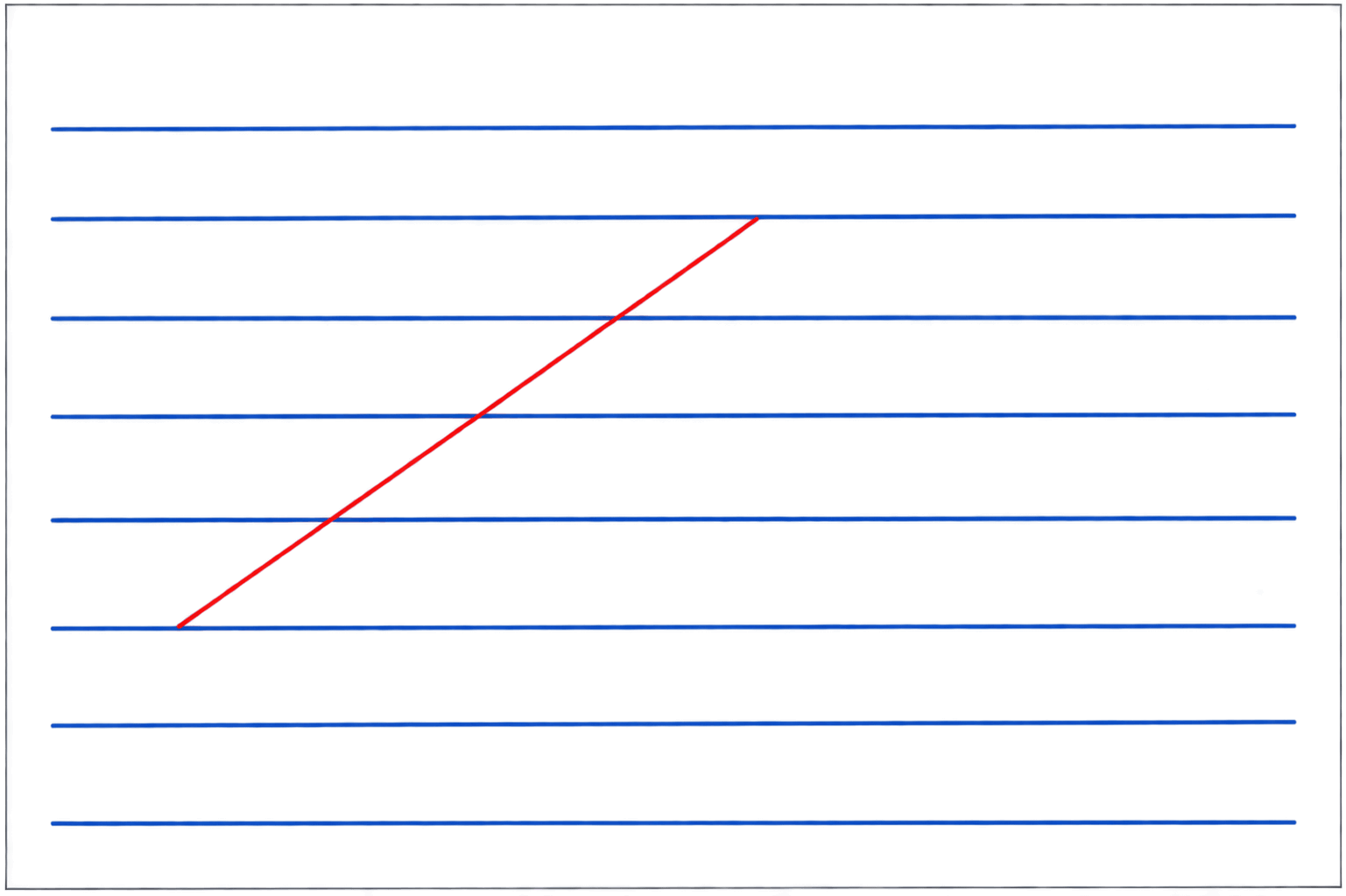
2. Mark the midpoint of the line drawn on the paper (see Fig. 12.33), given that the horizontal lines are equally spaced. Justify your answer.
Answer:
The midpoint is the point where the red line segment crosses the middle horizontal line between the two horizontal lines containing its endpoints.
The horizontal lines are parallel and equally spaced. Therefore, by the intercept theorem, they cut any transversal in equal segments.
Here, the red segment is divided into four equal parts by the equally spaced horizontal lines. Hence, the point after two equal parts from either endpoint is the midpoint.
So, mark the intersection of the red segment with the central horizontal line as its midpoint.
Related Links:
- Class 9 Maths Ganita Manjari Chapter 12 Solutions – Quadrilaterals
- Class 9 Maths Ganita Manjari Chapter 12 Exercise 12.1 Solutions – Quadrilaterals
- Class 9 Maths Ganita Manjari Chapter 12 Exercise 12.2 Solutions – Quadrilaterals
- Class 9 Maths Ganita Manjari Chapter 12 Exercise 12.3 Solutions – Quadrilaterals
- Class 9 Maths Ganita Manjari Chapter 12 Exercise 12.4 Solutions – Quadrilaterals