NCERT Solutions Class 8 Maths Chapter 9 Exercise 9.1
NCERT Solutions for Class 8 Maths Chapter 9 – Mensuration Ex 9.1 are given here in simple, step-by-step form. NCERT stands for National Council of Educational Research and Training, the body that makes your textbook. Mensuration is the part of maths that deals with the area and perimeter of flat shapes. You already know how to find the area of a square, a rectangle and a triangle. Exercise 9.1 takes the next step and teaches you to find the area of a trapezium, of any four-sided shape, and of a polygon with more sides.
NCERT Solutions Class 8 Maths Chapter 9 Exercise 9.1
 Mensuration
 Easy
Easy
 Mensuration
 Medium
 Mensuration
Easy
Mensuration
Easy
 Mensuration
Medium
Mensuration
Medium
 Mensuration
Medium
Mensuration
Medium
 Mensuration
Medium
Mensuration
Medium
 Mensuration
 Difficult
 Mensuration
Difficult
Mensuration
Difficult
Mensuration
Difficult
Mensuration
Difficult

This exercise has 6 questions. They come from real life, such as a field shaped like a trapezium, the top of a table, a piece of land, and floor tiles. The main idea is simple. If a shape looks difficult, split it into shapes you already know, find the area of each part, and add them up. Every question below is solved in short steps, with the final answer in bold. Students can use this page for homework and revision, parents can use it to check the work at home, and teachers can use it in class. A free printable PDF of these solutions is also available for offline study.
Exercise 9.1 – Questions and Answers
Q 1. The shape of the top surface of a table is a trapezium. Find its area if its parallel sides are 1 m and 1.2 m and perpendicular distance between them is 0.8 m.
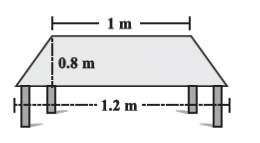
Answer:
Area of trapezium = ½ (Sum of parallel sides) × (Distance between parallel sides)
= [½ (1 + 1.2) (0.8)] m²
= 0.88 m²
Q 2. The area of a trapezium is 34 cm² and the length of one of the parallel sides is 10 cm and its height is 4 cm. Find the length of the other parallel side.
Answer:
It is given that, area of trapezium = 34 cm² and height = 4 cm
Let the length of the other parallel side be a.
We know that,
Area of trapezium = ½ (Sum of parallel sides) × (Distance between parallel sides)
34 cm² = ½ (10 cm + a) × 4 cm
⇒ 34 cm² = 2 (10 cm + a)
⇒ 17 cm = 10 cm + a
⇒ a = 17 cm − 10 cm = 7 cm
Thus, the length of the other parallel side is 7 cm.
Q 3. Length of the fence of a trapezium shaped field ABCD is 120 m. If BC = 48 m, CD = 17 m and AD = 40 m, find the area of this field. Side AB is perpendicular to the parallel sides AD and BC.
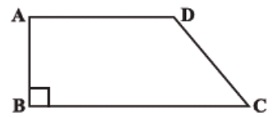
Answer:
Length of the fence of a trapezium shaped field ABCD = AB + BC + CD + DA
⇒ 120 m = AB + 48 m + 17 m + 40 m
⇒ AB = 120 m − 105 m
= 15 m
Area of the field ABCD = ½ (AD + BC) × AB
= [½ (40 + 48) × 15] m²
= (½ × 88 × 15) m²
= 660 m²
∴ Area of the field ABCD = 660 m²
Q 4. The diagonal of a quadrilateral shaped field is 24 m and the perpendiculars dropped on it from the remaining opposite vertices are 8 m and 13 m. Find the area of the field.
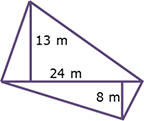
Answer:
It is given that,
Length of the diagonal, d = 24 m
Length of the perpendiculars, h₁ and h₂, from the opposite vertices to the diagonal are 8 m and 13 m.
Area of the quadrilateral = ½ d (h₁ + h₂)
= ½ × 24 × (13 m + 8 m)
= ½ × 24 × 21
= 252 m²
Thus, the area of the field is 252 m².
Q 5. The diagonals of a rhombus are 7.5 cm and 12 cm. Find its area.
Answer:
Area of rhombus = ½ (Product of its diagonals)
Therefore, area of the given rhombus = ½ (7.5 × 12)
= 45 cm²
Q 6. Find the area of a rhombus whose side is 5 cm and whose altitude is 4.8 cm. If one of its diagonals is 8 cm long, find the length of the other diagonal.
Answer:
Let the other diagonal of the rhombus be x.
Since a rhombus is also a parallelogram,
Therefore, area of the given rhombus = Base × Height
= 5 cm × 4.8 cm
= 24 cm²
Also, area of rhombus = ½ (Product of its diagonals)
⇒ 24 cm² = ½ (8 cm × x)
⇒ x = (24 × 2)/8 cm = 6 cm
∴ The length of the other diagonal of the rhombus is 6 cm and the area of the given rhombus is 24 cm².
Q 7. The floor of a building consists of 3000 tiles which are rhombus shaped and each of its diagonals are 45 cm and 30 cm in length. Find the total cost of polishing the floor, if the cost per m² is ₹ 4.
Answer:
Area of rhombus = ½ (Product of its diagonals)
Area of each tile = (½ × 45 × 30) cm²
= 675 cm²
Area of 3000 tiles = (675 × 3000) cm²
= 2025000 cm²
= 202.5 m²
∴ The total cost of polishing the floor, if the cost per m² is ₹ 4
= ₹ (4 × 202.5)
= ₹ 810
Thus, the cost of polishing the floor is ₹ 810.
Q 8. Mohan wants to buy a trapezium shaped field. Its side along the river is parallel to and twice the side along the road. If the area of this field is 10500 m² and the perpendicular distance between the two parallel sides is 100 m, find the length of the side along the river.
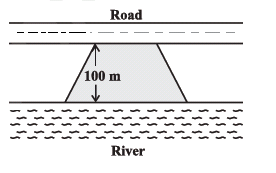
Answer:
Let the length of the field along the road be l m.
Hence, the length of the field along the river will be 2l m.
Area of trapezium = ½ (Sum of parallel sides) × (Distance between the parallel sides)
⇒ 10500 m² = ½ (l + 2l) (100 m)
⇒ 3l = (2 × 10500 / 100) m
⇒ 3l = 210 m
⇒ l = 70 m
Thus, length of the field along the river = (2 × 70) m = 140 m
Q 9. Top surface of a raised platform is in the shape of a regular octagon as shown in the figure. Find the area of the octagonal surface.
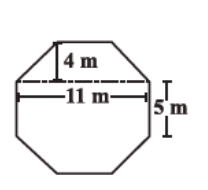
Answer:
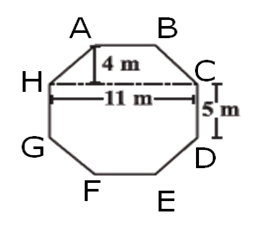
Side of regular octagon = 5 m
Area of trapezium ABCH = Area of trapezium DEFG
Area of trapezium ABCH = [½ × 4 × (11 + 5)] m²
= [½ × 4 × 16] m²
= 32 m²
Area of rectangle HGDC = 11 × 5 = 55 m²
Area of octagon = Area of trapezium ABCH + Area of trapezium DEFG + Area of rectangle HGDC
= 32 m² + 32 m² + 55 m² = 119 m²
Therefore, the area of the octagonal surface is 119 m².
Q 10. There is a pentagonal shaped park as shown in the figure. For finding its area Jyoti and Kavita divided it in two different ways. Find the area of this park using both ways. Can you suggest some other way of finding its area?
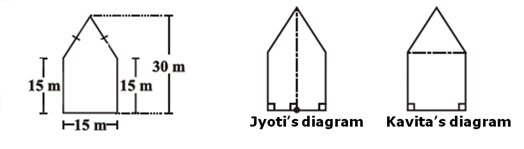
Answer:
Jyoti's way of calculating area:
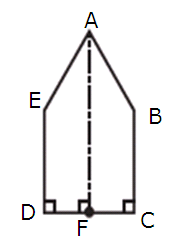
Area of pentagon = 2 (Area of trapezium ABCF)
= [2 × ½ × (15 + 30) × (15/2)] m²
= 337.5 m²
Kavita's way of calculating area:
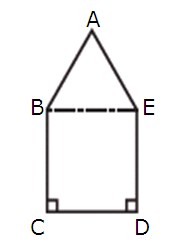
Area of pentagon ABCDE = Area of ΔABE + Area of square BCDE
= [½ × 15 × (30 − 15) + (15)²] m²
= [½ × 15 × 15 + 225] m²
= 337.5 m²
No, there is no other way to find its area.
Q 11. Diagram of the adjacent picture frame has outer dimensions 24 cm × 28 cm and inner dimensions 16 cm × 20 cm. Find the area of each section of the frame, if the width of each section is same.
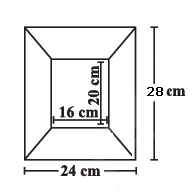
Answer:
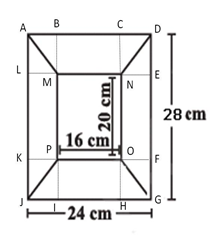
It is given that the width of each section is same.
Therefore,
LM = BM = CN = NE = OF = OH = PK = PI
CH = CN + NO + OH
28 = 2CN + 20
2CN = 28 − 20
2CN = 8
CN = 4 cm
Hence, LM = BM = NE = OF = OH = PK = PI = 4 cm
Area of section NDGO = Area of section AMPJ
= [½ (20 + 28) (4)] cm²
= 96 cm²
∴ Area of section NDGO = Area of section AMPJ = 96 cm²
Also, Area of section AMND = Area of section PJGO
= [½ (16 + 24) (4)]
= 80 cm²
∴ Area of section AMND = Area of section PJGO = 80 cm²